Online Gaming Taxation in India: Section 115BBJ, Section 194BA & Net Winnings Rules (FY 2026-27)
Statutory Summary: The Net Winnings Revolution
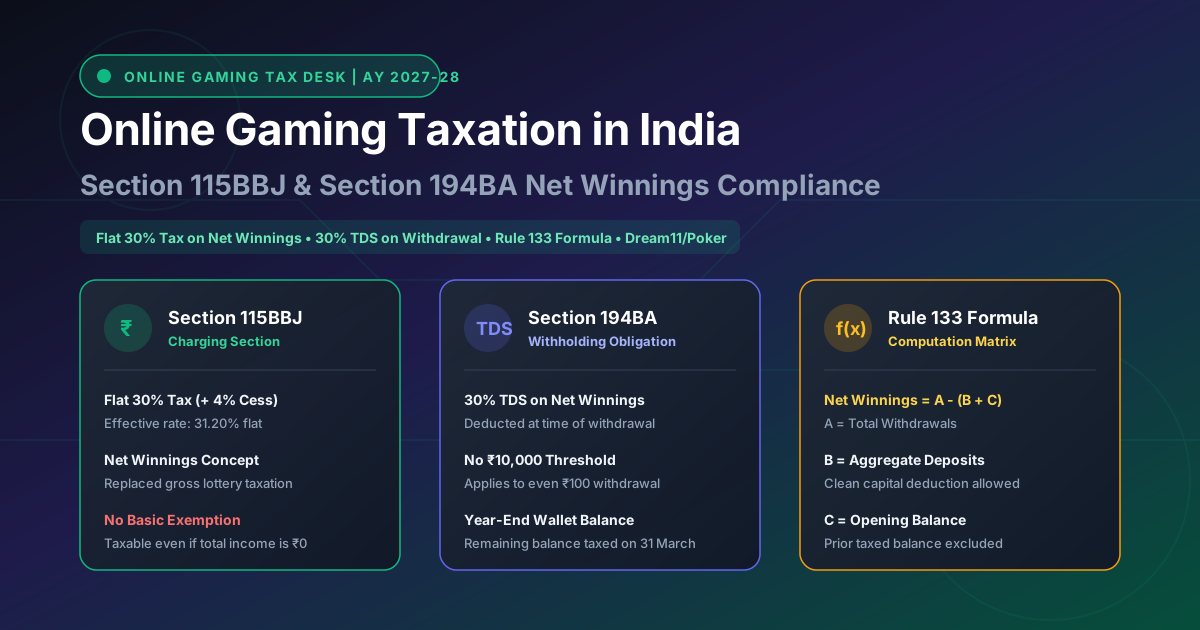
The taxation of real-money online gaming in India—spanning fantasy sports (Dream11, My11Circle), card games (rummy, poker), and esports—underwent a permanent statutory transformation with the enactment of Section 115BBJ (charging section) and Section 194BA (withholding section), operationalized by Rule 133 of the Income-tax Rules, 1962. Unlike traditional lotteries governed under Section 115BB where gross prize money is taxed without deducting contest entry fees, online gaming is taxed strictly on "Net Winnings" at a flat rate of 30% plus 4% cess (effective 31.20%). TDS is deducted at 30% upon withdrawal with zero minimum threshold, and remaining wallet balances are taxed annually on 31 March.
Table of Contents
- 1. Legislative Evolution: Bifurcating Gaming from Traditional Lotteries
- 2. Section 115BBJ: Flat 30% Tax on Net Winnings
- 3. Rule 133 Mathematical Formulas: Withdrawal vs. Year-End Netting
- 4. Operational Infographic: The Rule 133 TDS Lifecycle
- 5. Section 194BA Withholding Mechanism: Zero Minimum Threshold
- 6. Analytical Matrix: Gaming (115BBJ) vs. Lotteries (115BB) vs. Crypto (115BBH)
- 7. Prohibition on Inter-Platform Loss Offsetting & Section 58(4)
- 8. Treatment of Year-End Wallet Balances on 31st March
- 9. Schedule OS Reporting & Tax Audit Thresholds
- 10. Comprehensive Mathematical Case Studies
- 11. Frequently Asked Questions (FAQ)
1. Legislative Evolution: Bifurcating Gaming from Traditional Lotteries
Prior to Financial Year 2023-24, income derived from online real-money games was lumped together under the catch-all umbrella of Section 115BB alongside lottery winnings, crossword puzzles, card games, horse races, and gambling. This legacy framework proved structurally untenable for the modern digital gaming industry for several reasons:
- Gross Winning Inequity: Under Section 115BB, tax was levied on the gross prize won in a single game without permitting deduction of the entry fee or deposit. If an esports participant entered ten consecutive ₹1,000 poker tables, lost nine, and won one table for ₹9,000, their actual cash position was a net loss of ₹1,000 (spent ₹10,000, recovered ₹9,000). Yet under Section 115BB, the player was liable to pay 30% tax on the ₹9,000 win (₹2,700 tax), plunging them into deeper financial distress.
- The ₹10,000 Per-Transaction Loophole: The former TDS provision (Section 194B) only applied to winnings exceeding ₹10,000 per transaction. Gaming companies and users exploited this threshold by splitting withdrawals into micro-tranches of ₹9,999, entirely circumventing tax withholding while moving hundreds of crores in aggregate untaxed capital.
Recognizing the unique, high-frequency nature of digital gaming platforms, Parliament excised online games from Section 115BB and created a dedicated direct tax code comprising Section 115BBJ (the substantive charging section) and Section 194BA (the withholding section). Simultaneously, the Central Board of Direct Taxes (CBDT) notified Rule 133, establishing an automated mathematical formula to determine net winnings with precision.
Definition of "Online Game" u/s 115BBJ Explanation (a)
The statute defines an "online game" as a game that is offered on the internet and is accessible by a user through a computer resource including any telecommunication device. This comprehensive statutory definition encompasses fantasy cricket (Dream11, My11Circle), rummy, poker, chess, casual mobile gaming tournaments, and digital skill-based or chance-based competitive platforms.
2. Section 115BBJ: Flat 30% Tax on Net Winnings
Section 115BBJ of the Income-tax Act, 1961 governs the total tax computation for any assessee whose gross total income includes net winnings from online games. The charging provision mandates:
"Where the total income of an assessee includes any income by way of net winnings from online games, the income-tax payable shall be the aggregate of—
(i) the amount of income-tax calculated on net winnings from such online games, computed in the prescribed manner, at the rate of thirty per cent; and
(ii) the amount of income-tax with which the assessee would have been chargeable had his total income been reduced by the amount of net winnings referred to in clause (i)."
Key Statutory Characteristics of Section 115BBJ
- Flat 30% Tax Rate: The base tax is fixed at exactly 30%. When augmented by the statutory 4% Health and Education Cess, the baseline tax rate is 31.20%.
- Applicability of Surcharge: For high-net-worth gamers whose total income exceeds statutory thresholds, direct tax surcharges apply (10% for income > ₹50L, 15% for income > ₹1 Cr, 25% for income > ₹2 Cr under the New Regime).
- Prohibition on Expense Deductions: Under Section 58(4), no deduction in respect of any expenditure or allowance in connection with earning gaming income is permissible. Players cannot deduct the cost of high-end gaming smartphones, laptops, broadband subscriptions, analytics software, coaching subscriptions, or travel expenses.
- Denial of Basic Exemption Adjustment: Gaming winnings are special rate incomes under Chapter XII. An individual cannot set off an unexhausted basic exemption limit against net winnings. Even if an unemployed student or homemaker has zero other income, net gaming winnings are taxable from the very first rupee.
- Ineligibility for Section 87A Rebate: Rebate under Section 87A is unavailable to reduce tax liabilities computed at special statutory rates under Section 115BBJ.
3. Rule 133 Mathematical Formulas: Withdrawal vs. Year-End Netting
To give effect to the "net winnings" principle, the CBDT formulated Rule 133 of the Income-tax Rules, 1962. Rule 133 provides two distinct mathematical equations: one for calculating TDS at the time of each withdrawal, and a second for determining the final tax liability on the user's closing wallet balance at midnight on 31st March.
Formula 1: Net Winnings at the Time of Withdrawal [Rule 133(1)]
Whenever a user requests a withdrawal from their gaming account balance into their bank account, the platform must compute net winnings using the following statutory formula:
Net Winnings (NW) = A − (B + C)
Where:
- A = The aggregate amount of all withdrawals made from the user account during the financial year, including the withdrawal being requested.
- B = The aggregate amount of all deposits made into the user account by the player from their bank account/UPI during the financial year up to the time of the withdrawal.
- C = The opening balance of the user account at the beginning of the financial year (1st April), which was already subjected to TDS on the preceding 31st March.
If NW > 0, TDS at 30% is deducted on this positive amount (minus any net winnings on which TDS was already deducted during earlier withdrawals in the same FY). If NW ≤ 0, no TDS is deductible, because the withdrawal represents a return of deposited capital.
Formula 2: Net Winnings at the End of the Financial Year [Rule 133(2)]
On 31st March of every financial year, gaming platforms must perform a mandatory year-end reconciliation across all active user accounts. The closing balance left in the user wallet is brought to tax using the following equation:
Year-End Net Winnings = (A + D) − (B + C)
Where:
- A = Total withdrawals during the entire financial year.
- D = The closing balance of the user account as of midnight on 31st March.
- B = Total deposits made during the entire financial year.
- C = The opening balance at the start of the financial year (1st April).
The platform deducts 30% TDS on any untaxed net winnings reflected in $(A + D) - (B + C)$ directly from the user's wallet balance. If the remaining wallet balance is insufficient to cover the 30% TDS liability, the platform must notify the player to deposit the shortfall, or the unpaid balance is reported as an outstanding tax liability in Form 26Q.
4. Operational Infographic: The Rule 133 TDS Lifecycle
The following technical flowchart maps the exact operational lifecycle of funds inside a regulated Indian gaming platform, showing how capital deposits, gameplay results, withdrawal requests, and year-end reconciliations trigger withholding actions under Section 194BA.

As visualized above, Rule 133 creates a dynamic ledger for every gamer:
- Protected Capital Core: A player's own deposits ($B$) form a tax-free shield. Until cumulative withdrawals exceed cumulative deposits, every withdrawal is treated as a return of capital, and 0% TDS is deducted.
- Realized Surplus Harvesting: The moment cumulative withdrawals exceed capital deposits, every additional rupee withdrawn represents net winnings, triggering an automatic 30% TDS deduction at source.
- No Cash Leakage: Players do not lose tax withholding on unsuccessful contest entries because intra-platform losses directly suppress the value of $A$ relative to $B$, ensuring tax is levied only on genuine economic profit.
5. Section 194BA Withholding Mechanism: Zero Minimum Threshold
Section 194BA of the Act establishes the withholding obligations governing any entity responsible for paying any person any income by way of winnings from any online game. Crucially, the statute eliminated the historical ₹10,000 threshold that applied under Section 194B.
Statutory Features of Section 194BA Withholding
| Compliance Element | Statutory Requirement | Operational Mechanism |
|---|---|---|
| Deduction Rate | Flat 30% | Applied strictly to computed Net Winnings |
| Minimum Threshold | ₹0 (Zero Threshold) | Applies to micro-withdrawals (even ₹50 or ₹100 of net winnings) |
| Timing of Deduction | At withdrawal & FY-end | Deducted instantaneously before bank payout; reconciled on 31 March |
| Challan & Return Form | Form 26Q (Quarterly) | Deposited by operator under Section 200 via Challan ITNS 281 |
| TDS Certificate | Form 16A | Issued quarterly to player; auto-populated into AIS and 26AS |
CBDT Circular No. 5 of 2023 Relaxations for Micro-Transactions
Recognizing the operational friction of deducting small fractions of rupees on micro-withdrawals, the CBDT issued Circular No. 5 of 2023 granting a minor operational concession: gaming platforms are permitted to defer TDS on micro-withdrawals under ₹100 per transaction, provided that:
- Total withdrawals by the user in that month do not exceed ₹500; and
- The deferred TDS is compulsorily deducted on subsequent withdrawals or at the end of the month / financial year.
This ensures seamless user experiences without altering the aggregate annual tax payable by the gamer.
6. Analytical Matrix: Gaming (115BBJ) vs. Lotteries (115BB) vs. Crypto (115BBH)
The Income-tax Act contains three specialized regimes for speculative and digital asset incomes. The table and chart below contrast their statutory rules.
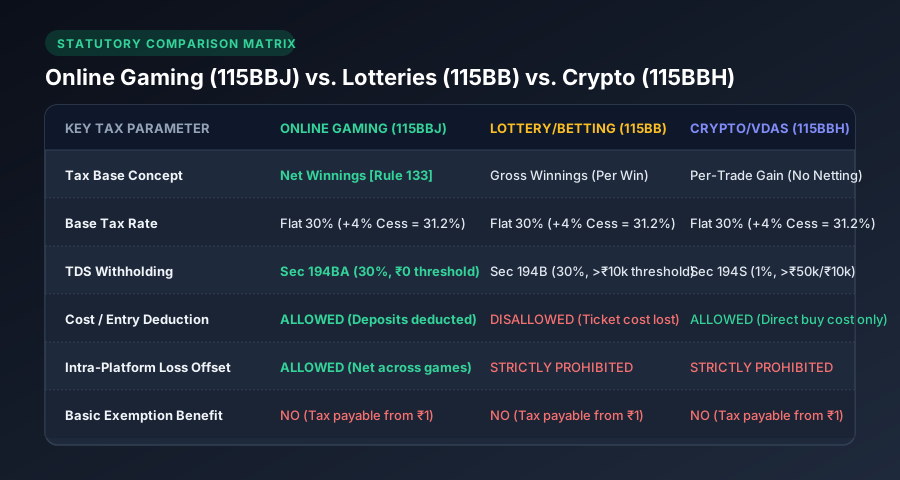
| Statutory Parameter | Online Gaming (Sec 115BBJ / 194BA) | Lotteries & Betting (Sec 115BB / 194B) | Crypto & VDAs (Sec 115BBH / 194S) |
|---|---|---|---|
| Charging Section | Section 115BBJ | Section 115BB | Section 115BBH |
| Taxable Base | Net Winnings (Formula Rule 133) | Gross Prize per lucky draw | Per-transaction Gain (Transfer price − cost) |
| Deduction of Ticket / Entry Cost | Allowed (Deposits deducted from withdrawals) | Prohibited (Ticket cost completely forfeited) | Allowed (Direct cost of purchase only) |
| TDS Section & Rate | Sec 194BA (Flat 30%) | Sec 194B (Flat 30%) | Sec 194S (Flat 1%) |
| TDS Exemption Threshold | ₹0 (Zero threshold) | ₹10,000 per prize event | ₹50,000 (Specified Person) / ₹10,000 (Others) |
| Intra-Platform Loss Netting | Permitted across contests within FY | Strictly Prohibited | Strictly Prohibited across tokens |
| Inter-Platform Loss Netting | Prohibited (No cross-app loss offset) | Prohibited | Prohibited |
7. Prohibition on Inter-Platform Loss Offsetting & Section 58(4)
A frequent query among professional gamers and active sports bettors is whether losses sustained on one application can offset profits generated on a competing application. The statutory answer is an unequivocal No.
The Mechanics of Section 58(4)
Under Section 58(4) of the Income-tax Act, no deduction in respect of any expenditure or allowance in connection with that income shall be allowed under any provision of this Act in computing the income by way of winnings from lotteries, crossword puzzles, races including horse races, card games, other games of any sort, or gambling or betting of any form or nature, or net winnings from online games referred to in Section 115BBJ.
Furthermore, under Section 71 and Section 72, losses from online gaming cannot be set off against income under any other head—such as salary, business profits, capital gains, or house property. Nor can gaming losses be carried forward to subsequent assessment years.
The Inter-App Dilemma Explained
Consider a gamer who maintains active accounts on two separate platforms during FY 2026-27:
- Platform A (Dream11): Deposits ₹2,00,000; Withdraws ₹7,00,000. Net Winnings = ₹5,00,000. (30% TDS deducted = ₹1,50,000).
- Platform B (PokerBaazi): Deposits ₹6,00,000; Withdraws ₹1,00,000. Net Loss = ₹5,00,000.
In economic reality, the player broke even: total deposits were ₹8,00,000 and total withdrawals were ₹8,00,000 (net financial gain = ₹0). However, for Indian income tax purposes:
- The ₹5,00,000 net winnings on Platform A must be reported in Schedule OS and are taxed at 30% plus cess (₹1,56,000 tax liability).
- The ₹5,00,000 loss on Platform B cannot be set off against Platform A's winnings. It is completely extinguished and dead.
- The player must pay ₹1,56,000 in income tax even though their overall bank balance shows zero net profit from gaming!
Golden Rule of Platform Management
Gamers should consolidate their competitive play on a single platform whenever feasible. Rule 133 allows full netting of losses against wins within the same platform entity, but the Income-tax Act completely prohibits cross-platform netting across different gaming operators.
8. Treatment of Year-End Wallet Balances on 31st March
Unlike traditional investment accounts where capital gains are recognized only upon realization (sale), Section 194BA and Rule 133 treat digital gaming wallets under a modified mark-to-market withholding rule. You cannot avoid tax simply by refusing to withdraw your winnings to your bank account.
The 31st March Mandatory Deduction
On midnight of 31st March, the gaming software automatically freezes the ledger and evaluates:
Net Winnings = (Total FY Withdrawals + Closing Wallet Balance) − (Total FY Deposits + Opening Balance)
If this equation yields a positive number that has not already been subjected to TDS during interim withdrawals, the platform performs the following steps:
- Deducts 30% TDS directly from the user's available wallet balance.
- Remits this deducted TDS to the Income Tax Department under the player's PAN using Challan 281.
- Credits the remaining 70% as the opening balance ($C$) for the new financial year beginning 1st April.
Because this 70% balance has already suffered tax, it becomes Component $C$ (Opening Balance) in the subsequent year's formula. When the player eventually withdraws this money in the next financial year, it will be deducted as an exempt opening balance, ensuring zero double taxation.
9. Schedule OS Reporting & Tax Audit Thresholds
Every individual who earns net winnings from online games must disclose these earnings accurately when filing their annual Income Tax Return. The Central Board of Direct Taxes updated ITR-2 and ITR-3 to incorporate explicit disclosures for Section 115BBJ.
Where to Report in ITR-2 / ITR-3
Online gaming winnings cannot be filed using ITR-1 (Sahaj) or ITR-4 (Sugam). Gamers must use:
- ITR-2: For salaried individuals, professionals, or retirees who do not carry on a proprietary business.
- ITR-3: For individuals or HUFs having income under the head "Profits and gains of business or profession".
Within the return, navigate to Schedule OS (Income from Other Sources):
- Locate Section 2: "Income chargeable to tax at special rates".
- Select sub-item: "Winnings from online games taxable u/s 115BBJ".
- Enter the aggregate annual net winnings computed across all platforms.
- Verify that the TDS reported in Schedule TDS-2 (deducted by the gaming platforms under Form 16A) matches the figure in your AIS (Annual Information Statement) and Form 26AS.
Is a Tax Audit Applicable to Gamers?
Under Indian tax law, winnings from online games are statutorily classified as Income from Other Sources under Section 56(2)(ib). They do not constitute business turnover or gross receipts from profession. Therefore, Section 44AB tax audit limits do not apply to casual or recreational gamers, even if annual gaming volumes run into crores of rupees.
However, if an individual operates as a registered commercial gaming esports entity, streaming organization, or gaming tournament organizer receiving sponsorship fees and merchandise sales, those ancillary revenue streams fall under business income (PGBP) and are subject to normal Section 44AB audit thresholds.
10. Comprehensive Mathematical Case Studies
Case Study A: Fantasy Cricket Season Lifecycle (Dream11)
Player Profile: Arjun is a corporate manager who deposits and plays fantasy cricket across the 2026 IPL season. His account details on Dream11 for FY 2026-27 are as follows:
- Opening Balance (1 April 2026): ₹0 ($C = 0$).
- Deposit 1 (10 April 2026): Deposits ₹50,000 from bank ($B_1 = 50,000$).
- Gameplay: Arjun plays multiple contests. His wallet balance grows to ₹1,80,000.
- Withdrawal 1 (2 May 2026): Arjun withdraws ₹1,00,000 ($A_1 = 1,00,000$).
- Deposit 2 (15 May 2026): Deposits an additional ₹30,000 ($B_2 = 30,000$; Total $B = 80,000$).
- Gameplay: Arjun loses several contests. Wallet balance drops to ₹40,000.
- Withdrawal 2 (30 May 2026): Arjun requests withdrawal of ₹20,000 ($A_2 = 20,000$; Total $A = 1,20,000$).
TDS Computation on Withdrawal 1 (2 May 2026):
- $NW_1 = A_1 - (B + C) = ₹1,00,000 - (₹50,000 + 0) = \mathbf{₹50,000}$.
- 30% TDS under Section 194BA = $30\% \times ₹50,000 = \mathbf{₹15,000}$.
- Net payout received in Arjun's bank account = ₹1,00,000 − ₹15,00,000 = ₹85,000.
TDS Computation on Withdrawal 2 (30 May 2026):
- Cumulative Withdrawals ($A$) = ₹1,00,000 + ₹20,000 = ₹1,20,000.
- Cumulative Deposits ($B$) = ₹50,000 + ₹30,000 = ₹80,000.
- Cumulative Net Winnings = $A - (B + C) = ₹1,20,000 - ₹80,000 = \mathbf{₹40,000}$.
- Prior Net Winnings already subjected to TDS in Withdrawal 1 = ₹50,000.
- Incremental Net Winnings on Withdrawal 2 = $₹40,000 - ₹50,000 = \mathbf{-₹10,000}$ (Negative).
- TDS Deductible = ₹0. Arjun receives the full ₹20,000 in his bank account with zero withholding!
Case Study B: Year-End Balance Reinvestment Scenario
Background: Sneha is a competitive online rummy player. Throughout FY 2026-27:
- Opening Balance ($C$): ₹10,000.
- Total Deposits ($B$): ₹1,50,000.
- Total Withdrawals ($A$): ₹1,00,000 (TDS deducted during the year was ₹0 because $A < B + C$).
- Closing Wallet Balance on 31 March 2027 ($D$): ₹2,00,000.
Year-End Computation on 31 March 2027:
- Year-End Formula: $NW = (A + D) - (B + C)$.
- $NW = (₹1,00,000 + ₹2,00,000) - (₹1,50,000 + ₹10,000) = ₹3,00,000 - ₹1,60,000 = \mathbf{₹1,40,000}$.
- Section 194BA 30% TDS on wallet balance = $30\% \times ₹1,40,000 = \mathbf{₹42,000}$.
- The platform debits ₹42,000 from Sneha's wallet balance on 31 March and deposits it to the government under her PAN.
- Sneha's revised closing balance = ₹2,00,000 − ₹42,000 = ₹1,58,000.
- This ₹1,58,000 becomes Sneha's tax-paid Opening Balance ($C$) on 1 April 2027 for the next financial year.
11. Frequently Asked Questions (FAQ)
What is the tax rate on online gaming winnings under Section 115BBJ?
Under Section 115BBJ of the Income-tax Act, 1961, net winnings from online games are taxed at a flat rate of 30%. With the mandatory 4% Health and Education Cess, the effective base tax rate is 31.20%. Surcharges apply if total taxable income exceeds standard threshold slabs (e.g., ₹50 Lakhs).
How is Section 194BA TDS deducted when withdrawing money from a gaming app?
Under Section 194BA, the gaming platform must deduct 30% TDS on the "net winnings" included in the withdrawal amount, calculated using Rule 133 formula: Net Winnings = A - (B + C), where A is aggregate withdrawals, B is aggregate deposits, and C is opening balance. If the withdrawal represents a return of deposited capital, no TDS is deducted.
Is there any minimum threshold like ₹10,000 for Section 194BA gaming TDS?
No. Unlike Section 194B for lotteries which has a ₹10,000 threshold, Section 194BA has no minimum threshold. Even if a player withdraws ₹200 of net winnings, the platform must deduct 30% TDS (₹60) and remit ₹140 to the user's bank account.
Can I offset losses incurred on one gaming app (e.g., PokerBaazi) against winnings on another (e.g., Dream11)?
No. While Rule 133 allows netting of wins and losses within the same gaming platform across multiple games and contests during the financial year, Section 58(4) strictly prohibits offsetting losses from one gaming platform or entity against net winnings earned on another platform.
Can an individual with income below ₹4,00,000 claim a refund of 30% gaming TDS?
No. Income taxable under Section 115BBJ is a special rate income under Chapter XII of the Income-tax Act. The basic exemption limit under either the New or Old Tax Regime cannot be adjusted against online gaming winnings, nor is Section 87A rebate permitted against special rate taxes. A non-earning student earning ₹50,000 in net gaming winnings must pay ₹15,600 in tax.
What happens to the money left in my gaming wallet on 31st March?
Under Rule 133, the gaming platform must compute net winnings on the remaining wallet balance on the last day of the financial year (31st March) using the formula: Net Winnings = (A + D) - (B + C), where D is the closing balance. If positive, the platform will deduct 30% TDS from the wallet balance on 31st March and remit it to the government.