Section 44AB Tax Audit Limits: ₹10 Crore Digital Threshold & Form 3CA/3CD Guide (FY 2026-27)

Statutory Summary: The Indian Statutory Tax Audit Framework
Under the direct tax framework of India, Section 44AB of the Income-tax Act, 1961 governs the compulsory audit of accounts of commercial businesses and professionals by a practicing Chartered Accountant. For Assessment Year 2027-28 (Financial Year 2026-27), the statutory turnover threshold for businesses is bifurcated: a baseline of ₹1 Crore for cash-intensive enterprises, and an expanded ₹10 Crore threshold for digital businesses satisfying the strict twin 5% test (both cash receipts and cash payments ≤ 5%). Professionals face a ₹50 Lakh threshold under Clause (b). Compliance requires submitting Form 3CA/3CB and the 44-clause Form 3CD before 30th September, with failure attracting severe penalties under Section 271B.
Table of Contents
- 1. Legislative Objective & Statutory Architecture of Section 44AB
- 2. Substantive Clauses: Clauses (a) through (e) of Section 44AB
- 3. The ₹10 Crore Digital Threshold & The Twin 5% Test
- 4. Operational Infographic: Section 44AB Tax Audit Decision Engine
- 5. Audit Report Architecture: Form 3CA vs. Form 3CB
- 6. Analytical Matrix: Audit Clauses & Form 3CD Reporting Dimensions
- 7. Deep-Dive into Form 3CD: Critical Reporting Clauses
- 8. Compliance Deadlines (30 Sept vs 31 Oct) & Section 271B Penalties
- 9. Futures & Options (F&O) and Intraday Trading Audit Rules
- 10. Comprehensive Real-World Numerical Case Studies
- 11. Frequently Asked Questions (FAQ)
1. Legislative Objective & Statutory Architecture of Section 44AB
Tax administration in a vast, continental economy like India faces inherent difficulties when relying solely on self-assessed financial statements submitted by taxpayers. In the absence of an independent, professional examination of commercial records, revenue authorities would need to subject millions of business returns to intensive physical scrutiny—an administrative impossibility that would burden both the state and honest taxpayers.
To establish institutional integrity in commercial reporting, Parliament inserted Section 44AB via the Finance Act 1984. The provision creates a legal mandate:
"Every person carrying on business shall, if his total sales, turnover or gross receipts, as the case may be, in business exceed or exceeds one crore rupees in any previous year... get his accounts of such previous year audited by an accountant before the specified date and furnish by that date the report of such audit in the prescribed form duly signed and verified by such accountant."
The primary statutory objectives of a tax audit under Section 44AB are threefold:
- Verification of Books: Ensuring that proper books of accounts have been maintained in accordance with Section 44AA and reflect a true and fair view of financial affairs.
- Quantitative Reconciliation: Reporting statutory tax adjustments, including disallowances of cash expenses under Section 40A(3), statutory employee liabilities under Section 43B, and cash loans under Section 269SS/269T.
- Administrative Efficiency: Enabling Assessing Officers to rely on a standardized, audited statement of particulars (Form 3CD) without requiring exhaustive routine voucher audits during assessment proceedings.
2. Substantive Clauses: Clauses (a) through (e) of Section 44AB
Section 44AB is not a monolithic provision; it is segmented into five distinct statutory clauses, each addressing a specific category of taxpayer or presumptive default scenario:
| Statutory Clause | Target Category | Audit Applicability Threshold | Statutory Condition |
|---|---|---|---|
| Section 44AB(a) | Commercial Business | Turnover > ₹1 Crore (or > ₹10 Crore if 5% digital test satisfied) | Mandatory audit on breaching gross turnover/sales limits |
| Section 44AB(b) | Professionals | Gross Receipts > ₹50 Lakhs | Exempt up to ₹75 Lakhs if opting for Section 44ADA (cash ≤ 5%) |
| Section 44AB(c) | Transporters (Goods Carriages) | Any turnover; claiming profit lower than Section 44AE rates | Mandatory audit if total income exceeds basic exemption limit |
| Section 44AB(d) | Specified Professionals | Claiming profit < 50% under Section 44ADA | Mandatory audit if total income exceeds basic exemption limit |
| Section 44AB(e) | Small Businesses Opting Out | Breaching Section 44AD(4) 5-year lock-in rule | Mandatory audit if total income exceeds basic exemption limit |
3. The ₹10 Crore Digital Threshold & The Twin 5% Test
The most important direct tax reform concerning Section 44AB is the progressive enhancement of the turnover limit from ₹1 Crore to ₹5 Crore (via Finance Act 2020) and subsequently to ₹10,00,00,000 (₹10 Crore) (via Finance Act 2021) under the proviso to Section 44AB(a).
The Proviso to Section 44AB(a)
"Provided that in the case of a person whose—
(a) aggregate of all amounts received including amount received for sales, turnover or gross receipts during the previous year, in cash, does not exceed five per cent of the said amount; and
(b) aggregate of all payments made including amount incurred for expenditure, in cash, does not exceed five per cent of the said payment,
this clause shall have effect as if for the words 'one crore rupees', the words 'ten crore rupees' had been substituted."
Deconstructing the "Twin 5% Test"
Many business owners mistakenly assume that as long as 95% of their sales are digital, they are exempt from tax audit up to ₹10 Crore. This is a dangerous legal misinterpretation. The statute mandates a twin test covering both inflows AND outflows:
- Condition A (Aggregate Receipts Test): The sum total of ALL amounts received by the business in physical cash during the financial year must not exceed 5% of gross receipts.
- This includes sales turnover, recovery of trade debtors, sales of machinery or motor vehicles, capital contributions introduced by partners/proprietor, and unsecured loans or advances taken!
- Condition B (Aggregate Payments Test): The sum total of ALL payments made by the business in physical cash during the financial year must not exceed 5% of gross payments.
- This includes raw material purchases, trade creditor settlements, commercial rent, employee wages, electricity, capital asset purchases, loan repayments, and drawings taken by the owner!
The Fatal Outflow Pitfall
Consider a digital e-commerce business with an annual turnover of ₹8 Crore. 100% of customer orders are paid online via payment gateways (0% cash receipts). However, the business pays ₹60 Lakhs in cash to local packaging vendors and casual warehouse labor out of total annual disbursements of ₹7.5 Crore (cash payments = 8%). Even though cash receipts were 0%, the business failed Condition B! Because both conditions were not simultaneously satisfied, the ₹10 Crore threshold is completely forfeited, the limit collapses to ₹1 Crore, and the business faces mandatory tax audit under Section 44AB(a).
4. Operational Infographic: Section 44AB Tax Audit Decision Engine
The technical flowchart below illustrates the exact algorithmic pathway an auditor or tax advisor follows to determine whether an Indian business or profession requires a mandatory audit under Section 44AB.

As visualized in the decision engine above:
- Under ₹1 Crore: Complete immunity from audit under Clause (a).
- Between ₹1 Crore and ₹10 Crore: Audit applicability hinges strictly on passing both Condition A and Condition B of the twin 5% test.
- Above ₹10 Crore: Audit is mandatory for 100% of businesses, even if 100% of transactions are executed digitally through RTGS and UPI.
5. Audit Report Architecture: Form 3CA vs. Form 3CB
When a Chartered Accountant completes a tax audit under Section 44AB, the audit report uploaded to the income tax portal consists of two parts: a primary Audit Report (Form 3CA or Form 3CB) accompanied by a comprehensive Statement of Particulars (Form 3CD).
When to Use Form 3CA
Under Rule 6G(1)(a) of the Income-tax Rules, 1962, Form 3CA is used where the accounts of the business or profession have been audited under any other statutory law. The most common entities filing Form 3CA are:
- Companies registered under the Companies Act, 2013 (Private Limited, Public Limited, One Person Companies).
- Banking Companies audited under the Banking Regulation Act, 1949.
- Insurance Companies audited under the Insurance Act, 1938.
- Co-operative Societies audited under State Co-operative Societies Acts.
In Form 3CA, the auditor states that the statutory audit under the relevant Act was conducted, annexes the audited balance sheet and profit & loss account, and certifies that the annexed Form 3CD particulars are true and correct.
When to Use Form 3CB
Under Rule 6G(1)(b), Form 3CB is used in all cases where the assessee's accounts are not required to be audited under any other law. This applies to:
- Sole Proprietorship businesses and retail traders.
- Partnership firms registered under the Indian Partnership Act, 1932.
- Hindu Undivided Families (HUFs).
- Association of Persons (AOP) and Body of Individuals (BOI).
Form 3CB contains a comprehensive independent audit opinion. The auditor certifies that they have examined the balance sheet and profit & loss account, states whether proper books of accounts were kept in compliance with Section 44AA, and expresses a true and fair view opinion on the financial statements.
6. Analytical Matrix: Audit Clauses & Form 3CD Reporting Dimensions
The comparative matrix below maps the relationship between audit triggers under Section 44AB, the applicable certification forms, and key reporting mandates.
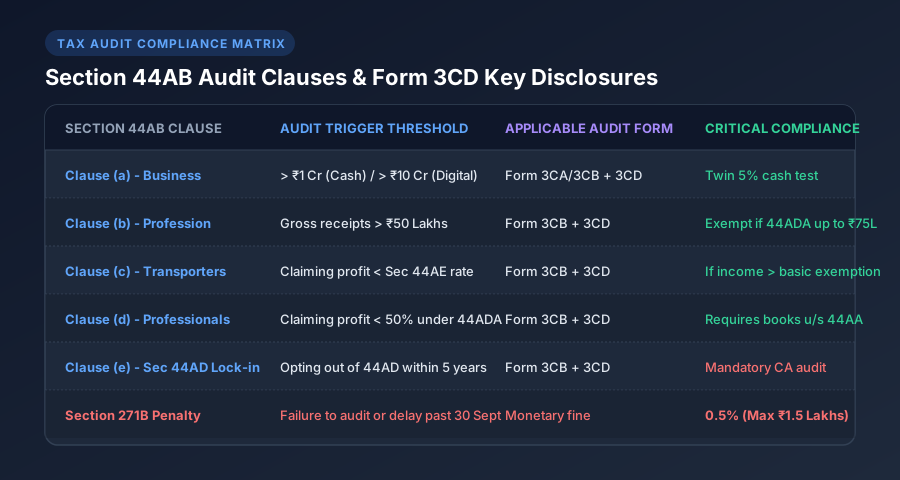
| Section 44AB Clause | Target Entity & Activity | Prescribed Audit Form | ITR Form Used | Reporting Deadline |
|---|---|---|---|---|
| Clause (a) - Digital | Business turnover ₹1 Cr to ₹10 Cr (cash ≤ 5%) | Form 3CA/3CB + 3CD | ITR-3 / ITR-5 / ITR-6 | 30th September |
| Clause (a) - Cash | Business turnover > ₹1 Crore (cash > 5%) | Form 3CA/3CB + 3CD | ITR-3 / ITR-5 / ITR-6 | 30th September |
| Clause (b) - Profession | Gross professional receipts > ₹50 Lakhs | Form 3CB + 3CD | ITR-3 / ITR-5 | 30th September |
| Clause (c) - Transport | Transporters declaring < Sec 44AE deemed rates | Form 3CB + 3CD | ITR-3 / ITR-5 | 30th September |
| Clause (d) - Prof Default | Professionals declaring < 50% under Sec 44ADA | Form 3CB + 3CD | ITR-3 / ITR-5 | 30th September |
| Clause (e) - 44AD Lock-in | Small businesses opting out within 5-year lock-in | Form 3CB + 3CD | ITR-3 / ITR-5 | 30th September |
7. Deep-Dive into Form 3CD: Critical Reporting Clauses
Form 3CD is a massive, 44-clause statement of particulars that translates raw commercial accounting figures into statutory tax compliance metrics. Understanding its most critical clauses is vital for business owners facing tax audits.
1. Clause 21: Cash Expenses & TDS Non-Deduction Disallowances
- Section 40A(3) Disallowance: Clause 21(d) requires the auditor to report every single payment made to a person in a single day exceeding ₹10,000 in cash (or exceeding ₹35,000 in cash for goods carriage transport payments). Any reported cash payment is 100% disallowed and added back to taxable business profits!
- Section 40(a)(ia) TDS Defaults: Clause 21(b) reports all expenditure on which TDS was deductible but was either not deducted or, after deduction, was not paid on or before the due date under Section 139(1). In such cases, 30% of the expenditure is disallowed.
2. Clause 26: Section 43B Statutory Dues & MSME 45-Day Payment Rule
- Section 43B Dues: Taxes, duties, cess, employee bonus, and leave encashment are allowed as deductions only if paid on or before the due date of filing ITR under Section 139(1).
- Section 43B(h) (MSME Clause): Any sum payable to a Micro or Small Enterprise beyond the time limit specified in Section 15 of the MSMED Act, 2006 (within 15 days if no agreement, or within 45 days if an agreement exists) is disallowed in the year of purchase and allowed only in the year of actual payment!
3. Clause 20: Employee Contributions to PF and ESIC
Under Clause 20(b), the auditor must report the exact date of deposit of employee contributions to provident fund (EPF) and state insurance (ESIC). Following the landmark Supreme Court ruling in Checkmate Services P. Ltd. v. CIT (2022), employee contributions deposited after the statutory due date under the EPF Act (15th of the following month) are permanently disallowed under Section 36(1)(va) and cannot be claimed even if paid before the ITR deadline.
4. Clause 31: Cash Loans & Deposits (Section 269SS & 269T)
Clause 31 mandates the reporting of every loan or deposit taken or accepted in cash exceeding ₹20,000 (violating Section 269SS), and every loan or deposit repaid in cash exceeding ₹20,000 (violating Section 269T). Violations attract an equivalent 100% penalty under Section 271D and Section 271E!
8. Compliance Deadlines (30 Sept vs 31 Oct) & Section 271B Penalties
Tax audit compliance is governed by strict chronological deadlines enforced by automated portal validation rules.
The Staggered Due Date System
- 30th September of the Assessment Year: The statutory due date for the Chartered Accountant to digitally sign and upload Form 3CA/3CB and Form 3CD on the e-filing portal, and for the taxpayer to approve the report via their personal login using a Digital Signature Certificate (DSC) or Electronic Verification Code (EVC).
- 31st October of the Assessment Year: The statutory due date for the audited taxpayer to file their annual Income Tax Return (ITR-3, ITR-5, or ITR-6) under Section 139(1). The one-month buffer between 30 September and 31 October allows the assessee to incorporate audit adjustments and disallowances into their final return computation.
Penalties for Default under Section 271B
If any person required to get their accounts audited under Section 44AB fails to get their accounts audited or fails to furnish the audit report on or before 30th September, the Assessing Officer can levy a mandatory monetary penalty under Section 271B:
Section 271B Penalty = Lower of: 0.5% of Gross Turnover/Receipts OR ₹1,50,000
Reasonable Cause Defense under Section 273B: No penalty under Section 271B shall be imposable if the assessee proves that there was a reasonable cause for the failure. Recognized judicial grounds include natural disasters, serious illness/sudden death of the statutory auditor, seizure of books by revenue authorities, or documented total server crashes of the income tax e-filing portal.
9. Futures & Options (F&O) and Intraday Trading Audit Rules
One of the most frequent areas of confusion among modern Indian investors is whether active trading in equity derivatives (Futures & Options) or equity intraday shares triggers a tax audit under Section 44AB.
Turnover Computation for F&O Trading
Under ICAI Guidance Note on Tax Audit, F&O turnover is not the contract value or trade volume. It is calculated as:
F&O Turnover = Sum of Absolute Profits + Sum of Absolute Losses + Premium Received on Sale of Options
For example, if you made a profit of ₹3 Lakhs on Trade 1 and a loss of ₹2 Lakhs on Trade 2, your trading turnover is ₹3 Lakhs + ₹2 Lakhs = ₹5 Lakhs (not ₹1 Lakh net profit!).
Audit Applicability for Derivative Traders
- 100% Digital Environment: Because all transactions on the NSE and BSE settle digitally through Indian banking rails, F&O traders qualify 100% for the enhanced ₹10 Crore turnover limit!
- If your F&O turnover is under ₹10 Crore, you are completely exempt from tax audit under Section 44AB(a).
- The Presumptive Lock-in Exception (Section 44AB(e)): If an F&O trader opted for Section 44AD in a previous year, and in the current year reports a net loss or profit lower than 6% with total income exceeding the basic exemption limit (₹4 Lakhs under New Regime), the trader triggers Section 44AB(e) and must get their accounts audited!
10. Comprehensive Real-World Numerical Case Studies
Case Study A: Manufacturing Business Passing the Twin 5% Test
Business Profile: Precision Tools LLP is an industrial parts manufacturer with total turnover of ₹8,40,00,000 (₹8.40 Crore) for FY 2026-27. Its financial ledger reveals:
- Total Gross Inflows (Turnover + scrap sales + advances): ₹8,60,00,000.
- Cash Receipts: ₹22,00,000 ($22L / 860L = \mathbf{2.56\%}$ ≤ 5%).
- Total Gross Outflows (Raw materials + power + wages + machine purchase): ₹7,80,00,000.
- Cash Payments: ₹28,00,000 ($28L / 780L = \mathbf{3.59\%}$ ≤ 5%).
Audit Determination:
- Turnover (₹8.40 Crore) exceeds the ₹1 Crore baseline, but is below the enhanced ₹10 Crore ceiling.
- Condition A (Receipts): Cash receipts = 2.56% (≤ 5% limit). PASS.
- Condition B (Payments): Cash payments = 3.59% (≤ 5% limit). PASS.
- Verdict: Because both tests are satisfied, Precision Tools LLP qualifies for the ₹10 Crore limit under the proviso to Section 44AB(a). NO TAX AUDIT IS REQUIRED! The firm files normal ITR-5 before 31st July 2027.
Case Study B: High-Volume F&O Trader with Losses
Trader Profile: Varun is an active retail derivative trader in Mumbai. For FY 2026-27, his derivative records show:
- Sum of positive trades (profits): ₹18,00,000.
- Sum of negative trades (losses): ₹24,00,000.
- Options premium received: ₹12,00,000.
- Total F&O Turnover: ₹18L + ₹24L + ₹12L = ₹54,00,000.
- Net Trading Loss: ₹18L − ₹24L = -₹6,00,000 (Net Loss).
- Varun has never claimed Section 44AD in any previous assessment year. His other income consists of bank interest of ₹80,000.
Audit Determination:
- Varun's turnover of ₹54 Lakhs is well below the ₹10 Crore digital threshold under Section 44AB(a).
- Because Varun never opted for Section 44AD, Section 44AB(e) does not apply to him.
- His total taxable income (₹80,000) is well below the basic exemption limit.
- Verdict: Varun is NOT required to get his accounts audited under Section 44AB! He can file ITR-3, report his ₹54 Lakh turnover and ₹6 Lakh business loss, and carry forward the loss for 8 assessment years without incurring Chartered Accountant audit expenses.
11. Frequently Asked Questions (FAQ)
What is the turnover limit for tax audit under Section 44AB for business?
For businesses, the baseline tax audit threshold is ₹1 Crore under Section 44AB(a). However, an enhanced threshold of ₹10 Crore applies if both aggregate cash receipts and aggregate cash payments (including capital expenditure, loans, drawings, and expenses) do not exceed 5% of total receipts and total payments, respectively.
What is the gross receipts threshold for tax audit of professionals?
Under Section 44AB(b), a person carrying on a profession must get their accounts audited if their gross receipts exceed ₹50 Lakhs in the previous year. However, if an eligible professional opts for presumptive taxation under Section 44ADA and declares 50% or more profit, no tax audit is required up to gross receipts of ₹75 Lakhs (provided cash receipts do not exceed 5%).
What is the difference between Form 3CA and Form 3CB?
Form 3CA is an audit report furnished for a person who is already required by or under any other law to get their accounts audited (such as companies governed under the Companies Act, 2013). Form 3CB is furnished for a person who is NOT required by any other law to get their accounts audited (such as sole proprietorships, partnership firms, and individuals).
What is the due date for filing the tax audit report?
The statutory due date for uploading the tax audit report (Form 3CA/3CB and Form 3CD) on the Income Tax e-filing portal is 30th September of the relevant Assessment Year (one month prior to the income tax return filing due date of 31st October for audited taxpayers).
What is the penalty for failing to get accounts audited under Section 44AB?
Under Section 271B of the Income-tax Act, failure to get accounts audited or delayed filing of the audit report attracts a penalty equal to 0.5% of total turnover, sales, or gross receipts, subject to a statutory maximum cap of ₹1,50,000.
Does trading in Futures & Options (F&O) require a tax audit under Section 44AB?
F&O trading is non-speculative business income. F&O turnover is computed as the absolute sum of positive and negative differences plus premium received on options sale. If F&O turnover exceeds ₹10 Crore (assuming 100% digital transactions), audit is mandatory under Section 44AB(a). If turnover is under ₹2 Crore and the trader declared Section 44AD in prior years but reports lower profit now with total income > basic exemption, audit is triggered under Section 44AB(e).