Section 44AA Maintenance of Books of Accounts: Rule 6F & Business Limits (FY 2026-27)
Statutory Summary: The Statutory Duty to Maintain Commercial Records
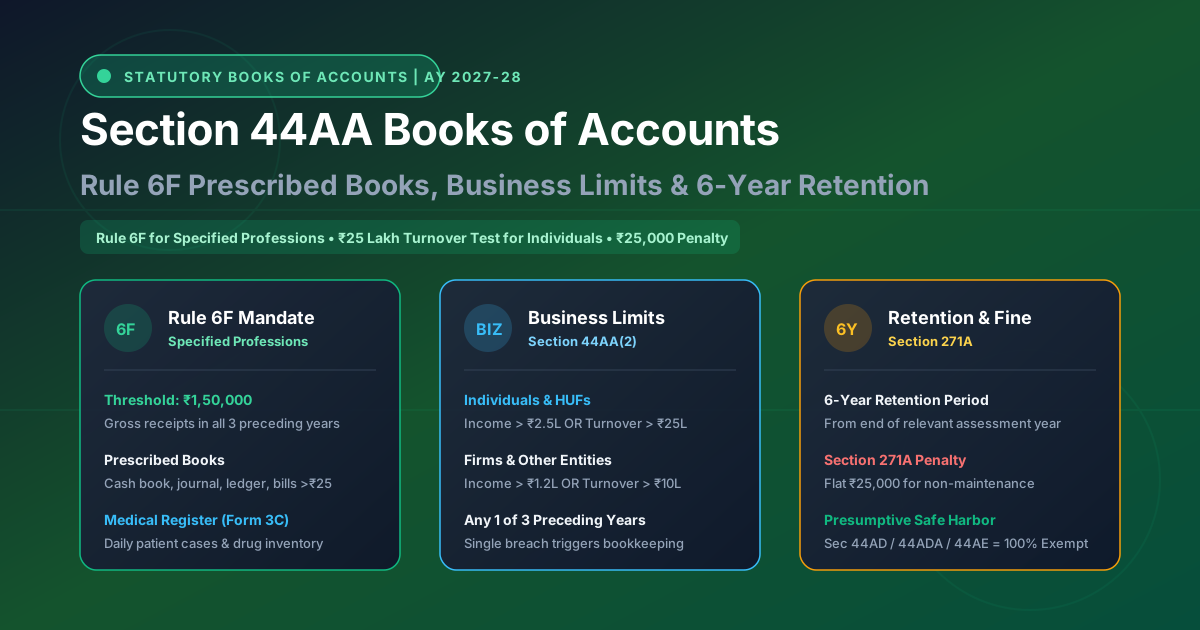
Under the direct tax jurisprudence of India, Section 44AA of the Income-tax Act, 1961 establishes the compulsory legal requirement for commercial businesses and professionals to maintain, preserve, and furnish formal books of accounts. For Assessment Year 2027-28 (Financial Year 2026-27), the law enforces two distinct regimes: Rule 6F prescribed books for "specified professions" exceeding ₹1.5 Lakh gross receipts in all three preceding years, and turnover/income thresholds (₹25 Lakh turnover / ₹2.5 Lakh income for Individuals and HUFs; ₹10 Lakh turnover / ₹1.2 Lakh income for firms) for non-specified businesses. Records must be retained for 6 years, with non-compliance triggering a flat ₹25,000 penalty under Section 271A.
Table of Contents
- 1. Legislative Intent & Statutory Architecture of Section 44AA
- 2. Section 44AA(1) Specified Professions: Scope & Notified Callings
- 3. Rule 6F Mandated Books of Accounts: The Specific Ledger List
- 4. Operational Infographic: Section 44AA Compliance Architecture
- 5. Section 44AA(2) Business Thresholds: Individuals vs. Partnership Firms
- 6. Analytical Matrix: Specified Professions vs. Non-Specified Businesses
- 7. The 6-Year Mandatory Retention Rule Under Rule 6F(5)
- 8. The Presumptive Safe Harbor: Exemption Under 44AD, 44ADA & 44AE
- 9. Section 271A Penalty & Reasonable Cause Defenses Under Section 273B
- 10. Comprehensive Real-World Numerical Case Studies
- 11. Frequently Asked Questions (FAQ)
1. Legislative Intent & Statutory Architecture of Section 44AA
In the absence of a statutory obligation requiring commercial taxpayers to record their day-to-day transactions in an orderly accounting system, assessing authorities would be left completely helpless during tax scrutiny proceedings. Businesses could manipulate cash inflows, invent fictitious expense deductions, conceal trading inventory, and claim that transactions occurred verbally without paper documentation.
To establish an evidentiary paper trail and assist revenue authorities in correctly determining taxable income, Parliament enacted Section 44AA. The statute is bifurcated into two mutually exclusive sub-sections:
- Section 44AA(1): Applies to a select group of notified "specified professions". For these professionals, the Central Board of Direct Taxes (CBDT) has exercised its rule-making powers under Rule 6F to prescribe an exact, compulsory list of specific account books, ledgers, and registers.
- Section 44AA(2): Applies to all other non-specified professions and general commercial businesses (manufacturing, wholesale, retail, services). Here, the statute does not prescribe a rigid list of account books, but mandates that taxpayers maintain "such books of account and other documents as may enable the Assessing Officer to compute his total income" once specific historical turnover or income thresholds are breached.
2. Section 44AA(1) Specified Professions: Scope & Notified Callings
Under Section 44AA(1), every person carrying on any of the following callings is statutorily classified as engaged in a "specified profession":
| Specified Calling | Statutory / Notification Reference | Professional Scope Covered |
|---|---|---|
| Legal | Section 44AA(1) | Advocates, legal practitioners, barristers, corporate legal consultants |
| Medical | Section 44AA(1) | Allopathic doctors, surgeons, dental practitioners, homeopathic/ayurvedic doctors, radiologists |
| Engineering | Section 44AA(1) | Civil, electrical, mechanical, industrial design consulting engineers |
| Architectural | Section 44AA(1) | Licensed architects, town planners, landscape architects |
| Accountancy | Section 44AA(1) | Practicing Chartered Accountants, Cost & Management Accountants |
| Technical Consultancy | CBDT Notification No. SO 890(E)/2001 | Software developers, IT system architects, data science consultants, cybersecurity engineers |
| Interior Decoration | Section 44AA(1) | Commercial and residential interior decorators and spatial designers |
| Authorized Representative | CBDT Notification No. SO 17(E)/1977 | Tax consultants and practitioners authorized to appear before tribunals and authorities |
| Film Artists | CBDT Notification No. SO 17(E)/1977 | Actors, cameramen, directors, music directors, art directors, dance directors, editors, lyricists, writers |
| Company Secretary | CBDT Notification No. SO 2680/1992 | Practicing Company Secretaries governed under the Company Secretaries Act, 1980 |
3. Rule 6F Mandated Books of Accounts: The Specific Ledger List
For individuals, firms, or entities carrying on any of the specified professions listed above, bookkeeping is governed strictly by Rule 6F of the Income-tax Rules, 1962.
The Rule 6F(1) Monetary Threshold
A specified professional is required to maintain the prescribed books of accounts only if their gross professional receipts exceed ₹1,50,000 in all the three years immediately preceding the previous year.
- The "All 3 Years" Rule: If gross receipts were ₹3,00,000 in Year 1, ₹2,50,000 in Year 2, but dropped to ₹1,40,000 in Year 3, the condition of exceeding ₹1,50,000 in all three preceding years is broken. The professional is NOT legally mandated to maintain Rule 6F books for Year 4!
- Newly Set-up Profession: If the profession is newly set up during the previous year, books must be maintained if the professional's gross receipts are likely to exceed ₹1,50,000 in that first year.
The Prescribed Books Under Rule 6F(2)
If the ₹1,50,000 threshold is breached, the professional must maintain the following specific records:
- Daily Cash Book: A book recording all cash receipts and cash payments kept and maintained from day-to-day, with the daily cash balance reconciled at the end of each day or at the end of each month.
- General Journal: A journal book recording all non-cash transactions, debit/credit journal entries, and asset adjustments (compulsory if the professional follows the mercantile system of accounting).
- Ledger: A general ledger where all accounts are classified, debit and credit balances are struck, and financial statements are extracted.
- Carbon Copies of Bills & Receipts: Carbon copies or electronic counterparts of machine-numbered serially generated bills and receipts exceeding ₹25 issued to clients.
- Original Expense Vouchers: Original signed purchase bills, rent receipts, travel vouchers, and payment chits for expenditure exceeding ₹50.
Special Additional Registers for Medical Professionals [Rule 6F(3)]
Recognizing the sensitive public health and cash-intensive nature of medical practices, Rule 6F(3) mandates that medical practitioners (physicians, surgeons, dentists, radiologists) must maintain two additional specialized registers:
- Daily Case Register in Form No. 3C: A register showing the patient's serial number, patient name, date of visit, nature of professional service rendered, fees charged, and date and mode of receipt.
- Inventory Stock Register: A quantitative stock register recording opening stock, daily purchases, daily consumption/dispensing, and closing stock of all drugs, medicines, bandages, and surgical consumables used in clinical operations.
4. Operational Infographic: Section 44AA Compliance Architecture
The operational framework below illustrates the bifurcated architecture of Section 44AA, contrasting the rigid Rule 6F requirements for specified callings against the quantitative turnover tests for general commercial businesses.
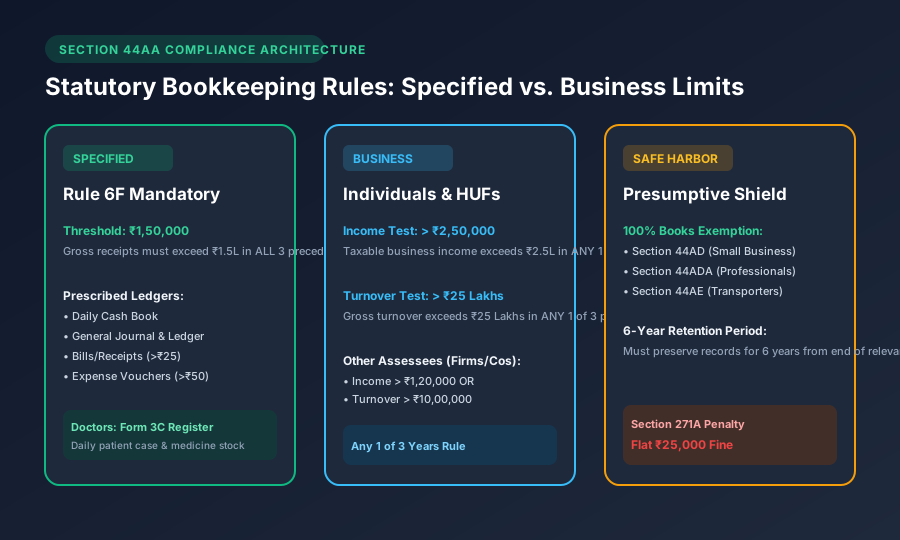
As visualized across the three structural pillars:
- Pillar 1 (Specified Callings): Requires specific books prescribed under Rule 6F once the ₹1.5 Lakh threshold is breached in all 3 preceding years.
- Pillar 2 (Businesses): Bookkeeping obligations are triggered if either income exceeds ₹2.5 Lakhs OR turnover exceeds ₹25 Lakhs in ANY single preceding year.
- Pillar 3 (Presumptive Shield): Opting for Section 44AD, 44ADA, or 44AE grants 100% statutory immunity from Section 44AA books.
5. Section 44AA(2) Business Thresholds: Individuals vs. Partnership Firms
For non-specified professions and general commercial businesses (such as wholesalers, retailers, manufacturers, traders, brokers, contractors, and transporters), bookkeeping is governed under Section 44AA(2).
Higher Thresholds for Individuals and HUFs
To reduce compliance friction for small family-run proprietorships, Parliament amended Section 44AA(2) to provide higher exemption limits for Individuals and Hindu Undivided Families (HUFs):
- Income Test: Income from business or profession exceeds ₹2,50,000 (₹2.5 Lakhs); OR
- Turnover Test: Total sales, turnover, or gross receipts exceed ₹25,00,000 (₹25 Lakhs);
- The "Any 1 of 3 Years" Rule: If EITHER the income test OR the turnover test is breached in ANY ONE of the three years immediately preceding the previous year, the individual/HUF must compulsorily maintain books of accounts.
Lower Thresholds for Other Assessees (Partnership Firms, LLPs & Companies)
For all other business entities—including partnership firms, LLPs, Private Limited companies, and Association of Persons (AOPs)—the statutory thresholds are substantially lower:
- Income Test: Taxable business income exceeds ₹1,20,000 (₹1.2 Lakhs); OR
- Turnover Test: Total sales, turnover, or gross receipts exceed ₹10,00,000 (₹10 Lakhs) in ANY ONE of the three preceding financial years.
What Nature of Books Must Businesses Maintain?
Unlike Rule 6F which mandates specific ledgers for professionals, Section 44AA(2) does not prescribe an exhaustive catalog of books for businesses. The statutory requirement is functional: the assessee must maintain such books of account and other documents as may enable the Assessing Officer to compute total income. For a typical commercial trader, this standard is satisfied by maintaining:
- Bank account statements reflecting all commercial inflows and vendor disbursements.
- Chronological sales register and purchase register with supporting tax invoices.
- Physical inventory / stock register indicating opening and closing inventory values.
- Cash book documenting cash collections, cash sales, and petty cash disbursements.
6. Analytical Matrix: Specified Professions vs. Non-Specified Businesses
The comparative matrix below outlines the critical statutory distinctions governing bookkeeping rules across different taxpayer categories.
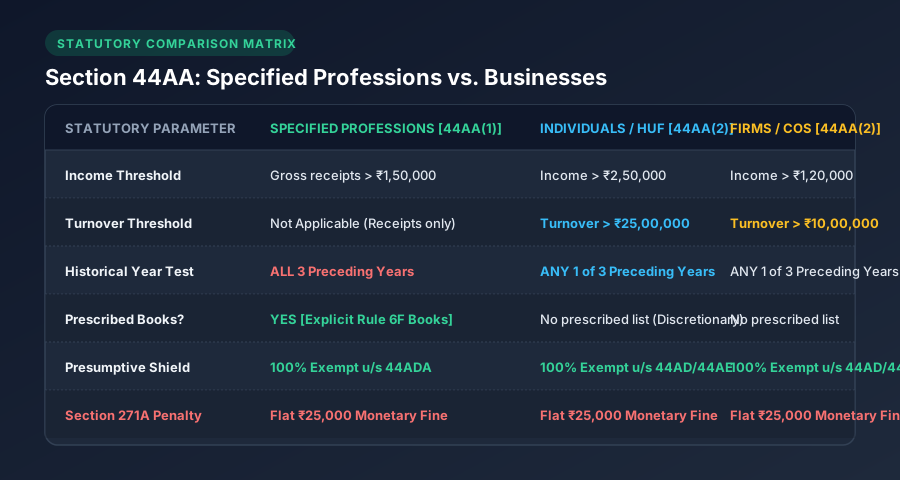
| Compliance Feature | Specified Professions [Sec 44AA(1)] | Individuals & HUFs [Sec 44AA(2)] | Partnership Firms & Companies |
|---|---|---|---|
| Governing Rule | Rule 6F of Income-tax Rules, 1962 | Section 44AA(2) statutory limits | Section 44AA(2) statutory limits |
| Gross Receipts Limit | ₹1,50,000 (Gross Receipts) | Not applicable (Turnover metric) | Not applicable (Turnover metric) |
| Turnover Limit | Not applicable | ₹25,00,000 (₹25 Lakhs) | ₹10,00,000 (₹10 Lakhs) |
| Income Limit | Not applicable | ₹2,50,000 (₹2.5 Lakhs) | ₹1,20,000 (₹1.2 Lakhs) |
| Preceding Years Test | ALL 3 Preceding Years | ANY 1 of 3 Preceding Years | ANY 1 of 3 Preceding Years |
| Nature of Books | Explicitly Prescribed Ledgers | Discretionary (Sufficient to compute) | Discretionary (Sufficient to compute) |
| Presumptive Safe Harbor | 100% Exempt under Section 44ADA | 100% Exempt under Section 44AD/44AE | 100% Exempt under Section 44AD/44AE |
| Statutory Penalty | Flat ₹25,000 under Section 271A | Flat ₹25,000 under Section 271A | Flat ₹25,000 under Section 271A |
7. The 6-Year Mandatory Retention Rule Under Rule 6F(5)
Simply preparing books of accounts during the financial year is insufficient; the law imposes a strict, ongoing custodial duty on taxpayers to preserve, protect, and retain those records for prospective scrutiny.
Statutory Retention Mandate
Under Rule 6F(5) of the Income-tax Rules:
"The books of account and other documents specified in sub-rule (2) and sub-rule (3) shall be kept and maintained for a period of six years from the end of the relevant assessment year."
Chronological Retention Calculation
Because the 6-year clock starts ticking from the end of the relevant assessment year (not the financial year), the actual holding period is approximately seven to eight calendar years from the date transactions occur:
| Financial Year (FY) | Assessment Year (AY) | End of Assessment Year | Mandatory Retention Expiry Date |
|---|---|---|---|
| FY 2024-25 | AY 2025-26 | 31st March 2026 | 31st March 2032 |
| FY 2025-26 | AY 2026-27 | 31st March 2027 | 31st March 2033 |
| FY 2026-27 | AY 2027-28 | 31st March 2028 | 31st March 2034 |
Exception for Reopened Assessments: Proviso to Rule 6F(5) specifies that where any assessment in relation to any relevant assessment year has been reopened under Section 147 of the Act, all the books of account and other documents must be preserved until the reassessment proceedings and all appellate challenges have attained finality!
8. The Presumptive Safe Harbor: Exemption Under 44AD, 44ADA & 44AE
For millions of Indian small businesses, retail merchants, transport operators, and freelancers, the most effective strategy to eliminate Section 44AA bookkeeping entirely is to claim safe harbor under Chapter IV-D presumptive taxation.
Complete Statutory Exemption Clauses
- Small Businesses (Section 44AD): Section 44AD(1) opens with an overriding non-obstante clause ("Notwithstanding anything to the contrary contained in sections 28 to 43C"). Under sub-section (5), an eligible assessee declaring deemed profit under Section 44AD is completely exempt from Section 44AA. You do not need to maintain ledgers, inventory sheets, or expense chits.
- Professionals (Section 44ADA): A software engineer, doctor, lawyer, or consultant declaring 50% deemed profit under Section 44ADA is 100% exempt from Rule 6F books. No daily cash books, no Form 3C case registers, and no expense voucher files are legally required.
- Transporters (Section 44AE): Fleet owners owning up to 10 trucks declaring deemed per-vehicle slabs are 100% exempt from Section 44AA.
9. Section 271A Penalty & Reasonable Cause Defenses Under Section 273B
Failure to comply with Section 44AA triggers direct financial consequences under Chapter XXI of the Act.
The Flat ₹25,000 Penalty Under Section 271A
Under Section 271A of the Income-tax Act, 1961:
"Without prejudice to the provisions of section 271, if any person fails to keep and maintain any such books of account and other documents as required by section 44AA or the rules made thereunder, in respect of any previous year or to retain such books of account or other documents for the period specified in the said rules, the Assessing Officer or the Joint Commissioner (Appeals) or the Commissioner (Appeals) may direct that such person shall pay, by way of penalty, a sum of twenty-five thousand rupees."
Key statutory characteristics of the Section 271A penalty:
- Fixed Monetary Amount: The penalty is fixed at exactly ₹25,000 per assessment year of default. It is not linked to turnover or taxable income.
- Discretionary Power: The statute uses the phrase "may direct", giving the tax officer discretionary authority rather than imposing an automated portal fine.
Reasonable Cause Defense Under Section 273B
Under Section 273B, no penalty under Section 271A shall be imposable on the person if they prove that there was a reasonable cause for the failure. Judicial precedents have established reasonable cause in the following circumstances:
- Destruction of Books by Calamity: Documented loss of physical ledgers due to accidental fire, severe flooding, or natural disasters, supported by an official police First Information Report (FIR) and fire department certificates.
- Theft or Robbery: Books stolen during an office burglary with contemporaneous police complaint records.
- Seizure by Other Government Agencies: Original books seized by the GST Department, Enforcement Directorate (ED), or state police during search proceedings, preventing the assessee from retaining custody.
- Bona Fide Legal Belief: Where an assessee bona fide believed their income was exempt under agricultural provisions or fell below taxable limits based on professional advice from a Chartered Accountant.
10. Comprehensive Real-World Numerical Case Studies
Case Study A: Architecture Firm Exceeding Rule 6F Limits
Professional Profile: Skyline Architects is an architectural partnership firm in Hyderabad. Its gross professional fee receipts across four consecutive assessment years are:
- FY 2023-24 (AY 2024-25): Gross Receipts = ₹2,40,000.
- FY 2024-25 (AY 2025-26): Gross Receipts = ₹1,80,000.
- FY 2025-26 (AY 2026-27): Gross Receipts = ₹1,65,000.
- FY 2026-27 (AY 2027-28): Gross Receipts = ₹1,90,000.
Section 44AA & Rule 6F Analysis for FY 2026-27:
- Historical Check: To determine whether Rule 6F books are mandatory for FY 2026-27, we examine the three preceding financial years (FY 2023-24, FY 2024-25, FY 2025-26).
- Threshold Evaluation:
- FY 2023-24: ₹2,40,000 > ₹1,50,000 (Exceeded).
- FY 2024-25: ₹1,80,000 > ₹1,50,000 (Exceeded).
- FY 2025-26: ₹1,65,000 > ₹1,50,000 (Exceeded).
- Statutory Result: Gross receipts exceeded ₹1,50,000 in ALL THREE preceding financial years. Therefore, Skyline Architects is legally mandated to maintain the complete suite of Rule 6F books (Cash Book, Journal, Ledger, serially numbered bills >₹25, and original expense vouchers >₹50).
- Alternative Safe Harbor: If the partners do not want to maintain Rule 6F books, they can opt for Section 44ADA, declare 50% deemed profit (₹95,000), and enjoy complete statutory exemption from Section 44AA!
Case Study B: Retail Grocery Proprietor and the "Any 1 Year" Test
Business Profile: Jagdish runs a wholesale grain trading proprietorship in Indore as an individual. His gross turnover records show:
- FY 2023-24: Turnover = ₹18,00,000; Net Income = ₹1,80,000.
- FY 2024-25: Turnover = ₹28,00,000; Net Income = ₹2,40,000.
- FY 2025-26: Turnover = ₹16,00,000; Net Income = ₹1,90,000.
- FY 2026-27: Current Year under assessment.
Section 44AA(2) Analysis for FY 2026-27:
- Jagdish is an individual carrying on a non-specified commercial business. The applicable statutory limits are Turnover > ₹25 Lakhs OR Income > ₹2.5 Lakhs in ANY ONE of the 3 preceding years.
- In FY 2024-25, his turnover reached ₹28,00,000 (exceeding the ₹25 Lakh threshold).
- Even though his turnover dropped back down to ₹16 Lakhs in FY 2025-26, the threshold was breached in one of the three preceding years.
- Statutory Mandate: Jagdish is legally required under Section 44AA(2) to maintain proper commercial books of accounts (sales register, purchase register, bank reconciliation, inventory record) for FY 2026-27.
- If Jagdish fails to maintain these books and does not opt for Section 44AD presumptive taxation, the Assessing Officer can impose a ₹25,000 penalty under Section 271A.
11. Frequently Asked Questions (FAQ)
What are the turnover and income limits for maintaining books under Section 44AA for individuals?
Under Section 44AA(2), an individual or HUF carrying on business or a non-specified profession must compulsorily maintain books of accounts if their income from business exceeds ₹2,50,000 OR their total sales, turnover, or gross receipts exceed ₹25,00,000 in ANY ONE of the three years immediately preceding the previous year.
Which books are statutorily prescribed under Rule 6F for specified professionals?
Under Rule 6F(2), specified professionals whose gross receipts exceed ₹1,50,000 in all 3 preceding years must maintain: (1) Cash Book, (2) Journal (if mercantile system is followed), (3) Ledger, (4) Carbon copies of serially numbered bills/receipts exceeding ₹25, and (5) Original signed purchase/expense vouchers exceeding ₹50. Medical professionals must additionally maintain a daily case register in Form 3C and a drug inventory register.
For how many years must books of accounts be preserved under Section 44AA?
Under Rule 6F(5), books of accounts and related documents must be preserved for a minimum period of 6 years from the end of the relevant assessment year. For example, books of accounts maintained for FY 2026-27 (AY 2027-28) must be retained until 31st March 2034.
What is the penalty for not maintaining books of accounts under Section 44AA?
Under Section 271A of the Income-tax Act, if an assessee fails to keep and maintain or retain books of accounts and other documents as required under Section 44AA or Rule 6F, the Assessing Officer may levy a flat monetary penalty of ₹25,000.
Does an assessee opting for presumptive taxation need to maintain books of accounts?
No. Assessees declaring income under the presumptive schemes of Section 44AD (small businesses), Section 44ADA (professionals), or Section 44AE (transporters) are 100% exempt from maintaining books of accounts and documents under Section 44AA.
What is the threshold for partnership firms to maintain books under Section 44AA(2)?
For partnership firms, LLPs, companies, and AOPs, the threshold under Section 44AA(2) is lower than for individuals: books of accounts must be maintained if taxable income exceeds ₹1,20,000 OR total sales, turnover, or gross receipts exceed ₹10,00,000 in any one of the three preceding financial years.