Professional Tax Across All Indian States: Complete Slabs 2026-27
The ultimate state-by-state reference guide to Professional Tax (PT) in India for FY 2026-27 (AY 2027-28). Discover the ₹2,500 constitutional ceiling under Article 276(2), slab schedules for Karnataka, Maharashtra, Telangana, and Tamil Nadu, remote work rules, and zero-PT zones like Delhi NCR.
Executive Summary: The State-Level Wage Levy
Every month, salaried employees across India inspect their payslips and observe a modest recurring deduction—typically ₹200 per month—listed under the acronym "PT" (Professional Tax). Unlike Income Tax, which is a federal direct tax enacted by the Parliament of India and collected by the Central Board of Direct Taxes (CBDT), Professional Tax is a state-level levy administered independently by individual state governments and municipal corporations.
Despite its name, Professional Tax does not apply solely to doctors, lawyers, or chartered accountants. It applies universally to all salaried corporate employees, wage earners, business owners, and freelancers carrying on a trade or profession within the geographic boundaries of enacting states.
Key takeaways for Assessment Year 2027-28 (Financial Year 2026-27):
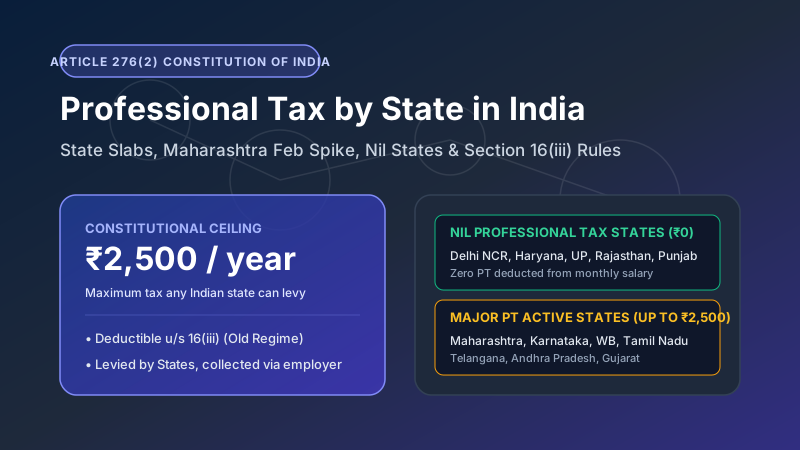
- The Constitutional Ceiling (Article 276(2)): The maximum professional tax that any state or municipality can legally collect from an individual is capped by the Constitution of India at ₹2,500 per annum.
- Income Tax Deductibility (Section 16(iii)): Any professional tax deducted by your employer is 100% deductible from gross salary under Section 16(iii) of the Income Tax Act when filing under the Old Tax Regime. In the New Tax Regime (Section 115BAC), this deduction is disallowed in favor of the higher ₹75,000 standard deduction.
- The Zero-PT Geographic Advantage: States like Delhi, Haryana (Gurugram), Uttar Pradesh (Noida), and Rajasthan do not levy any professional tax. Employees working in Gurugram or Noida automatically enjoy an extra ₹2,500 in annual take-home pay compared to peers in Bengaluru or Mumbai.
- The Maharashtra February Anomaly: In Maharashtra, employees pay ₹200 per month from April to January, and a special lump sum of ₹300 in February to hit the exact ₹2,500 annual statutory ceiling.
1. Constitutional Foundation: Article 276(2) & The ₹2,500 Cap
In the Indian federal legislative division governed by the Seventh Schedule of the Constitution, taxes on income other than agricultural income are reserved exclusively for the Union Parliament under Entry 82 of List I (Union List).
However, to provide state governments and municipal corporations with independent municipal revenue streams, the Constitution created a specific exception under Entry 60 of List II (State List): "Taxes on professions, trades, callings and employments."
To prevent state governments from imposing predatory income taxes under the guise of professional taxes, the Constitution enacted a rigid statutory safeguard under Article 276(2):
Originally in 1950, this constitutional limit was set at just ₹250 per year. It was enhanced to ₹2,500 via the 60th Constitutional Amendment Act in 1988. Although state finance ministers repeatedly lobby the Union Government to amend Article 276 to hike the ceiling to ₹12,000, Parliament has not enacted any amendment, keeping the statutory cap locked at ₹2,500 per year for FY 2026-27.
2. State-by-State Professional Tax Landscape (FY 2026-27)
Because Professional Tax is a state subject, enactment is entirely elective. Some states levy the maximum permitted ₹2,500, others maintain graduated multi-slab brackets, and several major commercial states have chosen not to enact any professional tax legislation whatsoever.

The regulatory map of India is partitioned into three distinct statutory categories:
- Tier 1: Maximum Levy States (Up to ₹2,500/year): Includes Maharashtra, Karnataka, Telangana, Tamil Nadu, Andhra Pradesh, West Bengal, Gujarat, and Madhya Pradesh.
- Tier 2: Graduated Regional States: Includes Kerala, Assam, Odisha, Bihar, Meghalaya, Tripura, and Chhattisgarh.
- Tier 3: Zero Professional Tax States / UTs (₹0 Levy): Includes Delhi NCT, Haryana, Uttar Pradesh, Rajasthan, Punjab, Chandigarh, Himachal Pradesh, Uttarakhand, Goa, and all Union Territories (except Puducherry).
3. Detailed Slab Schedules for Top 5 Employment Metros
For over 80% of formal sector white-collar workers in India, employment is concentrated within five primary metropolitan clusters. The chart and detailed tables below outline the exact slab schedules for each hub.

1. Maharashtra (Mumbai, Pune, Nagpur)
Governed by the Maharashtra State Tax on Professions, Trades, Callings and Employments Act, 1975. Maharashtra maintains gender-differentiated exemption thresholds:
| Gross Monthly Salary Range | Male Employees | Female Employees |
|---|---|---|
| Up to ₹7,500 | Nil (₹0) | Nil (₹0) |
| ₹7,501 to ₹10,000 | ₹175 per month | Nil (₹0) |
| ₹10,001 to ₹25,000 | ₹200 per month | Nil (Exempted by State Govt) |
| Above ₹25,000 | ₹200/mo (₹300 in Feb) | ₹200/mo (₹300 in Feb) |
Notice the special relief granted to women: female employees earning up to ₹25,000 per month pay ₹0 in PT. Men earning above ₹10,000 and women earning above ₹25,000 pay ₹2,500 annually (₹200 × 11 months + ₹300 in February).
2. Karnataka (Bengaluru, Mysuru)
Governed by the Karnataka Tax on Professions, Trades, Callings and Employments Act, 1976. The Karnataka legislature substantially simplified its slab structure:
| Gross Monthly Salary | Monthly Professional Tax | Annual Total |
|---|---|---|
| Up to ₹24,999 | Nil (100% Exempt) | ₹0 |
| ₹25,000 and Above | ₹200 per month | ₹2,400 per year |
3. Telangana (Hyderabad, Cyberabad)
Governed by the Telangana Professions, Trades, Callings and Employments Act, 1987:
| Gross Monthly Salary | Monthly Professional Tax | Annual Total |
|---|---|---|
| Up to ₹15,000 | Nil (₹0) | ₹0 |
| ₹15,001 to ₹20,000 | ₹150 per month | ₹1,800 per year |
| Above ₹20,000 | ₹200 per month | ₹2,400 per year |
4. Tamil Nadu (Chennai, Coimbatore)
In Tamil Nadu, professional tax is collected directly by municipal corporations (such as the Greater Chennai Corporation) on a half-yearly basis (every six months):
| Six-Month Gross Salary Range | Half-Yearly PT Deduction | Annual Total Deduction |
|---|---|---|
| Up to ₹21,000 | Nil (₹0) | ₹0 |
| ₹21,001 to ₹30,000 | ₹135 | ₹270 |
| ₹30,001 to ₹45,000 | ₹315 | ₹630 |
| ₹45,001 to ₹60,000 | ₹690 | ₹1,380 |
| ₹60,001 to ₹75,000 | ₹1,025 | ₹2,050 |
| Above ₹75,000 (Average > ₹12.5k/mo) | ₹1,250 every 6 months | ₹2,500 per year |
5. West Bengal (Kolkata)
West Bengal operates a detailed five-tier graduated monthly slab schedule:
| Gross Monthly Salary | Monthly Professional Tax | Annual Total |
|---|---|---|
| Up to ₹10,000 | Nil (₹0) | ₹0 |
| ₹10,001 to ₹15,000 | ₹110 per month | ₹1,320 per year |
| ₹15,001 to ₹20,000 | ₹130 per month | ₹1,560 per year |
| ₹20,001 to ₹40,000 | ₹150 per month | ₹1,800 per year |
| Above ₹40,000 | ₹200 per month | ₹2,400 per year |
4. Zero Professional Tax Zones: Delhi NCR & North India
A frequent surprise for corporate employees relocating from Mumbai or Bengaluru to North India is the complete disappearance of the "PT" line item on their payslips.
The entire National Capital Region (NCR) operates with 0% Professional Tax:
- Delhi NCT: Has never enacted a professional tax law.
- Haryana (Gurugram, Manesar, Faridabad): The Haryana Government has not legislated professional tax. MNC software engineers in Cyber Hub, Gurugram, pay ₹0 in PT.
- Uttar Pradesh (Noida, Greater Noida): Although Uttar Pradesh has historical statutes on its books, professional tax collection from salaried private employees is currently not enforced or levied.
- Other Zero-PT States: Rajasthan, Punjab, Chandigarh, Himachal Pradesh, Uttarakhand, and Goa.
This creates an annual take-home wage differential: an engineer earning ₹15 LPA in Gurugram takes home ₹2,500 more per year than an identical engineer on the exact same CTC in Bengaluru or Pune.
5. Income Tax Deductibility under Section 16(iii): Old vs New Regime
Because Professional Tax is a compulsory direct state levy, the Central Government historically allowed salaried employees to deduct it from their gross salary before calculating federal income tax.
Under Section 16(iii) of the Income Tax Act:
$$\text{Income Chargeable under Salaries (Old Regime)} = \text{Gross Salary} - \text{Sec 16(ia) } [₹50,000] - \text{Sec 16(iii) PT } [₹2,500]$$
However, with the introduction and default enactment of the New Tax Regime (Section 115BAC), the deductibility of professional tax depends strictly upon your chosen tax regime:
| Tax Regime | Standard Deduction (16(ia)) | Professional Tax Deduction (16(iii)) | Total Section 16 Deductions |
|---|---|---|---|
| Old Tax Regime | ₹50,000 | Deductible (up to ₹2,500) | ₹52,500 |
| New Tax Regime (115BAC) | ₹75,000 | Disallowed (₹0) | ₹75,000 |
Under the New Tax Regime, you lose the ₹2,500 deduction under Section 16(iii), but you gain an extra ₹25,000 in enhanced standard deduction (₹75,000 vs ₹50,000), leaving salaried workers significantly ahead.
6. Remote Work, Multi-State Employment & Dual Employer Traps
The rise of hybrid work and permanent work-from-home (WFH) models has triggered complex multi-jurisdictional tax questions for Indian professionals:
A. The Remote Work Jurisdiction Doctrine
If an employee lives in Delhi (zero PT) but works remotely for an enterprise headquartered in Bengaluru, which state's PT applies?
Under the statutory doctrine of situs of employment, professional tax is levied where the employee actually exercises their profession or calling. If your employment agreement and payroll record your primary work location as your residential address in Delhi, the employer should not deduct Karnataka Professional Tax. However, if your contract designates you as an employee of the Bengaluru branch with temporary remote permission, corporate payroll software typically withholds Karnataka PT by default.
B. The Mid-Year Employer Switch Trap
If you resign from Company A in August in Pune (which deducted ₹200/mo × 5 months = ₹1,000) and join Company B in Mumbai in September:
- Company B will start deducting ₹200 per month from September to January (₹1,000) and ₹300 in February.
- Total PT deducted across both employers = ₹1,000 + ₹1,300 = ₹2,300 (Within the ₹2,500 ceiling).
- However, if you joined in April and both employers deducted overlapping amounts exceeding ₹2,500, your total deduction under Section 16(iii) on your ITR is strictly capped at ₹2,500. You cannot claim deduction for amounts paid in excess of the constitutional limit.
7. Employer Compliance: PTRC vs PTEC Explained
For entrepreneurs, consultants, and corporate directors, professional tax compliance involves two distinct legal registrations:
- Professional Tax Registration Certificate (PTRC): Required by an employer to deduct professional tax from employees' monthly salaries and remit it to the state government treasury. Every enterprise employing staff in a PT state must possess a PTRC.
- Professional Tax Enrollment Certificate (PTEC): Required by the business entity itself (company, LLP, sole proprietorship) and individual directors/partners to pay professional tax on their own commercial activity. The business entity pays a flat ₹2,500 annual PTEC levy independent of its employees.
Verify Your In-Hand Salary Across Indian States
Wondering how state professional tax, PF deductions, and income tax shape your actual monthly paycheck? Use our 100% free, private client-side calculators to model your exact compensation package.
8. Frequently Asked Questions (FAQ)
What is the maximum limit of Professional Tax that can be levied in India?
Under Article 276(2) of the Constitution of India, the total amount of professional tax payable in respect of any one person to any state or local authority cannot exceed ₹2,500 per annum. No state government has the constitutional power to levy professional tax exceeding this statutory threshold.
Which Indian states and Union Territories have ZERO Professional Tax?
States and Union Territories that do not levy any Professional Tax include Delhi NCT, Haryana (Gurugram, Faridabad), Uttar Pradesh (Noida, Greater Noida, Lucknow), Rajasthan, Punjab, Chandigarh, Himachal Pradesh, Uttarakhand, Goa, and Jammu & Kashmir.
Can Professional Tax be deducted from income tax under Section 16(iii)?
Yes, but ONLY under the Old Tax Regime. Under Section 16(iii) of the Income Tax Act, any professional tax actually paid during the financial year (up to ₹2,500) is 100% deductible from gross salary. Under the New Tax Regime (Section 115BAC), Section 16(iii) deduction is disallowed.
Why is ₹300 deducted for Professional Tax in February in Maharashtra?
In Maharashtra, the standard monthly professional tax deduction for gross salary above ₹10,000 is ₹200 per month for eleven months (April to January = ₹2,200). To reach the exact statutory constitutional maximum of ₹2,500 per year, ₹300 is deducted in the final month of February (₹2,200 + ₹300 = ₹2,500).
What is the current Professional Tax exemption limit in Karnataka?
In Karnataka (including Bengaluru), employees earning a gross monthly salary of up to ₹24,999 are completely exempt from Professional Tax. If gross monthly salary is ₹25,000 or more, a flat ₹200 per month (₹2,400 per year) is deducted.
If I work remotely from Delhi for a company in Bengaluru, which state's PT applies?
Under Indian labor and tax jurisprudence, Professional Tax is determined by the physical 'place of work' (situs of employment). If your employment contract and payroll officially designate your work location as Delhi, you should not be subject to PT since Delhi has no PT statute. However, if your payroll is mapped to the Bengaluru office without a recognized remote branch, employers often withhold Karnataka PT.
Are senior citizens exempt from Professional Tax in Maharashtra?
Yes. In Maharashtra, individuals who have attained the age of 65 years or above are completely exempt from paying professional tax. Additionally, women earning up to ₹25,000 per month are exempt from professional tax in Maharashtra.
What happens to PT if I switch employers mid-year in the same state?
Because both employers will deduct ₹200 monthly, you may inadvertently pay more than the ₹2,500 constitutional limit. When filing your ITR, ensure that your total Section 16(iii) deduction does not exceed ₹2,500, and declare your previous salary via Form 12B to your new employer to stop excess deductions.