Leave Encashment Tax Exemption: ₹25 Lakhs Limit & Rules (2026-27)
The definitive regulatory manual for leave encashment under Section 10(10AA) for FY 2026-27 (AY 2027-28). Master the enhanced ₹25,00,000 tax-free ceiling, the 4-factor statutory exemption formula, 30-day annual leave caps, resignation vs retirement distinctions, and Section 89 relief.
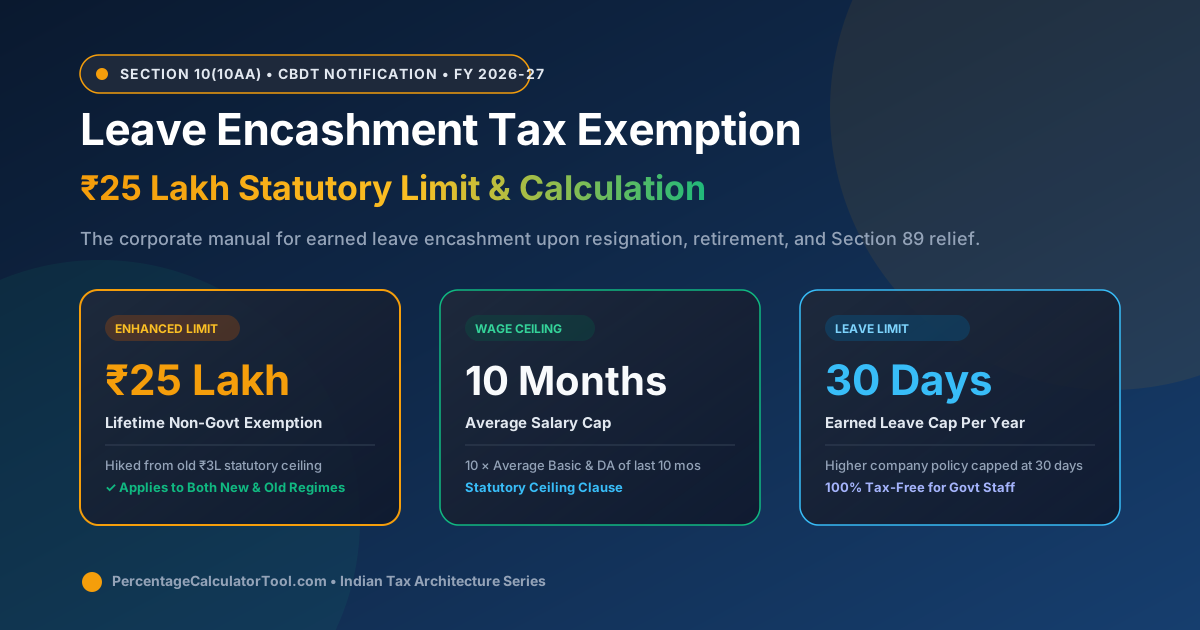
Executive Summary: Monetizing Unavailed Leaves Tax-Free
Throughout a corporate career spanning decades, diligent employees accumulate hundreds of days of Earned Leave (EL) or Privilege Leave (PL). When parting ways with an employer—whether through superannuation, early retirement, or resignation—the company converts these unavailed leave days into a cash payout known as Leave Encashment.
For over two decades (from 2002 to 2023), private sector employees faced a punitive tax trap: while central and state government employees enjoyed unlimited 100% tax-free leave encashment, private sector workers were restricted to an archaic tax-exempt ceiling of just ₹3,00,000 set during the Vajpayee administration. Any leave payment exceeding ₹3 Lakhs was added directly to salary income and taxed at steep 30% slab rates.
Recognizing the unfairness of this disparity, the Central Board of Direct Taxes (CBDT) issued Notification No. 31/2023 (F.No. 200/4/2023-ITA-I), dramatically enhancing the lifetime tax-exempt ceiling for non-government employees to ₹25,00,000 (₹25 Lakhs).
Key takeaways for Assessment Year 2027-28 (Financial Year 2026-27):
- The Enhanced ₹25 Lakh Cap: Private sector employees can receive up to ₹25 Lakhs in leave encashment upon separation completely free of income tax under Section 10(10AA)(ii).
- Active Service vs Separation: Any leave encashed while continuing in active employment is 100% fully taxable for all employees. The tax exemption applies exclusively when leaves are encashed upon retirement, resignation, or termination.
- The 4-Factor Funnel: The exact tax-free sum is not arbitrarily chosen; it is the least of four statutory amounts, including 10 months' average salary and the cash value of unavailed leaves.
- The 30-Day Statutory Ceiling: Even if your employer's HR policy generously grants 36, 42, or 48 days of earned leave per year, the Income Tax Act strictly restricts the calculation of exempt leave to 30 days per completed year of service.
- Universal Regime Immunity: Section 10(10AA) exemption is fully preserved under both the New Tax Regime (Section 115BAC) and the Old Tax Regime.
1. Legislative Evolution: From ₹3 Lakhs to ₹25 Lakhs
Section 10(10AA) was enacted to provide terminal relief on accumulated leave balances. Historically, the central government periodically gazetted the maximum exemption ceiling for non-government employees:
- 1998 to 2002: Capped at ₹2,40,000.
- 2002 to 2023: Capped at ₹3,00,000 via Notification No. S.O. 588(E) dated May 31, 2002.
Between 2002 and 2023, executive salaries grew tenfold. A senior professional retiring with 240 days of accumulated leave routinely earned ₹15 Lakhs to ₹30 Lakhs in terminal leave encashment. Because the exemption was frozen at ₹3 Lakhs, retirees faced an unexpected tax bill on the remaining ₹12L to ₹27L, eroding their retirement cushion.
In Union Budget 2023, the Finance Minister announced an over eight-fold increase in the statutory limit, which was formally notified by the CBDT under Section 10(10AA)(ii) at ₹25,00,000. This ₹25 Lakh lifetime ceiling applies to all leave encashments received on or after April 1, 2023, and remains the governing statutory benchmark for FY 2026-27 (AY 2027-28).
2. Encashment During Service vs at Retirement / Resignation
The tax treatment of leave encashment hinges fundamentally upon when the cash is disbursed. The Income Tax Act draws a rigid boundary between active employment and terminal separation.
A. Encashment During Active Employment (Section 17(1)(va))
Many corporate employers permit employees to encash a portion of their accrued earned leave balances every December or March (e.g., encashing any leave accumulated above 30 or 45 days) while continuing on the corporate payroll.
B. Encashment Upon Retirement, Superannuation, or Resignation
When an employee permanently severs their employment relationship—whether through voluntary resignation, superannuation at age 58/60, or medical retirement—the leave encashment payout becomes eligible for statutory exemption under Section 10(10AA).
C. Encashment Paid to Legal Heirs on Demise
Under CBDT Circular No. 309 dated 05-01-1981, if an employee passes away while in service and the unavailed leave balance is paid to their surviving spouse, children, or legal heirs, the entire payout is 100% tax-free in the hands of the family, without any monetary ceiling.
3. The Section 10(10AA) 4-Factor Exemption Funnel
For private sector employees, the tax-exempt component of leave encashment is calculated through a statutory four-factor test. The law specifies that the exempt amount shall be the LEAST of the following four parameters:

Let us examine each factor in precise legal detail:
- Factor 1: Actual Leave Encashment Received: The gross rupee amount credited by your employer's payroll department representing unavailed earned leaves.
- Factor 2: Statutory Ceiling Notified by CBDT: Fixed at ₹25,00,000 (₹25 Lakhs). Note that this is a lifetime cumulative limit. If you utilized ₹5 Lakhs of exemption upon leaving a previous employer, your remaining lifetime ceiling is ₹20 Lakhs.
- Factor 3: 10 Months' Average Salary:
10 × Average Monthly Basic Salary + DAearned during the 10 calendar months immediately preceding the date of retirement or resignation. - Factor 4: Cash Equivalent of Unavailed Leaves (30-Day Rule): The unavailed leave balance calculated based on a maximum entitlement of 30 days of earned leave per completed year of actual service, multiplied by the daily average salary:
$$\text{Permissible Leave Days} = (\text{Completed Years} \times 30) - \text{Total Leaves Availed/Encashed}$$ $$\text{Factor 4 Value} = \frac{\text{Permissible Leave Days}}{30} \times \text{Average Monthly Salary}$$
4. Comprehensive Step-by-Step Computational Case Study
To understand how these four factors interact in real life, consider the case of Vikram Malhotra, an engineering director resigning from a private technology firm:
Case Profile: Vikram Malhotra
- Service Tenure: 18 years and 9 months.
- Last Drawn Basic Salary: ₹1,50,000 per month (Uniform over the last 10 months; No DA).
- Company Leave Policy: Granted 36 days of Earned Leave per year.
- Total Leaves Availed during career: 180 days.
- Leave Balance at Resignation: (18 years × 36) - 180 = 468 days.
- Actual Leave Encashment Received: 468 days × (₹1,50,000 ÷ 30) = ₹23,40,000.
Step-by-Step Exemption Calculus:
Step 1: Determine Completed Years of Service:
Under Section 10(10AA), fractional years are ignored. 18 years and 9 months is taken strictly as 18 completed years.
Step 2: Compute 10 Months' Average Salary (Factor 3):
$$\text{Average Monthly Salary} = ₹1,50,000$$ $$\text{Factor 3 (10 Months)} = 10 \times ₹1,50,000 = ₹15,00,000$$
Step 3: Compute Cash Value under 30-Day Cap (Factor 4):
Even though the company granted 36 days per year, the Income Tax Act restricts the entitlement to 30 days per completed year:
- Statutory Maximum Leave Entitlement = 18 years × 30 days = 540 days.
- Less: Total Leaves Availed = -180 days.
- Eligible Leave Balance for Tax Calculation = 540 - 180 = 360 days (12 months).
- Factor 4 Value = (360 days ÷ 30 days) × ₹1,50,000 = ₹18,00,000.
Step 4: Compare All 4 Factors to Find the LEAST:
| Factor | Description | Calculated Value |
|---|---|---|
| Factor 1 | Actual Leave Encashment Received | ₹23,40,000 |
| Factor 2 | Statutory CBDT Maximum Limit | ₹25,00,000 |
| Factor 3 | 10 Months' Average Salary | ₹15,00,000 (LEAST) |
| Factor 4 | Cash Value under 30-Day Statutory Cap | ₹18,00,000 |
Final Tax Outcome:
- Tax-Exempt Leave Encashment (Sec 10(10AA)): ₹15,00,000 (The Least).
- Taxable Leave Encashment: ₹23,40,000 - ₹15,00,000 = ₹8,40,000.
Vikram receives ₹23.40 Lakhs from his employer. A massive ₹15 Lakhs is 100% tax-free, while the remaining ₹8.40 Lakhs is added to his taxable salary in that financial year.
5. Taxability Matrix: Government vs Private Sector Employees
The legal rules differ dramatically based on whether you work for the government or the private corporate sector.
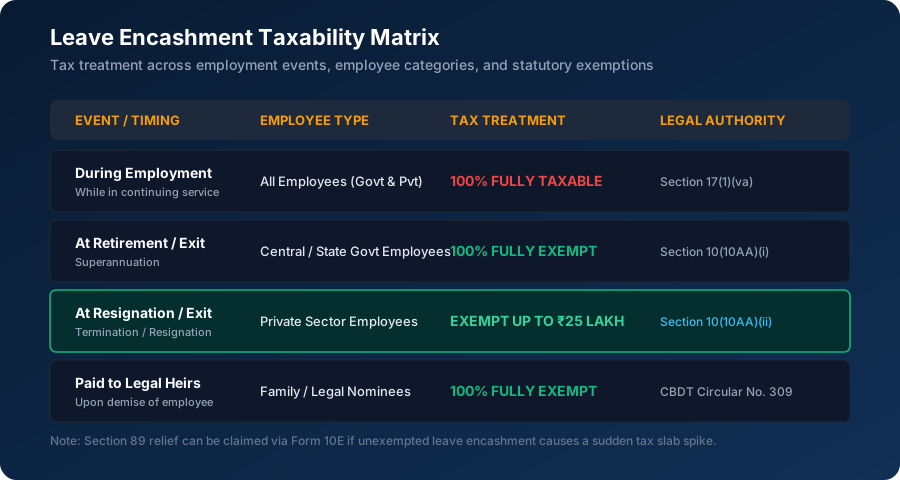
Key category breakdowns include:
- Central & State Government Employees (Sec 10(10AA)(i)): 100% Tax-Free upon retirement without any monetary cap. Whether a retiring IAS officer or railway employee receives ₹15 Lakhs or ₹45 Lakhs in leave encashment, zero tax is payable.
- Public Sector Undertakings (PSUs) & Nationalized Banks: Employees of PSUs (such as ONGC, IOCL, BHEL, or SBI) are classified as non-government employees for the purposes of Section 10(10AA). They are subject to the ₹25 Lakh statutory cap and the 4-factor formula.
- Private Corporate Employees (Sec 10(10AA)(ii)): Fully covered by the enhanced ₹25 Lakh statutory ceiling and the 4-factor test.
6. Corporate Leave Policy Traps: 30-Day Cap & Completed Years
When planning your exit, beware of two major structural traps that reduce your tax-exempt entitlement:
Trap 1: The 30-Day Statutory Cap
Many multinational consulting and technology firms offer 36, 42, or even 48 days of annual leave to attract talent. If you accumulate leaves under a 42-day policy:
- Your company will calculate your gross payout using 42 days.
- However, when computing your tax exemption, the Income Tax Assessing Officer will recalculate your balance using strictly 30 days per year.
- Any payout corresponding to the extra 12 days per year is automatically classified as 100% taxable salary.
Trap 2: Strict Exclusion of Fractional Years
Unlike gratuity under the Payment of Gratuity Act—where 9 years and 7 months is rounded up to 10 years—Section 10(10AA) states: "completed years of service".
If you resign after 9 years and 11 months, your service is calculated as 9 years. You permanently lose 30 days (1 full month) of tax-exempt entitlement. If feasible, delaying your formal resignation or last working date by a few weeks to cross an anniversary year boundary unlocks significant additional tax-free headroom.
7. Mitigating Slab Jumping via Section 89 Relief & Form 10E
If your taxable leave encashment exceeds the exempt limit (e.g., you receive ₹35 Lakhs, of which ₹10 Lakhs is taxable), that entire ₹10 Lakhs is added to your salary in a single financial year. This sudden lump sum can catapult you from the 15% slab into the 30% slab, or trigger mandatory 10% surcharge under Section 115BAC(1A).
To protect taxpayers against this artificial tax spike caused by multi-year accumulated earnings, the Income Tax Act provides Relief under Section 89(1):
- How Section 89 Works: The computational engine spreads the taxable leave encashment across the previous financial years during which the leaves were actually accrued, calculating what tax you would have paid had the money been received each year.
- Tax Differential Rebate: If the tax on the lump sum in the current year is higher than the aggregate tax that would have been payable across past years, the difference is granted as a direct tax rebate under Section 89.
- Mandatory Form 10E Requirement: Under Section 89(1) Rule 21AA, you must file Form 10E online on the e-filing portal before submitting your Income Tax Return. If you claim Section 89 relief in your ITR without previously e-verifying Form 10E, the CPC will automatically disallow the relief and issue a tax demand under Section 143(1)(a).
Verify Your Take-Home Salary & Terminal Payouts
Planning a career transition or retirement? Use our 100% free, private financial calculators to compute your in-hand salary, gratuity, and income tax liability across both regimes.
8. Frequently Asked Questions (FAQ)
What is the maximum tax exemption limit for leave encashment under Section 10(10AA)?
For non-government and private-sector employees, the maximum lifetime tax exemption limit for leave encashment received upon retirement or resignation is ₹25,00,000 (₹25 Lakhs). This threshold was enhanced from the previous limit of ₹3,00,000 via CBDT Notification No. 31/2023.
Is leave encashment received during active service tax-free?
No. Any leave encashed by an employee while continuing in active service is 100% fully taxable under Section 17(1)(va) as profits in lieu of salary for both government and non-government employees. Exemption under Section 10(10AA) is available only upon separation (retirement, superannuation, or resignation).
Is leave encashment tax-exempt under the New Tax Regime (Section 115BAC)?
Yes. The statutory exemption under Section 10(10AA) is completely available under BOTH the New Tax Regime and the Old Tax Regime up to the ₹25 Lakh statutory ceiling. It is not impacted by opting for Section 115BAC.
What is the 30-day annual leave cap for calculating tax exemption?
Under Section 10(10AA), the Income Tax Act mandates that for the purpose of tax exemption, an employee's leave entitlement cannot exceed 30 days of earned leave for every completed year of actual service. Even if your employer grants 36 or 45 days of annual leave, the tax-exempt formula caps the entitlement at 30 days per completed year.
How is 10 months' average salary calculated for leave encashment?
Average salary is computed by taking the aggregate of Basic Salary and Dearness Allowance (DA) earned during the 10 calendar months immediately preceding the date of retirement or resignation, and dividing the total by 10. Other allowances like HRA, medical, or performance bonus are excluded.
Are fractional years of service rounded up for leave encashment?
No. Unlike gratuity where fractions exceeding 6 months are rounded up to the next full year, the leave encashment formula under Section 10(10AA) strictly counts only completed full years of continuous service. Any fractional months or days (even 11 months and 28 days) are completely disregarded.
Is leave encashment received by legal heirs upon the death of an employee taxable?
No. Under CBDT Circular No. 309, leave encashment paid to the legal heirs or nominees of an employee who dies while in service is 100% exempt from income tax without any monetary limitation.
Can I claim Section 89 relief on taxable leave encashment?
Yes. If an employee receives a substantial leave encashment payout exceeding ₹25 Lakhs that pushes their total income into a higher tax slab, they can claim tax relief under Section 89(1) by filing Form 10E online on the e-filing portal prior to filing their ITR.