EPS Pension Scheme Explained: Formula, Eligibility & 2026 Pension Rules
The definitive guide to the Employees' Pension Scheme 1995 (EPS-95) for FY 2026-27 (AY 2027-28). Master the statutory pension formula, the 10-year vesting milestone, 60-month wage averaging, early pension reductions, and Supreme Court higher pension mechanics.
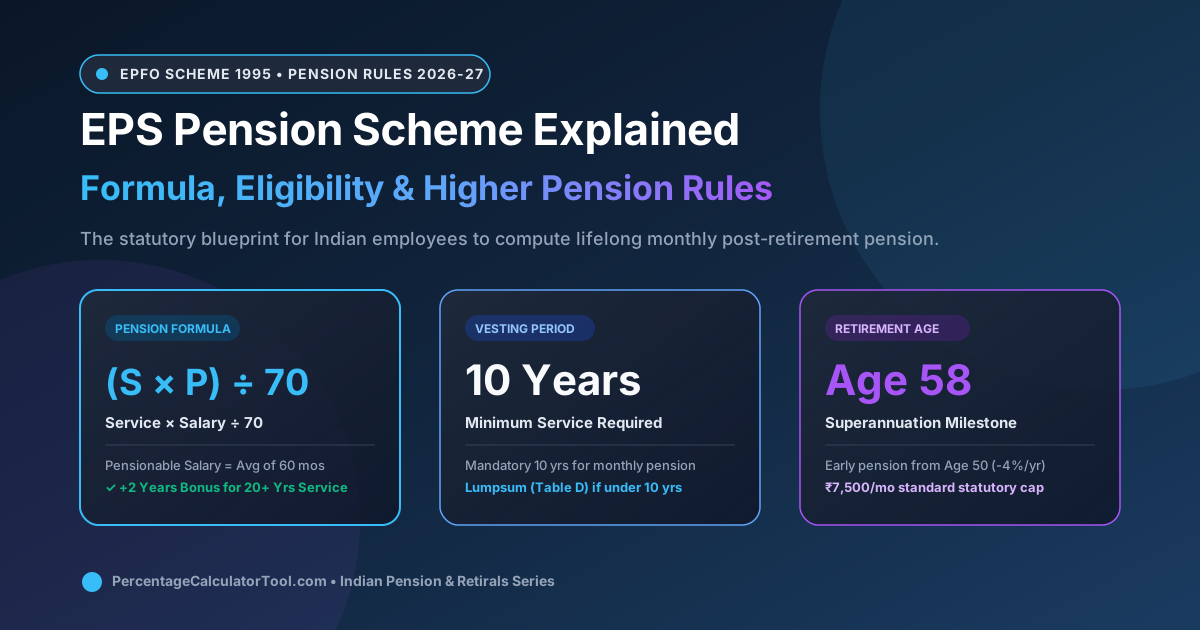
Executive Summary: Unlocking Your Lifelong Monthly Annuity
Every month, when 12% is deducted from an Indian employee's basic salary toward the Employee Provident Fund, the employer contributes an equal 12%. However, many corporate professionals are unaware that this employer contribution does not go entirely into their PF interest-bearing account. Instead, a statutory portion—specifically 8.33% of Basic Salary—is systematically diverted into the Employees' Pension Scheme (EPS-95) administered by the Employees' Provident Fund Organisation (EPFO).
While the EPF component accumulates as an interest-earning lump sum that you receive upon retirement or job exit, the EPS pool functions as a defined-benefit pension scheme. It guarantees a monthly lifelong annuity to the member starting from age 58, with continuing survivor pensions for the spouse and dependent children in the event of the member's demise.
Key takeaways for Assessment Year 2027-28 (Financial Year 2026-27):
- The Statutory Pension Formula: Monthly Pension =
(Pensionable Service × Pensionable Salary) ÷ 70. - The 10-Year Vesting Milestone: You must complete at least 10 years of eligible contributory service to qualify for a monthly pension. If you leave corporate employment before 9.5 years, you can withdraw the cash as a lumpsum via Form 10C.
- Permanent Lumpsum Lockout: Once your service reaches 9.5 years (rounded up to 10), you are legally barred from cashing out your EPS. You must take an EPS Scheme Certificate to preserve pension rights until retirement.
- The ₹15,000 Wage Cap: Under standard rules, pensionable salary is capped at ₹15,000 per month, restricting the maximum standard pension to ₹7,500 per month (or ₹1,000 minimum guaranteed).
- The 2-Year Bonus Weightage: If you complete 20 or more years of service and retire at age 58, the EPFO awards an extra 2 bonus years to your service tenure, boosting monthly payouts permanently.
1. Legislative Foundation of EPS-95 & Employer Contribution Split
The Employees' Pension Scheme was introduced on November 16, 1995, replacing the earlier Family Pension Scheme of 1971. Governed by the Employees' Provident Funds and Miscellaneous Provisions Act, 1952, EPS provides comprehensive social security for private and public sector employees.
To understand how EPS is funded, examine the breakdown of the total 24% monthly statutory contribution:
| Contributor | Total Percentage | EPF Account (Provident Fund) | EPS Account (Pension Fund) |
|---|---|---|---|
| Employee | 12% of (Basic + DA) | 12% (100% of deduction) | 0% (Zero deduction from employee) |
| Employer | 12% of (Basic + DA) | 3.67% (+ any excess over ₹1,250 cap) | 8.33% (Capped at ₹1,250/mo) |
| Central Government | 1.16% subsidy | 0% | 1.16% (Paid into EPS pool) |
Notice that the employee pays ₹0 directly into EPS; the entire pension fund is financed by diverting 8.33% of the employer's contribution plus a 1.16% central government budgetary subsidy.
Under the statutory ceiling, the 8.33% employer contribution is calculated on a maximum basic wage of ₹15,000 per month:
$$\text{Max Monthly EPS Contribution} = ₹15,000 \times 8.33\% = ₹1,250 \text{ per month}$$
If an employee's basic salary is ₹60,000 per month, the employer's total 12% contribution is ₹7,200. Of this, ₹1,250 is credited to EPS, and the entire remaining balance of ₹5,950 (₹7,200 minus ₹1,250) is credited to the employee's EPF account.
2. The Statutory Monthly Pension Formula & 60-Month Averaging
When an employee superannuates upon reaching age 58 with at least 10 years of service, their monthly pension is calculated strictly under Paragraph 12 of the EPS-95 Scheme Rules:
Let us break down each component of this statutory equation:
A. Pensionable Service
Pensionable service represents the total cumulative span of contributory service across all employers where EPS contributions were remitted. Service across multiple companies is consolidated via the Universal Account Number (UAN).
- Fractions of a year equal to or exceeding 6 months are rounded up to the next full year. For example, 14 years and 7 months of service is treated as 15 years. Fractions under 6 months are ignored.
- The 2-Year Bonus Weightage (Section 10(2)): If an employee completes 20 or more years of contributory service AND retires upon attaining the superannuation age of 58, their pensionable service is automatically enhanced by 2 extra bonus years. Thus, 22 years of service becomes 24 years in the formula.
- Maximum allowable pensionable service is capped at 35 years (including the 2-year bonus).
B. Pensionable Salary (The 60-Month Rule)
Prior to September 1, 2014, pensionable salary was calculated as the average basic pay of the last 12 months. However, under the 2014 EPFO amendment, pensionable salary is calculated as the average monthly basic wage earned during the 60 months (5 years) immediately preceding retirement.
Unless the employee successfully opted for the Supreme Court's higher pension window on actual wages, the pensionable salary is subject to the statutory ceiling of ₹15,000 per month.
3. EPS-95 Eligibility & Benefit Flowchart
A member's entitlements under EPS depend entirely upon their total years of contributory service. The diagram below illustrates the decision paths available at various career milestones.
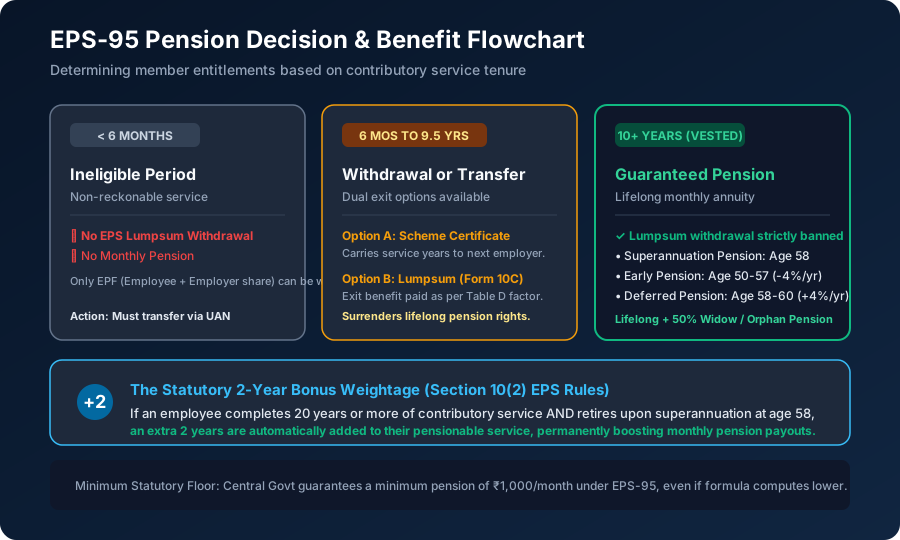
The regulatory framework establishes three distinct service categories:
Category 1: Service Less Than 6 Months
Under Paragraph 14, contributory service of less than 6 months is treated as non-reckonable. The member is ineligible for both pension and EPS cash withdrawal. When exiting the firm, only the EPF balance (employee + employer share) can be withdrawn or transferred to a new employer.
Category 2: Service Between 6 Months and 9.5 Years
If a member resigns and has accumulated between 6 months and 9.5 years of service, they have two mutually exclusive options:
- Option A: Obtain an EPS Scheme Certificate (Recommended): If the member plans to work for another EPFO-covered company, they should apply for a Scheme Certificate. This preserves service tenure and transfers credit to the new employer, helping the member cross the 10-year threshold.
- Option B: Lumpsum Withdrawal (Form 10C / Table D): If the member is permanently exiting the formal corporate workforce (or moving abroad), they can withdraw the accumulated EPS balance in cash using Table D factors based on completed service years. Note: Taking a Table D lumpsum resets your service tenure to zero.
Category 3: Service 9.5 Years or More (Vested Pension)
Once service reaches 9.5 years, it is automatically rounded to 10 years, and the member enters the Vested Pension Tier.
4. Superannuation, Early Pension (Age 50) & Deferred Pension (Age 60)
While the standard age of superannuation pension is 58 years, the scheme provides flexibility for members who retire early or wish to defer payouts:
A. Superannuation Pension (Age 58)
The standard pension commences automatically from the first day of the month following your 58th birthday, provided you have completed at least 10 years of service and have ceased employment.
B. Early Reduced Pension (Age 50 to 57)
If you retire early or become unemployed after completing 10 years of service, you can elect to start receiving your pension between the ages of 50 and 57.
However, early pension carries a severe financial haircut: under Paragraph 12(7), the pension amount is permanently reduced by 4% for every year that the commencement age falls short of 58:
- Retiring at Age 57: Reduced by 4% (You receive 96% of normal pension).
- Retiring at Age 55: Reduced by 12% (You receive 88% of normal pension).
- Retiring at Age 52: Reduced by 24% (You receive 76% of normal pension).
- Retiring at Age 50: Reduced by 32% (You receive only 68% of normal pension for life).
C. Deferred Enhanced Pension (Up to Age 60)
Conversely, if you complete 10 years of service and continue working past age 58, you can defer your pension commencement up to age 60. In this case, the EPFO enhances your monthly pension by 4% for every completed year of deferment past age 58:
- Starting at Age 59: Normal pension + 4% enhancement.
- Starting at Age 60: Normal pension + 8.16% enhancement.
5. Standard Wage Cap (₹15,000) vs Supreme Court Higher Pension
For over two decades, Indian corporate employees complained that despite earning substantial basic salaries (₹50,000 to ₹1,50,000 monthly), their EPS pension was restricted to meager amounts because of the statutory wage cap.
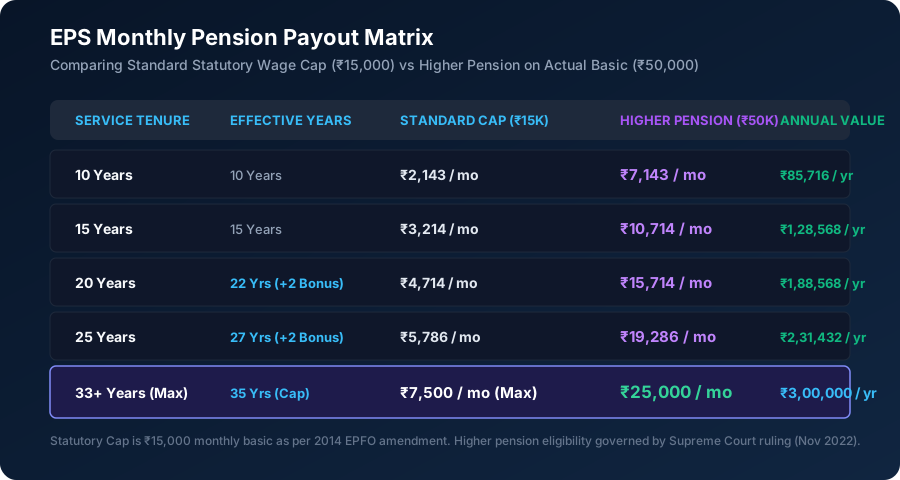
Under the standard statutory cap of ₹15,000, the maximum possible pension for an employee with 33 years of service (credited as 35 years with the 2-year bonus) is:
$$\text{Max Standard Pension} = \frac{35 \times ₹15,000}{70} = ₹7,500 \text{ per month}$$
The Supreme Court Higher Pension Breakthrough
In a landmark judgment delivered on November 4, 2022 (EPFO vs Sunil Kumar), the Supreme Court of India upheld the validity of the 2014 amendments while directing the EPFO to provide an option for eligible employees to contribute to EPS on their actual basic salary rather than the artificial ₹15,000 cap.
Under the higher pension option:
- The employer's 8.33% contribution is calculated on actual basic wages (e.g., ₹50,000).
- A past retrospective adjustment is made, transferring the difference between actual 8.33% and the capped ₹1,250 monthly remittance from the member's EPF account to the EPS pool with compounded interest.
- Upon retirement, the 60-month average basic wage reflects actual compensation, boosting monthly pensions from ₹7,500 to ₹25,000 or more for career corporate professionals.
6. Family, Widow & Orphan Survivor Pension Entitlements
EPS-95 is not merely a retirement plan; it is a comprehensive family life insurance and survivor security covenant. If an EPS member dies during active service, after leaving service with 10 years vesting, or after retirement while receiving pension, the scheme automatically triggers survivor benefits:
| Beneficiary Category | Statutory Quantum | Conditions & Durations |
|---|---|---|
| Widow / Widower Pension | 50% of Member's Calculated Pension | Paid for life or until remarriage (Statutory minimum ₹1,000/mo). |
| Children's Pension | 25% of Widow Pension per child | Payable to up to 2 children simultaneously until age 25. |
| Orphan Pension | 75% of Widow Pension per orphan | Triggered if both parents are deceased; payable up to age 25. |
| Nominee / Dependent Parents | Equivalent to Widow Pension | Paid to nominated dependent parents if member had no spouse/child. |
7. How to Claim Monthly Pension via Form 10D Online
Once you reach age 58 and exit active corporate employment, claiming your monthly pension is executed entirely online through the EPFO Unified Member Portal. Follow this verified submission protocol:
- Step 1: Verify Service History on UAN Portal: Log in to
unifiedportal-mem.epfindia.gov.in. Ensure that your Date of Exit (DOE) has been marked by your last employer in the "Service History" tab. - Step 2: Confirm Aadhaar, PAN & Bank KYC: Confirm that your Aadhaar is verified and linked, PAN is seeded, and your active bank savings account (with IFSC) is approved by the employer.
- Step 3: Navigate to Online Services > Claim (Form-31, 19, 10C & 10D): From the drop-down menu, select Form 10D (Monthly Pension Claim).
- Step 4: Enter Pension Particulars:
- Select your pension type: Superannuation (Age 58) or Early Pension (Age 50-57).
- Provide your communication address and upload a scanned copy of a cancelled cheque showing your name, account number, and IFSC.
- Enter details of your spouse and dependent children for family pension records.
- Step 5: E-Sign via Aadhaar OTP: Authenticate the claim using Aadhaar OTP. Once verified, the field EPFO office processes the application and issues a Pension Payment Order (PPO) within 20 working days.
Model Your Retirement Savings & EPF Corpus
Wondering how your EPF balance, VPF booster, and SIP investments compound alongside your monthly EPS pension? Use our 100% free financial calculators to map your golden years.
8. Frequently Asked Questions (FAQ)
What is the statutory monthly pension formula under EPS-95?
Under EPS-95, the monthly pension is calculated using the formula: Monthly Pension = (Pensionable Service × Pensionable Salary) ÷ 70. Pensionable Service is the total years of contributory service, and Pensionable Salary is the average monthly basic salary earned during the 60 months immediately preceding retirement.
What is the minimum service period required to receive an EPS monthly pension?
A member must complete a minimum of 10 years of eligible contributory service under EPS-95 to be eligible for a lifelong monthly pension. If service is less than 9.5 years (rounded down to under 10), the member can withdraw the accumulated corpus as a lumpsum via Form 10C (Table D).
Can an employee withdraw their EPS balance in cash if service exceeds 10 years?
No. Once a member completes 9.5 years or more of contributory service, lumpsum withdrawal via Form 10C is strictly prohibited by law. The member's pension is vested, and they are issued an EPS Scheme Certificate to carry forward their service to subsequent employers until they reach retirement age.
What is the statutory wage cap for pensionable salary under EPS-95?
The statutory wage ceiling is ₹15,000 per month (increased from ₹6,500 effective September 1, 2014). Therefore, under standard rules, even if an employee's actual basic salary is ₹1,00,000 per month, the maximum pensionable salary is capped at ₹15,000, limiting the maximum monthly pension to ₹7,500.
What is the 2-year bonus service rule under Section 10(2) of EPS-95?
Under Section 10(2) of the EPS-95 rules, if an employee completes 20 or more years of contributory service and superannuates upon attaining the age of 58 years, an additional 2 years are credited to their pensionable service as a bonus, significantly boosting their monthly pension.
Can I claim an early pension under EPS-95 before age 58?
Yes. A member who has completed 10 years of service can opt for an Early Reduced Pension starting from age 50 to 57. However, the pension amount is permanently reduced by 4% for every year that the pension commencement age falls short of 58 years (e.g., opting at age 50 causes a 32% permanent reduction).
What pension benefits do surviving family members receive if the EPS member passes away?
Upon the death of a member, the surviving spouse is entitled to a lifelong Widow/Widower Pension equal to 50% of the member's calculated monthly pension (subject to statutory minimums). Up to two dependent children also receive a Children's Pension equal to 25% of the widow pension each until attaining 25 years of age.
Is monthly pension received under EPS-95 taxable under the Income Tax Act?
Yes. Uncommuted monthly pension received from EPS is classified as salary income under Section 17(1)(ii) of the Income Tax Act and is taxed at normal slab rates. However, pensioners are entitled to claim the full standard deduction of ₹75,000 under the New Tax Regime or ₹50,000 under the Old Tax Regime.