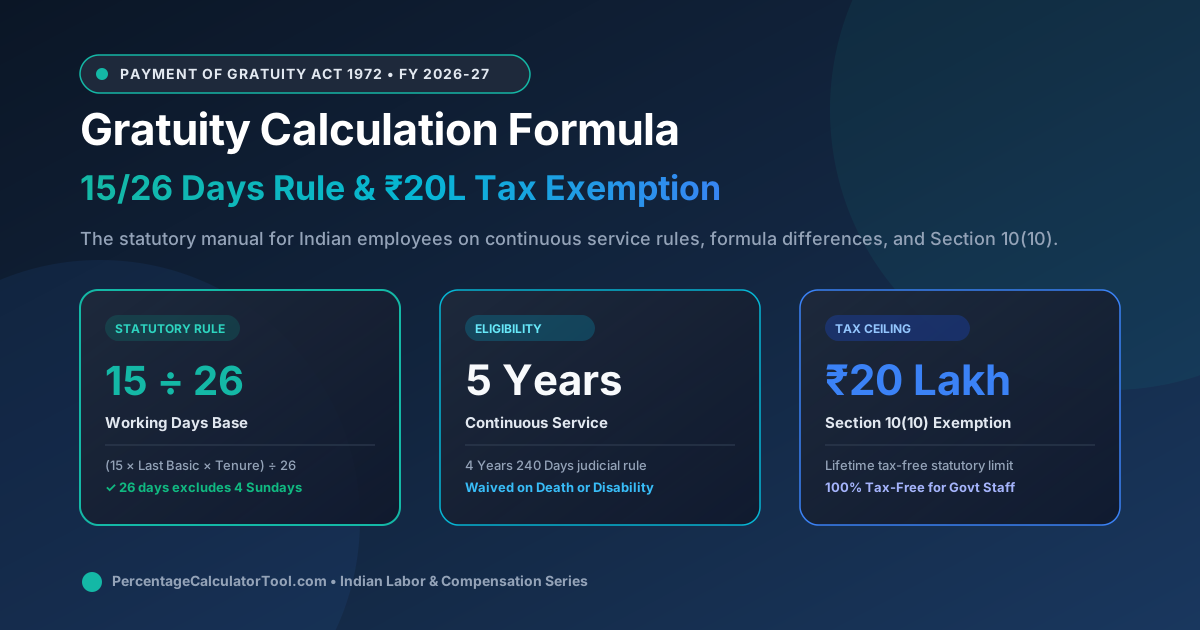
Gratuity Calculation Formula: 15/26 Days Rule & Tax Exemption (2026-27)
The exhaustive guide to statutory gratuity for Indian employees for FY 2026-27 (AY 2027-28). Unpack the 15/26 days formula, the landmark 4 years 240 days judicial vesting threshold, covered vs non-covered establishment differences, and the ₹20 Lakh tax exemption under Section 10(10).
Executive Summary: The Reward for Long-Term Loyalty
In the Indian corporate ecosystem, Gratuity is a statutory terminal monetary benefit paid by an employer to an employee as a token of gratitude for rendering long, continuous service. Codified under the Payment of Gratuity Act, 1972, this is not an elective company bonus or discretionary perk; it is a legally enforceable right that takes statutory precedence over company balance sheets, corporate bankruptcies, and executive employment agreements.
However, because gratuity is calculated only upon separation (resignation, retirement, superannuation, or retrenchment), employees frequently carry substantial misconceptions about their entitlements. Corporate offer letters list gratuity as an annual deduction inside CTC (typically 4.81% of basic salary), leading workers to believe they have a personal accumulated cash pot. In reality, gratuity is governed strictly by tenure formulas and statutory thresholds.
Key takeaways for Assessment Year 2027-28 (Financial Year 2026-27):
- The 15/26 Statutory Formula: For establishments covered under the Act, Gratuity =
(15 × Last Drawn Basic + DA × Tenure) ÷ 26. The divisor 26 represents working days in a month after excluding Sundays. - The 4 Years & 240 Days Rule: While Section 4(1) prescribes 5 years of continuous service, established judicial precedent (including Supreme Court interpretations of Section 2A) affirms that completing 4 years and 240 days (or 190 days in 5-day week IT firms) satisfies the 5-year eligibility criteria.
- The ₹20 Lakh Tax Shield (Section 10(10)): Gratuity received by private sector employees is 100% tax-free up to a lifetime statutory ceiling of ₹20,00,000. This exemption applies unconditionally under both the New and Old Tax Regimes.
- Waiver on Death or Disability: The 5-year vesting requirement is completely waived if employment terminates due to death or permanent disablement of the employee; full calculated gratuity is disbursed to legal nominees immediately.
- Employer Delay Penalty: Employers must disburse gratuity within 30 days of exit. Any failure to pay attracts mandatory simple interest at 10% per annum under Section 7(3A).
1. Legislative Mandate: Payment of Gratuity Act, 1972
The Payment of Gratuity Act, 1972, is a social security statute enacted to provide financial support to employees upon retirement, resignation, death, or disablement.
Under Section 1(3), the Act applies to:
- Every factory, mine, oilfield, plantation, port, and railway company.
- Every shop or commercial establishment within the meaning of any state shops and establishments law employing 10 or more persons on any day of the preceding twelve months.
Crucially, gratuity is payable directly by the employer from company revenue. Unlike EPF, where monthly deductions are deposited into an external government trust, gratuity liability is an employer balance-sheet provision. Companies may manage this internally or purchase a group gratuity insurance scheme through Life Insurance Corporation (LIC) or private insurers.
2. The 5-Year Milestone & The '4 Years 240 Days' Judicial Rule
Section 4(1) of the Act establishes that gratuity shall be payable to an employee on the termination of their employment after they have rendered continuous service for not less than five years:
- On their superannuation (retirement).
- On their retirement or voluntary resignation.
- On their death or disablement due to accident or disease.
The Proviso to Section 4(1): Immediate Vesting
The statute provides an absolute exception: "Provided that the completion of continuous service of five years shall not be necessary where the termination of the employment of any employee is due to death or disablement." In such tragic events, even if an employee worked for only 2 months, gratuity must be paid to their legal heirs or nominees based on service rendered.
The Landmark '4 Years and 240 Days' Judicial Interpretation
One of the most litigated questions in Indian corporate labor law is: "If an employee resigns after 4 years and 8 months, are they eligible for gratuity?"
Employers historically denied gratuity in such cases, citing a strict 5-year threshold. However, Indian constitutional courts resolved this debate by harmonizing Section 4(1) with Section 2A (Definition of Continuous Service):
- Under Section 2A(2)(a), an employee is deemed to be in continuous service for a period of one year if they have actually worked under the employer for at least 240 days in an establishment that works 6 days a week, or at least 190 days in an establishment that works 5 days a week (such as modern software and consulting MNCs).
- In Surendra Kumar Verma vs Central Government Industrial Tribunal and the landmark ruling of the Madras High Court in Mettur Beardsell Ltd., the judiciary held that completing 4 full calendar years plus 240 days of actual working attendance in the 5th year constitutes 5 years of continuous service.
Therefore, any employee who resigns after completing 4 years and 240 days (roughly 4 years and 8 months) in a 6-day week company, or 4 years and 190 days in a 5-day week company, is legally entitled to full statutory gratuity.
3. Covered vs Non-Covered Establishments: The Formula Split
The computational formula for gratuity depends entirely on whether your organization is covered under the Payment of Gratuity Act, 1972.
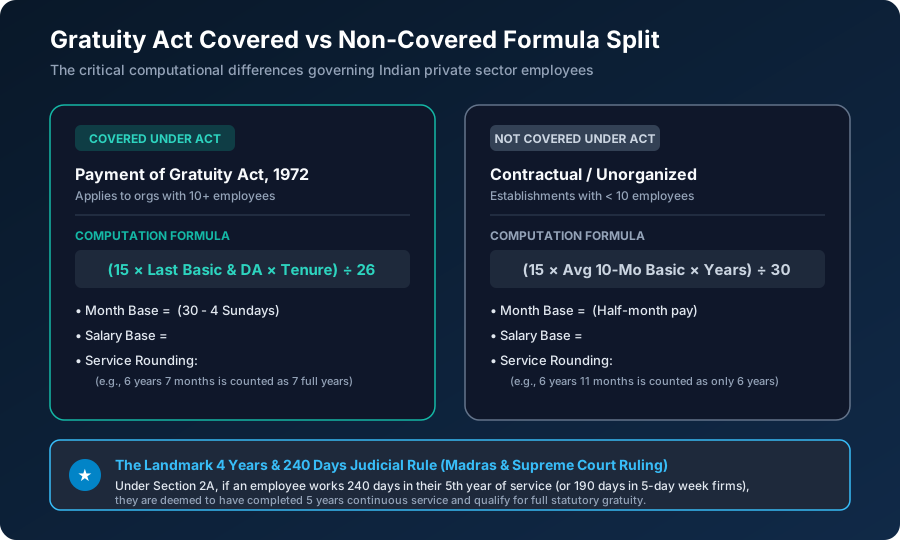
The table below illustrates the critical structural differences between both categories:
| Factor | Covered Under Gratuity Act, 1972 | NOT Covered Under Gratuity Act |
|---|---|---|
| Applicability | Organizations with 10 or more employees | Small firms / trusts with < 10 employees |
| Computational Formula | (15 × Last Basic & DA × Tenure) ÷ 26 | (15 × 10-Mo Average Basic & DA × Tenure) ÷ 30 |
| Month Divisor | 26 Working Days (Excludes 4 Sundays) | 30 Calendar Days (Effectively half month pay) |
| Salary Base | Last Drawn Basic Salary + Dearness Allowance | Average of Basic + DA of preceding 10 months |
| Service Tenure Rounding | > 6 months rounded UP to next year | Fractions ignored (Only completed years counted) |
| Example: 8 Yrs 7 Mos | Calculated as 9 full years | Calculated as 8 full years |
| Maximum Tax Exemption | ₹20,00,000 (Section 10(10)(ii)) | ₹20,00,000 (Section 10(10)(iii)) |
The 26-day divisor in the covered formula provides a substantial financial advantage: because you divide by 26 rather than 30, each single day's wage is valued higher, producing approximately 15.4% more gratuity than the non-covered formula for the exact same salary and tenure.
4. Gratuity Payout Matrix & Step-by-Step Numerical Case Studies
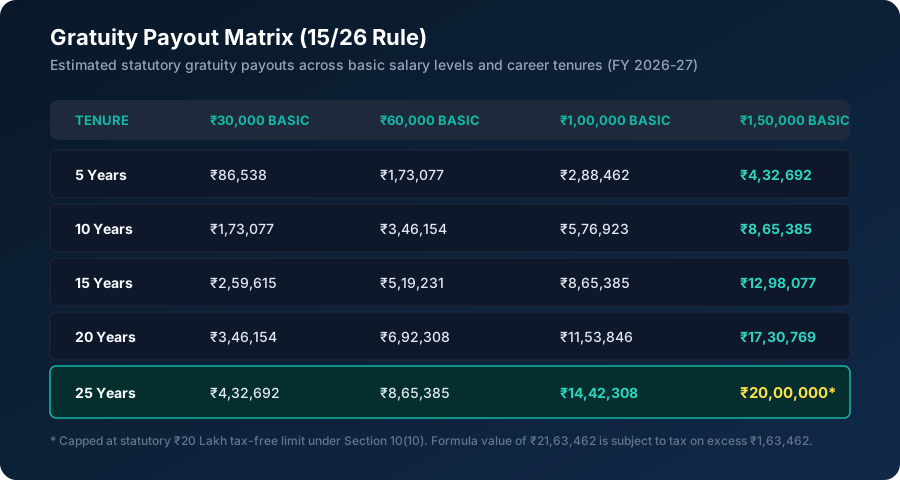
To understand how gratuity scales across a career, inspect the payout matrix below, computed under the standard 15/26 formula:
Case Study 1: Mid-Career Tech Lead (Kavita Sharma)
- Total Service Tenure: 7 years and 8 months.
- Last Drawn Basic Salary: ₹78,000 per month (No DA).
- Establishment Status: Covered under Gratuity Act (IT firm with 500+ employees).
Step 1: Round the Tenure: Because the fractional tenure (8 months) exceeds 6 months, Kavita's tenure is rounded up to 8 completed years.
Step 2: Apply the 15/26 Formula:
$$\text{Gratuity} = \frac{15 \times ₹78,000 \times 8}{26} = \frac{₹93,60,000}{26} = ₹3,60,000$$
Kavita receives a gross gratuity payout of ₹3,60,000. Because this is well below the ₹20 Lakh statutory ceiling, the entire ₹3.6 Lakhs is 100% tax-free.
Case Study 2: Senior Vice President (Ramesh Nambiar)
- Total Service Tenure: 24 years and 2 months.
- Last Drawn Basic Salary: ₹1,80,000 per month.
- Establishment Status: Covered under Gratuity Act.
Step 1: Round the Tenure: Because the fraction (2 months) is under 6 months, it is ignored. Tenure is taken as 24 completed years.
Step 2: Compute Formula Value:
$$\text{Formula Gratuity} = \frac{15 \times ₹1,80,000 \times 24}{26} = \frac{₹6,48,00,000}{26} = ₹24,92,308$$
Step 3: Apply Section 10(10) Tax Exemption:
- Actual Formula Gratuity = ₹24,92,308.
- Statutory Tax-Free Limit = ₹20,00,000.
- Taxable Gratuity Component = ₹24,92,308 - ₹20,00,000 = ₹4,92,308.
Ramesh receives ₹24,92,308. Of this, ₹20 Lakhs is completely tax-free, and the remaining ₹4,92,308 is added to his taxable salary in the year of receipt and taxed at normal slab rates. Ramesh can also seek relief under Section 89 using Form 10E to spread the tax burden across past financial years.
5. Section 10(10) Tax Exemption Mechanics (New vs Old Regime)
Taxation of gratuity is governed by Section 10(10) of the Income Tax Act, 1961. The exemption rules are structured across three categories:
- Government Employees (Section 10(10)(i)): Any gratuity received by central, state, or local defense personnel is 100% exempt from income tax with zero upper monetary ceiling.
- Private Employees Covered under Gratuity Act (Section 10(10)(ii)): The tax exemption is the least of the following three statutory amounts:
- Actual gratuity received from the employer.
- The statutory formula amount:
(15 × Last Basic × Tenure) ÷ 26. - The maximum statutory ceiling of ₹20,00,000 (₹20 Lakhs).
- Private Employees NOT Covered under Gratuity Act (Section 10(10)(iii)): The tax exemption is the least of:
- Actual gratuity received.
- Half month's average salary for each completed year:
(15 × 10-Mo Avg Basic × Tenure) ÷ 30. - The statutory ceiling of ₹20,00,000.
6. Gratuity Inside CTC: The 4.81% Payroll Accounting Mystery
Open your corporate salary offer letter, and you will almost certainly find a line item under employer contributions titled "Gratuity: ₹XX,XXX per year".
How do HR departments derive this exact figure?
$$\text{Annual Gratuity Percentage} = \frac{15 \text{ days}}{26 \text{ working days}} \times \frac{1}{12 \text{ months}} \approx 4.8077\% \text{ of Basic Salary}$$
Corporates multiply your monthly basic salary by 4.81% to represent their accrued annual liability. For example, if your Basic Salary is ₹10,00,000 per year, your employer lists ₹48,100 per year under the gratuity component of your CTC.
7. Lawful Grounds for Gratuity Forfeiture (Section 4(6))
A frequent anxiety among resigning employees is whether an angry employer can withhold or forfeit their gratuity due to unserved notice periods or employment disputes.
The statutory answer is that employers cannot withhold gratuity for ordinary commercial or notice period disputes. Under Section 4(6) of the Act, gratuity can be forfeited only under two strict, exhaustive conditions:
- Damage to Employer's Property (Section 4(6)(a)): If an employee's service has been terminated for any act, willful omission, or negligence causing damage, loss, or destruction of property belonging to the employer, gratuity can be forfeited only to the extent of the damage caused (proven through departmental enquiry).
- Riotous Conduct or Moral Turpitude (Section 4(6)(b)): Gratuity can be forfeited wholly or partially only if the employee has been terminated for:
- Riotous or disorderly conduct or any other act of violence.
- Any act which constitutes an offense involving moral turpitude, provided that such offense is committed by him in the course of his employment.
In repeated judgments (such as Jaswant Singh Gill vs Bharat Coking Coal Ltd), the Supreme Court ruled that unless an employee is formally terminated through disciplinary proceedings on grounds of moral turpitude or willful property destruction, an employer has zero authority to forfeit gratuity.
8. How to Claim Gratuity: Form I, Form L & Controlling Authority Recourse
To ensure timely disbursement of your gratuity upon resignation or retirement, execute this statutory procedure:
- Step 1: Submit Form I to Employer: Under Rule 7(1) of the Payment of Gratuity Rules, an eligible employee must submit an application in Form I to their employer within 30 days of leaving employment, specifying their tenure, last basic salary, and bank details.
- Step 2: Employer Verification (Form L): Under Rule 8, within 15 days of receiving Form I, the employer must verify the calculation and issue a formal notice in Form L specifying the exact gratuity amount and the date of payment.
- Step 3: 30-Day Mandatory Disbursement: The employer is statutorily mandated to disburse the gratuity into the employee's bank account within 30 days from the last working day.
- Step 4: Legal Redressal via Form N (Controlling Authority): If your employer refuses to pay, delays beyond 30 days, or under-calculates the payout:
- Submit an application in Form N to the Controlling Authority under the Payment of Gratuity Act (typically the Regional Labor Commissioner).
- The Controlling Authority will issue a summon to the employer. Under Section 7(3A), the Authority will direct the employer to pay the principal gratuity plus 10% simple annual interest for every day of delay.
Calculate Your Exact Gratuity & Take-Home Pay
Wondering exactly how much gratuity you have accumulated at your current firm? Use our client-side calculators to compute your statutory payout and model your in-hand salary.
9. Frequently Asked Questions (FAQ)
What is the statutory gratuity calculation formula under the Payment of Gratuity Act?
For employees covered under the Payment of Gratuity Act 1972, the formula is: Gratuity = (15 × Last Drawn Basic Salary & DA × Completed Years of Service) ÷ 26. The number 26 represents the working days in a month (30 days minus 4 Sundays).
What is the 4 years and 240 days rule for gratuity eligibility?
Under Section 2A of the Act as interpreted by the Supreme Court and Madras High Court, an employee is deemed to have completed continuous service of one year if they work for at least 240 days in a 6-day workweek (or 190 days in a 5-day workweek). Therefore, completing 4 years and 240 days satisfies the statutory 5-year requirement for gratuity.
What is the maximum tax-free gratuity limit under Section 10(10)?
For private-sector employees (both covered and non-covered), the maximum lifetime tax-exempt gratuity under Section 10(10) is ₹20,00,000 (₹20 Lakhs). For central, state, and defense government employees, gratuity is 100% tax-free without any monetary ceiling.
Is gratuity exempt under the New Tax Regime (Section 115BAC)?
Yes. Statutory gratuity exemption under Section 10(10) is 100% available under BOTH the New Tax Regime and Old Tax Regime up to the statutory ceiling of ₹20 Lakhs. It is not eliminated by Section 115BAC.
Is gratuity payable if an employee leaves before completing 5 years?
Generally no. If an employee resigns voluntarily before completing 5 years (or 4 years and 240 days), they forfeit gratuity. However, under Section 4(1), the 5-year requirement is completely waived if employment terminates due to death or permanent total disablement of the employee.
How is service tenure rounded off when computing gratuity?
For employees covered under the Act, any service fraction exceeding 6 months is rounded up to the next full year. For example, a tenure of 7 years and 7 months is calculated as 8 years. For employees not covered under the Act, only full completed years are counted and fractions are ignored.
Why do employers deduct 4.81% in CTC for gratuity?
Employers include gratuity in annual CTC structures at 4.81% of basic salary. This is derived from the formula: (15 days ÷ 26 days) ÷ 12 months = 4.807%. If the employee resigns before 5 years, the company retains this accumulated internal accounting reserve.
What is the time limit for an employer to pay gratuity after resignation?
Under Section 7(3), the employer must determine and pay the gratuity amount within 30 days from the date it becomes payable. If payment is delayed beyond 30 days without valid government-approved reasons, the employer must pay simple interest (typically 10% p.a.) under Section 7(3A).