HUF Partition Rules: Total vs Partial Partition Direct Tax Guide (FY 2026-27)
1. Concept of Partition Under Hindu Personal Law vs. Income Tax Law
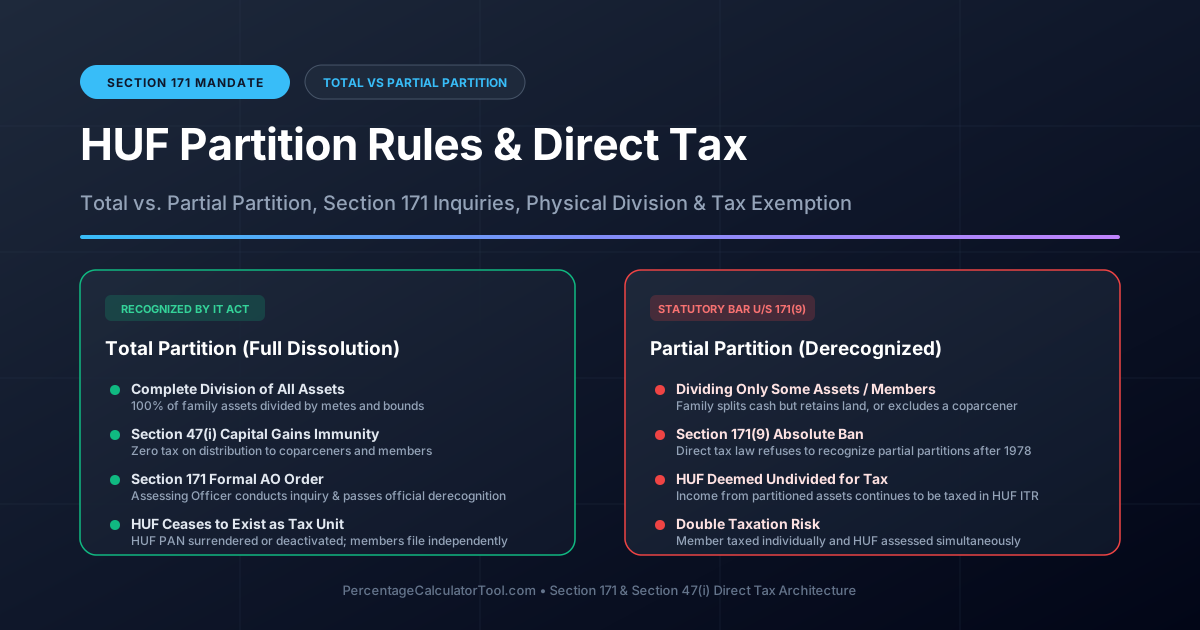
In traditional Hindu jurisprudence governed by the Mitakshara School, a Partition signifies the disruption or severance of the joint family status among coparceners. Under civil personal law, an intention to separate unequivocally declared by any single coparcener—whether oral or written—is legally sufficient to effect a severance in status. The coparcener immediately ceases to hold an undivided, fluctuating interest and becomes an owner of a defined, ascertainable share.
However, Indian direct tax law adopts a fundamentally stricter, statutory stance. Under Section 171(1) of the Income-tax Act, 1961, an HUF that has been assessed to income tax as an undivided family shall be deemed for the purposes of this Act to continue to be a Hindu Undivided Family, except where and in so far as a finding of partition has been formally recorded under this section by the Assessing Officer (AO).
In short: A family may be completely partitioned under civil Hindu law, but until an official statutory inquiry is conducted and a formal written order is passed by the jurisdictional Assessing Officer under Section 171, the Income Tax Department will continue assessing the HUF as an existing undivided taxable unit!
2. Total vs. Partial Partition: The Crucial Statutory Dichotomy
To successfully navigate HUF dissolution, one must understand the stark divergence between a Total Partition and a Partial Partition under direct tax statutes.
1. Total Partition (Full Dissolution)
A Total Partition represents the complete and final winding-up of the HUF entity. It occurs when:
- All coparceners sever their joint family ties and separate simultaneously, and
- 100% of all assets belonging to the HUF (including all land, commercial buildings, bank accounts, Demat securities, vehicles, and business assets) are physically divided among all coparceners and members.
A total partition is fully recognized by Section 171(1). Once verified and approved by the Assessing Officer, the HUF ceases to exist as a separate taxable unit, its PAN is closed or deactivated, and the income from the distributed assets is taxed strictly in the individual returns of the respective recipients.
2. Partial Partition (The Statutory Ban Under Section 171(9))
A Partial Partition occurs in two distinct scenarios under civil law:
- Partial as to Assets: The family divides certain specific assets (for example, fixed deposits and mutual funds) while keeping other assets (like ancestral farmland or the family business) joint.
- Partial as to Members: One or two coparceners take their shares and leave the family, while the remaining members continue to hold the rest of the estate in an undivided HUF status.
Section 171(9): The Absolute Prohibition on Partial Partitions
Prior to 1978, affluent business families extensively utilized partial partitions: they created multiple satellite HUFs or transferred profitable business divisions to individual members while keeping nominal properties in the parent HUF. To eradicate this practice, Parliament enacted Section 171(9) through the Finance (No. 2) Act, 1980 with retrospective effect from January 1, 1979.
Section 171(9) states in unequivocal terms that no claim of partial partition effected after December 31, 1978 shall be inquired into or recognized by the Assessing Officer. If a family executes a partial partition today, direct tax law simply ignores it: the entire income arising from the partitioned assets continues to be assessed and taxed in the hands of the HUF entity as if no partition ever took place!
This creates a dangerous double-tax trap: the separated member includes the income in their personal return, while the Assessing Officer issues an assessment order adding that exact same income back into the HUF's return, resulting in dual taxation, interest under Sections 234B/234C, and prolonged litigation.
3. Section 171 Deconstruction: Assessment of HUF After Partition
Section 171 sets out the mandatory procedural jurisprudence for dissolving an HUF for income tax purposes:
| Statutory Sub-Section | Legal Mandate & Procedural Requirement | Practical Operational Impact |
|---|---|---|
| Section 171(1) | Presumption of Continued Joint Status | HUF remains taxable until an order under Section 171 is passed. Mere verbal partition is disregarded. |
| Section 171(2) | Claim of Partition by Coparceners | Karta or coparceners must formally submit a written claim of total partition during assessment proceedings. |
| Section 171(3) | Mandatory Statutory Inquiry | Assessing Officer MUST issue written notices to all coparceners and members (including married daughters and wife). |
| Section 171(4) | Recording of Order | AO records a formal written finding stating that a total partition has taken place and specifies the date of partition. |
| Section 171(6) | Joint & Several Tax Liability | Members remain jointly and severally liable for past unpaid HUF tax arrears, capped at their allocated share. |
| Section 171(9) | Derecognition of Partial Partition | Any partition that is partial as to assets or members is statutorily void for income tax purposes. |
Failure to follow the Section 171 claim procedure is fatal. Even if the family has registered a Partition Deed with the Sub-Registrar, if no Section 171 claim is preferred before the Assessing Officer, the AO will continue issuing reassessment notices and demand notices under Section 148 to the HUF PAN.
4. The "Metes and Bounds" Physical Division Doctrine: Supreme Court Mandate
One of the most litigated principles in Indian estate taxation is the physical division doctrine, commonly known in legal language as division by "Metes and Bounds".
The Landmark Ruling: Kalloomal Tapeswari Prasad (HUF) v. CIT
In the foundational judgment of Kalloomal Tapeswari Prasad (HUF) v. CIT (1982) 133 ITR 690 (SC), the Supreme Court of India interpreted the Explanation to Section 171, which defines partition as:
"(a) Where the property admits of a physical division, a physical division of the property, but a physical division of the property without a severance in status will not be considered a partition; or
(b) Where the property does not admit of a physical division, then such division as the property admits of, but a mere severance in status will not be considered a partition."
The Supreme Court authoritatively established that under the Income-tax Act, a mere division of legal title or book entries in financial accounts does NOT constitute a partition:
- Immovable Properties (Land & Houses): If an HUF owns land or residential apartments, they must be physically partitioned by demarcating boundaries, executing registered deeds of partition with distinct plot/flat numbers, or selling the property and physically dividing the liquid sale proceeds into the separate bank accounts of each member.
- Financial Assets (Shares & FDs): Fixed deposits must be broken and transferred into the individual PAN bank accounts of members. Demat securities must be transferred from the HUF Demat folio into the individual Demat accounts of the respective coparceners.
- Indivisible Assets (Running Business): Where an asset cannot be physically split without destroying its commercial value (such as a running factory or partnership business interest), the partition is valid if the members physically divide the underlying capital, allocate defined shares in the profits, and execute a new partnership deed among the separating members.
5. Capital Gains Immunity: Section 47(i) & Section 49(1) Cost Basis
The single greatest statutory advantage of partitioning an HUF is the complete exemption from capital gains tax provided under Chapter IV-E of the Income-tax Act, 1961.
The Blanket Protection of Section 47(i)
Under Section 45, any transfer of a capital asset attracts capital gains tax. However, Section 47(i) explicitly excludes family partitions from the definition of transfer:
"Section 47: Nothing contained in Section 45 shall apply to the following transfers: (i) any distribution of capital assets on the total or partial partition of a Hindu Undivided Family."
This means that when an HUF holding ancestral agricultural land, high-value commercial properties, or appreciated equity portfolios valued at ₹20 Crores distributes those properties among the Karta, his wife, sons, and daughters, zero capital gains tax is payable by the HUF and zero tax is payable by the receiving members. The transaction is completely neutral at the point of distribution.
Subsequent Sale: Section 49(1) Cost & Holding Period Step-Up
When a coparcener or daughter eventually sells the property received on partition to an outside buyer, how are capital gains computed? Under Section 49(1)(i):
- Cost of Acquisition: The cost of acquisition in the hands of the member is deemed to be the cost for which the HUF originally acquired the asset. If the HUF acquired the asset prior to April 1, 2001, the member can substitute the Fair Market Value (FMV) as on April 1, 2001 (capped at the stamp duty circle rate).
- Holding Period: Under Section 2(42A), the period of holding includes the entire duration for which the HUF held the asset prior to partition. Therefore, even if the member sells the property one month after partition, the gain is classified as Long-Term Capital Gain (LTCG) taxed at the favorable 12.5% rate under current FY 2026-27 rules.
6. Step-by-Step Partition Execution Roadmap: Deed Drafting & AO Claim
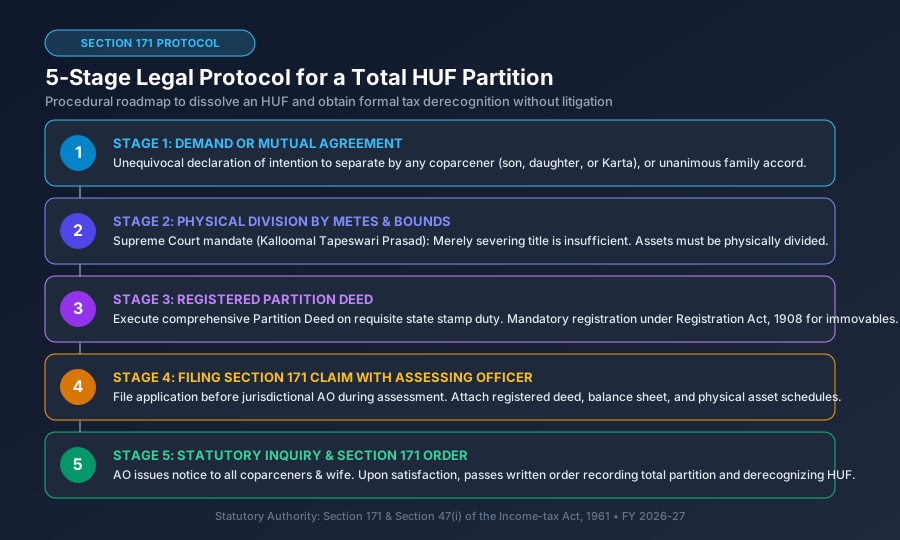
To ensure that an HUF total partition withstands scrutiny and obtains a clean Section 171 assessment order, follow this comprehensive operational checklist:
Step 1: Unanimous Partition Agreement & Metes/Bounds Plan
Convene a formal meeting of all adult coparceners (Karta, sons, daughters) and members (wife). Value all family properties (movable, immovable, cash, and securities) at current fair market value. Prepare an equitable allocation schedule ensuring equal shares for all coparceners and the wife.
Step 2: Execute a Comprehensive Partition Deed
Draft a formal Deed of Total Partition on non-judicial stamp paper. State stamp duty laws vary widely:
- Maharashtra: Nominal stamp duty applies if partition is among family members (Article 46 of Maharashtra Stamp Act).
- Delhi & Haryana: Stamp duty ranges from 1% to 2% on the market value of the separated shares.
- Karnataka & Tamil Nadu: Fixed nominal stamp duty applies for family partition deeds.
Under Section 17 of the Registration Act, 1908, registration is mandatory whenever immovable properties (land, houses, commercial units) are partitioned.
Step 3: Physical Transfer of Bank Balances & Securities
Execute off-market Demat transfers (via DIS slips or CDSL easi/NSDL SPEED-e) moving share units from the HUF Demat folio into the individual Demat accounts of members under the reason code "Partition of HUF". Disburse bank fixed deposits and close HUF bank accounts.
Step 4: Formal Application Under Section 171 to the AO
During the ongoing assessment year, submit an application under Section 171 to the jurisdictional Income Tax Officer (ITO) accompanied by:
- Certified copy of the Registered Partition Deed,
- Final audited Balance Sheet of the HUF showing zero remaining assets,
- Bank statement showing closure of all accounts and disbursement of funds,
- Affidavits of consent signed by all coparceners and members confirming physical receipt of their respective shares.
Step 5: Obtain Written Order Under Section 171(4)
The AO issues notices under Section 171(3) to all members. Upon being satisfied that 100% of the properties have been physically divided, the AO passes an official written order under Section 171(4) recognizing the total partition. The HUF PAN is then marked for deactivation.
7. Execution Roadmap Infographic: 5-Stage Protocol
The following visual workflow illustrates the sequential stages required to dissolve an HUF and obtain formal tax derecognition:
8. Statutory Comparison Matrix: Total vs. Partial Partition
The following analytical matrix summarizes the stark statutory differences between total and partial partitions under the Income-tax Act, 1961 for FY 2026-27 (AY 2027-28):
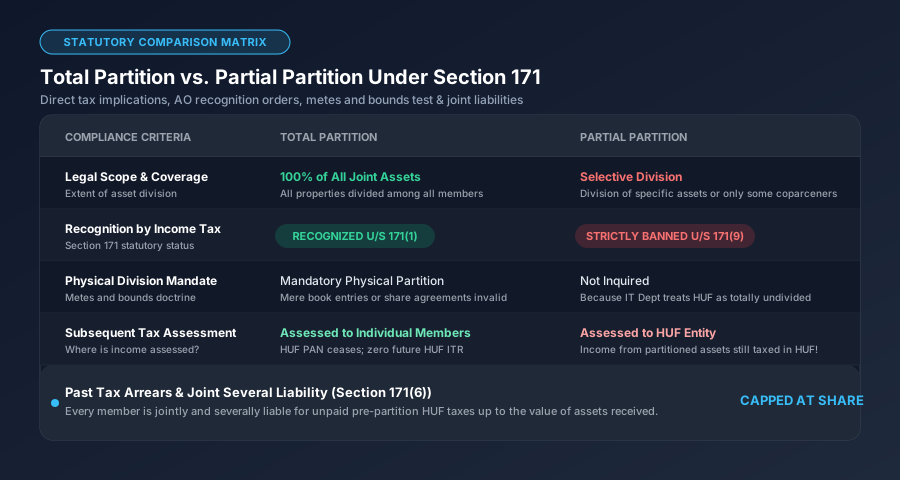
| Compliance Feature | Total Partition (Section 171(1)) | Partial Partition (Section 171(9)) |
|---|---|---|
| Asset Coverage | 100% of All Joint Assets | Selective Assets / Some Coparceners |
| Income Tax Recognition | Recognized (AO passes Sec 171 order) | BANNED U/S 171(9) (Treated as nullity) |
| Physical Division Test | Mandatory physical division by metes and bounds. | Disregarded (HUF treated as totally undivided). |
| Capital Gains Tax (Sec 47(i)) | 100% Tax-Free upon distribution. | 100% Tax-Free under general transfer law. |
| Future ITR Filing | HUF ceases; members file individual ITRs. | HUF MUST continue filing ITR on all partitioned assets! |
| Tax Risk Profile | Zero litigation risk if procedure is followed. | High risk of double taxation and Section 148 notices. |
9. Joint & Several Tax Liability Post-Partition (Section 171(6))
A frequent question asked by coparceners is: "Once the HUF is dissolved and its PAN is deactivated, can the Income Tax Department pursue me for past unpaid taxes or undisclosed income of the HUF?"
The Clawback of Section 171(6)
Under Section 171(6), every person who was a member of the HUF at the time of partition remains jointly and severally liable for any tax, interest, or penalty assessed on the HUF for periods prior to partition. The Assessing Officer can proceed against any separating member to recover the outstanding government dues.
Statutory Protection: Liability Capped at Asset Value
Importantly, Section 171(6) contains a critical statutory safeguard for coparceners and daughters:
The personal liability of any member for past HUF tax debts is strictly limited to the fair market value of the assets received by that member on partition.
If a daughter receives ₹1 Crore worth of shares on partition, and the Income Tax Department subsequently unearths a ₹5 Crore tax demand against the parent HUF, the tax recovery officer cannot seize her personal salary or self-acquired home. Her liability is legally capped at the ₹1 Crore she received from the family estate.
Simulate Your Capital Gains & Tax Obligations
Calculate long-term capital gains tax on post-partition property sales, evaluate surcharge thresholds, and model family income distributions with our free financial tools.
10. Frequently Asked Questions (FAQ)
What is the legal difference between a Total Partition and a Partial Partition of an HUF?
A Total Partition occurs when all coparceners sever their joint family status and 100% of the joint family's movable and immovable properties are completely divided by metes and bounds among all coparceners and members. A Partial Partition occurs when either: (1) only a portion of the family properties is divided while the rest remains joint, or (2) only one or more coparceners separate from the family while the remaining members continue to stay undivided.
Does the Income Tax Department recognize Partial Partitions?
No. Under Section 171(9) of the Income-tax Act, 1961, partial partitions effected after December 31, 1978 are statutorily derecognized for tax purposes. Even if a partial partition is perfectly valid under civil Hindu personal law, the Income Tax Department treats the HUF as entirely undivided. Any income arising from the partitioned assets continues to be assessed and taxed in the hands of the HUF entity, leading to potential double-taxation disputes.
Is capital gains tax payable when assets are distributed upon an HUF partition?
No. Under Section 47(i) of the Income-tax Act, 1961, any distribution of capital assets (real estate, listed equities, mutual fund units, gold) on the total or partial partition of a Hindu Undivided Family is explicitly excluded from the definition of "transfer". Therefore, no capital gains tax is payable by the HUF or the receiving members upon partition.
What is the "Metes and Bounds" physical division test established by the Supreme Court?
In Kalloomal Tapeswari Prasad (HUF) v. CIT, the Supreme Court of India ruled that a mere severance of legal title or book entries in accounting ledgers does not satisfy Section 171. If an asset is capable of physical division (such as land, buildings, or liquid bank accounts), it must be physically divided by metes and bounds. If an asset cannot be physically broken (like a functioning business firm), members must enjoy distinct, separate shares in the profits and management.
Are members personally liable for unpaid tax debts of an HUF after it is partitioned?
Yes. Under Section 171(6) of the Income-tax Act, every person who was a member of the HUF at the time of partition is jointly and severally liable for any tax, interest, or penalty assessed on the family for periods prior to partition. However, the recovery liability of each individual member is statutorily capped at the fair market value of the assets received by them on partition.