HUF Creation, PAN Card & Tax Benefits: Step-by-Step Guide (FY 2026-27)
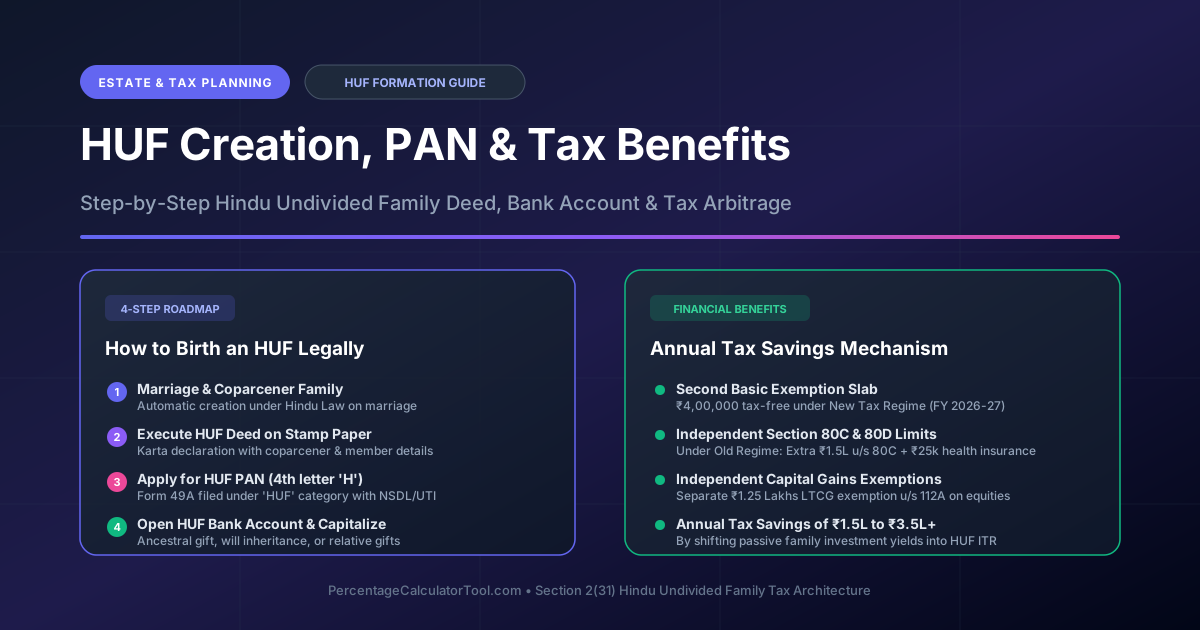
1. Statutory Foundation: What is an HUF Under Indian Law?
A Hindu Undivided Family (HUF) is a unique, time-honored legal institution recognized under both ancient Hindu customary law and modern Indian statutory law. Unlike a company, partnership firm, or limited liability partnership (LLP), an HUF cannot be created by a commercial contract; it is a legal entity that arises automatically by operation of law when a family comes into existence.
Under Section 2(31) of the Income-tax Act, 1961, the term "person" includes:
- An individual,
- A Hindu Undivided Family (HUF),
- A company,
- A firm,
- An association of persons or a body of individuals,
- A local authority, and
- Every artificial juridical person.
Because an HUF is recognized as an independent taxable unit separate from the individuals who compose it, an HUF is assessed to income tax under its own Permanent Account Number (PAN), files its own independent Income Tax Return (ITR-2 or ITR-3), and is entitled to its own distinct basic tax exemption slabs and statutory deductions. This dual-entity reality forms the cornerstone of legitimate family estate planning and income splitting in India.
Who Can Form an HUF?
The right to form an HUF is available to all persons governed by Hindu personal law across India (except the state of Kerala, which abolished the joint family system through the Kerala Joint Hindu Family System (Abolition) Act, 1975). Under the Hindu Succession Act, 1956, this includes:
- Hindus by religion,
- Buddhists,
- Jains, and
- Sikhs.
Muslims, Christians, Parsis, and Jews cannot form an HUF, as their personal laws do not recognize joint family property concepts.
2. Organizational Structure: Karta, Coparceners & Members
An HUF consists of a defined hierarchy governed by personal law principles. It is crucial to distinguish between the three distinct roles within the family structure:
1. The Karta (Family Patriarch / Head)
The Karta is the manager or executive head of the family. Traditionally, the senior-most male coparcener functions as the Karta. The Karta possesses wide administrative and managerial powers: he can manage family assets, enter into contracts, operate bank accounts, make investments, and represent the family before judicial and tax authorities. Following the landmark Delhi High Court judgment in Mrs. Sujata Sharma v. Shri Manu Gupta (2015), an eldest female coparcener (such as an eldest daughter) is also legally competent to act as the Karta of an HUF.
2. Coparceners (Owners by Birth)
A coparcener is a family member who acquires an undivided, vested legal right in the ancestral and joint properties of the HUF immediately upon birth. Crucially, a coparcener has the absolute legal right to demand a partition of the family assets at any time. Coparcenership extends up to four generations from the common ancestor:
- The common ancestor (Karta),
- Sons and Daughters (1st generation descendants),
- Grandsons and Granddaughters (2nd generation descendants), and
- Great-grandsons and Great-granddaughters (3rd generation descendants).
The Historic Hindu Succession (Amendment) Act, 2005
Prior to September 9, 2005, only male lineage members were recognized as coparceners. However, Section 6 of the Hindu Succession Act was amended in 2005 to grant daughters identical coparcenary rights by birth as sons. In the historic ruling of Vineeta Sharma v. Rakesh Sharma (2020), the Supreme Court confirmed that a daughter becomes a coparcener by birth with equal rights and liabilities as a son, even if her father was not alive on the date of the 2005 amendment. Furthermore, a daughter continues to remain a coparcener in her father's HUF even after her marriage!
3. Members (Wives / Spouses)
A "Member" is someone who belongs to the joint family but is not a coparcener. The classic example is a wife who enters the family upon marriage. A wife is a full member of her husband's HUF. She is entitled to maintenance from the family corpus and is legally entitled to an equal share whenever a partition of the HUF occurs. However, because she does not acquire her interest by birth, a wife cannot independently demand or initiate a partition of the HUF.
Can a Newly Married Couple with No Children Form an HUF?
A widespread misconception is that an HUF requires children before it can come into legal being. This was authoritatively settled by the Supreme Court of India in Gowli Buddanna v. CIT (1966) 60 ITR 293. The Supreme Court ruled that a joint Hindu family consists of all persons lineally descended from a common ancestor, and includes their wives and unmarried daughters. Therefore, the moment a Hindu male marries, an HUF comes into existence between husband and wife. The husband becomes the Karta, and the wife becomes a Member. You do not need to wait for the birth of a child to execute an HUF deed, apply for a PAN card, or open an HUF bank account.
3. Step-by-Step HUF Creation Process & Deed Drafting Format
Although an HUF is created automatically by operation of personal law upon marriage, third-party institutions (such as the Income Tax Department, scheduled commercial banks, and registrar authorities) require documentary proof of its existence. Creating the documentary paper trail involves executing a formal HUF Declaration Deed.
Step 1: Execute the HUF Declaration Deed
The Karta executes a written declaration on non-judicial stamp paper (typically ₹100 or ₹200, depending on the state Stamp Act, such as Maharashtra, Delhi, Karnataka, or Uttar Pradesh). The deed records the creation of the HUF, identifies the Karta, and lists all living coparceners and members with their dates of birth, PAN numbers, and relationships.
Standard HUF Declaration Deed Legal Draft (Verifiable Format)
DECLARATION OF HINDU UNDIVIDED FAMILY
I, [Name of Karta], Son of [Father's Name], residing at [Residential Address], do hereby solemnly declare and state as follows:
- That I am the Karta of the Hindu Undivided Family known as [Name of Karta] HUF.
- That the said HUF came into existence on [Date of Marriage] upon my marriage with Smt. [Wife's Name] under Hindu personal law.
- That the present constitution of the said HUF is as under:
- Shri [Name of Karta] — Karta / Adult Coparcener (DOB: DD/MM/YYYY)
- Smt. [Name of Wife] — Member / Wife (DOB: DD/MM/YYYY)
- Master/Kumari [Child Name] — Coparcener / Son or Daughter (DOB: DD/MM/YYYY)
- That the capital of the said HUF has been initialized with a sum of ₹[Initial Capital, e.g., ₹25,000] gifted/received by the family as ancestral corpus / gift from [Name of Relative / Will].
- That I, as Karta, am fully authorized to operate bank accounts, invest in shares, mutual funds, real estate, and execute all statutory documents for and on behalf of the said HUF.
Declared at [City] on this [Day] day of [Month], 2026.
Signature: ______________________ (Karta, for and on behalf of [Name] HUF)
Once printed on stamp paper and signed by the Karta and adult coparceners, the deed should be notarized by an authorized Notary Public. While registration with the Sub-Registrar is not mandatory for movable assets or cash capital, notarization satisfies all bank and Income Tax Department KYC mandates.
4. Obtaining an HUF PAN Card: Form 49A Protocol & NSDL Procedure
Just as an individual cannot transact or file an ITR without a personal PAN, an HUF must possess its own unique Permanent Account Number. The PAN card for an HUF is issued under the status of 'HUF', which can be verified by the fourth letter of the PAN string:
- Individual PAN: 4th letter is 'P' (e.g., ABCPE1234F)
- Company PAN: 4th letter is 'C' (e.g., ABCCE1234F)
- HUF PAN: 4th letter is strictly 'H' (e.g., ABCHE1234F)
Application Steps via NSDL (Protean) or UTIITSL
- Navigate to the official Protean (formerly NSDL) PAN portal or UTIITSL portal and select Form 49A (Application for New PAN).
- Under Application Type, select "Individual / HUF / Company".
- Under Category of Applicant, select "HINDU UNDIVIDED FAMILY".
- Name of HUF: In the Last Name / Surname field, enter the full official name of the HUF, for example: "RAJESH SHARMA HUF". (Leave the First Name and Middle Name fields completely blank).
- Date of Incorporation: Enter the date of marriage or the date the HUF was formally initialized in the declaration deed.
- Supporting Documents: Under Rule 114 of the Income-tax Rules, the sole document required for proof of identity and address of an HUF is an Affidavit / Declaration Deed by the Karta of the HUF stating the name, address, and details of all coparceners on the date of application.
- Verification & Signing: The application must be signed by the Karta in his official capacity using the HUF rubber stamp: "For [Name] HUF - Karta". Pay the nominal processing fee (₹107 for physical dispatch within India) and submit.
The e-PAN is typically generated within 3 to 5 business days, followed by physical dispatch of the laminated PAN card bearing the name of the HUF and the Karta's name as father/representative.
5. Opening an HUF Bank Account, Demat & Trading Folio
Once the HUF PAN card is allotted, the Karta can approach any scheduled commercial bank (e.g., HDFC Bank, ICICI Bank, State Bank of India, Axis Bank) to open a dedicated HUF Savings or Current Bank Account.
Mandatory Documentation Checklist for Banks
| Document Required | Description & Compliance Requirement | Verification Authority |
|---|---|---|
| HUF PAN Card | Self-attested copy of the HUF PAN card (4th letter 'H'). | Original verified by bank officer. |
| HUF Declaration Deed | Notarized copy of the deed detailing Karta and all coparceners. | Notary Public seal and stamp. |
| Karta KYC Documents | Karta's personal PAN card, Aadhaar card, and residential proof. | Standard individual KYC. |
| HUF Rubber Stamp | Rectangular rubber stamp reading: "For [HUF Name] - Karta". | Affixed on application and signature card. |
| Bank HUF Resolution Form | Standard bank declaration form signed by all adult coparceners. | Signed by Karta, adult sons, and daughters. |
Following bank account activation, the Karta can open an HUF Demat and Trading Account with registered depository participants (such as Zerodha, Groww, ICICI Direct, or Upstox) to manage equities, mutual funds, and exchange-traded funds under the HUF name.
6. The Capitalization Challenge: Funding the HUF Without Section 64(2) Clubbing
Having an HUF PAN and bank account is useless without capital. However, how you fund the HUF determines whether you save taxes or trigger an immediate audit penalty! This is the single biggest trap in HUF tax planning, governed by Section 64(2) of the Income-tax Act, 1961.
The Section 64(2) Clubbing Trap Explained
Section 64(2) states that where an individual, who is a member of an HUF, converts their personal, separate, self-acquired property into property belonging to the family, or transfers such property directly or indirectly to the family otherwise than for adequate consideration, the entire income arising from such converted property shall be deemed to arise to the individual member and not to the family.
Example: Suppose Rajesh earns a high salary and has accumulated ₹30,00,000 in personal savings. Thinking he can exploit his new HUF's tax slabs, Rajesh transfers ₹30,00,000 from his personal savings account to his HUF bank account as a gift. The HUF invests this in bank fixed deposits generating ₹2,10,000 in annual interest. Under Section 64(2), 100% of that ₹2,10,000 is clubbed back into Rajesh's personal ITR and taxed at his 30% slab rate! The entire HUF structure yields zero tax savings.
Legitimate Methods to Capitalize an HUF Without Clubbing
To avoid Section 64(2) clubbing, an HUF must build its corpus through lawful, non-clubbed channels:
- Inheritance or Bequest Through a Will: When a relative (e.g., father, grandfather, or uncle) executes a Will, they can specifically designate that a particular asset (cash, property, shares) is bequeathed directly to the "[Name] HUF" rather than to the individual in his personal capacity. Income from testamentary bequests is 100% immune from Section 64(2) clubbing.
- Ancestral Property Partition: If family ancestral land or real estate is sold or partitioned among family branches, the proceeds received by a coparcener legitimately belong to his HUF branch, generating independent non-clubbed returns.
- Gifts from Non-Members (Third Parties): An HUF can receive gifts from relatives who are not members of that specific HUF (for example, the Karta's maternal uncle, mother-in-law, or friends). Note that under Section 56(2)(x), gifts from unrelated third parties to an HUF exceeding ₹50,000 in a year are taxable upon receipt, but gifts up to ₹50,000 are completely tax-free and build legitimate initial corpus.
- Commercial Loans to the HUF: A Karta or member can lend personal surplus funds to the HUF, provided a formal loan agreement is executed and the HUF pays a bona fide commercial interest rate (e.g., 7.5% to 8% per annum). The interest paid by the HUF is taxable in the Karta's personal hands, but any surplus profits generated by the HUF over and above the interest cost belong to the HUF and are taxed at the HUF's basic rates without triggering Section 64(2)!
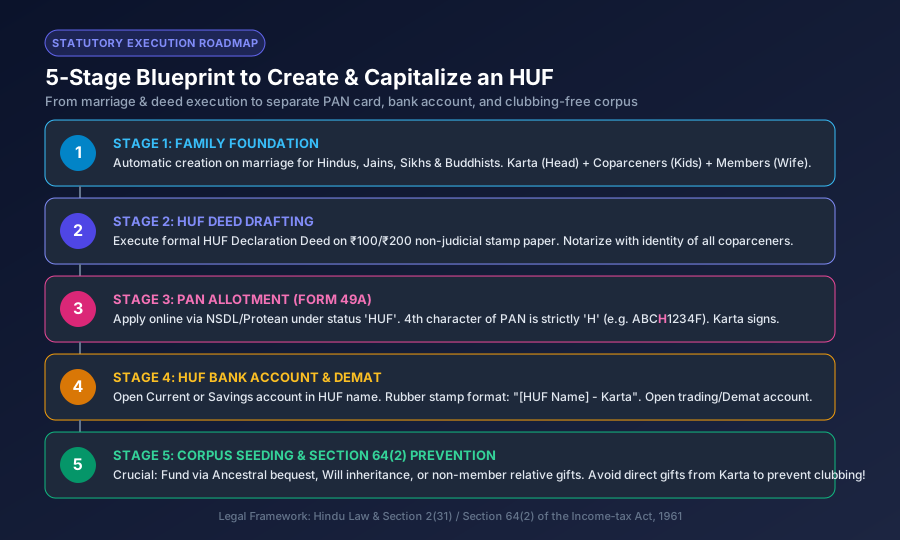
7. Blueprint Infographic: The 5-Stage HUF Execution Roadmap
The following visual flowchart summarizes the sequential legal and operational milestones required to establish a fully compliant HUF entity:
8. Direct Tax Benefits & Arbitrage in FY 2026-27 (AY 2027-28)
An HUF is assessed under the identical tax slabs applicable to non-senior individual taxpayers. This unlocks significant tax arbitrage opportunities for family investments:
1. Second Independent Basic Exemption Slab
Under the New Tax Regime (Section 115BAC) for FY 2026-27, an HUF enjoys an independent ₹4,00,000 basic tax exemption threshold. If your family shifts ₹4,00,000 of annual dividend, interest, or short-term trading profits into the HUF, that ₹4,00,000 is taxed at exactly 0%, saving up to ₹1,24,800 in personal taxes (30% + 4% cess) every single year.
2. Full Slabs Under the New Tax Regime
Even for income beyond ₹4,00,000, the HUF climbs the progressive tax ladder slowly:
- ₹0 to ₹4,00,000: Nil (0%)
- ₹4,00,001 to ₹8,00,000: 5%
- ₹8,00,001 to ₹12,00,000: 10%
- ₹12,00,001 to ₹16,00,000: 15%
- ₹16,00,001 to ₹20,00,000: 20%
- ₹20,00,001 to ₹24,00,000: 25%
- Above ₹24,00,000: 30%
3. Independent Chapter VI-A Deductions Under Old Tax Regime
If the HUF opts for the Old Tax Regime, it unlocks an entirely separate basket of deductions:
- Section 80C: Up to ₹1,50,000 by investing in PPF (public provident fund for HUF opened prior to 2005 or life insurance policies on the lives of members) or 5-year bank fixed deposits.
- Section 80D: Up to ₹25,000 on medical insurance premiums paid for family members (or ₹50,000 if members are senior citizens).
- Section 24(b): Up to ₹2,00,000 interest deduction on a housing loan taken by the HUF for self-occupied or rented residential property.
4. Separate Capital Gains Tax Exemptions
Under Section 112A, long-term capital gains on listed equity shares and equity-oriented mutual funds are exempt up to ₹1,25,000 per financial year. An individual investor gets ₹1,25,000 tax-free; with an HUF, the family gets an additional ₹1,25,000 tax-free every year, doubling your annual tax-free equity harvesting quota to ₹2,50,000!
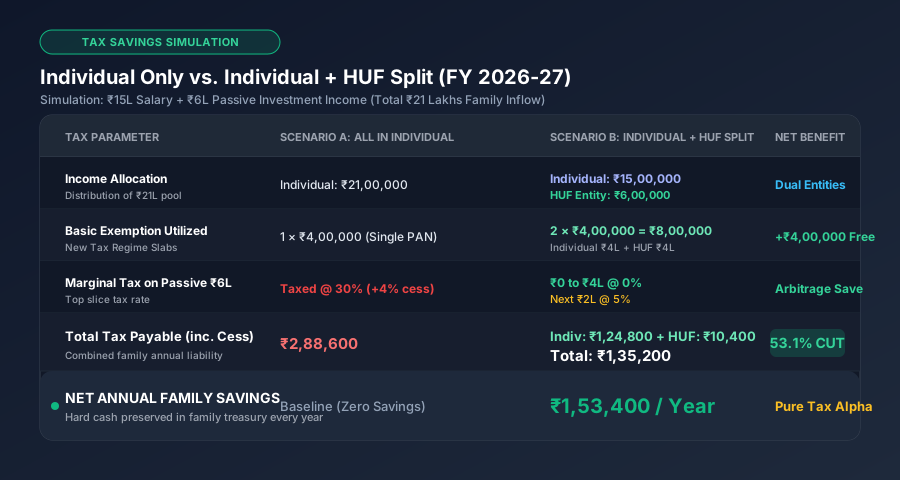
9. Real-World Tax Simulation: Individual Only vs. Individual + HUF Split
To demonstrate the mathematical power of an HUF, consider the case of Ananya, a senior software engineering director in Bangalore:
- Personal Salary: ₹15,00,000 per annum.
- Family Passive Income: ₹6,00,000 per annum (rental yield and dividend payouts from inherited assets).
- Total Annual Inflow: ₹21,00,000.
Let us compare Ananya's total family tax liability under two scenarios under the New Tax Regime (FY 2026-27):
| Step & Calculation | Scenario A: All Income in Individual PAN | Scenario B: Individual + HUF Split | Tax Difference |
|---|---|---|---|
| Individual Gross Income | ₹21,00,000 (Salary + Passive) | ₹15,00,000 (Salary Only) | ₹6,00,000 shifted to HUF |
| Individual Standard Deduction | -₹75,000 | -₹75,000 | Identical |
| Individual Net Taxable Income | ₹20,25,000 | ₹14,25,000 | -₹6,00,000 |
| Individual Tax Payable (inc. Cess) | ₹2,88,600 | ₹1,24,800 | Saves ₹1,63,800 on personal ITR |
| HUF Gross Taxable Income | ₹0 (No HUF) | ₹6,00,000 | Assessed under HUF PAN |
| HUF Tax Payable (New Regime) | ₹0 | ₹10,400 (0-4L @ 0%, next 2L @ 5% + cess) | Minimal entry tax bracket |
| Combined Family Tax Liability | ₹2,88,600 | ₹1,35,200 | Saves ₹1,53,400 / Year |
By routing the family's passive investment income through the HUF entity, Ananya's family slashes its total tax outflow from ₹2,88,600 to ₹1,35,200—a massive 53.1% annual tax reduction, putting an extra ₹1,53,400 in hard cash back into the family's wealth accumulation fund every single year!
Model Your Family's Multi-Entity Tax Savings
Evaluate your family's exact tax liability under New vs. Old Tax Regimes and calculate take-home gains with our 100% free, client-side direct tax engines.
10. Frequently Asked Questions (FAQ)
Can an HUF be created immediately after marriage without having children?
Yes. Under Hindu personal law and affirmed by the Supreme Court in Gowli Buddanna v. CIT, a Hindu Undivided Family comes into legal existence automatically upon marriage between a Hindu male and female. The husband functions as Karta and the wife as a Member. The birth of a child is not a prerequisite to create an HUF, execute an HUF deed, or obtain an HUF PAN card.
What is the difference between a Coparcener and a Member in an HUF?
A Coparcener acquires a birthright in ancestral HUF property and holds the statutory legal right to demand a partition of the family assets. After the Hindu Succession (Amendment) Act, 2005, daughters are coparceners by birth with equal rights as sons. A Member (such as a wife who enters the family through marriage) has a right of maintenance and a right to receive an equal share when a partition takes place, but cannot initiate or demand a partition on her own.
How does an HUF save taxes for an Indian family?
An HUF is treated as a separate distinct legal "person" under Section 2(31) of the Income-tax Act, 1961. It possesses its own PAN card and is assessed independently from its members. Under the New Tax Regime for FY 2026-27, an HUF receives its own ₹4,00,000 basic exemption slab. Under the Old Regime, it can claim separate Section 80C deductions (₹1.5 Lakhs), Section 80D medical insurance, Section 24(b) home loan deductions, and Section 112A ₹1.25 Lakh long-term capital gains exemptions.
How can an HUF be capitalized without triggering Section 64(2) clubbing?
If a member (such as the Karta) gifts personal self-acquired money to the HUF without consideration, Section 64(2) mandatorily clubs all income generated from that gift back into the member's personal ITR. To avoid clubbing, an HUF should be capitalized through: (1) Gifts or inheritances received through a Will of a deceased relative specifying the bequest is for the HUF, (2) Ancestral property receipts, (3) Gifts from non-members (relatives like maternal grandparents or family friends up to ₹50,000), or (4) A commercial loan given by the Karta to the HUF at prevailing market interest rates.
Can an HUF earn salary income?
No. Salary income requires an employer-employee relationship and personal manual or professional labour, which only an individual human being can perform. An HUF cannot earn salary income. An HUF can earn income from House Property (rental yields), Capital Gains (shares, mutual funds, real estate), Business and Profession, and Other Sources (interest, dividends).