Surcharge on High Incomes in India: 50L, 1Cr, 2Cr & 5Cr Slabs and Marginal Relief Calculation Guide (FY 2026-27)

Executive Compliance Snapshot: High-Income Surcharges (AY 2027-28)
In India, earning an annual income exceeding ₹50,00,000 (Fifty Lakh Rupees) activates an escalating surcharge on your basic income tax: 10% (>₹50L to ₹1Cr), 15% (>₹1Cr to ₹2Cr), 25% (>₹2Cr to ₹5Cr), and 37% (>₹5Cr in the Old Regime). However, the New Tax Regime permanently caps the maximum surcharge at 25%, dropping the peak effective tax rate from 42.744% down to 39.00%. To protect taxpayers from the unfair cliff where earning a few extra rupees triggers thousands in extra surcharge, Indian law provides the statutory protection of Marginal Relief. Master the exact formulas, capital gains caps, and optimization strategies below.
Table of Contents
- 1. What is Surcharge? An Additional Tax on Tax (Not on Income)
- 2. The 4 Surcharge Thresholds: ₹50L, ₹1Cr, ₹2Cr & ₹5Cr
- 3. The Ultra-HNI Arbitrage: New Regime 25% Cap vs. Old Regime 37% Rate
- 4. The 15% Surcharge Cap on Capital Gains & Dividend Income
- 5. The Marginal Relief Doctrine: Why You Never Pay More Tax Than Extra Income
- 6. Step-by-Step Mathematical Case Studies: ₹51L, ₹1.02Cr & ₹2.03Cr
- 7. Correct Sequencing: How 4% Health & Education Cess is Applied
- 8. How Marginal Relief is Declared in Schedule Part B-TTI of ITR-2 & ITR-3
- 9. Frequently Asked Questions (FAQs)
1. What is Surcharge? An Additional Tax on Tax (Not on Income)
In Indian public finance, taxes are levied under the authority of Article 270 and Article 271 of the Constitution of India. While ordinary income tax proceeds are divisible between the Union Government and State Governments, a Surcharge is an exclusive levy of the Central Government enacted through annual Finance Acts.
The single most important computational principle to understand is this:
Surcharge is NOT calculated as a percentage of your total income. Surcharge is calculated as a percentage of your basic income tax liability before adding the 4% Health and Education Cess.
For example, if your total income is ₹75,00,000 and your basic income tax under normal slab rates is ₹20,62,500, a 10% surcharge does not mean paying 10% of ₹75 Lakhs (which would be ₹7.5 Lakhs). It means paying 10% of your ₹20,62,500 tax liability—which equals ₹2,06,250.
2. The 4 Surcharge Thresholds: ₹50L, ₹1Cr, ₹2Cr & ₹5Cr
The Finance Act prescribes four progressive surcharge tiers for individuals, Hindu Undivided Families (HUFs), Associations of Persons (AOPs), and Bodies of Individuals (BOIs):
| Total Income Slab Bracket | Surcharge Rate | Effective Tax Rate on Marginal Income (30% Slab) | Qualifying Income Components |
|---|---|---|---|
| Up to ₹50,00,000 | 0% (NIL) | 31.20% (30% + 4% cess) | All income streams |
| Exceeding ₹50 Lakhs up to ₹1 Crore | 10% on Basic Tax | 34.32% [30% × 1.10 × 1.04] | All taxable income streams |
| Exceeding ₹1 Crore up to ₹2 Crores | 15% on Basic Tax | 35.88% [30% × 1.15 × 1.04] | All taxable income streams |
| Exceeding ₹2 Crores up to ₹5 Crores | 25% on Basic Tax | 39.00% [30% × 1.25 × 1.04] | Non-capital gain income |
| Exceeding ₹5 Crores (Old Regime) | 37% on Basic Tax | 42.744% [30% × 1.37 × 1.04] | Old Tax Regime only! |
3. The Ultra-HNI Arbitrage: New Regime 25% Cap vs. Old Regime 37% Rate
Prior to Assessment Year 2024-25, India possessed one of the highest personal income tax rates in the world, with individuals earning above ₹5 Crores paying an eye-watering 42.744% peak tax under the highest 37% surcharge bracket.
To curb capital flight, foster domestic entrepreneurship, and encourage high-net-worth individuals to adopt the simplified tax structure, the Parliament amended Section 115BAC (New Tax Regime):
Under the New Tax Regime, the 37% surcharge bracket is completely abolished. The maximum surcharge payable on any income—even if you earn ₹10 Crores, ₹50 Crores, or ₹100 Crores—is permanently capped at 25%!
- Old Tax Regime Peak Rate: 30% slab + 37% surcharge + 4% cess = 42.744%.
- New Tax Regime Peak Rate: 30% slab + 25% surcharge + 4% cess = 39.000%.
- Direct Tax Savings: High earners save exactly 3.744% in pure cash tax on every single rupee earned above ₹5 Crores. For an ultra-HNI earning ₹10 Crores, choosing the New Regime saves over ₹18,72,000 in annual direct tax liability!

Figure 1: Mathematical breakdown demonstrating how statutory Marginal Relief prevents additional tax from exceeding additional income earned over surcharge thresholds.
4. The 15% Surcharge Cap on Capital Gains & Dividend Income
A frequent fear among investors who experience a one-off capital gains windfall (such as selling a multi-crore ancestral property, an unlisted business, or a large equity portfolio) is that their profits will be wiped out by a 25% or 37% surcharge.
Fortunately, the direct tax code carves out an explicit statutory protection for investment capital gains and dividend income:
| Income Category | Governing Section | Maximum Statutory Surcharge Cap | Effective Peak Tax Rate (Inc Cess) |
|---|---|---|---|
| Listed Equity STCG | Section 111A | 15% Maximum Cap | 20% × 1.15 × 1.04 = 23.92% |
| Listed Equity LTCG | Section 112A | 15% Maximum Cap | 12.5% × 1.15 × 1.04 = 14.95% |
| Unlisted Shares & Real Estate LTCG | Section 112 | 15% Maximum Cap | 12.5% × 1.15 × 1.04 = 14.95% |
| Corporate & Mutual Fund Dividends | Section 56(2)(i) | 15% Maximum Cap | 30% × 1.15 × 1.04 = 35.88% |
Even if an investor earns ₹20 Crores in taxable income during a financial year, the surcharge applied to their equity capital gains and dividend income can never exceed 15%. The higher 25% or 37% surcharge applies strictly to ordinary non-investment income (such as salary, business turnover, or rental revenue).
5. The Marginal Relief Doctrine: Why You Never Pay More Tax Than Extra Income
Consider the catastrophic cliff edge that would exist without legislative protection: At exactly ₹50,00,000 of income, your surcharge is ₹0. But if you earn ₹50,50,000 (just ₹50,000 more), you cross into the 10% surcharge bracket, triggering over ₹1,30,000 in surcharge on your entire tax liability! You would be punished for working harder and earning more.
To eliminate this absurd anomaly, the Finance Act embeds the statutory doctrine of Marginal Relief across all four surcharge thresholds.
Whenever total income exceeds a surcharge threshold (₹50L, ₹1Cr, ₹2Cr, or ₹5Cr), the total amount payable as income tax and surcharge cannot exceed the aggregate of:
- The total tax payable on the threshold income (calculated at normal slab rates with zero surcharge); PLUS
- The amount of income that exceeds the threshold.
Maximum Permissible Tax & Surcharge = Tax on Threshold + (Total Income − Threshold)
Marginal Relief Granted = Raw (Basic Tax + Surcharge) − Maximum Permissible Tax
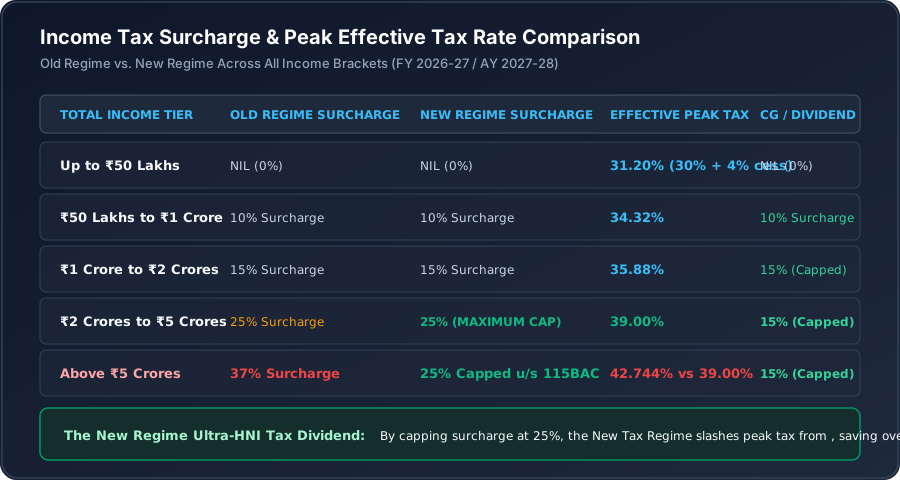
Figure 2: Comprehensive matrix comparing surcharge rates, peak effective marginal tax rates, and capital gains capping across Old and New Tax Regimes.
6. Step-by-Step Mathematical Case Studies: ₹51L, ₹1.02Cr & ₹2.03Cr
Let us walk through three exact mathematical computations demonstrating how Marginal Relief is calculated in practice under the New Tax Regime (Section 115BAC) for FY 2026-27:
Case Study A: Taxpayer Earning ₹51,00,000 (Crossing ₹50 Lakh Threshold)
- Step 1: Calculate Tax on ₹50,00,000 (The Threshold): Basic tax on ₹50,00,000 under the New Regime is ₹12,60,000. Surcharge is ₹0. Total = ₹12,60,000.
- Step 2: Calculate Raw Tax on ₹51,00,000: Basic tax on ₹51,00,000 is ₹12,90,000. Because income exceeds ₹50L, 10% surcharge applies: 10% of ₹12,90,000 = ₹1,29,000. Raw Total = ₹14,19,000.
- Step 3: Calculate Maximum Permissible Tax under Marginal Relief:
Max Permissible = Tax on ₹50L (₹12,60,000) + Extra Income (₹1,00,000) = ₹13,60,000. - Step 4: Compute Marginal Relief:
Marginal Relief = Raw Total (₹14,19,000) − Max Permissible (₹13,60,000) = ₹59,000. - Step 5: Compute Final Tax:
Net Tax + Surcharge = ₹13,60,000.
Add 4% Cess on ₹13,60,000 = ₹54,400.
Final Tax Payable = ₹14,14,400.
Case Study B: Taxpayer Earning ₹1,02,00,000 (Crossing ₹1 Crore Threshold)
At ₹1.02 Crore, the taxpayer moves from the 10% surcharge tier to the 15% surcharge tier:
- Tax on ₹1,00,00,000 (with 10% Surcharge): Basic Tax (₹27,60,000) + 10% Surcharge (₹2,76,000) = ₹30,36,000.
- Raw Tax on ₹1,02,00,000 (with 15% Surcharge): Basic Tax (₹28,20,000) + 15% Surcharge (₹4,23,000) = ₹32,43,000.
- Maximum Permissible Tax: ₹30,36,000 + ₹2,00,000 (extra income) = ₹32,36,000.
- Marginal Relief Granted: ₹32,43,000 − ₹32,36,000 = ₹7,000.
- Final Tax with Cess: ₹32,36,000 + 4% cess (₹1,29,440) = ₹33,65,440.
7. Correct Sequencing: How 4% Health & Education Cess is Applied
A frequent computational error in manual tax filings is applying the 4% Health and Education Cess before deducting marginal relief. Section 4 of the Finance Act specifies the exact statutory order of operations:
- Stage 1: Compute Basic Income Tax at applicable slab rates.
- Stage 2: Add applicable Surcharge (10%, 15%, 25%, or 37%) based on total income.
- Stage 3: Deduct Marginal Relief from (Basic Tax + Surcharge).
- Stage 4: Apply the 4% Health and Education Cess on the net amount resulting from Stage 3.
This statutory sequencing ensures that the taxpayer never pays cess on the artificial, unadjusted surcharge that was wiped out by marginal relief.
8. How Marginal Relief is Declared in Schedule Part B-TTI of ITR-2 & ITR-3
When filing your Income Tax Return on the e-filing portal (incometax.gov.in), you do not need to manually compute marginal relief on paper. The automated Java/JSON tax utility handles this internally:
- Schedule Part B-TI: Captures your gross total income across Salary, House Property, Business, Capital Gains, and Other Sources.
- Schedule Part B-TTI (Computation of Tax Liability):
- Item 2a: Tax at normal slab rates.
- Item 2b: Surcharge before marginal relief.
- Item 2c: Marginal Relief (automatically populated based on algorithmic verification).
- Item 2d: Surcharge after marginal relief (Item 2b − Item 2c).
- Item 3: Health and Education Cess @ 4% on (Item 2a + Item 2d).
Model your exact executive compensation, monthly TDS deductions, and surcharge obligations using our client-side CTC to In-Hand Salary Calculator and Income Tax Calculator.
9. Frequently Asked Questions (FAQs)
Q1: What are the income tax surcharge rates for individuals in India for FY 2026-27?
For individuals, HUFs, and AOPs: (1) Total income between ₹50 Lakh and ₹1 Crore: 10% surcharge on income tax; (2) Total income between ₹1 Crore and ₹2 Crores: 15% surcharge; (3) Total income between ₹2 Crores and ₹5 Crores: 25% surcharge; (4) Total income exceeding ₹5 Crores: 37% surcharge in the Old Tax Regime, but capped at 25% in the New Tax Regime.
Q2: How does Marginal Relief work when income slightly exceeds a surcharge threshold?
Marginal Relief ensures that the additional tax plus surcharge payable because of crossing a surcharge threshold (such as ₹50 Lakh or ₹1 Crore) cannot exceed the incremental income earned over that threshold. The statutory formula caps total tax + surcharge at: [Tax payable on the threshold income] + [Total income minus the threshold]. The excess surcharge is granted as marginal relief.
Q3: Is surcharge on capital gains and dividend income capped at 15%?
Yes. Under both the New and Old Tax Regimes, the surcharge on Short-Term Capital Gains under Section 111A, Long-Term Capital Gains under Section 112 and Section 112A, and dividend income is statutorily capped at a maximum of 15%, even if the taxpayer's total taxable income exceeds ₹2 Crores or ₹5 Crores.
Q4: What is the peak effective marginal tax rate in India under the New vs Old Tax Regime?
Under the Old Tax Regime, for incomes exceeding ₹5 Crores, the peak rate is 42.744% (30% basic tax + 37% surcharge + 4% cess). Under the New Tax Regime (Section 115BAC), because the maximum surcharge is capped at 25%, the peak effective marginal tax rate is reduced to 39.00% (30% basic tax + 25% surcharge + 4% cess), saving 3.744% in direct tax.
Q5: How is the 4% Health and Education Cess applied when surcharge and marginal relief are present?
The 4% Health and Education Cess is calculated on the net figure of [Basic Income Tax + Surcharge minus Marginal Relief]. Cess is never applied to the raw tax before deducting marginal relief.