Sweat Equity Shares & Phantom Stocks (SARs): Tax Implications for Indian Founders & Key Employees (FY 2026-27)

Executive Summary: Advanced Founder & CXO Equity Instruments
Beyond traditional ESOPs, Indian startups and growth enterprises utilize two specialized equity compensation instruments to align executive talent with enterprise valuation: Sweat Equity Shares under Section 54 of the Companies Act, 2013 (granting immediate equity for technical IP or value addition subject to a mandatory 3-year lock-in), and Phantom Stocks / Stock Appreciation Rights (SARs) (providing synthetic upside without cap-table dilution). While sweat equity triggers Section 17(2)(vi) perquisite tax on allotment followed by capital gains on sale, cash-settled phantom stocks are taxed strictly as bonus salary under Section 17(1) upon cash payout.
Table of Contents
- 1. What are Sweat Equity Shares? Section 54 Corporate Framework
- 2. The Mandatory 3-Year Lock-In & Corporate Governance Guardrails
- 3. Direct Tax Treatment of Sweat Equity: Allotment vs. Eventual Sale
- 4. What are Phantom Stocks and Stock Appreciation Rights (SARs)?
- 5. Tax Treatment of Phantom Stocks: Cash-Settled vs. Equity-Settled
- 6. Comparative Analysis: Sweat Equity vs. ESOPs vs. Phantom Stocks
- 7. Corporate Tax Deductibility for the Employer (Section 37 Relief)
- 8. Structuring Recommendations for Founders & Compensation Committees
- 9. Frequently Asked Questions (FAQs)
1. What are Sweat Equity Shares? Section 54 Corporate Framework
In high-growth technology, pharmaceutical, and manufacturing startups, early founders, chief technical officers (CTOs), and specialized engineers contribute immense intellectual capital, proprietary software code, or patented processes rather than pure monetary capital. To reward this non-financial contribution, Indian corporate law provides the mechanism of Sweat Equity Shares.
Under Section 2(88) of the Companies Act, 2013:
"Sweat equity shares means such equity shares as are issued by a company to its directors or employees at a discount or for consideration, other than cash, for providing their know-how or making available rights in the nature of intellectual property rights or value additions, by whatever name called."
Unlike standard Employee Stock Option Plans (ESOPs)—which merely grant a future option to buy shares after a vesting cliff—sweat equity shares represent immediate, actual equity allotment upfront. The recipient becomes a shareholder with full voting rights, dividend entitlements, and cap-table ownership on the date of allotment.
Statutory Conditions under Section 54
To issue sweat equity shares, a company must strictly satisfy the conditions of Section 54(1) of the Companies Act:
- Special Resolution: The issue must be authorized by a special resolution passed by the shareholders in a general meeting.
- Disclosures in Notice: The explanatory statement must specify the number of shares, current market price, consideration (if any), and the intellectual property or value addition provided.
- Annual & Lifetime Caps: A company cannot issue sweat equity shares for more than 15% of its existing paid-up equity share capital in a year or shares of issue value of ₹5 Crores, whichever is higher. The lifetime cap is 25% of paid-up capital (relaxed to 50% for DPIIT-recognized startups for up to 10 years from incorporation).
2. The Mandatory 3-Year Lock-In & Corporate Governance Guardrails
The defining legal characteristic of sweat equity shares is their complete illiquidity during the initial years. Under Rule 8(5) of the Companies (Share Capital and Debentures) Rules, 2014, sweat equity shares issued to directors or employees are subject to an absolute non-negotiable lock-in period of 3 years from the date of allotment.
- Non-Transferable: The employee cannot sell, transfer, assign, or gift the shares to any person for 3 full years.
- No Pledging: The shares cannot be pledged as collateral to secure bank loans or credit lines.
- Endorsement on Share Certificates: The share certificate must carry a prominent red stamp or digital endorsement stating that the shares are locked in until the specified calendar date. If held in demat mode, the depository participant (NSDL/CDSL) freezes the ISIN under corporate lock-in status.
If an employee resigns or is terminated during the 3-year lock-in period, the employment contract and articles of association (AOA) typically govern whether the company can buy back the shares at face value or if the employee retains them subject to lock-in expiry.

Figure 1: Architectural comparison between Sweat Equity, ESOPs, and Phantom Stocks, highlighting legal authorities, lock-in periods, and cap table dilution.
3. Direct Tax Treatment of Sweat Equity: Allotment vs. Eventual Sale
From an income tax standpoint, sweat equity shares follow a two-stage taxation model virtually identical to exercised ESOPs, but with unique cash-flow complications due to the 3-year lock-in.
Stage 1: Tax on Date of Allotment (Section 17(2)(vi))
Under Section 17(2)(vi) of the Income-tax Act, 1961, the allotment of sweat equity shares is treated as a Perquisite under the head "Salaries" in the previous year in which the shares are allotted:
Perquisite Value = Fair Market Value (FMV) on Allotment Date − Price Actually Paid by Employee
If the shares are allotted completely free of cash consideration in exchange for software IP or patents, the price paid is ₹0, meaning the entire Fair Market Value is taxable as salary perquisite!
Because the employee is legally locked in for 3 years, they CANNOT sell any shares to pay the tax. If an engineer is allotted sweat equity shares valued at ₹30 Lakhs, their employer must deduct approximately ₹9,36,000 in TDS (at 31.2% slab rate) from their regular cash monthly salary! This forces the employee to pay substantial cash taxes upfront on paper equity that cannot be liquidated for at least 36 months.
Stage 2: Tax on Sale after Lock-In Expiry (Section 45)
Once the 3-year lock-in expires and the employee sells the shares, the transaction triggers Capital Gains under Section 45:
- Cost of Acquisition (Section 49(2AA)): Stepped up to the Fair Market Value (FMV) adopted on the allotment date for perquisite tax computation.
- Capital Gain: Sale Consideration − Allotment Date FMV.
- Holding Period: Measured from the Date of Allotment to the Date of Sale. Because the mandatory lock-in is already 3 years (36 months), any subsequent sale automatically qualifies as Long-Term Capital Gains (LTCG)!
- Post-Budget 2024 LTCG Rate: Taxed at 12.5% without indexation under Section 112 for unlisted shares (or Section 112A for listed shares beyond the ₹1.25 Lakh exemption).
4. What are Phantom Stocks and Stock Appreciation Rights (SARs)?
To avoid cap-table dilution, complex company law approvals, and the cash-flow perquisite crisis of sweat equity, modern enterprises increasingly implement Phantom Stock Plans or Stock Appreciation Rights (SARs).
A Phantom Stock is a synthetic, contractual equity incentive. The company does not issue any real equity shares, warrants, or options. Instead, the company grants the employee "phantom units" that mirror the exact economic value and price movement of actual corporate shares.
How Phantom Stocks Function
Suppose an employee is granted 2,000 phantom units when the company’s internal valuation is ₹200 per share. The plan provides a 3-year vesting schedule. At the end of Year 3, the company’s valuation rises to ₹600 per share.
The unit appreciation is ₹400 per share (₹600 − ₹200). Upon exercise or settlement, the employee receives a cash bonus of ₹8,00,000 (2,000 units × ₹400 appreciation) directly into their bank account.
| Feature | Cash-Settled SARs / Phantom Stocks | Equity-Settled SARs |
|---|---|---|
| Settlement Mode | Employee receives 100% Cash payout. | Employee receives actual corporate shares equal to the appreciation value. |
| Cap Table Dilution | Zero Dilution. Founder shareholding remains 100% intact. | Minor dilution (shares issued only for gain component). |
| Shareholder Rights | Zero voting rights, zero statutory shareholder rights. | Becomes full voting shareholder after shares are allotted. |
| Company Law Filings | No RoC / MCA filings or special resolutions required. | Compliance with Section 62 and PAS-3 return of allotment. |
5. Tax Treatment of Phantom Stocks: Cash-Settled vs. Equity-Settled
The tax treatment of phantom stocks is remarkably clean and straightforward because there are no underlying shares held by the employee during the vesting period.
1. Cash-Settled Phantom Stocks: Pure Salary Bonus
For cash-settled SARs, no taxable event occurs at the grant date or during vesting. On the payout date, the entire cash amount paid by the company is classified under Section 17(1) as "Profits in lieu of or in addition to Salary" (Bonus).
- Tax Rate: Added to total income; taxed at your applicable personal income tax slab rate (up to 30% plus cess).
- TDS Obligation: The employer deducts TDS under Section 192 at the time of crediting the cash payment.
- Capital Gains: Zero capital gains tax. Because the employee never held a capital asset under Section 2(14), Chapter IV-E does not apply.
2. Equity-Settled Phantom Stocks: Two-Stage Taxation
If the plan settles the appreciation by issuing physical shares, the transaction converts into standard equity compensation: the value of the shares issued is taxed as a perquisite under Section 17(2)(vi) on allotment, and any subsequent appreciation upon ultimate sale is taxed as capital gains under Section 45.
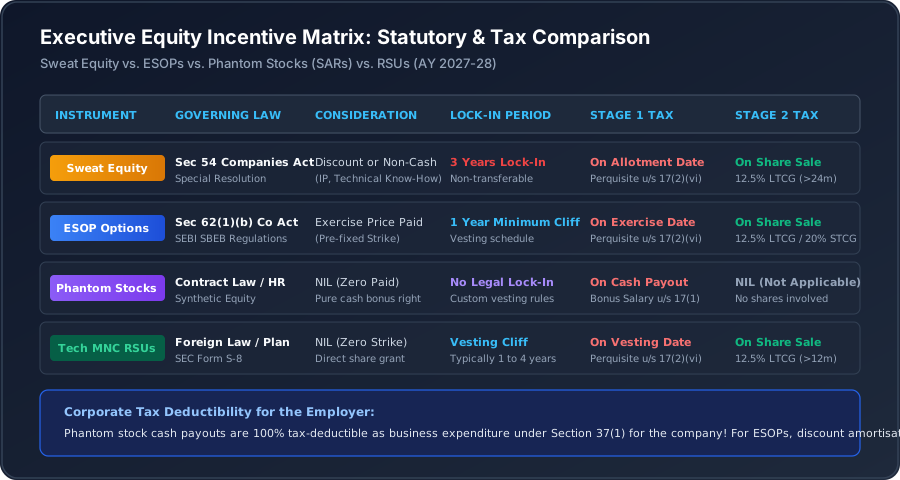
Figure 2: Comprehensive statutory and direct tax comparison across Sweat Equity, ESOPs, Phantom Stocks, and Tech MNC RSUs.
6. Comparative Analysis: Sweat Equity vs. ESOPs vs. Phantom Stocks
When designing executive compensation architectures, startup founders and board compensation committees must weigh dilution, employee cash flow, and tax timing across all available instruments:
| Strategic Attribute | Sweat Equity Shares | Standard ESOPs | Phantom Stocks (Cash SARs) |
|---|---|---|---|
| Target Recipients | Founders, Promoters, Core Technical Architects | Broad employee base, mid-to-senior staff | Consultants, advisors, key CXOs, foreign directors |
| Consideration Paid | Non-cash (IP / know-how) or deep discount | Exercise price paid upon conversion | Nil (Zero investment by employee) |
| Lock-In Requirement | 3 Years Mandatory by Law | Customary vesting cliff (typically 1 year) | No legal lock-in (governed by HR contract) |
| Employee Cash Outflow for Tax | High upfront risk (pays tax on locked shares) | High risk at exercise (unless 80-IAC exempt) | Zero Cash Risk (Tax deducted from cash received!) |
| Long-Term Wealth Upside | Maximum (Cap-table equity ownership) | High (Equity ownership post-exercise) | Capped at contractual cash bonus formula |
7. Corporate Tax Deductibility for the Employer (Section 37 Relief)
An essential consideration for corporate finance controllers is whether the cost of these equity incentive schemes can be deducted as an allowable business expenditure to reduce the company's corporate income tax under Section 37(1).
Phantom Stock Cash Payouts: 100% Deductible
Cash payments made to employees under Phantom Stock Plans represent genuine employee compensation. Under Section 37(1), cash-settled SAR payouts are 100% deductible as staff cost / business expenditure in the financial year in which the cash is disbursed, providing substantial corporate tax savings (typically 25% to 30% corporate tax shelter).
Sweat Equity & ESOPs: The Landmark Biocon Precedent
For decades, the tax department contested whether the discount on ESOPs or sweat equity (difference between FMV and strike price) was an allowable corporate deduction. The Special Bench of the Income Tax Appellate Tribunal (ITAT) in the landmark ruling of CIT vs. Biocon Limited (affirmed by the Karnataka High Court) held that the discount on share options represents an employee welfare cost and is fully deductible under Section 37(1) amortized over the vesting period.
8. Structuring Recommendations for Founders & Compensation Committees
To maximize executive retention while minimizing tax and regulatory friction, startup boards should adopt this decision matrix:
- For Co-Founders & Core IP Creators: Issue Sweat Equity Shares early in the company's lifecycle when the merchant banker valuation is modest. This minimizes the initial Section 17(2) perquisite tax burden while securing authentic voting equity before major venture capital funding rounds.
- For General Tech & Operating Talent: Deploy Standard ESOPs with standard 4-year vesting and a 1-year cliff. If the startup possesses Section 80-IAC certification, activate the Section 192(1C) tax deferral to protect employees from upfront perquisite taxes.
- For External Advisors, Board Observers & Overseas Executives: Implement Phantom Stocks / Cash-Settled SARs. This rewards them with equity-linked financial upside without cluttering your cap table, avoiding complex FEMA/RBI cross-border share allotment filings, and eliminating minority shareholder disputes.
Model your monthly executive salary slip, bonus TDS, and annual tax brackets using our In-Hand Salary Calculator and Income Tax Calculator.
9. Frequently Asked Questions (FAQs)
Q1: What are Sweat Equity Shares under Indian corporate law?
Under Section 2(88) and Section 54 of the Companies Act, 2013, sweat equity shares are equity shares issued by a company to its directors or permanent employees at a discount or for consideration other than cash, for providing know-how, making available intellectual property rights, or creating value additions to the company.
Q2: What is the mandatory statutory lock-in period for Sweat Equity Shares?
Under Rule 8(5) of the Companies (Share Capital and Debentures) Rules, 2014, sweat equity shares are subject to a mandatory statutory lock-in period of 3 years from the date of allotment. During these 3 years, the shares cannot be transferred, sold, gifted, or pledged under any circumstances, and the share certificate must carry a prominent lock-in endorsement.
Q3: How is perquisite tax calculated on Sweat Equity Shares at the time of allotment?
Under Section 17(2)(vi) of the Income-tax Act, 1961, the perquisite value of sweat equity shares is the Fair Market Value (FMV) of the shares on the date of allotment minus any discount price actually paid by the employee. This amount is added to salary income in Form 16 and taxed at normal personal slab rates (up to 30% plus cess).
Q4: What are Phantom Stocks or Stock Appreciation Rights (SARs)?
Phantom Stocks or Stock Appreciation Rights (SARs) are synthetic equity compensation tools that entitle an employee to receive a cash bonus (or shares) equal to the appreciation in the company's share price over a designated period, without actually granting real voting shares or diluting the company's cap table.
Q5: How are cash-settled Phantom Stocks taxed under Indian direct tax law?
Cash-settled Phantom Stocks or SARs are treated purely as performance bonus or salary compensation under Section 17(1) of the Income-tax Act. The cash payout is fully taxable at personal slab rates in the financial year in which it is received, with the employer deducting TDS under Section 192. There are no capital gains or demat transactions involved.