Clubbing of Income Provisions: Section 64 Rules for Spouses, Minor Children & In-Laws (FY 2026-27)

1. Legislative Intent & Statutory Architecture of Sections 60 to 65
In a progressive tax system like India's, where personal income tax rates scale from 5% up to 30% (and reach an effective peak marginal rate of 39.00% under the New Tax Regime or 42.744% under the Old Tax Regime when high-income surcharges and 4% Health & Education Cess are compounded), high-earning individuals face a strong economic incentive to fragment their wealth. By diverting income-producing assets—such as fixed deposit capital, mutual fund units, equity portfolios, or rental real estate—to non-earning spouses, dependent children, or elderly family members, taxpayers historically attempted to multiply basic exemption thresholds (₹4,00,000 under the New Tax Regime for FY 2026-27 or ₹2,50,000 under the Old Regime) and exploit entry-level tax brackets.
To preserve tax base integrity and neutralize artificial tax avoidance schemes, Chapter V of the Income-tax Act, 1961 (comprising Sections 60 through 65) enacts explicit anti-avoidance clubbing provisions. Under these statutory rules, income earned by certain individuals from assets transferred directly or indirectly without adequate financial consideration is statutorily attributed—or "clubbed"—back into the total gross income of the original transferor.
Key Statutory Sections in Chapter V of the Income-tax Act
- Section 60 (Transfer of Income without Transfer of Assets): If a taxpayer assigns or transfers income from an asset without transferring the asset itself, that income is taxed exclusively in the hands of the transferor.
- Section 61 & Section 62 (Revocable Transfers): All income arising from an asset transferred under a revocable settlement or trust is clubbed with the transferor, unless the trust cannot be revoked during the lifetime of the beneficiary.
- Section 64(1)(ii) (Remuneration to Spouse): Salary, commission, or fees paid to a spouse by a business entity in which the taxpayer holds a substantial interest (20% or more voting power or profit share) are clubbed with the taxpayer's income, unless the spouse possesses genuine technical or professional qualifications.
- Section 64(1)(iv) (Transfer of Asset to Spouse): Income from assets transferred to a spouse without adequate consideration is clubbed with the transferor spouse.
- Section 64(1)(vi) (Transfer of Asset to Son's Wife): Direct or indirect transfers to a daughter-in-law without adequate consideration are clubbed back to the father-in-law or mother-in-law.
- Section 64(1A) (Income of Minor Child): All income accruing to a minor child is clubbed with the parent having the higher total income, subject to strictly defined exceptions.
Understanding these provisions is vital for every taxpayer. While gifting money to your spouse is 100% tax-free at the point of receipt under the relative exemption of Section 56(2)(x), the subsequent returns generated on that capital trigger mandatory clubbing under Section 64, turning an apparent tax-saving maneuver into a potential tax scrutiny nightmare.
2. Section 64(1)(iv): Asset Transfers to Spouse & Inadequate Consideration
Section 64(1)(iv) represents the most widely encountered clubbing trap among Indian salaried executives and business owners. The statute provides that in computing the total income of any individual, there shall be included all such income as arises directly or indirectly to the spouse of such individual from assets transferred directly or indirectly to the spouse otherwise than for adequate consideration or in connection with an agreement to live apart.
Core Conditions for Section 64(1)(iv) Activation
For Section 64(1)(iv) to be triggered by the Assessing Officer, three foundational conditions must be concurrently satisfied:
- Subsistence of Marital Relationship: The relationship of husband and wife must exist both at the time of the transfer of the asset and at the time the resulting income accrues. In the precedent of Philip John Plasket Thomas v. CIT (1963) 49 ITR 97 (SC), the Supreme Court held that if an individual transfers shares or cash to their fiancé prior to marriage, Section 64(1)(iv) cannot be invoked, because the recipient was not the "spouse" on the date of transfer. Similarly, if the marriage is legally dissolved by divorce, income arising after dissolution ceases to be clubbed.
- Absence of Adequate Consideration: The transfer must take place either as an outright gift or for consideration that is legally inadequate in financial terms. Natural love and affection does not constitute "adequate consideration" under direct tax jurisprudence (established by the Supreme Court in Tulsidas Kilachand v. CIT 1961). Adequate consideration requires an arm's length monetary equivalent or commercial quid pro quo.
- Direct or Indirect Nexus: The income must arise directly or indirectly from the transferred asset. If an individual gifts ₹20,00,000 to their homemaker spouse and she deposits it into a bank Fixed Deposit generating ₹1,50,000 in annual interest, that ₹1,50,000 must be entered in the donor spouse's ITR under "Income from Other Sources".
| Asset Transferred to Spouse | Subsequent Income Generated | Clubbing Triggered? | ITR Treatment & Section |
|---|---|---|---|
| Cash Gift (₹15,00,000) | Bank Fixed Deposit Interest @ 7.2% (₹1,08,000) | Yes | Clubbed in donor spouse's ITR u/s 64(1)(iv) at marginal slab rate. |
| Residential Apartment gifted | Monthly Rental Income (₹35,000/mo) | Yes | Rental income (net of Sec 24(a) 30% deduction) clubbed in donor's hands u/s 27/64(1)(iv). |
| Listed Equity Shares gifted | Annual Dividend Payouts (₹45,000) | Yes | Dividends taxed under Other Sources in donor spouse's return. |
| Listed Equity Shares gifted | Capital Gains on eventual sale (₹3,20,000) | Yes | LTCG/STCG clubbed in donor's hands. Cost basis and holding period inherited u/s 49(1). |
| Asset transferred per Divorce Settlement | Interest / Rental Yields | No | Statutory exception: Transfer in connection with agreement to live apart is exempt from clubbing. |
| Savings from Household Allowance ("Pin Money") | Interest earned on accumulated kitty | No | Judicial exception: Savings from bona fide housekeeping allowances belong to spouse. |
The Pin Money (Stri-Dhan) Distinction
A frequent question arises regarding money handed over by a husband to his wife for managing domestic household expenses, commonly termed "pin money" in legal parlance. If the homemaker spouse prudently saves a portion of this monthly housekeeping allowance and invests those accumulated savings in small savings schemes, gold, or bank deposits, does the interest income get clubbed with the husband's income?
Courts have consistently held that unspent balances of reasonable household allowances saved by a wife, as well as gifts of jewelry or customary cash received during festivals (Stri-Dhan), represent the personal wealth of the wife. Income generated from such modest domestic savings is not subject to Section 64(1)(iv) clubbing, provided the monthly sums are demonstrably commensurate with the household's standard of living and do not represent disguised lump-sum capital diversions.
3. Section 64(1A): Minor Child Income & Section 10(32) Exemptions
Prior to 1992, parents routinely opened separate bank accounts and investment folios in the names of their infant children, taking advantage of multiple basic exemption limits and splitting family investment returns. In response, Parliament inserted Section 64(1A) through the Finance Act, 1992, creating an almost universal clubbing umbrella for minor children.
Statutory Mechanics of Section 64(1A)
Under Section 64(1A), all income which arises or accrues to a minor child (including an adopted child or a stepchild who has not attained 18 years of age) is clubbed with the total income of that parent whose total income (evaluating income before including the minor's returns) is higher.
- Determination of Higher Income Parent: If the father's taxable income is ₹18,00,000 and the mother's taxable income is ₹14,00,000, any investment returns earned by their 10-year-old daughter must be clubbed with the father's income.
- Consistency Rule: Once a minor's income is clubbed with one parent in any assessment year, it shall continue to be clubbed with that same parent in subsequent years unless the Assessing Officer is satisfied, after giving that parent an opportunity of being heard, that it is necessary to club it with the other parent (for example, if the other parent's income permanently overtakes the former).
- Parents Living Apart: Where the marriage of the parents does not subsist (due to divorce or legal separation), the minor's income is clubbed with the parent who maintains the minor child in the previous year.
Statutory Exceptions to Minor Child Clubbing
The statute provides three explicit exceptions where a minor child's earnings are NOT clubbed with the parents and the minor files an independent Income Tax Return through a legal guardian:
- Income Earned via Manual Work: Income derived by a minor child from physical manual labour is taxed strictly in the minor's hands.
- Income from Specialized Talent, Skill, or Artistic Knowledge: If a child earns income by applying their personal skill, intellect, artistic capability, or sports prowess—such as child actors, singers, professional chess prodigies, software coders, or YouTube/social media creators—that income is not clubbed with the parents. However, if that talent income is subsequently deposited into a bank Fixed Deposit, the interest earned on that FD in future years is subject to clubbing with the higher-earning parent under current judicial interpretation!
- Child with Specified Disabilities: Income of a minor child suffering from any physical or mental disability specified under Section 80U (such as blindness, autism, cerebral palsy, or locomotor disability of 40% or more) is completely exempt from Section 64(1A) clubbing.
Section 10(32) Exemption Cap: ₹1,500 Per Child
Under Section 10(32), where a parent clubs a minor child's income under Section 64(1A), the parent is entitled to an exemption of ₹1,500 per minor child per year (or the actual income clubbed, whichever is lower). This limit has remained frozen at ₹1,500 since 1992! Note that while this deduction is available under the Old Tax Regime, under Section 115BAC(2) of the New Tax Regime, Section 10(32) exemption is not permissible. If you opt for the New Tax Regime, 100% of the minor's passive income is clubbed without any ₹1,500 relief.
4. Section 64(1)(vi) & (viii): Transfers to Son's Wife & In-Law Clubbing
A classic estate planning maneuver in traditional Indian joint families involved affluent parents-in-law transferring funds, properties, or bullion to their daughter-in-law (son's wife or bahu). Because a daughter-in-law is a lineal descendant's spouse, the transfer is 100% tax-free at receipt under Section 56(2)(x). To block this loophole, Parliament introduced Section 64(1)(vi) and Section 64(1)(viii).
Section 64(1)(vi): Direct Transfer to Son's Wife
Under Section 64(1)(vi), any income arising directly or indirectly from assets transferred without adequate consideration to the son's wife by an individual (either father-in-law or mother-in-law) is clubbed with the total income of the transferor. Just as with spouse transfers, natural love and affection is not valid legal consideration.
Timing Rule: The relationship of father-in-law/mother-in-law and son's wife must exist on the date of transfer. If a prospective father-in-law gifts property or shares to his son's fiancée before the wedding takes place, Section 64(1)(vi) cannot legally apply, even after they get married! (However, gifts before marriage from an unrelated prospective in-law exceeding ₹50,000 would trigger upfront gift tax u/s 56(2)(x) unless given on the exact occasion of marriage).
Section 64(1)(viii): Indirect Transfers via Third Persons or Trusts
To prevent individuals from circumventing Section 64(1)(vi) by transferring assets to a private discretionary trust or a third person for the immediate or deferred benefit of their son's wife, Section 64(1)(viii) mandates that any income arising from such transferred assets is clubbed in the hands of the transferor to the extent of the benefit enjoyed by the daughter-in-law.
What About Transfers to Son-in-Law (Daughter's Husband)?
Curiously, the Income-tax Act specifically targets transfers to the son's wife (Section 64(1)(vi)), but there is no corresponding clubbing provision for assets transferred to a son-in-law (daughter's husband)! If a father-in-law or mother-in-law gifts funds or property to their son-in-law without consideration, the gift is exempt from tax upon receipt under Section 56(2)(x) (as a lineal descendant's spouse), and any future income earned on that gifted asset is taxed strictly in the son-in-law's hands—it is never clubbed back to the father-in-law or mother-in-law. This remains a distinct statutory asymmetry in Indian direct tax legislation.
5. The "Income on Income" Doctrine: Landmark Judicial Precedents
One of the most consequential legal principles established by Indian judicial authorities is the "Income on Income" Doctrine. While Section 64(1)(iv) mandates that direct income arising from a transferred asset must be clubbed with the donor spouse, what happens when that income is accumulated, compounded, or reinvested to produce subsequent secondary returns?
The Precedent: CIT v. Premanand & Subsequent Rulings
In the seminal judgment of CIT v. Premanand (1958) 34 ITR 47 (MP), followed by the Bombay High Court in CIT v. Ayodhyaprasad (1981) 128 ITR 526, the judiciary established an indelible rule of statutory interpretation: Clubbing applies strictly to the first-generation income generated directly by the gifted asset. It does NOT apply to second-generation income derived from reinvesting that first-generation income.
| Step in Financial Flow | Transaction & Capital Accumulation | Annual Yield Earned | Taxable in Whose ITR? |
|---|---|---|---|
| Year 1: Original Gift | Husband gifts ₹25,00,000 to Wife (invested in 8% Corporate FD) | ₹2,00,000 interest in Year 1 | Husband's ITR (Clubbed u/s 64(1)(iv) at husband's slab) |
| Year 2: Direct Return | Original ₹25,00,000 continues in FD at 8% | ₹2,00,000 direct interest | Husband's ITR (Clubbed u/s 64(1)(iv)) |
| Year 2: Reinvestment of Interest | Wife takes the ₹2,00,000 Year 1 interest (after tax) and buys Mutual Fund Units | Mutual Fund yields ₹24,000 gain | Wife's Own ITR (NOT clubbed! Income on income belongs to wife) |
| Year 5: Compounded Growth | Wife's reinvested portfolio grows to ₹10,00,000 | ₹1,10,000 dividend & gains | Wife's Own ITR (Treated as wife's independent wealth) |
This principle allows families to legally build an independent, non-clubbed asset base in the homemaker spouse's name over time. By maintaining meticulous accounting separation between the original gift principal (the source of clubbed returns) and the accumulated interest yields (the source of independent non-clubbed growth), the secondary income stream stays safely within the spouse's lower tax bracket.
6. The Cross-Gifting Trap & Supreme Court Anti-Avoidance Rulings
When high-net-worth families realize that Section 64(1)(iv) prevents direct gifting to a spouse without clubbing, some attempt complex circular or reciprocal transfer arrangements known as Cross-Gifts. These arrangements are designed to exploit apparent gaps in the letter of the law while violating its clear legislative intent.
The Classic Cross-Gift Structure
Consider two brothers, Rajesh and Suresh, who are both in the 30% tax bracket with non-earning homemaker wives:
- Rajesh gifts ₹20,00,000 to Suresh's wife (his sister-in-law).
- Simultaneously or within a short interval, Suresh gifts ₹20,00,000 to Rajesh's wife (his sister-in-law).
The superficial legal reasoning used by taxpayers is: Rajesh did not gift money to his own wife (so Sec 64(1)(iv) doesn't apply), and gifts from a brother-in-law are tax-free under Section 56(2)(x) as a recognized relative. Therefore, both families believe they have shifted ₹40,00,000 of income-generating capital into their wives' 0% tax brackets without triggering clubbing.
The Supreme Court Precedent: CIT v. Keshavlal Lallubhai Patel
In the landmark decision of CIT v. Keshavlal Lallubhai Patel (1965) 55 ITR 637 (SC), followed by CIT v. C.M. Kothari (1963) 49 ITR 107 (SC), the Supreme Court of India decisively crushed this scheme:
"If two transactions are interconnected and are parts of the same scheme, the court must look at the substance of the transaction and not merely the outward form. Where two persons make reciprocal transfers of assets to each other's wives or children, the transfers cannot be regarded as independent gifts. They are mutual transfers for consideration, and Section 64 applies with full force to club the income in the hands of the respective husbands."
The Income Tax Department's modern automated Insight Portal cross-references family PAN connections, AIS (Annual Information Statement) data, and high-value bank transaction reporting (SFT). Circular cross-gifts with matching amounts and identical transaction timelines are flagged automatically. When detected, the Assessing Officer invokes the substance-over-form doctrine, treats the transaction as an indirect transfer to the spouse, and levies not only the differential tax at the donor's peak slab rate but also penalties up to 200% under Section 270A for under-reporting of income consequence of misreporting.
7. Decision Flowchart: When Does Family Income Rebound to You?
To determine with absolute certainty whether any family asset transfer triggers statutory clubbing under Sections 60 through 64, examine the following comprehensive statutory decision tree:
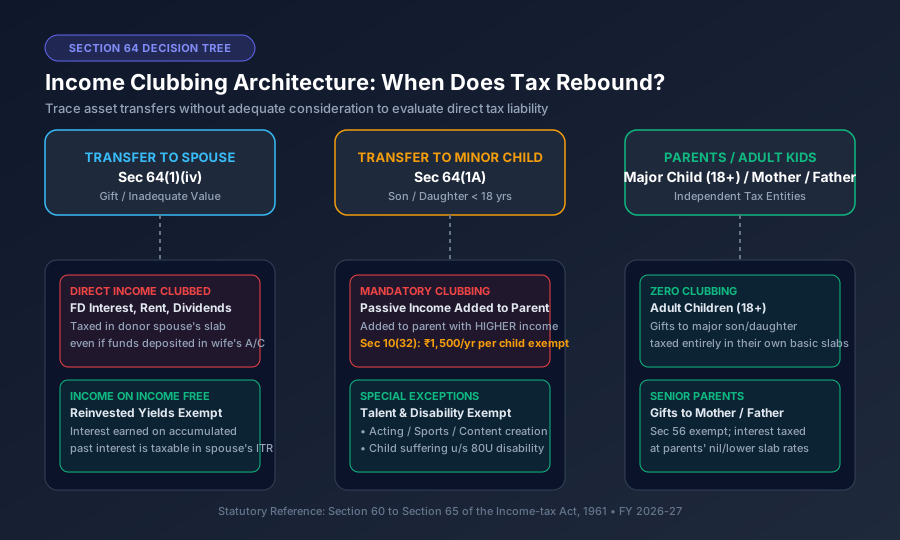
As illustrated in the flowchart above, the three critical axes of statutory scrutiny are: (1) whether adequate financial consideration was paid, (2) whether the recipient belongs to the restricted class of relatives under Section 64 (spouse, minor child, or son's wife), and (3) whether the returns represent direct first-generation income or secondary reinvested compounding.
8. Direct Tax Matrix: Gifting Across Different Family Relationships
The following analytical matrix summarizes the exact direct tax implications under the Income-tax Act, 1961 for asset transfers across every common family relationship, specifying both the upfront Section 56(2)(x) gift tax impact and the ongoing Section 64 clubbing consequences:
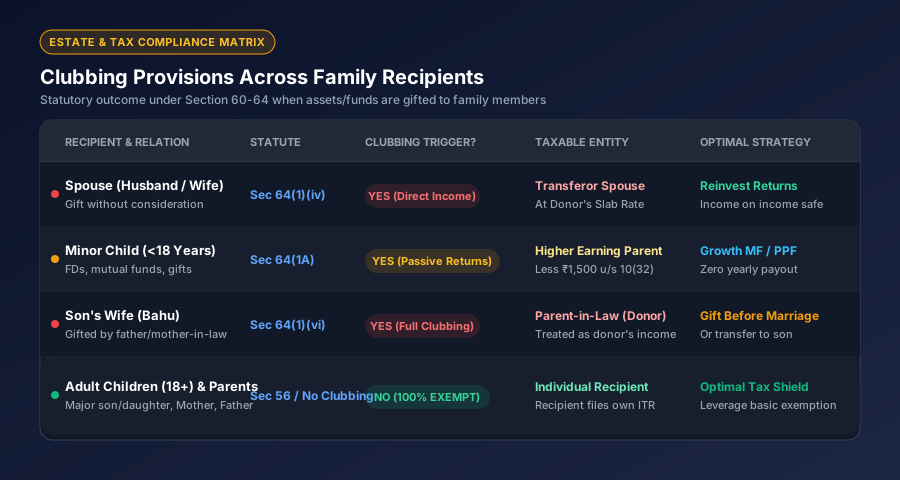
| Family Member Recipient | Gift Tax at Receipt (Sec 56(2)(x)) | Clubbing Triggered on Returns? (Sec 64) | Effective Tax Entity for Returns | Strategic Evaluation |
|---|---|---|---|---|
| Spouse (Wife / Husband) | 100% Tax-Free (Exempt Relative) | YES (Sec 64(1)(iv)) | Donor Spouse (at donor's peak slab) | Direct income clubbed; reinvested secondary returns remain spouse's wealth. |
| Minor Child (<18 Years) | 100% Tax-Free (Lineal Descendant) | YES (Sec 64(1A)) | Parent with Higher Total Income | ₹1,500 exemption u/s 10(32) under Old Regime only. Avoid passive yield instruments. |
| Son's Wife (Daughter-in-Law) | 100% Tax-Free (Exempt Relative) | YES (Sec 64(1)(vi)) | Parent-in-Law (Father/Mother-in-Law) | Full clubbing applies on all direct returns from gifted capital. |
| Major Child (Age 18+) | 100% Tax-Free (Lineal Descendant) | NO CLUBBING | Major Child (Own PAN & Basic Slabs) | Highly optimal tax shield. Exploit basic exemption (₹4L New / ₹2.5L Old). |
| Parents (Mother / Father) | 100% Tax-Free (Lineal Ascendant) | NO CLUBBING | Mother / Father (Senior Citizen Slabs) | Excellent strategy. Leverage senior citizen ₹50k Sec 80TTB interest deduction. |
| Son-in-Law (Daughter's Husband) | 100% Tax-Free (Exempt Relative) | NO CLUBBING | Son-in-Law (Own PAN & Slabs) | Statutory omission: No clubbing provision exists for son-in-law gifts. |
| Brother or Sister (Siblings) | 100% Tax-Free (Exempt Relative) | NO CLUBBING | Brother / Sister (Own PAN) | Zero clubbing, provided transfers are genuine and not part of circular reciprocal schemes. |
9. Legitimate Wealth Splitting Strategies: Major Children, Parents & Trusts
Given the rigorous enforcement of Section 64, how can high-earning taxpayers legally and legitimately optimize family tax liabilities without running afoul of the Income Tax Department? The following strategies represent legally compliant, judicially endorsed wealth-planning architectures for FY 2026-27 (AY 2027-28):
Strategy 1: Gifting to Adult Children (Age 18+)
The moment a son or daughter turns 18 years of age, Section 64(1A) minor clubbing ceases immediately. An adult college student or young professional is an independent taxable legal entity. You can gift ₹10,00,000, ₹25,00,000, or more to your 19-year-old child completely tax-free under Section 56(2)(x). When invested in bank FDs, debt instruments, or dividend-paying assets, the returns are taxed entirely in the adult child's hands. If the child has zero other income, they can earn up to ₹4,00,000 completely tax-free under the New Tax Regime (or up to ₹7,00,000 tax-free with Section 87A rebate), saving the family tens of thousands of rupees annually in tax outflow.
Strategy 2: Gifting to Retired Senior Citizen Parents
Gifting capital to your mother or father is completely tax-free upon receipt, and the Income-tax Act contains zero provisions to club parents' income with their children. If your parents are in lower tax brackets (or nil brackets), shifting interest-bearing capital to them provides multiple statutory advantages:
- Higher Basic Exemption Limit: Senior citizens (age 60+) enjoy an exemption threshold of ₹3,00,000 under the Old Regime, or ₹4,00,000 under the New Regime.
- Section 80TTB Deduction: Under the Old Regime, senior citizens can claim a dedicated tax deduction of up to ₹50,000 on interest income from bank fixed deposits and savings accounts (compared to just ₹10,000 u/s 80TTA for non-seniors).
- Nil Tax Liability up to ₹7.75 Lakhs: Under the New Tax Regime, a senior citizen earning up to ₹7,75,000 pays zero income tax after applying the Section 87A tax rebate.
Strategy 3: Non-Income-Generating or Growth-Oriented Assets for Spouse
If you desire to transfer wealth to your spouse, avoid transferring income-generating assets like fixed deposits, dividend stocks, or rental properties. Instead, transfer instruments designed strictly for capital appreciation:
- Growth-Option Equity Mutual Funds: Growth funds do not distribute dividends. As long as the units are held and not redeemed, zero income accrues, meaning zero clubbing occurs year-on-year. While capital gains upon eventual sale will technically be clubbed in the year of redemption, the compounding over 5 to 10 years happens unhampered by annual tax drag.
- Gold ETFs / Sovereign Gold Bonds (SGBs): Capital appreciation on gold instruments remains untaxed until liquidation.
- Self-Occupied Residential Property: Gifting a self-occupied house property (or registering it in the spouse's name) generates nil annual annual value under Section 23(2), triggering zero annual clubbing impact.
Strategy 4: Bona Fide Commercial Salary to Qualified Spouse (Proviso to Sec 64(1)(ii))
If you run a proprietorship firm, LLP, or private company and your spouse possesses genuine technical, professional, or academic qualifications (such as a degree in engineering, chartered accountancy, MBA, law, or certified design), you can employ your spouse and pay a legitimate commercial salary. Under the proviso to Section 64(1)(ii), clubbing is strictly barred if the remuneration is solely attributable to the application of the spouse's technical or professional knowledge and experience. The salary is deductible as a business expense for your firm and taxed in the spouse's independent hands, unlocking the ₹75,000 standard deduction under the New Tax Regime.
Simulate Your Family Tax Liability
Model your exact tax liability across New vs. Old Tax Regimes, calculate surcharge exposure, and evaluate optimal family salary distributions with our free suite of verified tools.
10. Frequently Asked Questions (FAQ)
What is the primary objective of Clubbing of Income under Section 64?
Under India's progressive tax slab structure, taxpayers in higher brackets frequently attempt to divert assets or cash to non-earning family members (such as homemaker spouses or minor children) to exploit their basic tax exemption limits. Sections 60 through 65 act as statutory anti-avoidance provisions that deem such diverted income to remain the income of the original transferor, taxing it at the transferor's higher marginal rate.
If I gift money to my spouse to open a Fixed Deposit, who pays tax on the interest earned?
Under Section 64(1)(iv), if you transfer monetary funds or capital assets to your spouse without adequate financial consideration (other than in connection with an agreement to live apart), any direct income generated from that gifted asset (such as bank FD interest, dividends, or rental yields) is mandatorily clubbed and taxed in your own income tax return at your applicable slab rate.
What is the "Income on Income" rule under Indian tax jurisprudence?
Landmark Supreme Court and High Court rulings (including CIT v. Premanand) established that clubbing under Section 64(1)(iv) applies ONLY to the direct income arising immediately from the transferred asset. If the recipient spouse accumulates that interest income and reinvests it into a new asset or instrument, the second-generation income (the "income on income") belongs exclusively to the spouse and is NOT clubbed with the transferor's income.
How is a minor child's income taxed under Section 64(1A)?
Under Section 64(1A), all income accruing to a minor child (under 18 years) is clubbed with the income of the parent whose total income (excluding the minor's income) is higher. The parent is entitled to an annual exemption of up to ₹1,500 per minor child under Section 10(32) under the Old Tax Regime. Clubbing does NOT apply if the minor child suffers from any disability specified under Section 80U, or if the child earns income through manual work or activities involving specialized talent, skill, or artistic knowledge.
What are cross-gifts and how does the Income Tax Department detect them?
Cross-gifting is a circular tax-evasion arrangement where Person A gifts funds to Person B's spouse or child, and simultaneously Person B gifts an equivalent sum to Person A's spouse or child, aiming to circumvent direct transfer rules under Section 64. The Supreme Court in CIT v. Keshavlal Lallubhai Patel ruled that interconnected and reciprocal transactions must be treated as part of a single unified scheme. Assessing Officers can pierce the circular veil and club the income back to the respective original donors.