Capital Contribution to HUF: Section 64(2) Clubbing Prevention Guide (FY 2026-27)
1. Legislative Genesis: The "Common Hotchpot" Doctrine & Section 64(2)
In traditional Hindu jurisprudence, a member of a coparcenary possesses the ancient right of blending—often termed "throwing self-acquired property into the common family hotchpot" or impressing personal wealth with the character of joint family property. When an individual abandoned his separate claims and merged personal assets into the ancestral family pool, Hindu law treated the asset as joint family estate.
During the mid-20th century, taxpayers extensively exploited this doctrine for aggressive tax avoidance. In the landmark case of CIT v. M.K. Stremann (1965) 56 ITR 62 (SC), the Supreme Court of India held that when a coparcener throws separate property into the joint family hotchpot, there is no "transfer" of property under general law, because the family is not a separate juristic transferee but an undivided unit of which the individual is already a part. Consequently, high-earning individuals threw lucrative rental properties, equity shares, and interest-bearing deposits into their newly minted HUFs completely tax-free, successfully diverting high-bracket income into the HUF's zero and low tax slabs.
To decisively dismantle this tax-avoidance mechanism, Parliament intervened through the Taxation Laws (Amendment) Act, 1970 by enacting Section 64(2) of the Income-tax Act, 1961. This statutory anti-avoidance provision explicitly overrides general Hindu personal law principles for direct tax purposes, establishing that throwing assets into the common hotchpot without full commercial consideration results in 100% tax attribution back to the individual transferor.
2. Deconstructing Section 64(2): The Statutory Clubbing Triggers
Section 64(2) operates with comprehensive statutory breadth. The statute provides that where an individual, being a member of a Hindu Undivided Family, after the 31st day of December, 1969:
- Converts at any time their separate property into property belonging to the family, through the act of impressing such separate property with the character of joint family property, or
- Throws such separate property into the common stock of the family, or
- Transfers such separate property, directly or indirectly, to the family otherwise than for adequate consideration,
then, for the purposes of computing the total income of such individual under the Income-tax Act, all income arising directly or indirectly from the converted property shall be deemed to arise to the individual and not to the family.
The Fallacy of "Natural Love and Affection"
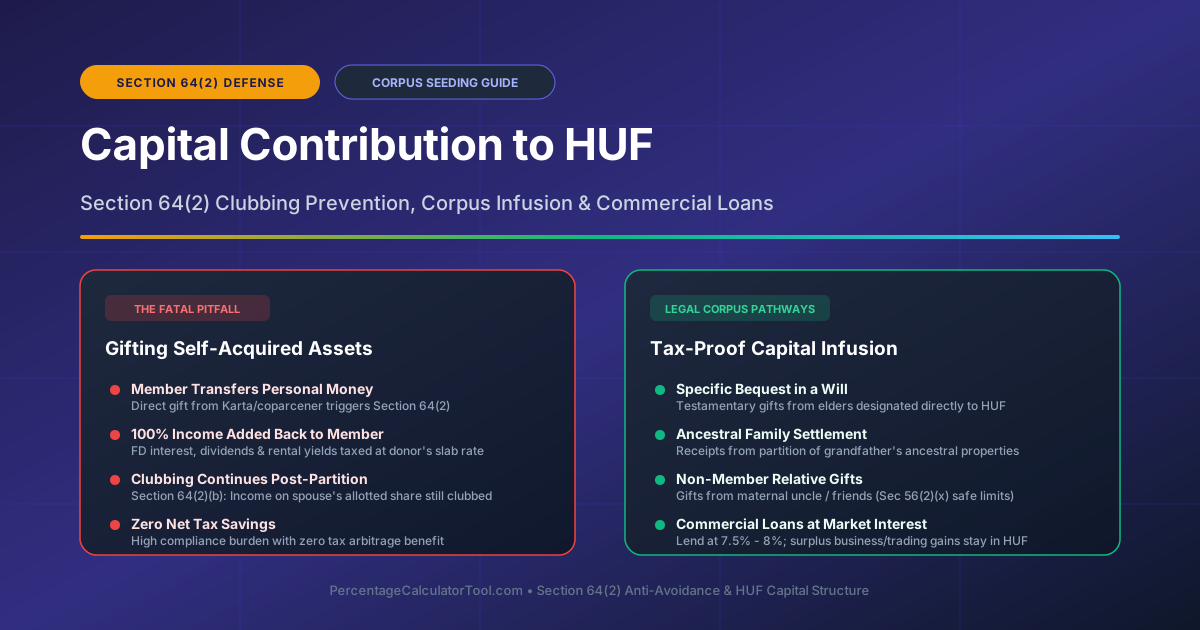
Many taxpayers mistakenly believe that executing a formal "Gift Deed" to their HUF on stamp paper citing "natural love and affection" shields them from tax scrutiny. Under established Supreme Court jurisprudence (beginning with Tulsidas Kilachand v. CIT 1961), natural love and affection does not constitute "adequate consideration" under the Income-tax Act. Adequate consideration demands an enforceable commercial, monetary quid pro quo. Any unilateral gift of personal savings from the Karta, his wife, or coparceners to the HUF is deemed a transfer without adequate consideration, triggering automatic, mandatory clubbing under Section 64(2).
If a software executive earning ₹25 LPA transfers ₹20,00,000 from his personal bank account into his HUF's account to open a bank Fixed Deposit yielding ₹1,50,000 annually, the Assessing Officer (AO) will apply Section 64(2) during automated AIS/SFT reconciliation. The entire ₹1,50,000 interest is stripped from the HUF's return and added back into the executive's personal ITR, taxing it at his 30% slab plus cess.
3. The Post-Partition Trap: Section 64(2)(b) & Spouse Allocations
Taxpayers historically attempted a secondary maneuver: throw self-acquired property into the HUF, wait a brief interval, and then execute a total partition of the HUF, allotting substantial chunks of the converted property to the homemaker spouse and minor children under the assumption that Section 64(2) would cease once the HUF was dissolved.
Parliament foresaw this scheme and enacted Section 64(2)(b), which establishes an enduring statutory clawback:
"Section 64(2)(b): Where the converted property has been the subject matter of a partition (whether partial or total) among the members of the family, the income derived from such converted property as is received by the spouse on partition shall be deemed to arise to the spouse from assets transferred indirectly by the individual to the spouse and shall be included in the total income of the individual."
Under Section 64(2)(b), the partition does not cleanse the asset. Any portion of the converted capital that is allotted to the spouse of the transferor member continues to generate income that is mandatorily clubbed into the transferor member's personal return under Section 64(1)(iv)! The statutory veil remains intact indefinitely.
Statutory Relief Note: However, Section 64(2)(b) targets only the share allotted to the spouse. Any portion of the converted property allotted upon partition to major (adult) sons or daughters ceases to be clubbed, because adult children are independent taxable entities and Section 64 does not club income of major children.
4. Compliant Pathway 1: Testamentary Bequests in a Will
The single most legally robust, unassailable method to capitalize an HUF without triggering Section 64(2) clubbing is through a specific testamentary bequest in a Will executed by an elder relative (such as a father, mother, grandfather, or uncle).
Why Testamentary Bequests are Immune from Clubbing
Section 64(2) applies strictly when an existing living member of an HUF transfers personal property to that HUF. When a deceased person bequeaths an asset through a Will, the transfer takes effect upon death. The deceased is not transferring assets to circumvent personal tax slabs, and Section 56(2)(x) explicitly excludes any property received under a Will or by way of inheritance from gift taxation.
Essential Drafting Language for a Will Bequest to an HUF
To ensure bulletproof tax compliance, the testator's Will must contain explicit, unambiguous language designating the bequest specifically for the beneficiary's HUF branch rather than the individual in his personal capacity:
"I hereby give, devise, and bequeath my fixed deposit bearing Account No. [XXXX] maintained with [Bank Name] having a principal sum of ₹[Amount], along with all accrued interest, exclusively to [Name of Son/Daughter] HINDU UNDIVIDED FAMILY (HUF), of which my son [Name] is Karta. It is my express intention and testamentary direction that this bequest shall constitute joint ancestral capital of the said HUF, to be held, invested, and enjoyed by the said HUF as a distinct entity, and shall not form part of the individual personal estate of my son."
Upon the testator's demise, the executor or Karta presents the registered Will, death certificate, and HUF PAN card to the bank or mutual fund house. The funds are credited directly to the HUF bank account. The capital becomes authentic, non-clubbed ancestral corpus, and 100% of future earnings are assessed strictly under the HUF's PAN at its independent basic tax slabs.
5. Compliant Pathway 2: Ancestral Family Partition Receipts
A second natural and legitimate method of capitalizing an HUF occurs when a broader ancestral family estate undergoes a total partition. Under traditional Mitakshara law, when a coparcener receives a share of ancestral property upon the partition of his father's or grandfather's larger joint family, that property does not become his separate self-acquired property; it retains the character of ancestral coparcenary property in his hands vis-à-vis his own sons and daughters.
Statutory Mechanics Under Direct Tax Law
- Section 47(i) Exclusion: The distribution of capital assets (land, commercial buildings, shares, fixed deposits) on the total partition of an HUF is not regarded as a "transfer" under Section 47(i), triggering zero capital gains tax at the point of division.
- Zero Section 64(2) Exposure: Because the capital originated from ancestral partition rather than a member's personal self-acquired salary or business income, Section 64(2) cannot be invoked by the Assessing Officer.
- Documentary Trail: The Karta must preserve the registered Partition Deed (or the final civil court decree of partition) along with the Section 171 assessment order passed in the case of the parent HUF. This establishes an unbroken chain of ancestral custody.
6. Compliant Pathway 3: Commercial Loans from Karta at Market Rates
For young families or professionals who do not have ancestral assets or pending inheritances, the most viable and practical mechanism to capitalize an HUF is through a Commercial Loan advanced by the Karta or a member.
Why a Loan Does Not Trigger Section 64(2)
Section 64(2) explicitly targets transfers "otherwise than for adequate consideration". A genuine loan advanced under a formal legal agreement with a commercial rate of interest is a bilateral contract supported by full financial consideration. A loan is an actionable claim and a balance-sheet liability for the HUF, not an unencumbered gift or blending of capital into the common hotchpot.
| Loan Parameter | Recommended Commercial Standard | Statutory Compliance Rationale |
|---|---|---|
| Interest Rate | 7.50% to 8.50% per annum (Arm's Length) | Must match prevailing State Bank of India 1-year MCLR or term deposit rates. Zero-interest loans trigger Section 64(2) deemed transfer scrutiny! |
| Documentation | Written Loan Agreement on Stamp Paper | Signed by Karta (as lender in individual capacity) and by adult coparceners on behalf of HUF. |
| Disbursement & Repayment | Strictly through Account Payee Bank Transfer | Cash loans exceeding ₹20,000 violate Section 269SS and attract 100% penalties under Section 271D. |
| Interest Servicing | Annual payment with proper TDS if applicable | Interest paid by HUF is taxable in Karta's personal return under "Other Sources". |
The Arbitrage: How an HUF Builds Corpus via Leveraged Business
How does a commercial loan generate tax savings if the Karta must pay tax on the interest received? The secret lies in deploying the borrowed capital into high-yield business, trading, or equity operations within the HUF:
- The Karta lends ₹30,00,000 from his personal savings to his HUF at 7.5% annual interest.
- The HUF pays ₹2,25,000 annual interest to the Karta. The Karta reports ₹2,25,000 in his personal ITR and pays tax.
- The HUF deploys that ₹30,00,000 into active financial markets, SME trading, algorithmic options strategies, or commercial operations generating a 15% return (₹4,50,000).
- The HUF deducts the ₹2,25,000 interest paid as a legitimate business expense under Section 36(1)(iii).
- The surplus net profit of ₹2,25,000 belongs exclusively to the HUF! Under the New Tax Regime, this ₹2,25,000 falls entirely within the HUF's ₹4,00,000 basic exemption limit, resulting in zero income tax.
- Over 5 to 7 years, these retained tax-free profits accumulate inside the HUF, creating an authentic, independent capital corpus of ₹15 to ₹25 Lakhs that belongs permanently to the HUF without debt!
7. Compliant Pathway 4: Gifts from Non-Members & Section 56(2)(x)
A fourth compliant strategy involves receiving gifts from individuals who are NOT members of the recipient HUF. Section 64(2) states with absolute precision: "Where an individual, being a member of a Hindu undivided family...". The statute does not apply to gifts made by strangers or non-members!
Who Qualifies as a Non-Member Relative?
Consider the family of Rajesh (Karta of Rajesh HUF, comprising Rajesh, his wife Priya, and their two children). The following individuals are completely external to Rajesh HUF:
- Maternal Relatives: Priya's father (father-in-law to Rajesh), Priya's brother (brother-in-law), or Rajesh's maternal uncle (mama). None of these individuals are coparceners or members of Rajesh HUF.
- Paternal Elders: Rajesh's father (who has his own separate HUF) can gift funds from his personal account or his own HUF.
Navigating the Section 56(2)(x) Relative Conundrum
While Section 64(2) is avoided when non-members gift capital, the taxpayer must carefully navigate Section 56(2)(x) (Gift Taxation):
- Under Explanation to Section 56(2)(x), the definition of "relative" in the case of an HUF means "any member thereof".
- Several Income Tax Appellate Tribunal (ITAT) benches (including ITAT Ahmedabad in Gyanchand M. Kothari and ITAT Rajkot in Pankaj Dahyabhai Patel) have ruled that gifts received by an HUF from relatives of the Karta or members (such as father, mother, or maternal uncle) are exempt from gift tax.
- However, to maintain absolute conservative safety and avoid litigation with aggressive Assessing Officers, non-member gifts from distant relatives or friends should be capped at ₹50,000 per financial year (which is universally 100% tax-free under Section 56(2)(x) regardless of relationship). A gift of ₹50,000 on the birth of a child or marriage anniversary can initialize the HUF account with zero tax exposure.
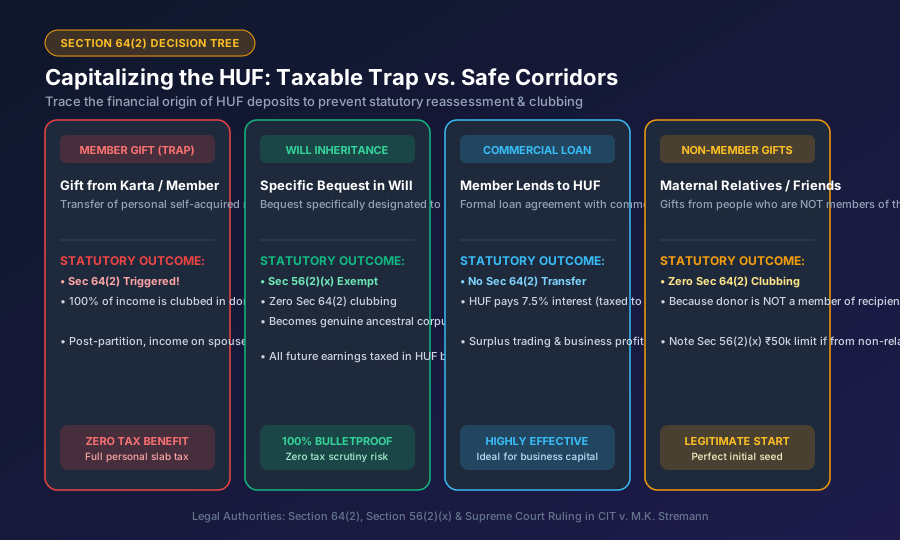
8. Audit Decision Tree: Tracing HUF Deposits
To determine whether any prospective capital infusion into your HUF will withstand scrutiny during a scrutiny assessment under Section 143(3), examine the following statutory decision tree:
9. Risk & Feasibility Matrix: Comparing All Capitalization Channels
The following analytical matrix summarizes the statutory risk profile, clubbing implications, and implementation documentation required across all primary HUF capitalization strategies for FY 2026-27 (AY 2027-28):
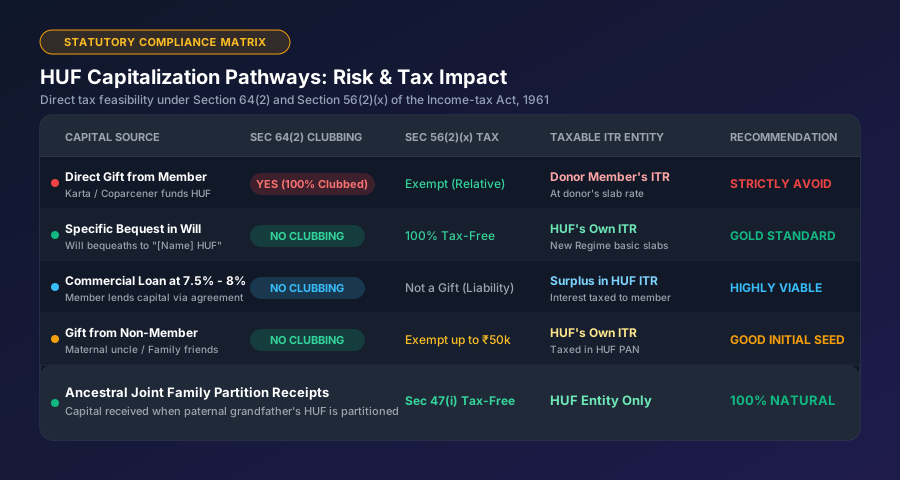
| Capital Source & Strategy | Section 64(2) Clubbing? | Section 56(2)(x) Gift Tax? | ITR Attribution | Documentary Protocol Required |
|---|---|---|---|---|
| Direct Gift from Karta / Member | YES (100% Clubbed) | Exempt (Transferee member) | Donor member's personal return at peak slab. | Avoid completely. Defeats all tax-planning objectives. |
| Testamentary Bequest in a Will | NO CLUBBING | 100% Exempt u/s 56(2)(x)(iv) | HUF's independent PAN at basic exemption slabs. | Registered Will with specific clause naming "[Name] HUF", death certificate, probate/notarization. |
| Ancestral Partition Distribution | NO CLUBBING | 100% Exempt u/s 47(i) | HUF's independent PAN as ancestral capital. | Registered Partition Deed, Section 171 assessment order of parent HUF, bank statements. |
| Commercial Loan from Karta (7.5%-8%) | NO CLUBBING | Not applicable (Debt obligation) | Interest to Karta; surplus trading profits to HUF. | Stamped loan agreement, bank transfer proof, annual interest computation, Form 26AS/AIS entries. |
| Non-Member Relative Gift (≤₹50k) | NO CLUBBING | 100% Exempt under basic threshold | HUF's independent PAN. | Gift letter from donor confirming non-member status and PAN, cheque/NEFT record. |
Simulate Your HUF's Direct Tax Savings
Model your multi-entity tax liabilities, calculate Section 87A rebate applicability, and evaluate post-tax yields across personal vs. HUF folios with our free calculation tools.
10. Frequently Asked Questions (FAQ)
What is Section 64(2) of the Income-tax Act, 1961?
Section 64(2) is a statutory anti-avoidance provision that applies when an individual, being a member of a Hindu Undivided Family (HUF), converts their personal self-acquired property into joint family property, throws it into the common hotchpot, or transfers it directly or indirectly to the HUF without adequate financial consideration. Under this section, all income arising from that transferred asset is deemed to remain the income of the individual member and is clubbed into their personal income tax return.
Can the Karta transfer his salary savings to the HUF bank account as a gift?
While a Karta can physically transfer money from his salary account to the HUF account, doing so as a gift without adequate consideration triggers Section 64(2). Consequently, any interest, dividends, or capital gains earned by the HUF on that gifted capital will be clubbed back into the Karta's personal ITR and taxed at his highest personal slab rate, neutralizing any tax-saving objective.
Does Section 64(2) clubbing continue if the HUF undergoes a partition?
Yes. Under Section 64(2)(b), where the converted property is subject to a partition among the members of the family, the income arising from the property allotted to the spouse of the transferor member continues to be clubbed with the income of the transferor. However, income from shares allotted to adult children post-partition is not clubbed.
How can a Karta give a loan to his HUF without triggering Section 64(2)?
A Karta can advance funds to his HUF as a bona fide commercial loan rather than a gift. A written loan agreement must be executed specifying a commercial market rate of interest (e.g., 7.5% to 8% per annum). The interest paid by the HUF is deductible for the HUF (if used for business/investments) and taxable in the Karta's hands. Any surplus profits or trading returns generated by the HUF beyond the interest cost belong to the HUF and are taxed at its own basic tax slabs without triggering Section 64(2).
Can an HUF receive tax-free gifts from maternal relatives under Section 56(2)(x)?
Under Section 56(2)(x), an HUF can receive gifts from relatives. For an HUF, any member of the HUF is considered a relative. However, if a gift is received from a non-member relative (such as the Karta's maternal uncle or maternal grandfather), Section 64(2) does NOT apply because the donor is not a member of the recipient HUF. If the donor is an individual relative of the members, gifts can be received tax-free to build the initial corpus.