HUF Coparcenary & Daughters' Rights: Hindu Succession Act Amendment Guide (FY 2026-27)
1. Historical Framework: The Mitakshara Coparcenary & Pre-2005 Gender Bias
Under traditional Hindu jurisprudence, property relations are governed predominantly by the Mitakshara School of Law (practiced across most of India, in contrast to the Dayabhaga School prevalent in West Bengal and Assam). At the heart of Mitakshara personal law lies the legal institution of the Coparcenary—a narrower, inner body within the larger joint Hindu family consisting exclusively of those persons who acquire an undivided, vested legal interest in the family's joint and ancestral property immediately upon their conception or birth.
For centuries, the traditional Mitakshara coparcenary was strictly patrilineal and agnatic. Coparcenary rights were restricted solely to male descendants up to four generations:
- The common male ancestor,
- His sons,
- His grandsons, and
- His great-grandsons.
Under this classical common law doctrine, a female family member—whether a daughter, wife, or mother—could never become a coparcener. While females were acknowledged as "members" of the joint family entitled to maintenance, residence, and marriage expenses out of the family estate, they held zero birthright in the ancestral properties and had no statutory standing to demand or initiate a partition of the HUF assets. When a male coparcener died intestate, his share in the joint family property devolved upon the surviving male coparceners by the ancient rule of survivorship, bypassing daughters entirely.
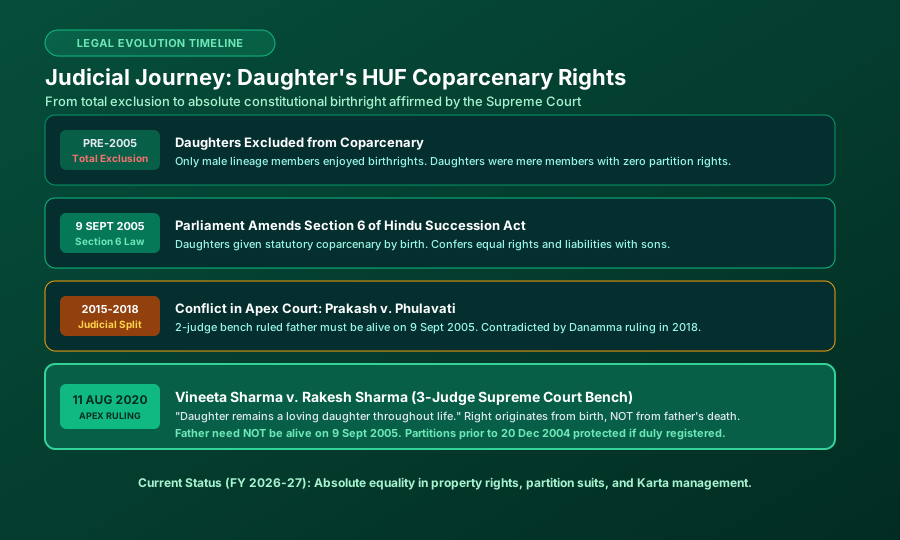
Even when the Hindu Succession Act was codified in 1956, Parliament preserved the male-dominated coparcenary under the original Section 6, granting daughters only an indirect succession share in the notional partition interest of their deceased father under Section 8. This structural disparity relegated millions of Indian women to financial dependency on male relatives for nearly five decades.
2. The 2005 Legislative Revolution: Section 6 Substituted
Recognizing that denying daughters equal inheritance rights in ancestral property violated Articles 14 and 15 of the Constitution of India, several progressive states (including Andhra Pradesh in 1986, Tamil Nadu in 1989, Maharashtra in 1994, and Karnataka in 1994) enacted state-level amendments granting coparcenary rights to unmarried daughters. Finally, Parliament stepped in to establish a uniform national mandate by passing the Hindu Succession (Amendment) Act, 2005 (Act No. 39 of 2005), which came into full statutory force on September 9, 2005.
The 2005 Amendment Act completely substituted Section 6 of the Hindu Succession Act, 1956 with a revolutionary statutory guarantee:
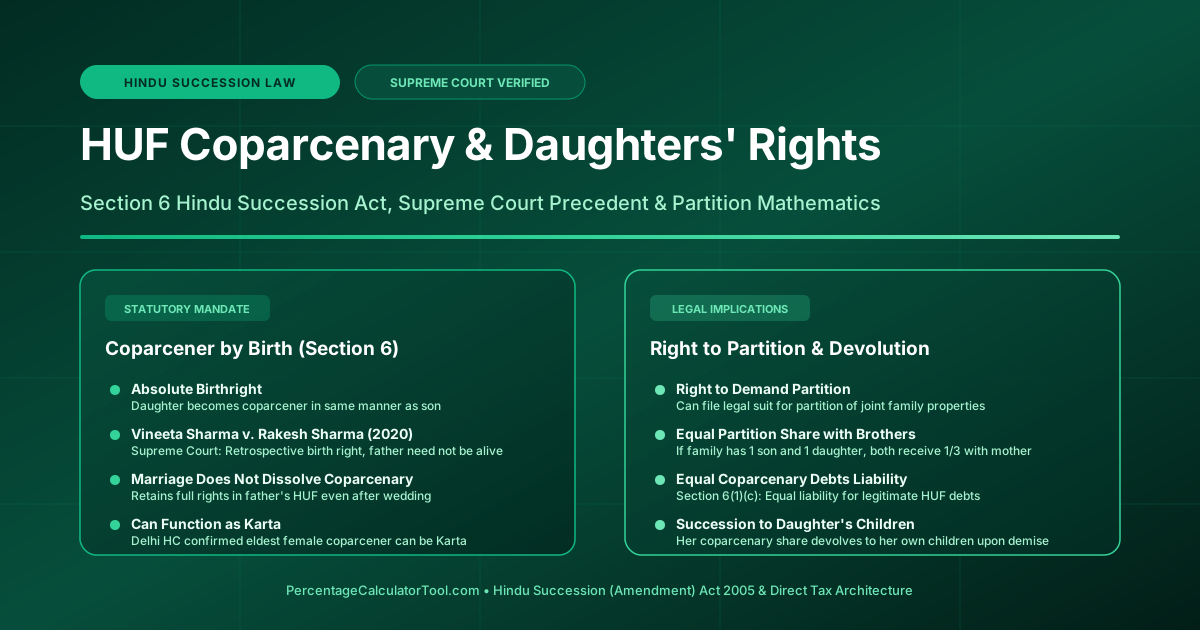
"Section 6(1): On and from the commencement of the Hindu Succession (Amendment) Act, 2005, in a Joint Hindu family governed by the Mitakshara law, the daughter of a coparcener shall—
(a) by birth become a coparcener in her own right the same manner as the son;
(b) have the same rights in the coparcenary property as she would have had if she had been a son;
(c) be subject to the same liabilities in respect of the said coparcenary property as that of a son,
and any reference to a Hindu Mitakshara coparcener shall be deemed to include a reference to a daughter of a coparcener."
This statutory substitution fundamentally altered the DNA of Hindu joint families. By explicitly enacting that a daughter becomes a coparcener "in the same manner as the son", the legislature abolished the agnatic monopoly. A daughter acquired the statutory legal power to claim an equal share in joint family assets, alienate her undivided interest by will (testamentary disposition u/s 30), and independently file a partition suit in a civil court.
3. The Definitive Landmark: Vineeta Sharma v. Rakesh Sharma (2020)
Despite the unequivocal language of Section 6, a decade of conflicting judicial interpretations plunged family estates and property registries into legal turmoil between 2015 and 2020. The central dispute was whether the 2005 amendment applied retrospectively or prospectively, and specifically whether the father (the coparcener) had to be alive on September 9, 2005 for the daughter to inherit.
The Conflict Between Two-Judge Benches
| Judicial Verdict | Bench & Year | Core Holding | Legal Impact |
|---|---|---|---|
| Prakash v. Phulavati (2016) 2 SCC 36 |
Justice Anil R. Dave & Justice A.K. Goel (2 Judges) | Held that the 2005 amendment is prospective. The daughter can only claim rights if both the daughter and the father were living on 9 September 2005. | Disqualified hundreds of thousands of daughters whose fathers passed away prior to September 2005. |
| Danamma @ Suman Surpur v. Amar (2018) 3 SCC 343 |
Justice A.K. Sikri & Justice Ashok Bhushan (2 Judges) | Held that daughters have an equal share in coparcenary property even if the father passed away in 2001 (prior to 2005), directly contradicting Phulavati. | Created an irreconcilable judicial deadlock across all Indian High Courts. |
The Historic Three-Judge Bench Resolution
To permanently resolve this constitutional conflict, a three-judge bench of the Supreme Court of India was constituted, comprising Justice Arun Mishra, Justice S. Abdul Nazeer, and Justice M.R. Shah. On August 11, 2020, the Supreme Court delivered its unanimous, historic judgment in Vineeta Sharma v. Rakesh Sharma (2020) 9 SCC 1, overruling Prakash v. Phulavati and cementing gender equality in Hindu succession law.
In his poetic and profound opening observations, Justice Arun Mishra famously authored:
"The daughters cannot be deprived of their right for equality conferred upon them by Section 6. A daughter remains a loving daughter throughout life. A son is a son until he gets a wife. A daughter remains a daughter for the rest of her life."
The Supreme Court laid down four monumental constitutional principles:
- Right Conferred by Birth: The provisions contained in substituted Section 6 of the Hindu Succession Act, 1956 confer the status of coparcener on the daughter born before or after the amendment in the same manner as a son with the same rights and liabilities.
- Father Need Not Be Alive on 9 September 2005: Since coparcenary rights are acquired by birth (unobstructed heritage), the death of the father prior to September 9, 2005 is completely irrelevant. The right does not flow through the father's demise; it attaches to the daughter's birth.
- Retroactive Application: The statute operates with retroactive effect. It takes in past events (a daughter's birth prior to 2005) to confer prospective rights on and from the date of the amendment.
- Safe Harbor for Registered Partitions: To prevent reopening century-old family settlements, Section 6(5) provides an absolute safe harbor: any partition, oral family settlement, or alienation that was completed and duly registered under the Registration Act, 1908 (or effected by a final court decree) prior to December 20, 2004 cannot be reopened by a daughter.
4. Jurisprudence of "Birthright": Apratibandha Daya Explained
The philosophical foundation of the Vineeta Sharma judgment rests on ancient Hindu jurisprudence regarding property inheritance, specifically the distinction between Apratibandha Daya (unobstructed heritage) and Sapratibandha Daya (obstructed heritage).
Apratibandha Daya vs. Sapratibandha Daya
- Apratibandha Daya (Unobstructed Heritage): Property in which a person acquires a vested legal right immediately upon their birth or conception. Ancestral joint family property belongs to this category. The existence or life of the father does not create an obstacle to the child's title. Sons were always recognized as holding Apratibandha Daya. By enacting Section 6, Parliament placed daughters on the exact same footing, granting them unobstructed heritage by birth.
- Sapratibandha Daya (Obstructed Heritage): Property in which a person acquires a right only upon the demise of the current owner. An individual's self-acquired property is obstructed heritage; the children have no right in it during the owner's lifetime. Their right is "obstructed" by the owner's existence and vests only if the owner dies intestate.
Because the Supreme Court recognized that Section 6 grants daughters Apratibandha Daya (unobstructed heritage), it follows inexorably that a daughter's coparcenary title does not depend on the survivorship or life of her father. The right was born when she took her first breath.
5. Marital Status & Dual Standing: Married Daughters in Paternal HUF
A widespread and persistent misconception in Indian society is that once a daughter gets married and enters her husband's family, she forfeits her rights in her father's ancestral property and HUF. Under current Indian law, this belief is completely false.
Dual Standing of a Married Hindu Woman
The Hindu Succession (Amendment) Act, 2005 makes no distinction between married and unmarried daughters. A daughter continues to be a full coparcener in her father's HUF even after her wedding. Consequently, a married Hindu woman occupies a unique and powerful dual legal standing:
| Legal Standing | Father's HUF (Paternal Family) | Husband's HUF (Matrimonial Family) |
|---|---|---|
| Status Held | COPARCENER (By Birth) | MEMBER (By Marriage) |
| Right to Ancestral Assets | Acquires equal undivided ownership interest by birth. | Right to maintenance, residence, and support from corpus. |
| Right to Demand Partition | YES. Can independently initiate a partition suit against brothers/father. | NO. Cannot demand partition; receives share only if partition is called. |
| Share on Actual Partition | Receives an equal share with brothers and father. | Receives an equal share with husband and sons on partition. |
| Devolution Upon Death | Her coparcenary share passes to her own children and heirs u/s 6(3). | Her membership interest ceases upon demise. |
When a married daughter passes away, her undivided coparcenary share in her father's HUF does not vanish or revert to her brothers. Under Section 6(3), her share devolves upon her own legal heirs—meaning her sons, daughters, and husband inherit her coparcenary interest in her paternal ancestral estate!
6. Can a Daughter Function as Karta? High Court Precedents
Traditionally, the management of an HUF was vested exclusively in the senior-most male coparcener as Karta. However, once Parliament equated the rights of daughters with sons under Section 6, the question arose: Can an eldest daughter act as the Karta of an HUF?
The Precedent: Mrs. Sujata Sharma v. Shri Manu Gupta (2015)
In a pathbreaking decision, the High Court of Delhi in Mrs. Sujata Sharma v. Shri Manu Gupta (CS (OS) No. 2011/2006, decided on 22 December 2015) authoritatively resolved this question. The plaintiff, Mrs. Sujata Sharma, being the eldest living coparcener of the D.N. Gupta HUF following the death of her father and uncles, claimed the right to act as the Karta.
Justice Najmi Waziri held:
"If a male member of an HUF, by virtue of his being the first-born elder, can be a Karta, so can a female member. Section 6 of the Hindu Succession Act has explicitly removed the disability of a daughter to become a coparcener. To hold that she cannot be a Karta would be to reintroduce the very discrimination that the legislative amendment sought to eradicate."
Under Indian law today, an eldest daughter possesses the full legal competency to become the Karta of her father's HUF. As Karta, she can manage all movable and immovable properties, execute sale deeds, operate HUF bank accounts, manage Demat portfolios, and represent the family before the Income Tax Department.
7. Timeline Infographic: The Judicial Journey to Gender Equality
The following visual timeline chronicles the major statutory milestones and judicial pronouncements that transformed women's coparcenary rights in India:
8. Partition Mathematics: Pre-2005 vs. Post-Vineeta Sharma Allocation
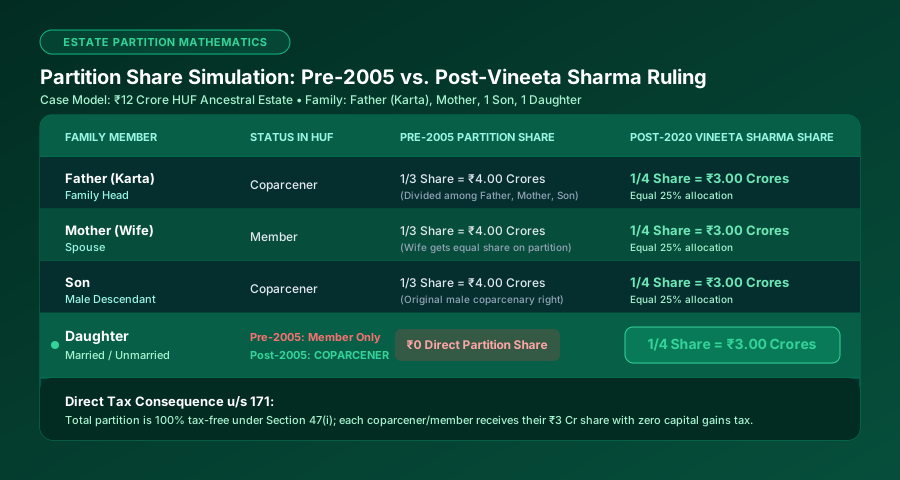
To grasp the profound economic impact of this legal transformation, let us evaluate a real-world mathematical partition simulation. Consider an HUF holding ancestral real estate, equity portfolios, and liquid fixed deposits valued at ₹12 Crores.
Family Composition: Father (Karta), Mother (Wife), 1 Son, and 1 Daughter.
Case A: Partition Allocation Pre-2005 Law
Under the pre-2005 legal framework, only male coparceners (Father and Son) and the Mother (entitled to an equal share upon a partition between husband and son under Hindu law) were allotted shares. The daughter was merely a member and received ₹0 in direct partition share:
- Father's Coparcenary Share: 1/3 = ₹4.00 Crores
- Mother's Partition Share: 1/3 = ₹4.00 Crores
- Son's Coparcenary Share: 1/3 = ₹4.00 Crores
- Daughter's Coparcenary Share: ₹0.00 (No legal claim on joint estate)
Note: The daughter received a share only upon her father's demise, where his individual 1/3 share (₹4 Cr) was divided equally among his Class I heirs (Mother, Son, Daughter = ₹1.33 Cr each). Her total effective entitlement was only ₹1.33 Cr out of a ₹12 Cr family estate.
Case B: Post-Vineeta Sharma (2020) Mandate
Under substituted Section 6 as interpreted by the Supreme Court, the daughter is a coparcener by birth with equal standing to the son. When a partition occurs, the joint property is divided equally among all coparceners and the mother:
- Father (Coparcener): 1/4 Share = ₹3.00 Crores (25%)
- Mother (Member): 1/4 Share = ₹3.00 Crores (25%)
- Son (Coparcener): 1/4 Share = ₹3.00 Crores (25%)
- Daughter (Coparcener): 1/4 Share = ₹3.00 Crores (25%)
The daughter's legal claim on the ancestral pool expands from ₹0 direct partition capital to an immediate, enforceable ₹3.00 Crores, on par with her brother.
9. Direct Tax Implications: Section 47(i) & Section 171 Partition Rules
When an HUF is partitioned to allocate assets to coparceners (including daughters), how does the Income Tax Department treat the transaction? Does the physical transfer of land, commercial properties, or share certificates attract capital gains tax?
1. Complete Tax Exemption Under Section 47(i)
Section 47 of the Income-tax Act, 1961 lists transactions that are explicitly excluded from the definition of "transfer" under Section 2(47). Clause (i) provides:
"Section 47: Nothing contained in Section 45 shall apply to the following transfers: (i) any distribution of capital assets on the total or partial partition of a Hindu Undivided Family."
Therefore, zero capital gains tax is payable by the HUF or by any coparcener/daughter on the date of partition. Whether a daughter receives ₹1 Crore in cash, shares, or real estate, the receipt is completely tax-free upon distribution.
2. Cost of Acquisition and Holding Period Step-Up (Section 49(1))
When the daughter subsequently sells the asset she received on partition, capital gains are computed under Section 49(1)(i). The cost of acquisition for the daughter is deemed to be the cost for which the HUF originally acquired the asset, and her holding period includes the entire duration for which the HUF held the asset. This allows the daughter to claim long-term capital gains status (12.5% tax beyond ₹1.25 Lakhs) even if she sells the asset shortly after partition.
3. Section 171: Mandatory Total Partition Recognition
Under Section 171 of the Income-tax Act, an HUF that has been assessed to tax can only be derecognized if a Total Partition takes place. All assets of the HUF must be partitioned by metes and bounds among all coparceners and members. The Karta must file an application under Section 171 before the Assessing Officer (AO). The AO conducts a formal inquiry, gives notice to all members (including daughters), and passes an official order derecognizing the HUF. If only some properties are partitioned while the HUF continues to hold others (a partial partition), Section 171(9) mandates that the Income Tax Department will ignore the partial partition and continue assessing the HUF as if no partition took place!
Plan Your Estate & Family Tax Strategy
Model your capital gains tax exposure on inherited properties, simulate family tax liabilities across regimes, and evaluate estate allocations with our free financial tools.
10. Frequently Asked Questions (FAQ)
What rights did the Hindu Succession (Amendment) Act, 2005 grant to daughters?
The Hindu Succession (Amendment) Act, 2005 substituted Section 6 of the principal Act with effect from September 9, 2005. It declared that in a joint Hindu family governed by Mitakshara law, the daughter of a coparcener shall by birth become a coparcener in her own right in the same manner as a son, have the same rights in coparcenary property as she would have had if she had been a son, and be subject to the same liabilities in respect of the coparcenary property as that of a son.
Does the father need to be alive on September 9, 2005 for a daughter to claim coparcenary rights?
No. In the historic three-judge bench verdict of Vineeta Sharma v. Rakesh Sharma (2020), the Supreme Court of India authoritatively held that coparcenary rights are conferred upon a daughter by birth (unobstructed heritage or Apratibandha Daya). Therefore, it is NOT necessary that the father of the daughter should have been alive on September 9, 2005. A daughter born prior to 2005 can claim equal coparcenary rights even if her father passed away before the 2005 amendment.
Does a daughter lose her rights in her father's HUF after she gets married?
No. Marriage does not terminate or diminish a daughter's coparcenary status in her paternal HUF. Under Hindu personal law, she remains a coparcener by birth in her father's joint family throughout her entire life. Simultaneously, upon marriage, she becomes a "Member" in her husband's HUF. Thus, a married Hindu woman holds dual standing: a coparcener with partition rights in her father's HUF, and a member entitled to maintenance and partition shares in her husband's HUF.
Can an eldest daughter become the Karta of an HUF?
Yes. In the precedent of Mrs. Sujata Sharma v. Shri Manu Gupta (2015), the Delhi High Court ruled that since Section 6 of the Hindu Succession Act places daughters on an identical legal footing as sons regarding coparcenary rights, an eldest female coparcener possesses the full legal entitlement to manage family assets and act as the Karta of the HUF upon the demise of her father.
How is the partition of an HUF taxed under the Income-tax Act, 1961?
Under Section 47(i) of the Income-tax Act, 1961, any distribution of capital assets on the total partition of an HUF is explicitly excluded from the definition of "transfer". Therefore, no capital gains tax is payable by either the HUF or the coparceners (including daughters) upon receiving their respective shares during an actual partition. Section 171 governs the direct tax assessment and derecognition of the partitioned HUF.