Black Money Act 2015: Undisclosed Foreign Income & Assets, Section 43 Penalties, Schedule FA Compliance & Tech RSUs (FY 2026-27)

Executive Statutory Warning
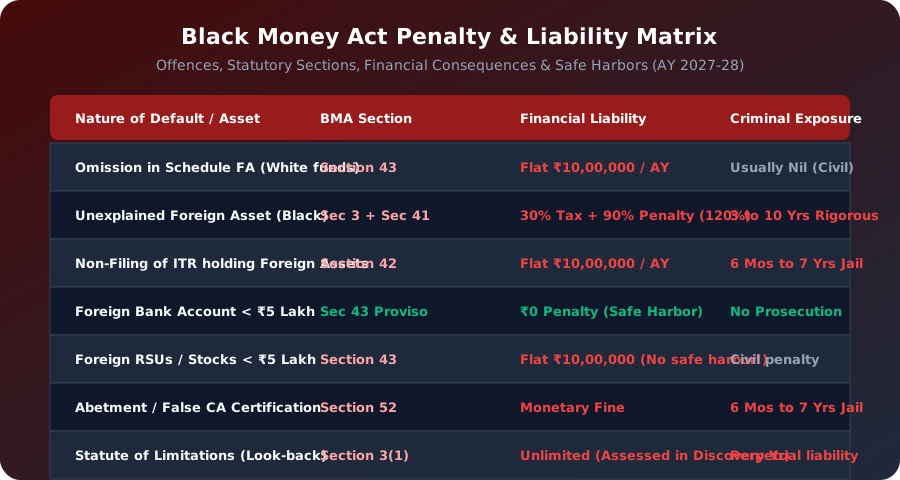
Enacted by the Indian Parliament as an aggressive, sui generis criminal tax statute, the Black Money (Undisclosed Foreign Income and Assets) and Imposition of Tax Act, 2015 (BMA) operates entirely outside the normal procedural boundaries of the Income Tax Act, 1961. The BMA recognizes no statute of limitations: an undisclosed foreign asset acquired twenty years ago is assessed at its current Fair Market Value in the year the tax department discovers it, subjecting the assessee to a flat 30% tax under Section 3 and a mandatory 90% penalty under Section 41 (totaling 120% financial confiscation). More dangerously for salaried software engineers and returning expatriates, Section 43 imposes a flat ₹10,00,000 (₹10 Lakh) fine per assessment year for mere failure to report foreign assets in Schedule FA of the ITR—even if the assets (such as US tech RSUs, ESPPs, or checking accounts) were acquired from 100% legitimate, fully tax-paid earnings. This definitive guide details every clause of the BMA, Section 43/44 penalties, the ₹5 Lakh bank safe harbor, and Table-by-Table Schedule FA reporting protocols for FY 2026-27 (AY 2027-28).
Table of Contents
- Legislative Architecture: How the Black Money Act Overrides Income Tax
- Scope of Chargeability: Who Is Governed by the BMA?
- Substantive Liabilities: 30% Tax + 90% Mandatory Penalty (120% Confiscation)
- Section 43 Penalty: The Flat ₹10 Lakh Fine for Schedule FA Omission
- The ₹5 Lakh Foreign Bank Account Safe Harbor (And Why RSUs Are Excluded)
- Criminal Prosecution under Section 50: Rigorous Imprisonment (3 to 10 Years)
- The Salaried Techie Dilemma: US RSUs, ESPP & Overseas Brokerage Accounts
- Table-by-Table Schedule FA Reporting Master Guide (ITR-2 / ITR-3)
- Global Data Pipelines: How the CBDT Automatically Catches Unreported Accounts
- Remedial Strategies: Can You File ITR-U to Escape BMA Penalties?
- Frequently Asked Questions (FAQ)
1. Legislative Architecture: How the Black Money Act Overrides Income Tax
Prior to 2015, undisclosed foreign income and offshore bank accounts were prosecuted under the Income Tax Act, 1961. However, revenue authorities were severely constrained by procedural roadblocks: assessing officers were bound by strict reassessment time limits under Section 149 (formerly 6 years, now 3 to 10 years), assessees could claim deductions under Chapter VI-A, and penalty adjudications under Section 271(1)(c) were frequently overturned on grounds of technical intent.
To create an uncompromising, zero-tolerance enforcement regime, Parliament enacted the Black Money (Undisclosed Foreign Income and Assets) and Imposition of Tax Act, 2015, which came into force on July 1, 2015.
Key Structural Distinctions Between BMA and Income Tax Act:
- No Statute of Limitations (Perpetual Look-Back): Under Section 3(1) of the BMA, undisclosed foreign assets are charged to tax in the previous year in which they come to the notice of the Assessing Officer, irrespective of the year in which the asset was actually acquired. If an assessee purchased an apartment in London in 1998 using undisclosed funds, and the CBDT discovers it in 2026, the entire asset is assessed at its Fair Market Value in 2026!
- Zero Deductions or Set-Off: Under Section 5 of the BMA, no deduction in respect of any expenditure, allowance, or Chapter VI-A deductions is permissible. Furthermore, no loss (whether domestic or foreign) can be set off against undisclosed foreign income or assets.
- Autonomous Appellate Framework: Assessments and penalties under the BMA cannot be regularized or condoned through standard Income Tax Settlement Commissions or standard rectification procedures.
2. Scope of Chargeability: Who Is Governed by the BMA?
The applicability of the Black Money Act is tied strictly to tax residency under Section 6 of the Income Tax Act:
This leads to two profound legal conclusions:
- Non-Residents (NRIs) are 100% Exempt: An individual who qualifies as a Non-Resident under Section 6 has zero obligation to report foreign assets to the Indian government and cannot be prosecuted under the Black Money Act.
- RNORs Enjoy Total Statutory Immunity: An individual qualifying as a "Resident but Not Ordinarily Resident" under Section 6(6) is NOT an assessee under the BMA. Returning expatriates during their 1 to 3-year RNOR holiday do not file Schedule FA and face zero BMA exposure.
- The Trap for Full Residents (ROR): The moment an individual transitions into ROR status, every single foreign asset—regardless of how tiny, whether acquired when they were an NRI, or whether funded from legitimate salary—enters the mandatory disclosure jurisdiction of the BMA.

3. Substantive Liabilities: 30% Tax + 90% Mandatory Penalty (120% Confiscation)
Where an Indian resident holds an undisclosed foreign asset whose source of investment cannot be explained to the satisfaction of the Assessing Officer, the financial consequences are catastrophic:
1. Flat 30% Tax under Section 3
Under Section 3(1), tax is charged at a flat rate of 30% of the value of the undisclosed foreign asset.
Valuation Rule 3: The value of the asset is determined at its Fair Market Value (FMV) on the first day of the financial year in which it is discovered by the tax officer. If an asset originally purchased for $100,000 has appreciated to $1,000,000 (roughly ₹8.5 Crore) at the time of discovery, the 30% tax is levied on the entire ₹8.5 Crore, not on the original purchase price.
2. Mandatory 90% Penalty under Section 41
Under Section 41 of the BMA, the Assessing Officer shall direct that the assessee pay by way of penalty, in addition to the tax, a sum equal to three times the tax computed under Section 3.
Tax under Section 3 = 30% of FMVPenalty under Section 41 = 90% of FMV (3 × 30%)Total Confiscatory Demand = 120% of Current Fair Market Value!
Because the tax demand exceeds the total value of the offshore asset, the assessee must dip into domestic Indian assets to pay the differential 20% plus compounding interest.
4. Section 43 Penalty: The Flat ₹10 Lakh Fine for Schedule FA Omission
While the 120% tax and penalty applies to "black money" (unexplained or illicit funds), the vast majority of tax notices issued under the BMA target completely innocent, law-abiding taxpayers under Section 43.
The Statutory Language of Section 43:
Section 43 states that if any person, being a resident and ordinarily resident in India, fails to furnish in the return of income any information about any asset located outside India, or furnishes inaccurate particulars, the Assessing Officer may direct that such person shall pay by way of penalty a sum of ₹10,00,000 (Ten Lakh Rupees).
The "White Funds" Doctrine:
Tax courts and appellate tribunals (including the Mumbai and Delhi ITAT) have repeatedly confirmed that Section 43 is a strict liability disclosure penalty.
- It does NOT matter that the foreign asset was acquired using post-tax salary saved while living abroad as an NRI.
- It does NOT matter that foreign shares were purchased through official RBI banking channels under the Liberalised Remittance Scheme (LRS).
- It does NOT matter that foreign dividends were duly reported under "Income from Other Sources" and full Indian tax was paid!
If the asset was simply omitted from Schedule FA (Foreign Assets) of the ITR, the Assessing Officer is empowered to levy a flat ₹10 Lakh penalty for EACH assessment year of omission. If an employee failed to disclose an overseas account across four consecutive tax returns, the cumulative penalty reaches ₹40,00,000 (₹40 Lakh)!
5. The ₹5 Lakh Foreign Bank Account Safe Harbor (And Why RSUs Are Excluded)
Recognizing the harshness of Section 43 on junior professionals and students who left minor foreign checking accounts open with small balances, Parliament inserted a specific legislative proviso to Section 43:
Critical Analytical Caveats of the Safe Harbor:
- Applies Exclusively to Bank Accounts: The safe harbor covers ONLY depository/bank accounts (checking, savings, term deposits). It is completely inapplicable to immovable property, trusts, mutual funds, or equity shares.
- RSUs & Foreign Stocks Disqualified: If you hold even a single share of Apple, Google, or Microsoft worth $200 (₹17,000) through an overseas broker (E*TRADE, Schwab) and omit it from Schedule FA, the ₹5 Lakh safe harbor does NOT protect you! The ₹10 Lakh penalty under Section 43 applies in full force.
- Aggregate Peak Balance Test: The ₹5,00,000 ceiling applies to the aggregate peak balance across ALL foreign bank accounts combined at any time during the year, not to individual accounts in isolation.
6. Criminal Prosecution under Section 50: Rigorous Imprisonment (3 to 10 Years)
Beyond astronomical monetary fines, the Black Money Act contains severe criminal sanction provisions designed to deter non-compliance:
Section 50: Willful Failure to Disclose Foreign Assets
Under Section 50 of the BMA, if an individual being a resident and ordinarily resident willfully fails to furnish the return of income, or fails to disclose foreign assets/income in the return, they shall be punishable with rigorous imprisonment for a term which shall not be less than 6 months but which may extend to 7 years, along with fine.
Section 51: Willful Attempt to Evade Tax
Where an assessee willfully attempts to evade tax, penalty, or interest chargeable under the BMA, Section 51 prescribes rigorous imprisonment for a term ranging from 3 years to 10 years, and with fine.
Non-Compoundable Nature: Unlike ordinary offences under the Income Tax Act which can be settled through compounding by paying administrative fees, offences involving undisclosed foreign assets under the BMA are categorized as non-compoundable economic crimes.
7. The Salaried Techie Dilemma: US RSUs, ESPP & Overseas Brokerage Accounts
The demographic most severely impacted by Section 43 penalty notices in Bengaluru, Hyderabad, Gurugram, and Pune is salaried software engineers working for Indian subsidiaries of US technology conglomerates (e.g., Google, Amazon, Microsoft, Adobe, Meta, Oracle, Cisco).
Why Tech Employees Fall into the Penalty Trap:
- TDS Was Already Deducted in India: When Restricted Stock Units (RSUs) vest, the Indian employer computes the perquisite value under Section 17(2) and deducts 30%+ TDS from the employee's domestic salary. Because the tax was fully paid in India and reflected on Form 16, the employee assumes no further reporting is necessary.
- Using ITR-1 (Sahaj): Taxpayers frequently file ITR-1 because they earn only salary and savings interest. However, ITR-1 does NOT contain Schedule FA! In fact, the CBDT rules explicitly prohibit any individual holding foreign assets from filing ITR-1 or ITR-4. They are legally mandated to file ITR-2 or ITR-3. Filing ITR-1 when holding foreign shares is treated as an invalid return and constitutes non-disclosure under Section 43.
- Foreign Custodial Account Ignored: Holding RSUs involves two separate foreign assets: (a) the custodial brokerage account itself (e.g., Charles Schwab or E*TRADE), and (b) the actual equity shares held within that account. Both must be reported in Schedule FA!
8. Table-by-Table Schedule FA Reporting Master Guide (ITR-2 / ITR-3)
Schedule FA contains ten distinct reporting tables. Every resident taxpayer holding foreign interests must report their holdings according to the calendar year (January 1 to December 31) or the relevant accounting period of the foreign jurisdiction:
| Table | Asset Description | What to Report | Mandatory Data Points |
|---|---|---|---|
| Table A1 | Foreign Depository Accounts | Overseas bank checking, savings, and term deposits. | Bank name, address, IBAN/account number, peak balance during year, closing balance, gross interest credited. |
| Table A2 | Foreign Custodial Accounts | Overseas brokerage accounts (E*TRADE, Fidelity, Schwab, Zerodha US). | Custodian name, address, account number, peak balance, closing value, gross interest/dividend paid. |
| Table A3 | Foreign Equity & Debt Interests | Vested RSUs, ESPPs, shares of foreign companies, mutual funds. | Entity name, address, country code, total investment cost, peak value during year, closing value, total gross dividend/gain. |
| Table A4 | Foreign Cash Value Insurance | Offshore life insurance or annuity contracts with surrender value. | Insurance company name, policy number, cash surrender value at year end. |
| Table B | Foreign Immovable Property | Apartments, land, villas owned outside India. | Country, address, acquisition date, total investment, income derived (rent). |
| Table D | Signing Authority Accounts | Accounts where you have signing power (overseas corporate/trust accounts). | Institution name, account holder name, peak balance during year. |
Forex Conversion Rule:
All foreign values (peak balances, closing values, dividends, and interest) must be converted into Indian Rupees using the Telegraphic Transfer (TT) Buying Rate of the State Bank of India (SBI) as of the relevant valuation date.
9. Global Data Pipelines: How the CBDT Automatically Catches Unreported Accounts
Many taxpayers mistakenly assume that offshore assets remain invisible to the Indian tax department. This is a hazardous misconception in the modern financial transparency era.
1. The Common Reporting Standard (CRS) Network
India is a signatory to the OECD's Multilateral Competent Authority Agreement on Automatic Exchange of Financial Account Information (AEOI/CRS). Over 110 countries (including the UK, Switzerland, Singapore, UAE, Germany, Canada, and Mauritius) automatically collect financial account information of Indian tax residents from local banks and transmit it electronically to the CBDT every September.
2. FATCA (Foreign Account Tax Compliance Act)
Under the bilateral Intergovernmental Agreement (IGA) between India and the United States, the US Internal Revenue Service (IRS) routinely shares bulk data on US brokerage and bank accounts associated with Indian tax identification numbers (PAN).
3. Project Insight & AIS Integration
The CBDT's artificial intelligence engine, Project Insight, automatically matches CRS and FATCA feeds against the assessee's PAN. If a foreign bank account or RSU holding is detected in the data stream but is missing from Schedule FA in the corresponding ITR-2/3, the system automatically triggers an automated nudge, followed by formal summons under Section 131(1A) or inquiry notices under Section 10 of the Black Money Act.
10. Remedial Strategies: Can You File ITR-U to Escape BMA Penalties?
Taxpayers who discover past omissions in Schedule FA often wonder whether they can file an Updated Return (ITR-U) under Section 139(8A) to retroactively include the foreign assets.
The ITR-U Statutory Limitation:
Under the direct tax rules governing Section 139(8A), an assessee is strictly prohibited from filing ITR-U if they hold foreign assets or earn foreign-source income. The e-filing portal deliberately disables Schedule FA within the ITR-U utility. Therefore, an ITR-U cannot be used to cure past non-disclosure of foreign assets.
Recommended Legal Action Plan:
- Current & Future ITR Compliance: Immediately ensure that the upcoming ITR (ITR-2 or ITR-3) accurately discloses every single foreign asset across Tables A1 through D. Never file ITR-1 or ITR-4 if you hold foreign shares or bank accounts.
- Respond to Section 10 Notices with Full Proof of Funds: If you receive an inquiry notice under Section 10 of the BMA, immediately engage a qualified cross-border tax counsel. Provide bank statements, employer perquisite Form 16 certificates, and inward remittance proofs establishing that the asset was acquired out of tax-paid white funds. Proving legitimate origin eliminates the 120% tax/penalty under Section 3/41 and leaves only the procedural Section 43 dispute.
- Judicial Defense Against Section 43: Several Income Tax Appellate Tribunals (such as ITAT Delhi in Sh. Shravan Kumar vs ACIT and ITAT Bangalore) have ruled that where non-disclosure was an inadvertent bona fide mistake, the source of funds was fully disclosed in domestic employer returns, and no intent to evade tax existed, the Section 43 penalty can be challenged on constitutional grounds of proportionality.
11. Frequently Asked Questions (FAQ)
What is the tax and penalty rate under the Black Money Act, 2015?
Under Section 3 of the Black Money Act, undisclosed foreign income or assets are taxed at a flat rate of 30% of the Fair Market Value of the asset in the year of discovery. In addition, Section 41 mandates a compulsory penalty equal to three times the tax (90% of the asset value), resulting in an aggregate financial liability of 120% without any basic exemption, deduction, or loss set-off.
What is the penalty under Section 43 for failing to report foreign assets in Schedule FA?
Under Section 43 of the Black Money Act, any resident individual who fails to furnish information or provides inaccurate details in Schedule FA (Foreign Assets) of the Income Tax Return is liable to a flat penalty of ₹10,00,000 (₹10 Lakh) per assessment year. This penalty applies strictly, even if the asset was purchased out of fully explained, tax-paid Indian funds.
What is the ₹5,00,000 safe harbor exception under Section 43?
The proviso to Section 43 provides a limited safe harbor: the flat ₹10 Lakh penalty does not apply to an individual who fails to report foreign bank accounts in Schedule FA if the aggregate balance or peak balance across all such foreign bank accounts did not exceed ₹5,00,000 at any time during the previous year. Crucially, this relief applies ONLY to bank accounts and does NOT protect unlisted foreign shares, ESOPs, RSUs, or mutual funds.
Does the Black Money Act apply to Non-Residents (NRIs) and RNORs?
No. The Black Money Act, 2015 applies strictly to persons who are 'Resident and Ordinarily Resident' (ROR) in India. Non-Residents (NR) and Residents but Not Ordinarily Residents (RNOR) are statutorily exempt from reporting foreign assets in Schedule FA and cannot be assessed under the Black Money Act for overseas assets.
Are tech workers holding US RSUs or ESPP covered under Schedule FA?
Yes. Indian residents working in multinational corporations who hold vested foreign shares, unvested RSUs, or Employee Stock Purchase Plan (ESPP) shares with US brokers (such as E*TRADE, Morgan Stanley, or Charles Schwab) are legally mandated to disclose them in Table A3 of Schedule FA. Failure to report them triggers the flat ₹10 Lakh penalty under Section 43.
Can an assessee file an Updated Return (ITR-U) to disclose omitted foreign assets?
No. Under the direct tax rules governing Section 139(8A), an Updated Return (ITR-U) cannot be filed by an individual who is holding foreign assets or whose total income includes income from foreign sources, nor can an ITR-U be filed to cure non-disclosure in Schedule FA to escape Section 43 penalties under the Black Money Act.
Explore Related Cross-Border & Tax Planning Calculators
Estimate your direct tax liabilities, simulate stock options, and model tax burdens:
Cross-Border Anti-Avoidance & Litigation Desk
Authored by international direct tax litigators and foreign exchange defense counsel at PercentageCalculatorTool. Citations reflect the Black Money Act, 2015, OECD CRS conventions, and judicial precedents for Assessment Year 2027-28.