Will Writing, Succession & Estate Tax Planning in India (FY 2026-27)
1. The Power of Testamentary Succession: Intestate vs. Testamentary
In India, when an individual departs without executing a legally valid Will, they die intestate. In an intestate situation, the deceased's personal wishes, lifetime commitments, or moral promises carry zero legal weight. The deceased's hard-earned wealth—comprising real estate, bank deposits, mutual fund folios, equity portfolios, and gold—is rigidly divided strictly according to the default formulas of personal religious succession statutes:
- For Hindus, Buddhists, Jains, and Sikhs: Governed by the Hindu Succession Act, 1956. Assets are divided equally among Class I heirs (mother, widow, sons, and daughters). If any child has predeceased, their share branches down to their children.
- For Christians, Parsis, and Jews: Governed by the Indian Succession Act, 1925.
- For Muslims: Governed by Muslim Personal Law (Shariat), which limits testamentary bequests to a maximum of one-third of the net estate, with two-thirds distributed among Quranic sharers and residuaries.
Intestate succession frequently triggers bitter family feuds, frozen bank accounts, locked properties, and multi-year succession certificate litigation in civil courts. Executing a Will (Testamentary Succession) empowers a person to supersede default intestate formulas for their separate, self-acquired property, ensuring that their life's wealth is distributed with surgical precision to the exact individuals, family branches, HUF entities, or charitable trusts they choose.
2. Statutory Essentials: Sections 59 & 63 of the Indian Succession Act
The substantive and procedural law governing the execution, validity, and interpretation of Wills in India is codified in the Indian Succession Act, 1925. Two pivotal sections define the baseline validity of any testamentary document:
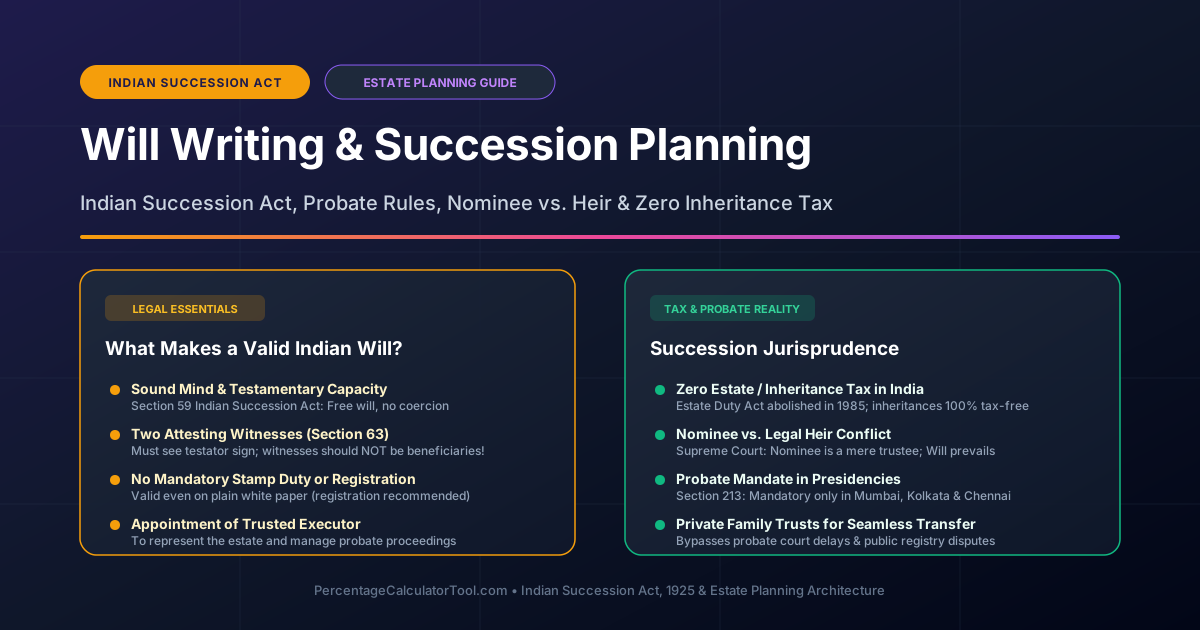
1. Section 59: Testamentary Capacity & Sound Mind
Under Section 59, every person of sound mind not being a minor may dispose of his property by Will. To establish sound testamentary capacity, the law does not demand medical perfection; it requires that the testator understands the nature of the act, the extent of the property being disposed of, and the claims of the persons who would naturally expect to benefit.
A Will executed under the influence of intoxication, coercion, fraud, or undue influence is statutorily void. For elderly testators (aged 70+), it is highly advisable to obtain a signed Medical Fitness Certificate from a registered medical practitioner on the date of execution confirming mental alertness, which effectively neutralizes future allegations of dementia or senility.
2. Section 63: The Mandatory Execution & Attestation Rules
Section 63 establishes three strict procedural conditions for the execution of an unprivileged Will:
- Testator's Signature: The testator must sign or affix their mark (thumb impression) to the Will, or it must be signed by some other person in their presence and by their direction. Crucially, the testator should sign at the bottom of every single page of the document to prevent fraudulent sheet substitution.
- Two Attesting Witnesses: The Will must be attested by two or more witnesses, each of whom must have seen the testator sign or affix their mark, or received from the testator a personal acknowledgment of their signature. Each witness must sign the Will in the physical presence of the testator.
- The Section 67 Beneficiary Disqualification: Under Section 67 of the Act, if a person who attests a Will is also named as a legatee or beneficiary in that Will, the Will itself remains valid, but the bequest to that attesting witness (or to the spouse of that witness) becomes completely void! Therefore, an attesting witness must always be an independent third party (such as a trusted chartered accountant, doctor, advocate, or family friend) who receives zero financial benefit from the estate.
3. Anatomy of a Bulletproof Will: Drafting Clauses & Residuary Mandate
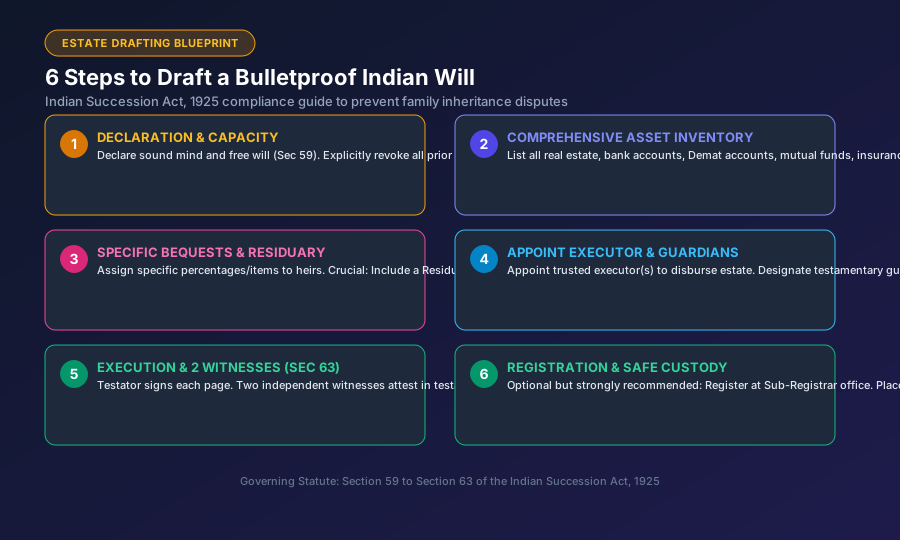
A legally sound Will does not require complex Victorian legalese. It requires absolute clarity, complete absence of ambiguity, and a logical structure comprising the following six indispensable clauses:
Essential Drafting Clauses for a Bulletproof Indian Will
- Declaration of Identity & Capacity: State your full legal name, father's/spouse's name, PAN, residential address, and an explicit declaration: "I am of sound disposing mind, memory, and understanding, and I am making this Will voluntarily, of my own free will, without any coercion, fraud, or undue influence."
- Revocation of Prior Wills: Prevent conflict with older drafts: "I hereby cancel and revoke all my former Wills, codicils, and testamentary dispositions made by me at any time heretofore."
- Appointment of Executor(s): Name a reliable executor (and an alternate executor): "I appoint Shri [Name], residing at [Address], to be the Sole Executor of this my Last Will. In the event he predeceases me or is unwilling to act, I appoint Smt. [Alternate Name] as alternate Executor."
- Specific Bequests (Asset Allocation): Clearly identify properties with full details (bank account numbers, branch IFSC, Demat DP ID, municipal property survey numbers, square footage): "I bequeath my residential apartment bearing Flat No. 402, [Complex Name], Bengaluru, to my daughter [Name] absolutely and forever."
- The Critical Residuary Clause: A Will must account for assets acquired after the date of execution or forgotten during drafting: "All the rest, residue, and remainder of my estate, both movable and immovable, of whatsoever nature and wheresoever situated, which I may possess or be entitled to at the time of my death, I give, devise, and bequeath to [Name of Spouse / Son / Daughter]." Without a residuary clause, unlisted assets fall into intestate succession!
- Testimonium & Attestation Clause: Signature block for the testator followed by the formal attestation statement signed by two witnesses specifying their names, addresses, and phone numbers.
4. Stamp Duty & Registration Realities: Debunking Common Myths
Widespread confusion exists among Indian families regarding the formal documentation requirements for a Will. The two most common myths are that a Will must be written on expensive stamp paper and that it is invalid unless registered.
Myth 1: "A Will Must Be on Stamp Paper"
Reality: Zero Stamp Duty. Under the Indian Stamp Act, 1899 and all state stamp laws, a Will is completely exempt from stamp duty. A Will drafted on plain A4 printer paper or handwritten on a blank sheet of paper carries the identical legal force as a document typed on high-denomination non-judicial stamp paper. Paying stamp duty on a Will is completely unnecessary.
Myth 2: "An Unregistered Will is Legally Invalid"
Reality: Registration is 100% Optional. Under Section 18(e) of the Registration Act, 1908, the registration of a Will is strictly optional. An unregistered Will executed in compliance with Section 63 of the Indian Succession Act is fully enforceable in every court of law across India.
Why Registration is Strongly Recommended in Practice
Although optional, registering your Will with the Sub-Registrar (under Book 3) provides immense strategic advantages:
- Evidentiary Superiority: The Sub-Registrar verifies the identity, photograph, and biometrics of the testator and witnesses. This establishes a heavy legal presumption of genuine execution, making it exceedingly difficult for disgruntled relatives to challenge the Will on grounds of forgery, impersonation, or coercion.
- Safe Custody at Registry: The original Will is scanned into official government digital archives. Even if the physical paper is lost, damaged, or destroyed, a certified true copy can be retrieved from the Sub-Registrar's office.
5. When is Probate Mandatory? The Presidency Towns Doctrine (Section 213)
One of the most widely misunderstood concepts in Indian estate planning is the requirement of Probate. A Probate is a certified copy of a Will issued under the official seal of a court of competent jurisdiction (typically a District Court or High Court exercising testamentary jurisdiction), with a grant of administration to the estate of the testator.
The Statutory Rule: Section 213 Read with Section 57
Under Section 213(1) of the Indian Succession Act, 1925, no right as an executor or legatee can be established in any court of justice unless a court of competent jurisdiction has granted probate of the Will. However, sub-section (2) carves out a historical exception based on Section 57, which limits the mandatory probate rule strictly to:
- Wills made by any Hindu, Buddhist, Sikh, or Jain within the local limits of the ordinary original civil jurisdiction of the High Courts of Mumbai (Bombay), Kolkata (Calcutta), or Chennai (Madras); or
- Wills made outside those territories, but relating to immovable property situated within the local limits of Mumbai, Kolkata, or Chennai.
| Jurisdiction & Property Location | Probate Mandatory? | Statutory Authority & Judicial Precedents |
|---|---|---|
| Mumbai, Kolkata, or Chennai (Will executed or property situated inside city limits) |
YES (MANDATORY) | Sections 57(a), 57(b) & Section 213(1). Banks, registrars, and buyers will refuse mutation without court probate. |
| Delhi NCR (New Delhi, Gurgaon, Noida, Faridabad) |
NO (OPTIONAL) | Delhi High Court full bench in Kanta Yadav v. Om Prakash Yadav (2019) confirmed probate is not mandatory in Delhi. |
| Bengaluru, Hyderabad, Pune, Ahmedabad (All other Indian cities and states) |
NO (OPTIONAL) | Supreme Court in Clarence Pais v. Union of India (2001) 4 SCC 325 held probate is not required outside presidency towns. |
In non-presidency territories (like Delhi, Karnataka, Telangana, or Gujarat), legal heirs can directly mutate municipal property records, transfer electricity meters, and liquidate bank accounts by presenting the registered Will along with the death certificate and an indemnity bond, bypassing the expensive court fees (which reach up to ₹75,000 in Maharashtra) and 1 to 3 years of probate court delays.
6. The "Nominee vs. Legal Heir" War: Supreme Court Precedents
Perhaps the most pervasive legal fallacy among Indian investors is the assumption: "I have registered my elder son as the 100% nominee in my bank Fixed Deposits, mutual funds, and Demat account, so he automatically inherits the money without needing a Will."
The Constitutional Truth: Nominee is NOT the Owner
The Supreme Court of India has repeatedly crushed this misconception. In the landmark case of Sarbati Devi v. Usha Devi (1984) 1 SCC 424, the Supreme Court authoritatively settled the status of a nominee:
"A nomination does not confer any beneficial interest on the nominee. A nomination only indicates the hand which is authorized to receive the amount from the bank or insurance company, so that the debtor may get a valid discharge of its liability. The amount, however, can be claimed by the legal heirs of the deceased in accordance with the law of succession."
This principle was decisively reaffirmed by the Supreme Court in Shakti Yezdani v. Jayanand Jayant Salgaonkar (2023), where the Court ruled that even under the Companies Act and Depositories Act, a nominee in a Demat account or company shares is merely a trustee holding the securities on behalf of the legal heirs named in the Will. If your Will leaves your estate to your daughter, but your bank account names your son as nominee, the bank will hand the money to your son—who is legally bound under trust law to transfer every single rupee to your daughter!
7. Blueprint Infographic: 6 Steps to Draft a Valid Indian Will
To ensure that your testamentary document is legally sound and immune from civil litigation, follow this 6-step statutory execution roadmap:
8. Succession Vehicle Matrix: Will vs. Trust vs. Gift vs. Nomination
The following analytical matrix evaluates the primary wealth-transmission instruments available to Indian taxpayers under current direct tax and estate laws:

| Estate Planning Vehicle | When Title Transfers | Probate Mandate? | Stamp Duty & Transaction Costs | Litigation Risk & Tax Impact |
|---|---|---|---|---|
| Registered Will | Strictly upon death of testator. Full lifetime control retained. | Mandatory only in Mumbai, Kolkata & Chennai. | Zero stamp duty. Nominal registration fee (₹100 - ₹500). | 100% tax-free under Section 56(2)(x). Can be contested on grounds of mental capacity. |
| Private Family Trust | Immediate upon settlement or gradual as per trust deed. | NO PROBATE REQUIRED (Bypasses court system) | Stamp duty payable on Trust Deed based on state stamp law. | Extremely low litigation risk. Complete bankruptcy and creditor protection if irrevocable. |
| Lifetime Gift Deed | Immediately during donor's lifetime. Permanent loss of control. | NO PROBATE REQUIRED | Heavy state stamp duty (2% to 7% on market circle rate). | 100% tax-free to specified relatives u/s 56(2)(x). Risk of elder abandonment post-transfer. |
| Bank / Demat Nomination | Temporary custody upon death. Title does NOT vest in nominee. | Subject to succession suits by legal heirs. | Zero cost (simple banking form). | High dispute risk. Nominee is merely a custodian; must surrender to heirs in Will. |
9. Direct Tax Status of Inheritances: Section 56(2)(x) & Estate Duty Status
One of the greatest financial blessings for Indian families is that India currently imposes zero inheritance tax or estate duty.
1. The Demise of the Estate Duty Act
Under the Estate Duty Act, 1953, the Government of India previously levied a steep estate tax of up to 85% on the value of properties passing upon death. However, recognizing that the tax generated negligible revenue while causing immense economic harassment and capital flight, Parliament repealed the Estate Duty Act with effect from March 16, 1985. For over four decades, inheritances in India have enjoyed complete tax immunity.
2. Blanket Exemption Under Section 56(2)(x)
Under Section 56(2)(x) of the Income-tax Act, 1961, while gifts from unrelated persons exceeding ₹50,000 are taxed under "Income from Other Sources", the fourth proviso to the section carves out an explicit, unconditional exception:
"Provided that this clause shall not apply to any sum of money or any property received—
(a) from any relative; or
(b) under a will or by way of inheritance; or
(c) in contemplation of death of the payer or donor..."
Regardless of whether you inherit ₹50 Lakhs, ₹50 Crores, or ₹500 Crores in gold, ancestral land, commercial towers, or corporate shares, the receipt of inherited assets is 100% exempt from income tax in India.
3. Capital Gains on Eventual Sale (Section 49(1))
When the beneficiary eventually decides to sell the inherited asset, capital gains are computed with generous statutory concessions:
- Step-Up in Cost Basis (Section 49(1)(iii)): The cost of acquisition for the heir is deemed to be the cost for which the deceased person originally acquired the asset. If acquired prior to April 1, 2001, the heir can adopt the Fair Market Value (FMV) as on April 1, 2001.
- Holding Period Indexation (Section 2(42A)): The period of holding by the deceased is aggregated with the period of holding by the heir. Therefore, inherited properties almost always qualify for long-term capital gains status (12.5% tax beyond ₹1.25 Lakhs for listed equity; 12.5% without indexation for real estate under FY 2026-27 rules).
Simulate Your Estate & Capital Gains Tax Liability
Model your long-term capital gains exposure on inherited real estate, evaluate post-tax yields across personal vs. HUF entities, and optimize your wealth distribution with our free suite of calculators.
10. Frequently Asked Questions (FAQ)
Does a Will in India need to be written on stamp paper or registered?
No. Under Indian law, a Will does not require stamp paper and does not attract any stamp duty. A Will written on a plain sheet of white paper is 100% legally valid if it is signed by the testator in the presence of two independent attesting witnesses. Furthermore, registration of a Will under Section 18 of the Registration Act, 1908 is optional. However, registering a Will with the Sub-Registrar provides strong evidentiary value against claims of forgery or coercion.
Where is obtaining a Probate of a Will legally mandatory in India?
Under Sections 57 and 213 of the Indian Succession Act, 1925, obtaining a Probate from a civil court is legally mandatory ONLY if: (1) the Will was executed within the ordinary original civil jurisdiction of the High Courts of Mumbai, Kolkata, or Chennai, or (2) the Will relates to immovable property situated within those presidency towns. For all other cities and states in India (such as Delhi, Bengaluru, Hyderabad, or Pune), probate is completely optional unless a specific local title dispute arises.
Does a bank or Demat nominee override the beneficiaries named in a Will?
No. The Supreme Court of India in landmark judgments (including Sarbati Devi v. Usha Devi and Shakti Yezdani v. Jayanand Jayant Salgaonkar) authoritatively ruled that a nominee is merely a "trustee" or "custodian" authorized by financial institutions to receive funds upon death. Nomination does NOT confer beneficial ownership. The beneficial ownership of the assets devolves strictly according to the deceased's registered Will or the statutory rules of intestate succession.
Is there an inheritance tax or estate duty in India?
No. India does not levy any inheritance tax or estate duty. The Estate Duty Act, 1953 was repealed by Parliament in 1985. Under Section 56(2)(x) and Section 47(iii) of the Income-tax Act, 1961, assets, money, or real estate received by way of inheritance or under a Will are 100% exempt from income tax in the hands of the beneficiary.
Can a beneficiary under a Will also act as an attesting witness?
No. While under Section 67 of the Indian Succession Act, 1925, a Will does not become invalid if a beneficiary witnesses it, any bequest or legacy given to that attesting witness (or to the spouse of that witness) becomes completely void! Therefore, attesting witnesses must always be independent third parties (such as trusted friends, family physicians, or legal advisors) who receive zero benefit under the Will.