Table of Contents
- 1. Section 16(ia) Standard Deduction: History, Purpose & ₹75,000 Hike
- 2. Section 87A Rebate: The Mechanics of the ₹25,000 Tax Credit
- 3. The ₹7.75 Lakh Zero-Tax Math Step-by-Step
- 4. Marginal Relief Explained: Why Earning ₹7,05,000 Doesn't Trigger ₹25k Tax
- 5. Official Income Tax Slabs for FY 2026-27 (AY 2027-28)
- 6. Old vs New Regime: Standard Deduction & 87A Comparison
- 7. Real Scenarios: ₹7.5 LPA, ₹8 LPA, ₹10 LPA & ₹12 LPA
- 8. 5 Critical Confusions Around 87A & Standard Deduction
- 9. Frequently Asked Questions (FAQ)
- 10. Summary & Action Plan
1. Section 16(ia) Standard Deduction: History, Purpose & ₹75,000 Hike
The Standard Deduction under Section 16(ia) is one of the most generous and straightforward provisions in the Indian tax code. It is an unconditional, flat deduction granted against income taxable under the head "Salaries".
Historically, salaried employees in India had to collect and submit physical proof for transport allowance (₹19,200 per annum) and medical reimbursements (₹15,000 per annum). In Budget 2018, the government abolished those cumbersome paperwork-heavy allowances and replaced them with a flat standard deduction of ₹40,000, which was later enhanced to ₹50,000.
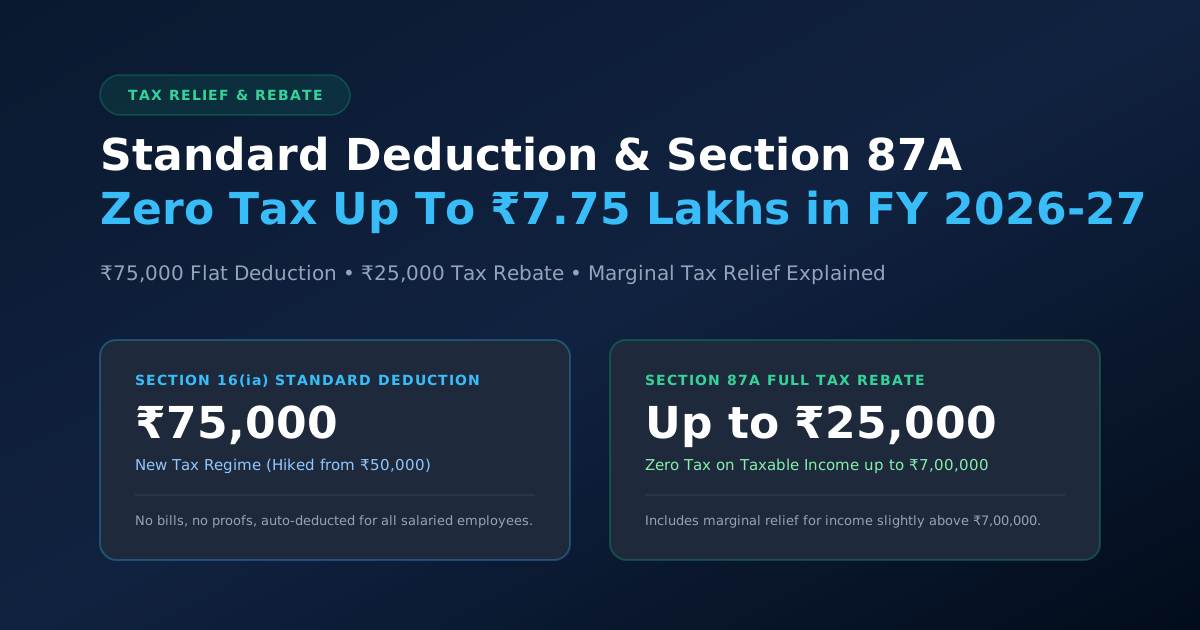
In the Union Budget, the Central Government delivered a major tax-relief boost specifically aimed at middle-class salaried employees by hiking the standard deduction from ₹50,000 to ₹75,000 under the New Tax Regime for FY 2026-27 (AY 2027-28).
Key Rule: The ₹75,000 standard deduction is applicable only under the New Tax Regime. If you choose the Old Tax Regime, the standard deduction remains capped at the legacy limit of ₹50,000.
Who is eligible?
- All full-time and part-time salaried employees across private, PSU, and government organizations.
- Pensioners receiving pension income from a former employer (classified under "Salaries"). Family pension receives a standard deduction under Section 57(iia) of ₹25,000 (hiked from ₹15,000 under the New Regime).
- Who is NOT eligible? Freelancers, consultants, professionals filing under presumptive taxation Section 44ADA, sole proprietors, and partners receiving firm remuneration.
2. Section 87A Rebate: The Mechanics of the ₹25,000 Tax Credit
While the standard deduction reduces your gross income to arrive at net taxable income, Section 87A is a direct tax credit applied against your calculated tax liability before the addition of the 4% Health and Education Cess.
The statutory rules governing Section 87A for FY 2026-27 are:
- Under New Tax Regime: Available to resident individuals whose net taxable income does not exceed ₹7,00,000. The maximum rebate allowable is ₹25,000 (or 100% of the computed tax liability, whichever is lower).
- Under Old Tax Regime: Available to resident individuals whose net taxable income does not exceed ₹5,00,000. The maximum rebate allowable is ₹12,500.
It is crucial to understand that Section 87A is an all-or-nothing threshold subject to marginal relief. If your taxable income is ₹7,00,000, your rebate is ₹25,000, and your net tax is ₹0. In the next section, we will see how the standard deduction and 87A work together like clockwork.
3. The ₹7.75 Lakh Zero-Tax Math Step-by-Step
One of the most heavily searched queries among Indian salaried professionals is: "How can someone earning ₹7.75 Lakhs pay zero income tax without making any tax investments?"
Here is the exact mathematical step-by-step audit under the New Tax Regime for FY 2026-27:

| Step | Tax Component / Slab | Amount (₹) | Explanation |
|---|---|---|---|
| 1 | Gross Salaried Income | ₹7,75,000 | Total salary received excluding employer PF |
| 2 | Less: Standard Deduction u/s 16(ia) | - ₹75,000 | Automatic flat deduction under New Regime |
| 3 | Net Taxable Income | ₹7,00,000 | Threshold for tax computation |
| 4 | Tax on ₹0 to ₹3,00,000 (0%) | ₹0 | Exempt baseline slab |
| 5 | Tax on ₹3,00,001 to ₹7,00,000 (5%) | ₹20,000 | 5% on ₹4,00,000 slab width (Revised Slabs) |
| 6 | Total Tax Before Rebate | ₹25,000 | Gross tax liability |
| 7 | Less: Tax Rebate u/s 87A | - ₹25,000 | 100% rebate since taxable income ≤ ₹7,00,000 |
| 8 | Net Tax Payable | ₹0 | Balance after 87A credit |
| 9 | Add: 4% Health & Education Cess | ₹0 | 4% of ₹0 = ₹0 |
| 10 | FINAL NET TAX PAYABLE | ₹0 | 100% Tax-Free Take-Home! |
This is why the New Tax Regime has become extraordinarily popular among early-career professionals earning between ₹6 LPA and ₹8 LPA: you do not need to lock up your cash in 15-year PPF accounts or insurance policies simply to save tax.
4. Marginal Relief Explained: Why Earning ₹7,05,000 Doesn't Trigger ₹25k Tax
Now consider a terrifying scenario that used to haunt taxpayers: what happens if an employee receives an extra ₹5,000 bonus, pushing their taxable income to ₹7,05,000?
Under the strict language of the slab rates, once taxable income exceeds ₹7,00,000 by even a single rupee, Section 87A ceases to apply. On ₹7,05,000, normal tax would be ₹25,500. Add 4% cess, and total tax would be ₹26,520!
Think about how absurd that would be: by earning an extra ₹5,000, the employee would have to pay ₹26,520 in tax—leaving them ₹21,520 poorer than if they had refused the increment!
To eliminate this grotesque cliff-effect anomaly, the Parliament introduced the Marginal Relief Proviso under Section 87A for the New Tax Regime.
The Statutory Marginal Relief Rule
Tax Payable CANNOT exceed the income earned in excess of ₹7,00,000.
Let us calculate the exact tax payable on a taxable income of ₹7,05,000 using the marginal relief formula:
- Excess Income Over ₹7,00,000: ₹7,05,000 - ₹7,00,000 = ₹5,000.
- Normal Tax Computed on ₹7,05,000: ₹25,500.
- Marginal Relief Granted: ₹25,500 - ₹5,000 = ₹20,500.
- Tax Payable Before Cess: Capped at ₹5,000.
- 4% Health and Education Cess: 4% of ₹5,000 = ₹200.
- Final Total Tax Payable: ₹5,200 (instead of ₹26,520!).
Marginal relief phases out gradually up to approximately ₹7,27,778 of taxable income, beyond which normal tax slab calculations take over smoothly.
5. Official Income Tax Slabs for FY 2026-27 (AY 2027-28)
Here are the official tax slabs applicable for FY 2026-27 under both regimes:
New Tax Regime (Default u/s 115BAC)
| Income Slab (₹) | Tax Rate | Notes |
|---|---|---|
| Up to ₹3,00,000 | NIL | Basic exemption threshold |
| ₹3,00,001 to ₹7,00,000 | 5% | Rebate u/s 87A makes tax ₹0 up to ₹7L |
| ₹7,00,001 to ₹10,00,000 | 10% | Lowest 10% bracket in history |
| ₹10,00,001 to ₹12,00,000 | 15% | Gradual progression |
| ₹12,00,001 to ₹15,00,000 | 20% | Previously 30% in Old Regime |
| Above ₹15,00,000 | 30% | Top marginal tax bracket |
Old Tax Regime (Optional)
| Income Slab (₹) | Tax Rate | Notes |
|---|---|---|
| Up to ₹2,50,000 | NIL | ₹3,00,000 for Senior Citizens (60-79 yrs) |
| ₹2,50,001 to ₹5,00,000 | 5% | Rebate u/s 87A makes tax ₹0 up to ₹5L |
| ₹5,00,001 to ₹10,00,000 | 20% | Sharp jump from 5% to 20% |
| Above ₹10,00,000 | 30% | Top marginal slab starts at just ₹10 Lakh |
6. Old vs New Regime: Standard Deduction & 87A Comparison
| Feature | New Tax Regime (Default) | Old Tax Regime (Optional) |
|---|---|---|
| Standard Deduction u/s 16(ia) | ₹75,000 | ₹50,000 |
| Section 87A Rebate Cap | Up to ₹25,000 | Up to ₹12,500 |
| Rebate Threshold (Taxable Income) | Up to ₹7,00,000 | Up to ₹5,00,000 |
| Zero-Tax Gross Salaried Threshold | ₹7,75,000 | ₹5,50,000 |
| Marginal Relief on 87A | Yes (Guaranteed by Proviso) | No (Strict cliff effect) |
| Chapter VI-A Deductions (80C, 80D) | Disallowed (Except 80CCD(2)) | Allowed (Up to ₹1.5L + ₹50k 80D) |
| HRA Exemption u/s 10(13A) | Disallowed | Allowed |
| Home Loan Interest u/s 24(b) | Disallowed for Self-Occupied | Allowed up to ₹2,00,000 |
7. Real Scenarios: ₹7.5 LPA, ₹8 LPA, ₹10 LPA & ₹12 LPA
Let us examine how the standard deduction and 87A rebate interact across real-world Indian salaries under the New Tax Regime:
1. Salaried Employee at ₹7.5 LPA
Gross: ₹7,50,000 − Standard Deduction: ₹75,000 = Taxable Income: ₹6,75,000. Normal tax is ₹18,750. Less: 87A Rebate: ₹18,750. Net Tax Payable = ₹0. Full monthly take-home preserved!
2. Salaried Employee at ₹8.0 LPA
Gross: ₹8,00,000 − Standard Deduction: ₹75,000 = Taxable Income: ₹7,25,000. Marginal relief applies! Excess over ₹7L is ₹25,000. Tax before cess is capped at ₹25,000 + 4% cess (₹1,000). Total Tax = ₹26,000 (Effective tax rate: just 3.25%).
3. Salaried Employee at ₹10.0 LPA
Gross: ₹10,00,000 − Standard Deduction: ₹75,000 = Taxable Income: ₹9,25,000. Normal slabs apply: ₹0 on first ₹3L, ₹20,000 on next ₹4L, and 10% on remaining ₹2,25,000 (₹22,500). Total tax: ₹42,500 + 4% cess (₹1,700) = ₹44,200 (Monthly TDS: ~₹3,683).
4. Salaried Employee at ₹12.0 LPA
Gross: ₹12,00,000 − Standard Deduction: ₹75,000 = Taxable Income: ₹11,25,000. Total tax: ₹50,000 (on first ₹10L) + 15% on remaining ₹1,25,000 (₹18,750) = ₹68,750 + 4% cess (₹2,750) = ₹71,500.
8. 5 Critical Confusions Around 87A & Standard Deduction
1. Believing Standard Deduction is Claimable Multiple Times for Job Switchers
If you switched jobs during the financial year and worked for Employer A and Employer B, both employers might apply the ₹75,000 standard deduction in their respective payroll calculations. However, on your annual Income Tax Return (ITR), the standard deduction is capped at ₹75,000 per individual taxpayer. You will have to pay the differential tax when filing your return!
2. Thinking Section 87A Applies After 4% Cess
Section 87A rebate is deducted directly from basic income tax liability. If the rebate reduces your basic tax to ₹0, the 4% Health & Education Cess is calculated on ₹0, resulting in zero cess. Cess is never charged if your tax liability is fully absorbed by 87A.
3. Assuming NRIs Can Claim Section 87A Rebate
Section 87A is explicitly restricted to resident individuals. Non-Resident Indians (NRIs) who earn rental income, interest, or capital gains in India cannot claim the ₹25,000 rebate, even if their total Indian income is just ₹4,00,000.
4. Applying 87A Rebate to Special-Rate Capital Gains
Under Section 112A, Long-Term Capital Gains on listed equities are taxed at a special rate of 12.5%. While 87A rebate is allowable against general income, there are specific restrictions when offsetting rebate against special-rate capital gains under certain legal interpretations. Consult a tax professional for complex equity portfolios.
5. Confusing Gross Salary with CTC
Cost to Company (CTC) includes non-cash and statutory employer expenses like Employer PF (12%) and Gratuity (4.81%). Standard deduction applies to Gross Salary, not CTC. A CTC of ₹8.3 Lakhs often translates to a Gross Salary of exactly ₹7.75 Lakhs!
9. Frequently Asked Questions (FAQ)
What is the standard deduction amount for FY 2026-27?
For FY 2026-27 (AY 2027-28), the standard deduction under Section 16(ia) is ₹75,000 for salaried employees and pensioners under the New Tax Regime, and ₹50,000 under the Old Tax Regime.
Why is income up to ₹7,75,000 completely tax-free under the New Tax Regime?
A gross salary of ₹7,75,000 receives an automatic ₹75,000 standard deduction, reducing net taxable income to ₹7,00,000. Under Section 87A, taxable income up to ₹7,00,000 receives a 100% tax rebate of up to ₹25,000, bringing final tax payable to ₹0.
How does marginal relief work under Section 87A if I earn ₹7,05,000?
Under Section 87A proviso, tax payable cannot exceed the income earned above ₹7,00,000. Therefore, on a taxable income of ₹7,05,000, your tax is capped at exactly ₹5,000 (plus 4% cess of ₹200 = ₹5,200) instead of the normal ₹26,520.
Do I need to submit bills or rent receipts to claim the standard deduction?
No. The standard deduction is a statutory flat deduction granted unconditionally to all salaried employees and pensioners. No bills, medical invoices, or employer approvals are needed.
Can non-resident Indians (NRIs) claim Section 87A rebate?
No. Section 87A rebate is strictly available to resident individuals only. Non-Resident Indians (NRIs) cannot claim the rebate even if their taxable income in India is below ₹7,00,000.
10. Summary & Action Plan
The combination of the ₹75,000 standard deduction and Section 87A rebate represents the most powerful middle-class tax shield in Indian fiscal history:
- If your gross salary is ≤ ₹7.75 LPA: Choose the New Tax Regime and pay zero tax. Enjoy 100% liquidity of your salary.
- If your gross salary is between ₹7.75 LPA and ₹8.25 LPA: Benefit from the marginal relief proviso, paying only a nominal tax on the excess amount.
- If your gross salary is > ₹12 LPA: Calculate whether your total deductions (80C + HRA + Home Loan 24b) exceed ₹3,75,000. If not, the New Tax Regime with lower slab rates is mathematically superior.
Verify your exact month-by-month TDS and in-hand pay on our free CTC to In-Hand Calculator or run side-by-side regime simulations on our Income Tax Calculator.