Old vs New Tax Regime: Which One Saves You More Money?
Every April, millions of Indian salaried employees face the same high-stakes dilemma on their corporate HR portal: should you opt for the default New Tax Regime or declare your investments under the traditional Old Tax Regime? With the standard deduction enhanced to ₹75,000 and revised slab intervals, the mathematical balance has tilted decisively. Here is the definitive guide to picking the right regime for your exact salary level.

1. The FY 2026-27 Direct Tax Landscape
Since its introduction under Section 115BAC in 2020, the New Tax Regime was initially treated with skepticism by Indian taxpayers. In its first iteration, slab rates were rigid and taxpayers had to sacrifice all familiar exemptions without adequate standard deductions.
However, recent amendments in the Finance Act have fundamentally re-engineered the regime. For Financial Year 2026-27 (Assessment Year 2027-28):
- The New Tax Regime is now the statutory default regime. Unless you explicitly choose otherwise, payroll systems automatically compute TDS using New Regime slabs.
- The standard deduction for salaried individuals under the New Regime stands at an elevated ₹75,000 (compared to ₹50,000 in the Old Regime).
- Section 87A rebate provides 100% tax exemption on net taxable income up to ₹7,00,000. Combined with standard deduction, any salaried professional earning up to ₹7,75,000 pays zero income tax!
2. Side-by-Side Slab Rate Comparison
The structural difference between the two regimes lies in how quickly rates escalate and the width of each tax bracket:
| Income Interval | New Regime Tax Rate | Old Regime Tax Rate |
|---|---|---|
| ₹0 to ₹2,50,000 | Nil (0%) | Nil (0%) |
| ₹2,50,001 to ₹3,00,000 | Nil (0%) | 5% |
| ₹3,00,001 to ₹5,00,000 | 5% | 5% |
| ₹5,00,001 to ₹7,00,000 | 5% | 20% (Sharp Jump!) |
| ₹7,00,001 to ₹10,00,000 | 10% | 20% |
| ₹10,00,001 to ₹12,00,000 | 15% | 30% (Peak Bracket!) |
| ₹12,00,001 to ₹15,00,000 | 20% | 30% |
| Above ₹15,00,000 | 30% | 30% |
Notice the striking contrast between ₹5 Lakhs and ₹15 Lakhs. In the Old Regime, the 20% slab attacks immediately at ₹5 Lakhs, and the 30% slab hits at just ₹10 Lakhs. In the New Regime, you don't encounter 20% until ₹12 Lakhs, and 30% does not touch you until your income crosses ₹15 Lakhs!
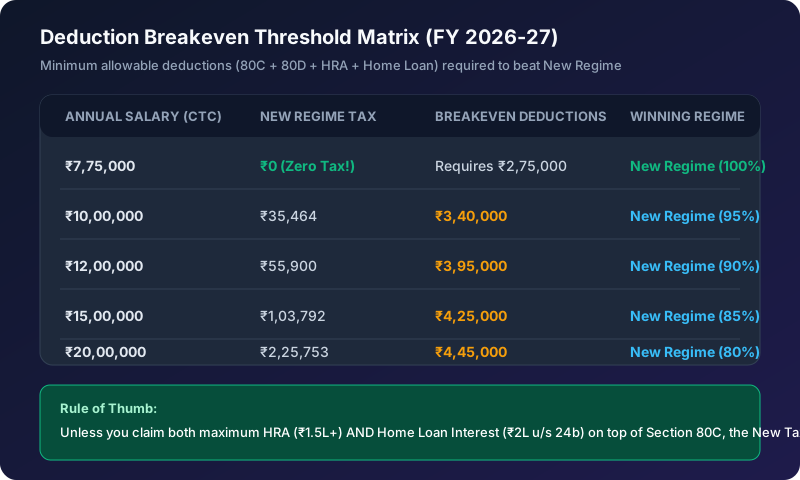
Figure 1: Minimum total deductions needed to make the Old Tax Regime beat the New Tax Regime.
3. The ₹7,75,000 Zero-Tax Threshold in New Regime
One of the greatest victories for middle-class salaried employees is the ₹7.75 Lakh zero-tax threshold:
- Gross Annual Salary: ₹7,75,000
- Standard Deduction u/s 16(ia): -₹75,000
- Net Taxable Salary: ₹7,00,000
- Tax on ₹0 to ₹3L: ₹0
- Tax on ₹3L to ₹7L (4L @ 5%): ₹20,000
- Section 87A Tax Rebate: -₹20,000 (100% Rebate)
- Net Tax Payable: ₹0.00
In contrast, in the Old Tax Regime, the Section 87A rebate terminates at ₹5,00,000. An employee earning ₹7.75 Lakhs under the Old Regime would have to scrounge up ₹2,25,000 in investments just to avoid paying tax!
4. Allowed vs Disallowed Deductions: Complete Catalog
To decide whether the Old Regime makes sense, you must inventory exactly which deductions you legally qualify for:
| Deduction / Exemption Head | Old Tax Regime | New Tax Regime |
|---|---|---|
| Standard Deduction (Salaried) | Allowed (₹50,000) | Allowed (₹75,000) |
| Section 80C (PPF, EPF, ELSS, Insurance) | Allowed up to ₹1,50,000 | Disallowed (₹0) |
| Section 10(13A) House Rent Allowance (HRA) | Allowed (Least of 3 conditions) | Disallowed (₹0) |
| Section 80D (Health Insurance Premium) | Allowed (₹25k to ₹1,00,000) | Disallowed (₹0) |
| Section 24(b) Home Loan Interest | Allowed up to ₹2,00,000 | Disallowed for self-occupied |
| Section 80CCD(2) Employer NPS Contribution | Allowed (up to 10% or 14%) | Allowed up to 14% of Basic! |
| Section 80CCD(1B) Self NPS Contribution | Allowed up to ₹50,000 | Disallowed (₹0) |
5. The Mathematical Breakeven Matrix (7L to 25L)
To determine whether you should switch to the Old Regime, calculate the **Breakeven Deduction Threshold**. If your total eligible deductions exceed this number, choose the Old Regime; otherwise, stay in the New Regime:
| Gross Salary | New Regime Tax (₹) | Breakeven Deductions Required | Recommended Action |
|---|---|---|---|
| ₹8,00,000 | ₹0 (Zero Tax!) | ₹2,50,000 | 100% New Regime |
| ₹10,00,000 | ₹35,464 | ₹3,40,000 | New Regime (unless heavy rent + loan) |
| ₹12,00,000 | ₹55,900 | ₹3,95,000 | New Regime for 90% employees |
| ₹15,00,000 | ₹1,03,792 | ₹4,25,000 | New Regime saves ₹50,000+ |
| ₹20,00,000 | ₹2,25,753 | ₹4,45,000 | New Regime wins unless home loan |
| ₹25,00,000 | ₹3,81,753 | ₹4,75,000 | New Regime + Corporate NPS |
6. Three Real-World Profiles: Who Wins Where?
Profile A: Ankit (Software Engineer, 12 LPA, Rented Flat in Pune)
Ankit earns ₹12 LPA, pays ₹18,000/month rent, and has ₹1.5L in EPF/ELSS.
- Total Deductions: Std Ded (₹50k) + 80C (₹1.5L) + HRA (₹1.2L) + 80D (₹20k) = ₹3,40,000.
- Old Regime Tax: ₹69,680
- New Regime Tax: ₹55,900
- Verdict: Ankit saves ₹13,780 by sticking with the New Tax Regime!
Profile B: Meera (Senior Manager, 18 LPA, Active Home Loan in Mumbai)
Meera pays ₹2,00,000 in home loan interest, ₹1.5L principal in 80C, ₹50,000 parent health insurance, and ₹50,000 in NPS.
- Total Deductions: Std Ded (₹50k) + 80C (₹1.5L) + Sec 24b (₹2.0L) + 80D (₹50k) + 80CCD(1B) (₹50k) = ₹5,00,000.
- Old Regime Tax: ₹1,40,400
- New Regime Tax: ₹1,78,984
- Verdict: Meera saves ₹38,584 by selecting the Old Tax Regime!
7. Switching Rules: Form 10-IEA, Timing and Form 16
How and when can you switch regimes? Here are the official rules laid down by the Central Board of Direct Taxes (CBDT):
- Salaried Individuals: You can select your regime at the start of the financial year with your employer for TDS deduction. Even if you choose New Regime in April, you can still switch to Old Regime when filing your ITR in July (or vice versa), provided you file on or before the due date (July 31).
- Individuals with Business/Profession Income: Professionals who have income under the head "Profits and Gains of Business or Profession" (PGBP) must file Form 10-IEA to opt out of the New Regime. Once they switch back, they are locked into that choice for subsequent years.
8. Frequently Asked Questions (FAQ)
Which tax regime is better for salaried employees in FY 2026-27?
For over 85% of salaried employees in India, the New Tax Regime is superior. It offers lower slab rates, a standard deduction of ₹75,000, zero tax up to ₹7,75,000 gross salary, and requires zero investment in lock-in financial instruments.
How much total deduction is needed in the Old Regime to beat the New Regime?
The breakeven threshold depends on your salary: at ₹10 Lakhs, you need at least ₹3,40,000 in deductions; at ₹12 Lakhs, you need ₹3,95,000; at ₹15 Lakhs, you need ₹4,25,000; and at ₹20 Lakhs, you need over ₹4,45,000 in eligible deductions (combining 80C, 80D, HRA, and Section 24b home loan interest).
Can I switch between Old and New Tax Regimes every year?
Yes, salaried employees with income from salary, house property, and capital gains (no business or professional income) can freely switch between the Old and New Tax Regimes each year when filing their Income Tax Return (ITR-1 or ITR-2) by the due date.
Is HRA exemption available in the New Tax Regime?
No. House Rent Allowance (HRA) exemption under Section 10(13A) is not permitted in the New Tax Regime. Salaried individuals receive an elevated flat standard deduction of ₹75,000 instead.
What deductions are still allowed in the New Tax Regime?
The New Tax Regime allows: (1) Standard deduction of ₹75,000 for salaried employees and pensioners, (2) Employer NPS contribution under Section 80CCD(2) up to 14% of basic salary, (3) Transport allowance for differently-abled employees, and (4) Gratuity exemption under Section 10(10) up to ₹20 Lakhs.
9. Quick Decision Checklist for Salaried Taxpayers
- Choose New Tax Regime if: Your total deductions (80C, 80D, HRA) are under ₹3.75 Lakhs, you don't have a massive home loan, or you prefer liquid mutual funds over locked tax-savers.
- Choose Old Tax Regime only if: You are servicing a large home loan (saving ₹2L u/s 24b) AND paying hefty rent (saving ₹1.5L+ in HRA) on top of maximum Section 80C.
- Simulate Before Deciding: Run your exact income through our side-by-side Income Tax Calculator before declaring to HR.