Table of Contents
- 1. Section 80C Fundamentals & FY 2026-27 Regime Status
- 2. How Much Tax Does ₹1.5 Lakh Actually Save?
- 3. Detailed Breakdown of All 10 Eligible 80C Instruments
- 4. Master Comparison Matrix: Returns, Lock-in & Taxability
- 5. Salaried Reality: Checking Your EPF & Tuition Before Investing
- 6. The Optimal 80C Portfolio by Age and Risk Profile
- 7. 5 Dangerous Traps: Endowment Plans, ULIPs & March Rushes
- 8. Frequently Asked Questions (FAQ)
- 9. Summary Checklist for Tax Season
1. Section 80C Fundamentals & FY 2026-27 Regime Status
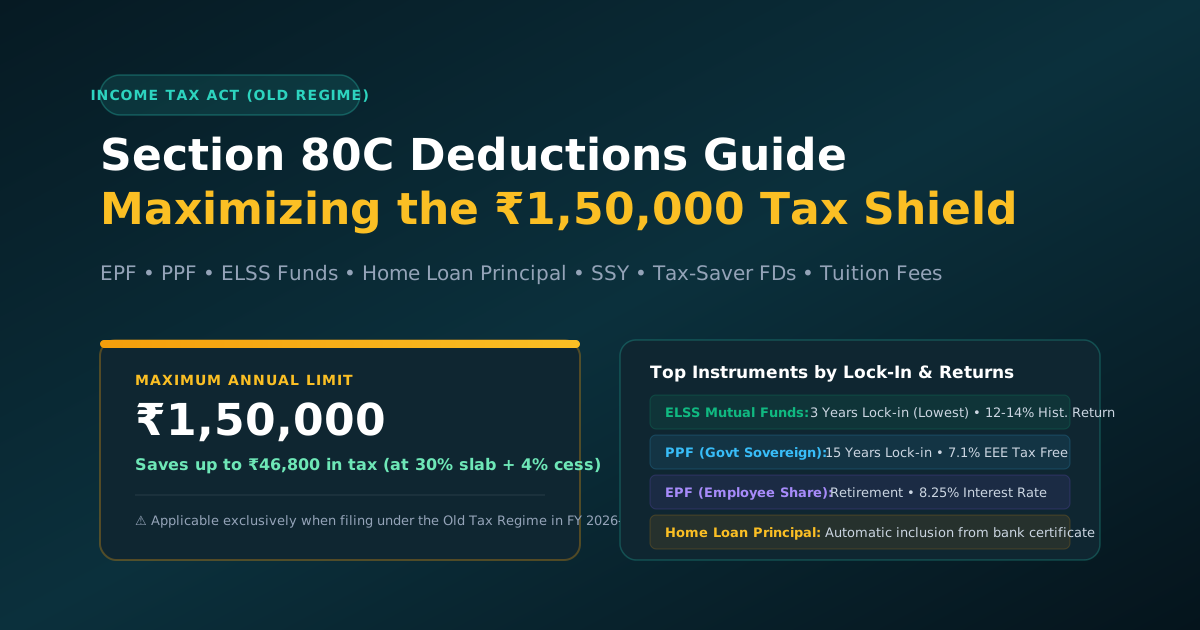
Enacted under Chapter VI-A of the Income Tax Act, 1961, Section 80C allows individual taxpayers and Hindu Undivided Families (HUFs) to deduct up to ₹1,50,000 from their gross total income in a given financial year.
Crucial Rule for FY 2026-27 / AY 2027-28
Under Section 115BAC, the New Tax Regime is the default tax regime in India. The New Tax Regime completely eliminates Section 80C! If you choose or remain in the New Tax Regime, you cannot claim a single rupee of deduction for EPF, PPF, ELSS, tuition fees, or life insurance. Section 80C is available only if you actively opt for the Old Tax Regime on the e-filing portal (Form 10-IEA for business income or regime declaration on your employer's payroll portal for salaried employees).
The statutory annual cap of ₹1,50,000 is an umbrella ceiling. It encompasses Section 80C, Section 80CCC (contributions to pension funds), and Section 80CCD(1) (employee contributions to the National Pension System). Even if you invest ₹1.5 Lakh in ELSS, ₹1.5 Lakh in PPF, and your employer deducts ₹80,000 in EPF, your maximum allowable tax deduction under this entire bucket remains strictly capped at ₹1,50,000.
2. How Much Tax Does ₹1.5 Lakh Actually Save?
A common misconception among beginner taxpayers is confusing a "tax deduction" with a "tax credit" or "tax rebate". Claiming ₹1,50,000 under Section 80C does not mean your income tax is reduced by ₹1,50,000; it means your taxable income is reduced by ₹1,50,000.
The actual hard-cash savings in your bank account depend entirely on your marginal tax slab under the Old Tax Regime (plus 4% Health and Education Cess):
| Old Regime Tax Slab | Nominal Slab Rate | Effective Rate (with 4% Cess) | Actual Tax Saved on ₹1.5 Lakh |
|---|---|---|---|
| ₹2,50,001 to ₹5,00,000 | 5% | 5.20% | ₹7,800 |
| ₹5,00,001 to ₹10,00,000 | 20% | 20.80% | ₹31,200 |
| Above ₹10,00,000 | 30% | 31.20% | ₹46,800 |
| Above ₹50,00,000 (with 10% surcharge) | 30% + 10% SC | 34.32% | ₹51,480 |
For a high-earning professional in the 30% slab, utilizing the full ₹1.5 Lakh limit saves a substantial ₹46,800 in cash every year. That is nearly ₹3,900 of extra monthly cash flow that would otherwise have been remitted to the government.
3. Detailed Breakdown of All 10 Eligible 80C Instruments
The Indian government created Section 80C to encourage long-term capital formation, housing, and social security. The eligible instruments span across equity, sovereign debt, banking deposits, insurance, and essential household expenses:
1. Employee Provident Fund (EPF)
For salaried employees, the 12% statutory employee contribution deducted every month from your Basic salary qualifies automatically for Section 80C. This is completely hands-free—your employer includes it in your Form 16 without requiring separate documentation. It currently earns an attractive 8.25% p.a. sovereign interest.
2. Equity Linked Savings Scheme (ELSS)
ELSS funds are diversified equity mutual funds that allocate at least 80% into domestic equities. They offer two unmatched advantages:
- Shortest Lock-in: Just 3 years—the lowest among all Section 80C instruments.
- Equity Wealth Creation: Over 10-year rolling periods, top-tier ELSS schemes have historically generated 12% to 15% annualized compound returns (CAGR).
Tax at Maturity: Capital gains exceeding ₹1.25 Lakh per financial year are taxed at 12.5% under revised Section 112A rules.
3. Public Provident Fund (PPF)
A 15-year government-backed savings scheme that offers the gold standard of tax efficiency: EEE (Exempt-Exempt-Exempt) status. Investment is tax-deductible under 80C, interest earned is 100% tax-free, and final maturity proceeds are 100% tax-free. Minimum deposit is ₹500/year and maximum is ₹1,50,000/year. Current interest rate is 7.1% p.a.
4. Sukanya Samriddhi Yojana (SSY)
Designed for parents of a girl child below 10 years of age. Offers an industry-leading sovereign interest rate of 8.2% p.a. with full EEE tax exemption. The account matures 21 years from opening or upon the girl's marriage after age 18.
5. 5-Year Tax-Saving Bank Fixed Deposits
Scheduled commercial banks and post offices offer specialized 5-year fixed deposits that carry Section 80C benefits. They have a strict 5-year lock-in with zero premature withdrawal or loan facilities. Interest rates hover between 6.50% and 7.25%. Major Drawback: Unlike PPF, interest is fully taxable at your income tax slab rate every year.
6. Home Loan Principal Repayment
When repaying a home loan for a purchase or construction, your EMI consists of principal and interest. The principal portion repaid during the financial year qualifies for deduction under Section 80C (interest is claimed separately under Section 24b up to ₹2,00,000). The property must not be sold within 5 years of possession, or the claimed deductions will be reversed and taxed as income.
7. Stamp Duty & Registration Charges for Home Purchase
In the specific financial year in which you buy or construct a house, the stamp duty, registration charges, and statutory transfer expenses paid can be claimed under Section 80C, even if you did not avail of a bank loan. This frequently absorbs the entire ₹1.5 Lakh limit by itself!
8. Children's School & College Tuition Fees
Tuition fees paid for full-time education of up to two children in any recognized school, college, university, or educational institution located in India qualify under Section 80C. Exclusions: Development fees, transport fees, hostel charges, mess fees, and coaching classes are strictly ineligible.
9. National Savings Certificate (NSC)
A 5-year post office certificate backed by the Government of India. The interest accrued annually is deemed to be reinvested and qualifies as a fresh 80C deduction for the first 4 years (interest in Year 5 is taxable).
10. Life Insurance Premiums
Premiums paid for life insurance policies (Term Insurance, Endowment, ULIP) covering yourself, your spouse, or your children qualify under Section 80C. Under Section 10(10D), the annual premium must not exceed 10% of the minimum sum assured to ensure maturity proceeds remain tax-free.
4. Master Comparison Matrix: Returns, Lock-in & Taxability
To help you select the ideal combination of products, here is an exhaustive comparative snapshot of the top Section 80C options:
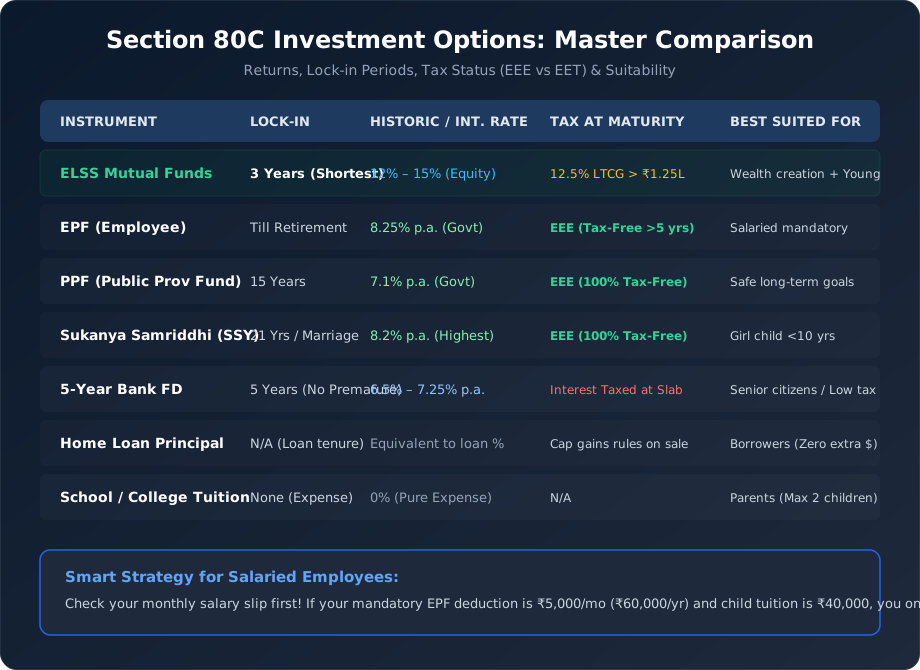
Notice the striking difference between tax-saver bank FDs and PPF/SSY. A 5-year bank FD yielding 7.0% drops to an effective post-tax yield of just 4.83% for someone in the 30% slab! In contrast, PPF's 7.1% and SSY's 8.2% are completely tax-free, delivering vastly superior real purchasing power.
5. Salaried Reality: Checking Your EPF & Tuition Before Investing
The single most common mistake salaried professionals make in India is rushing to buy new financial products in February or March without auditing what has already been deducted.
Pull out your latest monthly salary slip right now and inspect the "Deductions" column for Provident Fund (PF):
Example: Rahul earning ₹12 LPA CTC
- Monthly Basic Salary: ₹45,000
- Monthly Employee PF Deduction (12%): ₹5,400/month
- Annual Statutory PF Contribution: ₹5,400 × 12 = ₹64,800
- Annual School Tuition for 1 Child: ₹55,000
- Total Already Utilized under 80C: ₹64,800 + ₹55,000 = ₹1,19,800
- Remaining Cap to Invest: ₹1,50,000 - ₹1,19,800 = ₹30,200 only!
In Rahul's case, he only needs to invest ₹30,200 into an ELSS fund or PPF to completely max out his ₹1.5 Lakh limit! If Rahul had panicked and bought a ₹1,00,000 insurance policy, ₹69,800 of his hard-earned money would have been locked up with zero incremental tax benefit. Always calculate your existing mandatory deductions first.
6. The Optimal 80C Portfolio by Age and Risk Profile
Because Section 80C permits blending multiple instruments, you should tailor your remaining allocation to match your life stage:
Young Professionals (Age 22 to 32)
Strategy: High Equity Growth. You already have debt exposure through mandatory EPF. Allocate 100% of your remaining 80C surplus into ELSS Mutual Funds. The 3-year lock-in enforces investing discipline while compound equity returns build long-term wealth for milestone goals like buying a house.
Family with Young Children (Age 32 to 45)
Strategy: Balanced Protection & Education. Claim child tuition fees and home loan principal repayments first. If you have a daughter, prioritize Sukanya Samriddhi Yojana (SSY) for guaranteed 8.2% tax-free returns. Fill any remaining margin with ELSS.
Pre-Retirees (Age 45 to 58)
Strategy: Capital Preservation & Sovereign Safety. Combine EPF with PPF to build a solid debt foundation for post-retirement income. Maintain minimal ELSS exposure (20%-30%) solely to counter inflation.
7. 5 Dangerous Traps: Endowment Plans, ULIPs & March Rushes
1. Buying Traditional Endowment or "Money-Back" Life Policies
This is the single biggest wealth killer in India. Traditional insurance plans blend mediocre life cover with dismal 4.5% to 5.5% annual returns—barely matching inflation. Never mix insurance with investment. Buy a pure Term Life Insurance policy (giving ₹1 to ₹2 Crore cover for ₹10,000–₹15,000/yr) and invest the remaining money in ELSS or PPF.
2. Waiting Until March 25th to Make 80C Investments
Lumping ₹1.5 Lakh into an equity ELSS fund in late March carries extreme timing risk. Instead, initiate an automated monthly SIP of ₹12,500 from April onwards. You achieve smooth rupee cost averaging throughout the financial year without last-minute cash crunches.
3. Forgetting Section 80CCD(1B) Additional ₹50,000 NPS Shield
Many investors stop at ₹1,50,000. Under Section 80CCD(1B), you can invest an additional ₹50,000 into the National Pension System (NPS Tier 1), completely over and above the Section 80C limit! This provides an extra ₹15,600 tax saving for someone in the 30% slab.
4. Over-Locking Capital into Illiquid Debt Instruments
Locking all your surplus cash into 15-year PPF accounts can leave you asset-rich but cash-poor in emergency medical situations. Always maintain a 6-month liquid emergency fund before locking capital into multi-year tax schemes.
5. Premature Closure of Tax-Saving Products
If you surrender a life insurance policy within 2 years, or sell a home within 5 years of possession, all Section 80C tax deductions claimed in previous years are revoked, added back to your taxable income in the year of termination, and taxed at full slab rates!
8. Frequently Asked Questions (FAQ)
Is Section 80C deduction available under the New Tax Regime in FY 2026-27?
No. Section 80C deductions are strictly restricted to the Old Tax Regime. The default New Tax Regime under Section 115BAC disallows all Chapter VI-A deductions, offering lower tax slabs and a ₹75,000 standard deduction instead.
How much tax does Section 80C actually save?
By claiming the full ₹1,50,000 deduction, a taxpayer in the 30% bracket saves ₹46,800. A taxpayer in the 20% slab saves ₹31,200, and someone in the 5% slab saves ₹7,800 (all inclusive of 4% health and education cess).
Can I claim school tuition fees under Section 80C?
Yes. Tuition fees paid for full-time education of up to two children in recognized Indian schools, colleges, or universities qualify. Development fees, transport fees, and donations are strictly excluded.
Does home loan repayment count towards Section 80C?
Yes. The principal repayment component of your housing loan EMI qualifies under Section 80C up to ₹1,50,000. In the year of property purchase, stamp duty and registration fees can also be claimed under 80C.
Which Section 80C instrument has the shortest lock-in period?
ELSS (Equity Linked Savings Scheme) mutual funds have the shortest lock-in period of just 3 years, compared to 5 years for tax-saving bank FDs and NSC, and 15 years for PPF.
9. Summary Checklist for Tax Season
To execute a seamless, stress-free tax filing season:
- Audit your salary slip: Sum your monthly EPF contributions and multiply by 12. Check child school receipts for eligible tuition fee components.
- Collect home loan certificates: Obtain the provisional interest and principal certificate from your lending bank or HFC.
- Automate ELSS via SIP: Avoid March panic by running a monthly SIP from April to January.
- Separate Insurance from Investment: Buy pure term life cover and pure health insurance (80D); avoid high-commission endowment policies.
- Compare Regimes: If your total deductions (80C + HRA + 24b + 80D) are less than ₹3,75,000, you will likely save more money under the New Tax Regime.
Wondering whether Old or New Tax Regime saves you more money? Run your exact figures on our free Income Tax Calculator and decode your take-home pay with our CTC to In-Hand Calculator.