How PF Contribution Works: Employee Share, Employer Share and EPS
Provident Fund is the cornerstone of retirement security for Indian salaried professionals. Yet, behind the neat 12% deduction on your salary slip lies a complex statutory structure governing EPS pensions, employer splits, wage ceilings, and tax limits. Here is how your money actually moves.
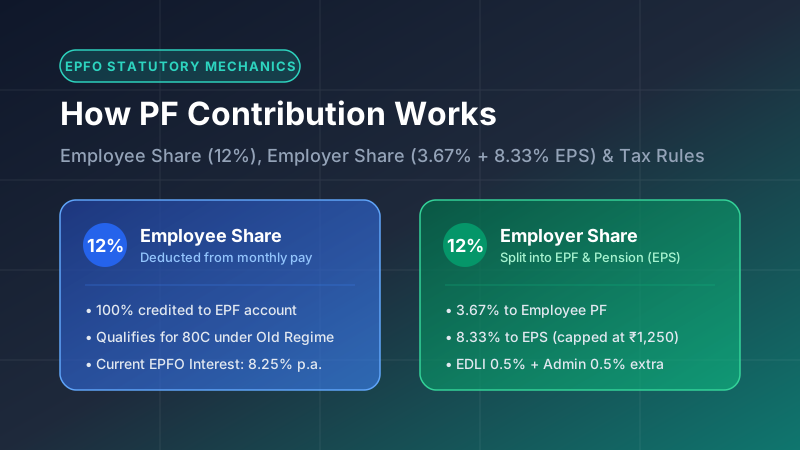
Table of Contents
- 1. The Statutory Framework: EPF, EPS, and EDLI
- 2. The ₹15,000 Statutory Wage Ceiling: Capped vs Uncapped PF
- 3. The 12% Math: How Employee and Employer Shares Are Calculated
- 4. Live Calculation Table Across Basic Salary Levels
- 5. Visual Contribution Flow: Where Does Every Rupee Go?
- 6. EPFO Interest Rate: Calculation and Annual Credit Mechanics
- 7. Income Tax Rules for FY 2026-27: Section 80C, Rule 9D, and the ₹2.5 Lakh Cap
- 8. Voluntary Provident Fund (VPF): How to Supercharge Contributions
- 9. UAN, Job Switching, and Partial Advance Withdrawal Grounds
- 10. Critical Mistakes Employees Make With Their EPF Passbook
- 11. Frequently Asked Questions (FAQ)
1. The Statutory Framework: EPF, EPS, and EDLI
Every month, when salaried professionals inspect their compensation slips, they encounter a line item labeled "PF" or "EPF". For most people, it represents an enforced reduction in take-home cash. However, under the Employees' Provident Funds and Miscellaneous Provisions Act, 1952, this contribution is a tripartite social security umbrella managed by the Employees' Provident Fund Organisation (EPFO).
The EPFO umbrella is actually composed of three distinct schemes running simultaneously, each serving a fundamentally different financial objective:
- Employees' Provident Fund (EPF) Scheme, 1952: A pure contributory retirement savings vehicle. Both employee and employer contribute money, which is pooled into a personal sovereign-backed account earning guaranteed compounding interest.
- Employees' Pension Scheme (EPS), 1995: A defined benefit pension system designed to pay a monthly pension to the employee post-retirement (after age 58), or to their surviving spouse and dependent children upon death.
- Employees' Deposit Linked Insurance (EDLI) Scheme, 1976: A statutory life insurance policy that provides up to ₹7,00,000 in term cover to the family of any active employee who passes away during service.
Understanding how these three branches intersect is essential because your employer does not simply dump 24% into a single savings account. The allocation between retirement wealth, pension rights, and insurance is strictly governed by statutory formulas.
2. The ₹15,000 Statutory Wage Ceiling: Capped vs Uncapped PF
To understand your PF deduction, the most critical number to know is ₹15,000 per month. This is the statutory wage ceiling fixed by the Central Government under the EPF Act.
For PF calculation purposes, "Wages" does not mean your gross salary or Cost to Company (CTC). Under Section 2(b) of the Act, qualifying wages comprise:
Eligible EPF Wages = Basic Salary + Dearness Allowance (DA) + Retaining Allowance
Because Dearness Allowance is rarely paid in the private corporate sector, for 95% of corporate employees, eligible EPF wages equal their Basic Salary. Depending on whether your employer applies the statutory ceiling or actual wages, you will fall into one of two operational models:
Model A: Statutory Capped PF
The employer caps the calculation at ₹15,000 per month, regardless of whether your actual basic salary is ₹40,000 or ₹1,50,000.
- Employee Share = 12% of ₹15,000 = ₹1,800/month
- Employer Share = 12% of ₹15,000 = ₹1,800/month
- Maximizes monthly take-home in-hand cash.
Model B: Actual Uncapped PF
The employer calculates 12% on your entire actual basic salary without any statutory ceiling limit.
- If Basic is ₹60,000: Employee pays 12% = ₹7,200/month
- Employer matches with ₹7,200/month
- Dramatically accelerates long-term compounding retirement savings.
3. The 12% Math: How Employee and Employer Shares Are Calculated
A widespread misconception among corporate employees is that their employer's 12% contribution is credited in its entirety to their EPF passbook alongside their own 12%. This is factually incorrect. The actual legal breakdown follows a strict distribution:
Part 1: The Employee's 12% Contribution
The employee's share is straightforward: exactly 12% of Basic + DA is deducted from your gross earnings and deposited 100% into your EPF Account (Account 1). None of the employee's contribution ever goes to pension (EPS) or administrative expenses. Every single rupee belongs directly to you and earns interest.
Part 2: The Employer's 12% Contribution Split
The employer's matching 12% does not go into a single bucket. It is bifurcated by statutory mandate into two portions:
-
8.33% to Employees' Pension Scheme (Account 10):
Under the EPS-95 rules, pension contributions are capped at 8.33% of the statutory wage ceiling of ₹15,000.
Even if your monthly basic salary is ₹2,00,000, your employer can only credit a maximum of ₹1,250 into your EPS account.
Maximum Monthly EPS Contribution = 8.33% of ₹15,000 = ₹1,250 per month - 3.67% (+ Excess) to EPF Account (Account 1): The remaining 3.67% of the statutory wage goes to your personal EPF account. Furthermore, whenever an employee's basic salary exceeds ₹15,000 under the uncapped model, all employer contributions exceeding the ₹1,250 EPS ceiling are redirected into the employee's EPF account.
Part 3: Overhead Charges Paid Exclusively by the Employer
In addition to the 12% matching contribution, the employer must remit two supplementary statutory charges out of their own pocket (which private companies frequently bundle into your Cost to Company):
- EDLI Contribution (Account 21): 0.50% of Basic (capped at 0.50% of ₹15,000 = ₹75 per month). Funds free group term life insurance up to ₹7,00,000.
- EPFO Administrative Charges (Account 2): 0.50% of total eligible wages (subject to a minimum of ₹500 per month per establishment).
4. Live Calculation Table Across Basic Salary Levels
To observe how these percentages manifest in hard numbers, review the exact monthly allocations across typical monthly basic salary brackets in India under the uncapped PF structure:
| Monthly Basic Salary | Employee EPF (12%) | Employer EPS (Capped) | Employer EPF (Balance) | Total Monthly Corpus Credit |
|---|---|---|---|---|
| ₹15,000 (Ceiling) | ₹1,800 | ₹1,250 (8.33%) | ₹550 (3.67%) | ₹2,350 to EPF |
| ₹30,000 | ₹3,600 | ₹1,250 (Capped) | ₹2,350 (₹3,600 - ₹1,250) | ₹5,950 to EPF |
| ₹50,000 | ₹6,000 | ₹1,250 (Capped) | ₹4,750 (₹6,000 - ₹1,250) | ₹10,750 to EPF |
| ₹80,000 | ₹9,600 | ₹1,250 (Capped) | ₹8,350 (₹9,600 - ₹1,250) | ₹17,950 to EPF |
| ₹1,20,000 | ₹14,400 | ₹1,250 (Capped) | ₹13,150 (₹14,400 - ₹1,250) | ₹27,550 to EPF |
Notice the critical takeaway: Because EPS is permanently frozen at ₹1,250 per month, as your career advances and your basic salary rises, the overwhelming majority of your employer's matching 12% floods directly into your personal interest-bearing EPF account.
5. Visual Contribution Flow: Where Does Every Rupee Go?
The flowchart below outlines the complete routing pipeline from your monthly gross payroll to the respective EPFO institutional accounts:

6. EPFO Interest Rate: Calculation and Annual Credit Mechanics
For the ongoing fiscal period, the EPFO Central Board of Trustees (CBT) has declared an attractive interest rate of 8.25% per annum. In an era where commercial bank fixed deposits offer between 6.5% and 7.2%, EPF remains one of the highest-yielding sovereign debt instruments in India.
However, very few employees understand how EPFO calculates and applies this interest. There is a sharp distinction between how interest is calculated and when it is credited:
- Monthly Accrual: Interest is calculated at the end of every calendar month on the running balance (Opening balance + fresh employee deposits + fresh employer deposits - any withdrawals).
- Annual Compounding & Credit: Although calculated every month, the accumulated interest for the entire 12-month period is credited to your passbook at the close of the financial year (March 31st).
- Zero Interest on EPS: The 8.33% directed to the Pension Scheme (EPS) earns zero interest. EPS is a defined-benefit pension scheme governed by a service formula, not a savings account.
Monthly Interest = (Closing Monthly Running Balance × Annual Rate) / 1200For example, at an 8.25% rate, a monthly running balance of ₹5,00,000 yields:
(5,00,000 × 8.25) / 1200 = ₹3,437.50 for that specific month.
7. Income Tax Rules for FY 2026-27: Section 80C, Rule 9D, and the ₹2.5 Lakh Cap
Historically, EPF enjoyed complete "Exempt-Exempt-Exempt" (EEE) status: contributions were deductible, interest grew tax-free, and maturity withdrawals were non-taxable. However, legislative amendments over recent budgets have introduced targeted tax provisions that every taxpayer must track:
A. Section 80C Deduction (Old Tax Regime Only)
Your personal 12% employee contribution qualifies for tax deduction under Section 80C up to the statutory ceiling of ₹1,50,000. Note that under the New Tax Regime, Section 80C is completely unavailable. Therefore, choosing the New Regime provides zero immediate tax rebate on your 12% EPF deduction.
B. Rule 9D: The ₹2.5 Lakh Annual Interest Tax Threshold
Under Rule 9D of the Income Tax Rules, if an employee's aggregate deposits (Mandatory EPF + Voluntary VPF) exceed ₹2,50,000 in a financial year, the interest earned on the excess contribution is no longer tax-exempt.
EPFO passbooks now explicitly partition your account into two ledgers:
- Non-Taxable Contribution Account: Stores contributions up to ₹2.5 lakh and its corresponding tax-free interest.
- Taxable Contribution Account: Stores all contributions above ₹2.5 lakh. The interest earned on this balance is added to your total income under "Income from Other Sources" and taxed at your marginal slab rate (up to 30% plus cess).
Note: In rare establishments where only the employee contributes and there is zero employer contribution, this statutory threshold is relaxed to ₹5,00,000 per year.
C. Section 17(2)(vii): Employer Contribution Cap of ₹7.5 Lakh
Under Section 17(2)(vii), if the employer's aggregate annual contributions to recognized PF, National Pension System (NPS), and approved superannuation funds exceed ₹7,50,000, the excess amount is taxed as a perquisite in the employee's hands, and any annual interest on that excess amount is also taxable u/s 17(2)(viia).
D. The 5-Year Continuous Service Rule for Withdrawals
Withdrawing your EPF corpus before completing 5 consecutive years of service triggers retrospective taxation. The entire employer contribution and accumulated interest will be treated as salary income, and tax relief claimed previously under Section 80C will be clawed back, attracting 10% TDS (or 20% without PAN) under Section 192A unless your total balance is under ₹50,000.
8. Voluntary Provident Fund (VPF): How to Supercharge Contributions
What if you want to save more than the mandatory 12% in this high-interest, sovereign-backed haven? That is where the Voluntary Provident Fund (VPF) comes into play.
VPF allows any salaried employee covered by EPFO to voluntarily increase their monthly contribution up to 100% of their Basic Salary and DA.
Key Attributes of VPF:
- Identical Interest Rate: VPF earns the exact same 8.25% interest rate as mandatory EPF.
- Zero Employer Obligation: Your employer is under no legal obligation to match your VPF contribution; they will only match the statutory 12%.
- No Separate Account: VPF is credited to your existing UAN and EPF passbook under a dedicated VPF column.
- Lock-in Period: Matches EPF rules; money remains invested until retirement or job exit, subject to partial advance rules.
For risk-averse investors seeking fixed-income allocation, VPF offers significantly higher post-tax yields than Public Provident Fund (PPF, capped at ₹1.5 lakh/year at 7.1%) and corporate bank deposits (taxable at 30% slab without any ₹2.5 lakh tax-free buffer).
9. UAN, Job Switching, and Partial Advance Withdrawal Grounds
The Universal Account Number (UAN) is a permanent 12-digit identifier that acts as an umbrella for all your Member IDs across different employers throughout your lifetime. When changing jobs, you must quote your existing UAN on Form 11 to seamlessly transfer service history.
EPFO Online Transfer (OTCP)
Instead of withdrawing PF when switching companies, submit an online transfer request via the Unified Member Portal (Form 13). Transferring your balance preserves your cumulative years of service, ensuring you cross the critical 5-year tax-exemption milestone and the 10-year service threshold required to become eligible for monthly pension under EPS.
Statutory Grounds for Partial Advances (Form 31)
While EPF is designed for retirement, the EPFO allows non-refundable partial advances for specific life milestones:
- Residential Property / Land Purchase: Requires 5 years of service. Up to 90% of total EPF corpus can be withdrawn.
- Home Renovation: Requires 5 years of service. Up to 12 times monthly wages.
- Higher Education / Marriage: Requires 7 years of service. Up to 50% of employee share can be withdrawn (max 3 times in lifetime).
- Medical Treatment (Self or Family): No minimum service requirement. Up to 6 months' basic salary or total employee share.
10. Critical Mistakes Employees Make With Their EPF Passbook
Millions of rupees languish in inoperative EPFO accounts due to preventable administrative oversights. Avoid these five major pitfalls:
- Withdrawing instead of transferring during job switches: Liquidating PF when changing jobs resets your continuous service counter to zero. If you switch after 3 years and withdraw, the payout is fully taxed as salary income.
- Leaving e-Nomination blank: If an employee passes away without an active e-nomination on the Member Portal, claiming EDLI insurance (up to ₹7 Lakh) and EPF accumulated funds requires court-issued legal heir certificates, delaying settlements for years.
- Unmatched Name or Date of Birth across PAN and Aadhaar: EPFO's digital verification system relies on exact biometric and demographic matching. A single typo in your initials between your Aadhaar card and employer payroll records will block online advance claims.
-
Assuming EPS functions like an equity mutual fund: EPS balance does not compound at 8.25%. Your pension is calculated as:
(Pensionable Service × Pensionable Salary) / 70. Do not expect millions from your EPS ledger. - Overlooking the ₹2.5 Lakh VPF tax trap: Pouring massive sums into VPF without tracking the ₹2.5 lakh threshold forces you to pay 30% slab tax on excess interest, eroding your net real rate of return.
Frequently Asked Questions (FAQ)
How is the 12% employer PF contribution divided between EPF and EPS?
The employer's 12% statutory contribution is split into two components: 8.33% goes to the Employees' Pension Scheme (EPS), capped strictly at ₹1,250 per month based on the ₹15,000 statutory wage ceiling. The remaining 3.67%, along with any excess contribution when basic salary exceeds ₹15,000, goes directly into the employee's EPF account.
Is EPF contribution mandatory for employees earning above ₹15,000 basic salary?
Under the EPF Act, mandatory coverage applies to employees joining with a basic salary of up to ₹15,000 per month. If you join an establishment with a starting basic salary above ₹15,000 and have never previously been an EPFO member, you are classified as an "excluded employee" and can opt out with mutual employer consent. However, once enrolled in EPFO, membership remains mandatory throughout your career.
What is the tax rule on PF interest for contributions above ₹2.5 lakh?
Under Rule 9D introduced by the Finance Act 2021, if an employee's annual EPF + VPF contribution exceeds ₹2,50,000 in a financial year (where the employer also contributes), the interest earned on the contribution exceeding ₹2.5 lakh is fully taxable as "Income from Other Sources" at your applicable slab rate every year.
Can an employee contribute more than 12% to Provident Fund?
Yes, through the Voluntary Provident Fund (VPF). An employee can contribute up to 100% of their Basic Salary and Dearness Allowance. VPF earns the exact same sovereign interest rate as regular EPF (8.25% p.a.) and shares the same UAN and passbook, although the employer is under no obligation to match VPF contributions beyond the statutory 12%.
What is the EDLI scheme and who pays for it?
The Employees' Deposit Linked Insurance (EDLI) Scheme 1976 provides term life insurance coverage up to ₹7,00,000 to the registered nominee of an active EPF member in the event of death during service. This benefit is funded entirely by the employer via a 0.5% statutory contribution, with zero deductions from the employee's salary.
Free Statutory & Salary Calculators
Estimate your exact retirement wealth, take-home salary, and gratuity payouts with our verified client-side calculators:
Related Salary & Tax Guides
About PercentageCalculatorTool Editorial Team
Our dedicated research desk comprises seasoned Indian payroll accountants, human resource compensation specialists, and chartered tax professionals. We believe complex statutory financial rules should be accessible, transparent, and completely free of opaque corporate jargon.