Section 79 Carry Forward of Corporate Losses: 51% Shareholding Rule Guide
An exhaustive direct tax masterclass on corporate loss preservation under Section 79 for AY 2027-28. Analyze the 51% beneficial voting power continuity rule, master the landmark Yum Restaurants doctrine, leverage unabsorbed depreciation immunities, and structure venture funding and IBC acquisitions to protect accumulated tax shields.
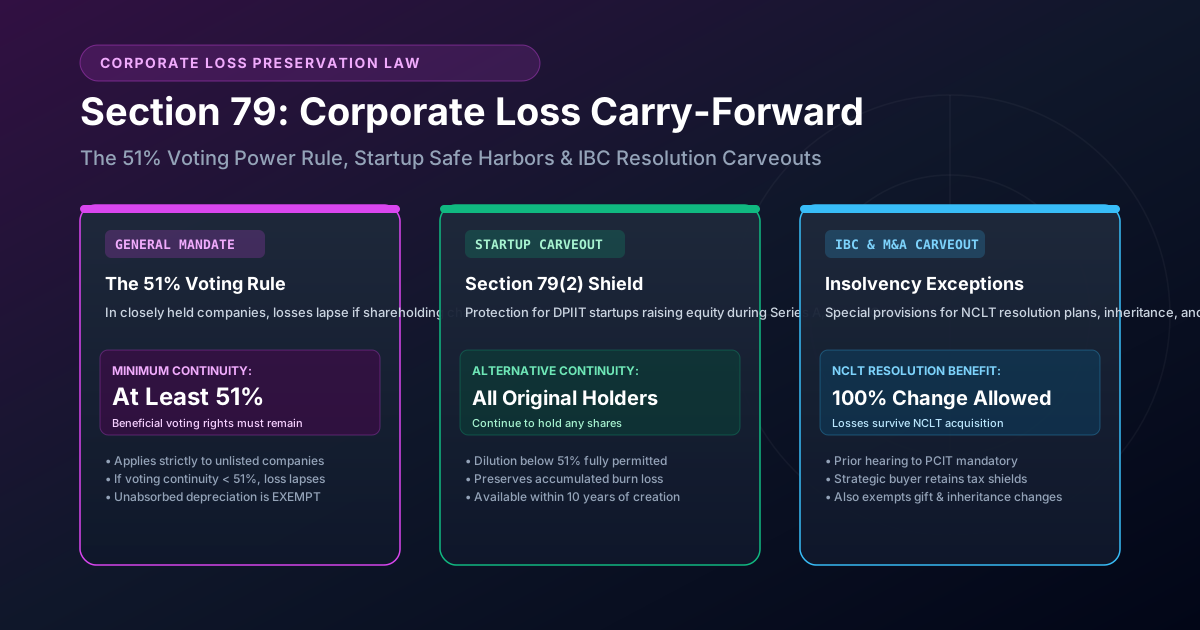
Table of Contents
- 1. Legislative Origin: Curbing the Lucrative Market in Corporate Tax Losses
- 2. Section 79 Statutory Mandate: The 51% Beneficial Voting Power Test
- 3. Registered vs Beneficial Ownership: The Yum Restaurants & Amalgamations Jurisprudence
- 4. The Critical Divide: Business Losses (Sec 72) vs Unabsorbed Depreciation (Sec 32(2))
- 5. Section 79(2) Startup Exemption: Protecting Venture Capital Dilution
- 6. The IBC Insolvency Revolution: NCLT Resolution Plan Carveouts
- 7. Statutory Exemptions: Death, Inheritance, Gifts & Foreign Amalgamations
- 8. Strategic M&A Structuring Playbook: Preserving Tax Shields in Acquisitions
- 9. Comprehensive Transaction Scenario & Loss Survival Matrix
- 10. Standard Operating Procedure (SOP) for Section 79 M&A Tax Due Diligence
- 11. Frequently Asked Questions (FAQ Schema)
1. Legislative Origin: Curbing the Lucrative Market in Corporate Tax Losses
In mid-twentieth-century corporate commerce, a widespread and lucrative tax avoidance scheme emerged: profitable business groups seeking to avoid corporate income tax would search for insolvent, dormant, or defunct private companies possessing massive accumulated business losses. By purchasing 100% of the equity shares of the loss-making target for a nominal sum, the acquirer would merge their own profitable business into the target or divert profitable commercial contracts through it. The target's historical tax losses would then wipe out hundreds of crores of taxable profits, depriving the national treasury of legitimate tax revenue.
To terminate this practice of "trafficking in corporate tax losses", Parliament enacted Section 79 of the Income Tax Act, 1961. Section 79 operates as an overarching anti-avoidance provision that overrides the general carry-forward provisions of Section 72. It establishes a strict rule: a change in the beneficial ownership of a closely held company strips the entity of its accumulated tax losses unless the original economic owners remain in substantial control.
2. Section 79 Statutory Mandate: The 51% Beneficial Voting Power Test
The substantive rule of Section 79(1) applies strictly to closely held companies (unlisted private or public companies in which the public are not substantially interested). It establishes a non-negotiable continuity test:
The Core Mandate of Section 79(1):
No loss incurred in any year prior to the previous year shall be carried forward and set off against the income of the previous year, unless:
On the last day of the previous year, the shares of the company carrying not less than 51% of the voting power were beneficially held by persons who beneficially held shares of the company carrying not less than 51% of the voting power on the last day of the year or years in which the loss was incurred.
This statutory test involves a precise, two-point temporal comparison:
- Point A (Loss Year): Examine the register of members and beneficial ownership on the last day of the financial year (31st March) in which the business loss was originally incurred.
- Point B (Set-off Year): Examine the register of members and beneficial ownership on the last day of the financial year (31st March) in which the company earns profits and seeks to set off the brought forward loss.
- The 51% Threshold: The common shareholders who held shares at Point A must continue to hold shares carrying at least 51% of the total voting power at Point B. If voting power continuity drops to 50.9%, the entire accumulated business loss for that loss year is permanently extinguished.
3. Registered vs Beneficial Ownership: The Yum Restaurants & Amalgamations Jurisprudence
The operative statutory phrase in Section 79 is "beneficially held". This gave rise to profound direct tax litigation regarding multi-tiered corporate holding structures: Does Section 79 look at the registered shareholder on the company's register of members, or does it pierce the corporate veil to identify the ultimate economic holding company?
The Yum Restaurants Doctrine (Delhi High Court):
In CIT v. Yum Restaurants (India) Pvt. Ltd. [2016] 380 ITR 637 (Delhi), Yum Restaurants India was a wholly owned subsidiary of Yum Asia, which in turn was owned by Yum USA. During a global group restructuring, 100% of the shares of Yum Restaurants India were transferred from Yum Asia to another subsidiary, Yum Singapore. Both Yum Asia and Yum Singapore were 100% owned by the ultimate parent, Yum USA.
The Delhi High Court held that the phrase "beneficially held" requires looking at who actually controls the voting power. However, the High Court emphasized that each corporate entity is a separate legal person. Because the immediate registered shareholder holding 100% voting power changed from Yum Asia to Yum Singapore, Section 79 was triggered, and accumulated business losses lapsed! The Supreme Court affirmed that beneficial ownership cannot be casually conflated with ultimate group economic interest unless an express trust or agency relationship is proven.

4. The Critical Divide: Business Losses (Sec 72) vs Unabsorbed Depreciation (Sec 32(2))
The most important legal protection for corporate acquirers and M&A tax practitioners is the profound statutory distinction between accumulated business loss and unabsorbed depreciation.
| Statutory Parameter | Accumulated Business Loss (Section 72) | Unabsorbed Depreciation (Section 32(2)) |
|---|---|---|
| Governing Section | Section 72 of the Income Tax Act | Section 32(2) of the Income Tax Act |
| Applicability of Section 79 | Directly Applicable Lapses if 51% continuity is broken. | Totally Inapplicable Never lapses under Section 79! |
| Carry Forward Horizon | Strict maximum cap of 8 assessment years. | Indefinite carry forward until fully absorbed. |
| Set-off Flexibility | Can be set off ONLY against "Profits and Gains of Business". | Can be set off against ANY head of income (except salaries). |
The Supreme Court Ruling in Mother India Refrigeration
In the landmark decision of CIT v. Mother India Refrigeration Industries (P.) Ltd. [1985] 155 ITR 711 (SC), the Supreme Court of India analyzed the interaction between Section 79 and Section 32(2). The Supreme Court ruled that Section 79 deliberately uses the word "loss", which refers to business loss determined under Section 72. In contrast, under Section 32(2), unabsorbed depreciation is not carried forward as a historical loss; it is statutorily deemed to be the depreciation of the current previous year.
Because current year depreciation does not constitute a "loss incurred in any year prior to the previous year", Section 79 has zero application to unabsorbed depreciation! Even if an acquirer buys 100% of the equity shares of a heavily indebted manufacturing target, wiping out 100% of the original shareholders, the target company's unabsorbed depreciation survives in its entirety and can be used to shelter future profits!
5. Section 79(2) Startup Exemption: Protecting Venture Capital Dilution
When high-growth tech startups raise institutional capital across Seed, Series A, Series B, and growth rounds, founder equity is systematically diluted. In a typical growth journey, founders who held 100% of equity at inception may find their collective holding reduced to 30% by Series B. Under the classical 51% rule, every major funding round would wipe out hundreds of crores of accumulated burn and R&D losses!
The Specialized Startup Safe Harbor (Section 79(2)(a)):
To protect the startup ecosystem, Parliament enacted Section 79(2)(a). For an eligible startup recognized by DPIIT under Section 80-IAC, the 51% voting power continuity requirement is completely waived. The accumulated business loss is allowed to be carried forward and set off, provided:
All the shareholders of such company who held shares carrying voting power on the last day of the year in which the loss was incurred continue to hold those shares on the last day of the year in which the loss is set off.
Under this safe harbor, it does not matter if the founders are diluted to 20%, 10%, or even 5% of voting power. As long as every original shareholder retains even a single share in the company and does not execute a 100% clean exit, 100% of the startup's accumulated losses remain intact!
6. The IBC Insolvency Revolution: NCLT Resolution Plan Carveouts
When strategic bidders acquire distressed corporate debtors under the Insolvency and Bankruptcy Code, 2016 (IBC), the resolution plan invariably involves a 100% cancellation or restructuring of existing promoter equity and the issuance of fresh equity to the incoming resolution applicant. If Section 79 applied, the multi-thousand-crore tax losses of the distressed target would immediately vanish, destroying the commercial viability of turnaround bids.
The IBC Resolution Plan Exemption (Section 79(2)(c)):
Under Section 79(2)(c), the 51% restriction shall NOT apply to any change in the shareholding of an Indian company if:
- The change takes place pursuant to a Resolution Plan approved by the NCLT under Section 31 of the IBC; AND
- A reasonable opportunity of being heard was afforded to the jurisdictional Principal Commissioner or Commissioner of Income Tax.
This statutory exemption allows corporate rescue bidders (such as Tata Steel acquiring Bhushan Steel or ArcelorMittal acquiring Essar Steel) to step into the shoes of the corporate debtor and utilize 100% of its accumulated business losses to offset future operating profits, providing immense post-acquisition tax shields.

7. Statutory Exemptions: Death, Inheritance, Gifts & Foreign Amalgamations
Section 79 contains explicit statutory provisos ensuring that non-commercial transfers and natural succession do not trigger punitive loss forfeitures:
1. Family Inheritance and Wills (First Proviso to Section 79)
Where a change in the voting power takes place in a financial year in consequence of the death of a shareholder, or on account of the transfer of shares by way of gift to any relative of the shareholder, such change is completely excluded from the Section 79 calculation. The heir or relative is deemed to step into the shoes of the original shareholder.
2. Cross-Border Amalgamation of Foreign Holding Companies
Where shares of an Indian closely held company are held by a foreign holding company, and that foreign company amalgamates or demerges into another foreign company, Section 79 is not violated if shareholders holding at least 51% in value of the shares of the amalgamating foreign company continue to remain shareholders in the amalgamated foreign company.
8. Strategic M&A Structuring Playbook: Preserving Tax Shields in Acquisitions
When executing an acquisition of a loss-making closely held target, corporate dealmakers and tax counsels employ sophisticated structuring techniques to neutralize Section 79 traps:
The 4 Core M&A Structuring Strategies:
- The Staged Acquisition Model (49% Equity + Convertible Debt): The acquirer purchases 49% of the voting equity shares upfront and infuses the remaining transaction consideration via Compulsorily Convertible Debentures (CCDs) or non-voting preference shares. The original promoters retain 51% voting power, allowing the target to utilize its accumulated losses over the next 2–3 years. Once the losses are fully absorbed, the CCDs convert into equity, granting the acquirer full 100% control.
- Differential Voting Rights (DVR) Structuring: The acquirer acquires an 80% economic interest in the target via non-voting equity or class-B shares with negligible voting power, while the selling promoters retain shares carrying 51% of total voting power until historical losses are exhausted.
- Slump Sale / Asset Acquisition (Section 50B): Instead of acquiring target shares, the buyer executes a slump sale of the profitable business unit into the loss-making target company, allowing the target to offset its historical losses against new operating profits without altering its underlying shareholding.
- Merger Route under Section 72A: For qualifying industrial and manufacturing companies, executing a court-approved amalgamation under Section 72A allows accumulated business losses to transfer directly into the acquiring company, bypassing Section 79 entirely.
9. Comprehensive Transaction Scenario & Loss Survival Matrix
The matrix below summarizes the direct tax impact across common corporate transactions:
| Transaction Type | Shareholding Shift | Business Loss (Sec 72) | Unabsorbed Dep. (Sec 32) | Operative Statutory Clause |
|---|---|---|---|---|
| Unlisted Share Sale (Standard M&A) | 60% equity sold to new third-party buyer | Lapses Completely | 100% Preserved | Section 79(1) General Mandate |
| DPIIT Startup VC Equity Round | Founders diluted from 70% to 30% voting power | 100% Preserved | 100% Preserved | Section 79(2)(a) Startup Safe Harbor |
| Insolvency Resolution Plan (IBC) | 100% equity cancelled and reissued to bidder | 100% Preserved | 100% Preserved | Section 79(2)(c) NCLT Carveout |
| Family Gift to Son / Daughter | 100% shares gifted by founder to daughter | 100% Preserved | 100% Preserved | Section 79(1) Proviso (Gift to Relative) |
| Listed Company Open Offer | 55% public shares acquired via stock exchange | 100% Preserved | 100% Preserved | Section 79 Inapplicable to Public Cos |
10. Standard Operating Procedure (SOP) for Section 79 M&A Tax Due Diligence
When advising on an acquisition or venture funding round involving an unlisted Indian target, execute this disciplined tax due diligence protocol:
Phase 1: Shareholding Reconstruction (Days 1–7)
- Examine Annual Returns (Form MGT-7) filed with the Registrar of Companies (ROC) and registers of members for all financial years in which tax losses were incurred.
- Map out the exact percentage of voting power held by each individual shareholder on 31st March of each loss year.
- Identify whether any intermediate holding entities exist and verify ultimate beneficial ownership under the Yum Restaurants doctrine.
Phase 2: Loss Decomposition & Unabsorbed Depreciation Carveout (Days 8–15)
- Inspect the latest Income Tax Returns (ITR-6) and assessment orders under Section 143(3).
- Segregate the target's total tax shield into: 1) Brought forward business loss under Section 72; and 2) Unabsorbed depreciation under Section 32(2).
- Isolate unabsorbed depreciation as a risk-free tax shield that survives 100% equity change under the Mother India Refrigeration precedent.
Phase 3: Safe Harbor Alignment & Term Sheet Structuring (Days 16–30)
- If the target is a startup, verify DPIIT recognition status and ensure investment agreements mandate that all original founding shareholders retain at least a nominal equity stake to satisfy Section 79(2)(a).
- If an unlisted buyout breaches the 51% threshold, negotiate a staged closing (49% equity + CCDs) or restructure via slump sale under Section 50B.
11. Frequently Asked Questions (FAQ Schema)
Under Section 79 of the Income Tax Act, a closely held unlisted company cannot carry forward and set off accumulated business losses incurred in earlier years against current year profits unless persons beneficially holding at least 51% of the voting power on the last day of the year in which the loss was incurred continue to hold at least 51% of the voting power on the last day of the year in which the loss is sought to be set off.
No. The Supreme Court in CIT v. Mother India Refrigeration Industries (P.) Ltd. [1985] 155 ITR 711 (SC) and numerous High Courts have conclusively held that Section 79 applies strictly to business losses under Section 72. Unabsorbed depreciation under Section 32(2) is deemed to be current year depreciation and carries forward indefinitely, regardless of whether 100% of the shareholding changes hands.
No. Section 79 explicitly applies only to 'a company, not being a company in which the public are substantially interested'. Therefore, listed companies whose equity shares are traded on recognized stock exchanges are completely exempt from Section 79 restrictions, allowing losses to survive hostile or negotiated corporate takeovers.
Under Section 79(2), an eligible startup under Section 80-IAC is exempt from the 51% voting power continuity rule. A startup can carry forward its accumulated business losses even if founders are diluted below 51% during venture capital funding rounds, provided that all original shareholders who held shares carrying voting power on the last day of the loss year continue to hold any shares on the last day of the set-off year.
Yes. Under Section 79(2)(c), any change in the shareholding of a corporate debtor pursuant to a resolution plan approved by the National Company Law Tribunal (NCLT) under Section 31 of the Insolvency and Bankruptcy Code, 2016 (IBC) is completely exempt from Section 79, provided a reasonable opportunity of being heard was afforded to the jurisdictional Principal Commissioner of Income Tax.
In CIT v. Yum Restaurants (India) Pvt. Ltd. [2016] 380 ITR 637 (Delhi), the Delhi High Court held that the phrase 'beneficially held' in Section 79 requires looking at the ultimate economic owners of the shares rather than mere nominee or intermediate holding companies. If the ultimate parent entity retains control, mere restructuring of intermediate subsidiaries does not violate Section 79.