Partner Profit Share Section 10(2A) Tax Exemption: Current Accounts, Drawings & Partner Tax Return Filing Guide
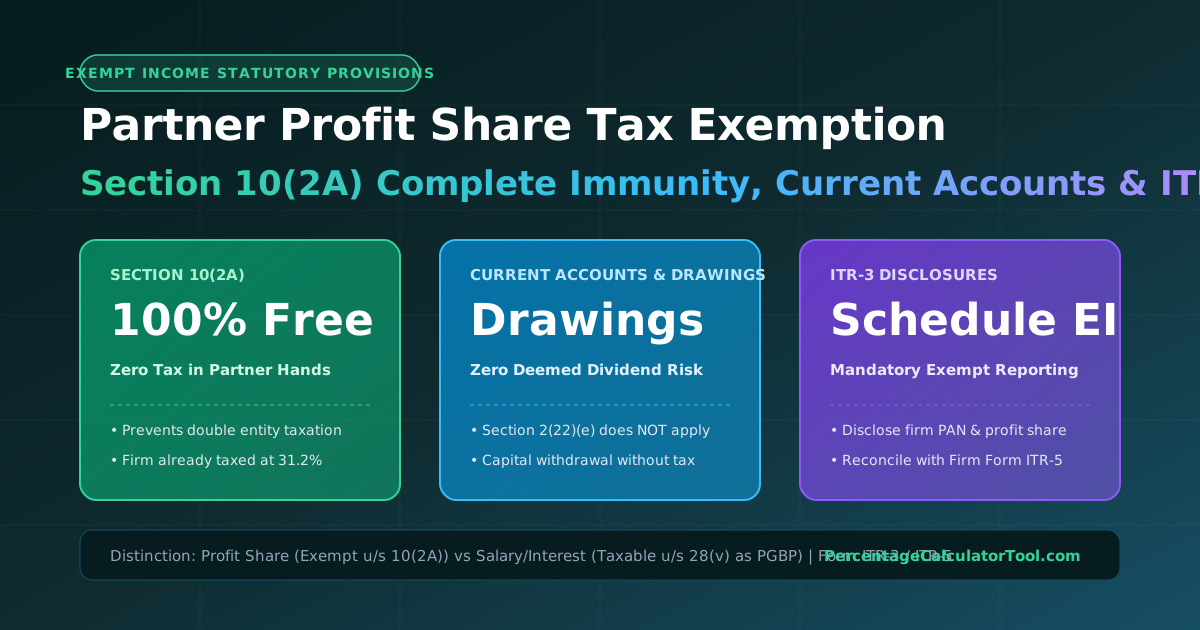
1. Statutory Foundation of Section 10(2A): Eliminating Double Taxation
In the direct tax jurisprudence of India, the partnership firm and its partners represent an integrated economic enterprise. While under the Indian Partnership Act, 1932 a firm is merely a collective name for the individuals who have entered into partnership, the Income Tax Act, 1961 treats the firm as an independent, distinct assessable unit under Section 2(31).
Because the firm is separately assessed and pays a flat statutory tax of 30% plus surcharge and cess (effective 31.20% to 34.944%) on its entire taxable net profit, taxing the residual profits a second time when they reach the partners' bank accounts would inflict catastrophic double taxation.
Statutory Text of Section 10(2A)
To establish absolute fiscal immunity, Parliament enacted Section 10(2A), which mandates that in computing the total income of a previous year of any person, the following shall be completely excluded:
Section 10(2A) Statutory Wording:
"in the case of a person being a partner of a firm which is separately assessed as such, his share in the total income of the firm."
The Explanation to Section 10(2A) further clarifies that the share of a partner in the total income of a firm shall be apportioned in the ratio specified in the partnership deed. Under this provision, whether a partner receives ₹50,000 or ₹50 Crores as their agreed share of net profit, zero personal income tax is payable on that amount.
2. The 3-Bucket Architecture: Profit Share vs Remuneration vs Interest
A fatal error made by taxpayers and junior accountants is conflating all disbursements received from a partnership firm or LLP as "profit share". In reality, the Income Tax Act divides cash flows to partners into three distinct statutory buckets, each governed by an entirely different tax regime:
| Cash Flow Bucket | Governing Income Tax Section | Tax Treatment at Entity Level (Firm/LLP) | Tax Treatment in Partner's Personal Hands |
|---|---|---|---|
| Bucket 1: Share of Net Profit | Section 10(2A) | Firm pays 30% base tax + 4% cess (no deduction allowed to firm) | 100% TAX-EXEMPT in partner hands. Disclosed in Schedule EI of ITR-3. |
| Bucket 2: Partner Remuneration (Salary/Bonus/Commission) | Section 28(v) read with Section 40(b) | Deductible as business expenditure up to Section 40(b) limits (90% / 60%) | TAXABLE as Business Income (PGBP) at individual slab rates. (Disallowed portion is exempt). |
| Bucket 3: Interest on Partner Capital & Current Accounts | Section 28(v) read with Section 40(b)(iv) | Deductible up to 12% simple interest p.a. authorized by deed | TAXABLE as Business Income (PGBP) up to 12%. (Disallowed portion over 12% is exempt). |
This statutory separation is rigid: while Bucket 1 is completely exempt under Section 10(2A), Buckets 2 and 3 are fully taxable under Section 28(v) as business profits, subject to the partner’s applicable personal tax slabs.

3. The "Total Income" Doctrine: Firm Deductions & Partner Exemption
A contentious historical dispute between the Income Tax Department and taxpayers centered on the meaning of "total income of the firm" under Section 10(2A):
If a firm claims 100% tax holidays under Section 80-IA, Section 10AA (SEZ), or heavy Section 32 depreciation such that its assessed taxable total income is NIL, does the partner still get tax exemption on their share of commercial book profits?
Judicial Victory for Partners
Assessing Officers previously argued that if the firm paid zero tax, the partner could not claim exemption under Section 10(2A) because there was no "double taxation" to avoid.
This Departmental argument was comprehensively rejected by multiple High Courts, including the Bombay High Court in CIT v. R.M. Chidambaram Pillai and the Gujarat High Court. The courts established the Absolute Exemption Doctrine:
- Section 10(2A) requires only that the firm is "separately assessed as such" (i.e., assessed under Section 184 as a registered firm).
- Once a firm is assessed as an entity, the partner's share of profits arising from the firm’s activities is completely sheltered by Section 10(2A), regardless of whether the firm's taxable income is reduced to zero through statutory incentives, investment allowances, or past unabsorbed losses.
4. Capital Accounts vs Current Accounts: Accounting Mechanics & Drawings
To maintain flawless records that satisfy tax scrutiny under Section 143(3), firms must clearly bifurcate partner equity into two accounting ledgers:
1. Fixed Capital Account
- Records the permanent, core equity contributed by the partner upon admission or pursuant to formal deed modifications.
- Remains relatively static across accounting years unless formal capital calls are injected.
- Forms the primary baseline for calculating the 12% simple interest allowable under Section 40(b)(iv).
2. Fluctuating Current Account
- Maintains the day-to-day commercial movements between the partner and the firm.
- Credit Entries (+): Partner remuneration, authorized interest on capital, and the annual allocation of post-tax profit share u/s 10(2A).
- Debit Entries (-): Partner personal drawings, personal tax payments made from firm accounts, and any share of net commercial losses.
Tax Neutrality of Partner Drawings
When a partner withdraws money from their current account for personal living expenses, purchasing a personal car, or paying home EMIs, does that withdrawal attract income tax? NO.
Under Indian law, a partner cannot earn income from themselves. Drawings represent a mere withdrawal of post-tax capital or previously accumulated exempt profit. It is a balance sheet capital transmission, completely outside the scope of income taxation.
5. Personal Expenses Borne by the Firm: Section 37(1) Disallowances
While drawings from capital are non-taxable, a common operational mistake occurs when a firm pays personal household expenses of the partners (e.g., family vacation flights, children's school tuition, home grocery bills) and attempts to debit them as business expenses in the firm's Profit & Loss account.
Statutory Consequences:
- Section 37(1) Disallowance: Under Section 37(1), only expenditure incurred "wholly and exclusively for the purposes of the business" is deductible. Any personal expenditure of a partner is added back to the firm's business income, and the firm pays 31.2% tax plus penal interest.
- Proper Accounting Practice: If the firm’s bank account is used to pay a partner’s personal expense, the bookkeeper must never debit the P&L account. Instead, debit the partner’s Personal Drawings / Current Account directly. This maintains the purity of the firm's P&L and ensures zero tax controversy.
6. Total Immunity from Section 2(22)(e) Deemed Dividend & Section 56(2)(x) Gifts
Operating through a partnership firm or LLP confers two colossal statutory protections unavailable to corporate shareholder-directors:
1. Complete Immunity from Section 2(22)(e) Deemed Dividend
In a private limited company, if the company advances a loan to a shareholder holding 10%+ voting power, Section 2(22)(e) deems the entire loan as a taxable dividend in the shareholder's hands at regular slab rates up to the extent of accumulated profits.
In an LLP or Partnership Firm: Section 2(22)(e) applies strictly to "companies". It has zero application to partnership firms or LLPs. A partner can borrow ₹1 Crore from the firm’s surplus funds, maintain a debit balance in their current account, or take a short-term advance without triggering deemed dividend taxation!
2. Immunity from Section 56(2)(x) "Gift / Deemed Income" Provisions
Section 56(2)(x) taxes any sum of money or property received without consideration or for inadequate consideration as "Income from Other Sources". Does the allocation of profit share or distribution of firm assets to a partner trigger Section 56(2)(x)?
Judicial Consensus: The Bombay High Court and Mumbai ITAT benches have repeatedly held that profit share received by a partner represents their statutory contractual entitlement flowing from partnership capital and personal sweat equity under the partnership deed. It is not a gratuitous "receipt without consideration" and is completely outside the ambit of Section 56(2)(x).
7. Cash Transactions Between Partner & Firm: Sections 269SS & 269T Judicial Doctrines
Sections 269SS and 269T mandate that no person shall accept or repay any loan, deposit, or specified sum exceeding ₹20,000 in cash, under pain of a 100% penalty under Sections 271D and 271E.
Does introducing capital in cash by a partner into the firm, or withdrawing cash drawings from the firm, trigger Section 269SS and 269T penalties?
The Landmark Judicial Doctrine
In landmark decisions, including CIT v. Muthoot M. George Bankers (Kerala HC), CIT v. R.M. Chidambaram Pillai (SC), and CIT v. Lokhpat Film Exchange (Rajasthan HC), the courts established that:
- A partnership firm is not an independent juristic person distinct from its partners under general law.
- Therefore, money introduced by a partner as capital or withdrawn as drawings does not constitute a "loan" or "deposit" between two independent parties. It represents a transaction between a person and themselves.
- Consequently, capital contributions and profit drawings are generally protected from Sections 269SS and 269T penalties.
Professional Caution: Despite this favorable judicial doctrine, tax authorities frequently issue show-cause notices for cash transactions exceeding ₹20,000. To avoid costly litigation, firms and partners should route 100% of capital injections, remuneration, interest, and profit distributions through account payee bank transfers (NEFT/RTGS/IMPS/Cheque).
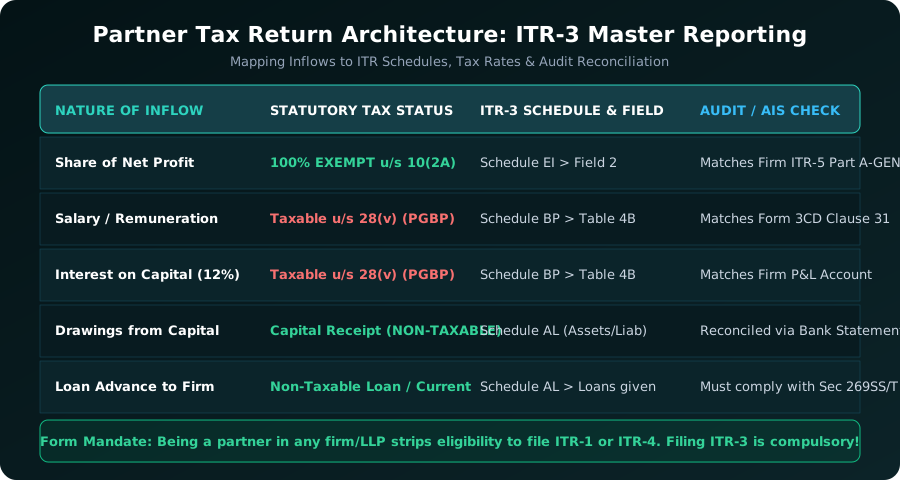
8. Mandatory ITR-3 Filing: Why Partners Are Strictly Barred from ITR-1 & ITR-4
Every individual who is a partner in a partnership firm or LLP is subject to strict statutory restrictions when filing their annual income tax return:
Statutory Bar on Simple ITR Forms
- Barred from Form ITR-1 (Sahaj): The instructions to Form ITR-1 explicitly state that ITR-1 cannot be used by an individual who is a partner in a firm.
- Barred from Form ITR-2: ITR-2 cannot be used by anyone having income from business or profession. Because partner remuneration and interest are classified as PGBP under Section 28(v), partners cannot file ITR-2.
- Barred from Form ITR-4 (Sugam): While traditional partnership firms can file ITR-4, an individual partner in a firm cannot use ITR-4 to report their partner remuneration or presumptive earnings from that firm.
The Mandatory Universal Form: Form ITR-3
Under Rule 12 of the Income Tax Rules, 1962, every individual partner in a partnership firm or LLP must file Form ITR-3. Filing an incorrect form (such as ITR-1) results in the return being declared Defective under Section 139(9), invalidating the filing and exposing the partner to late fees under Section 234F!
9. Reporting in Schedule EI (Exempt Income) & Schedule BP Step-by-Step
To properly disclose partnership earnings in Form ITR-3 without triggering automated CPC tax demand notices, follow this precise schedule mapping:
Step 1: Disclose Exempt Profit Share in Schedule EI
- Navigate to Schedule EI (Exempt Income) in Form ITR-3.
- Locate Field 2: Share in the profit of firm/LLP.
- Enter the mandatory details:
- PAN of the Firm / LLP: (e.g., AABFA1234K).
- Name of the Firm / LLP: (Legal registered title).
- Assessee's Percentage Share in Profit: (e.g., 50.00%).
- Total Amount of Profit Share Received: (Exact rupee figure credited to capital/current account).
- This amount flows into the Exempt Income total and is automatically excluded from Gross Total Income.
Step 2: Disclose Remuneration & Interest in Schedule BP
- Navigate to Schedule BP (Computation of Income from Business or Profession).
- Locate Table 4B: Income from Firm (Partner’s Share of Remuneration & Interest).
- Enter the remuneration and interest figures allowable under Section 40(b).
- If you incurred interest on capital borrowed to invest in the firm, claim the interest deduction under Section 36(1)(iii) in the dedicated expense column.
- The net figure automatically adds to your Net PGBP Income and is taxed at your regular slab rates.
10. Master Mathematical Case Study: Reconciling Firm ITR-5 with Partner ITR-3 Returns
Consider M/s Vertex Architectural Studios LLP, a high-end design firm with two equal partners: Ar. Rohan and Ar. Priya (50:50 profit sharing).
Firm Financial Overview (AY 2027-28):
- Gross Professional Fees: ₹1,20,00,000.
- Allowable Studio Commercial Expenses & Depreciation: ₹60,00,000.
- Book Profit before Partner Payments: ₹60,00,000.
- Interest on Capital (12% Simple): ₹3,00,000 each = ₹6,00,000 Total.
- Book Profit for Remuneration: ₹60,00,000 - ₹6,00,000 = ₹54,00,000.
Step 1: Section 40(b) Remuneration Allocation
- First ₹3,00,000 @ 90% = ₹2,70,000
- Balance ₹51,00,000 @ 60% = ₹30,60,000
- Total Permissible Remuneration: ₹33,30,000 (₹16,65,000 per partner).
Step 2: Firm Tax Computation (Form ITR-5)
- Book Profit before Remuneration: ₹54,00,000
- Less Remuneration Deduction u/s 40(b): ₹33,30,000
- Net Taxable Total Income of LLP: ₹20,70,000
- Base Tax @ 30%: ₹6,21,000
- Surcharge: Nil (Income < ₹1 Crore)
- Health & Education Cess @ 4%: ₹24,840
- Total Tax Paid by LLP: ₹6,45,840
- Residual Post-Tax Commercial Profit: ₹20,70,000 - ₹6,45,840 = ₹14,24,160.
Step 3: Partner Tax Assessment (Ar. Rohan’s Personal ITR-3)
Ar. Rohan receives three streams from Vertex Studios LLP:
- Remuneration: ₹16,65,000 → Taxable in Schedule BP u/s 28(v).
- Interest on Capital: ₹3,00,00,00 → Taxable in Schedule BP u/s 28(v).
Less Interest on Bank Overdraft borrowed to invest in capital: ₹50,000 deductible u/s 36(1)(iii).
Net Taxable Business Income: ₹16,65,000 + ₹2,50,000 = ₹19,15,000. - Share of Profit (50% of ₹14,24,160): ₹7,12,080 → 100% TAX-FREE under Section 10(2A).
Reported in Schedule EI (Field 2). Zero tax paid on this ₹7.12 Lakhs!
Both partners achieve absolute mathematical reconciliation between the firm’s audited balance sheet and their individual ITR-3 filings.
11. Scrutiny Defense & AIS / TIS Information Reconciliation Checklist
With the integration of the Annual Information Statement (AIS) and Taxpayer Information Summary (TIS), the Income Tax Department's Insight Portal cross-verifies firm filings against partner returns using automated algorithms.
Scrutiny Defense Protocols
- Cross-PAN Reconciliation: Ensure that the partner remuneration and interest figures claimed as deductions in the firm’s ITR-5 (and reported in Form 3CD Tax Audit Report Clause 31) exactly match the figures offered to tax in Schedule BP of the partners' ITR-3 returns.
- Profit-Sharing Ratio Audit: Verify that the percentage of exempt profit reported in Schedule EI matches the exact profit-sharing ratio recorded in Part A-GEN of the firm’s ITR-5 and the registered partnership deed.
- Bank Statement Verification: Ensure all profit distributions and drawings are documented through banking channels to easily withstand inquiry notices under Section 133(6) or Section 142(1).
12. Frequently Asked Questions (FAQs)
Can a salaried individual become a partner in an LLP and claim Section 10(2A) exemption?
Yes. A salaried employee can be a partner in a partnership firm or LLP (subject to the terms of their employment contract). Their salary from their employer is taxed under the head 'Salaries' with standard deduction, while their profit share from the LLP is completely exempt under Section 10(2A). They must file Form ITR-3.
Does a partner have to pay GST on the profit share received from the firm?
No. Under Schedule III of the CGST Act, distribution of profit by a partnership firm or LLP to its partners is an actionable claim and a distribution of post-tax surplus; it does not constitute a 'supply of goods or services' and is completely exempt from GST.
What happens if the partnership firm incurs a loss instead of a profit?
If the firm incurs a business loss, the loss cannot be apportioned to the partners to set off against their personal salary or other incomes. The business loss remains within the firm and is carried forward by the firm itself under Section 72 for up to 8 assessment years to be set off against the firm's future business profits.
Can an NRI partner repatriate their Section 10(2A) exempt profit share abroad?
Yes. Under the Foreign Exchange Management Act (FEMA) and RBI guidelines, post-tax profit share distributed by an Indian firm or LLP to an NRI partner is fully repatriable outside India on a current account basis, subject to obtaining a Chartered Accountant's certificate in Form 15CB and filing Form 15CA on the e-filing portal.