Section 40(b) Partner Salary, Remuneration & Interest Limits: Book Profit Slabs, Partnership Deed Clauses & Tax Planning Guide
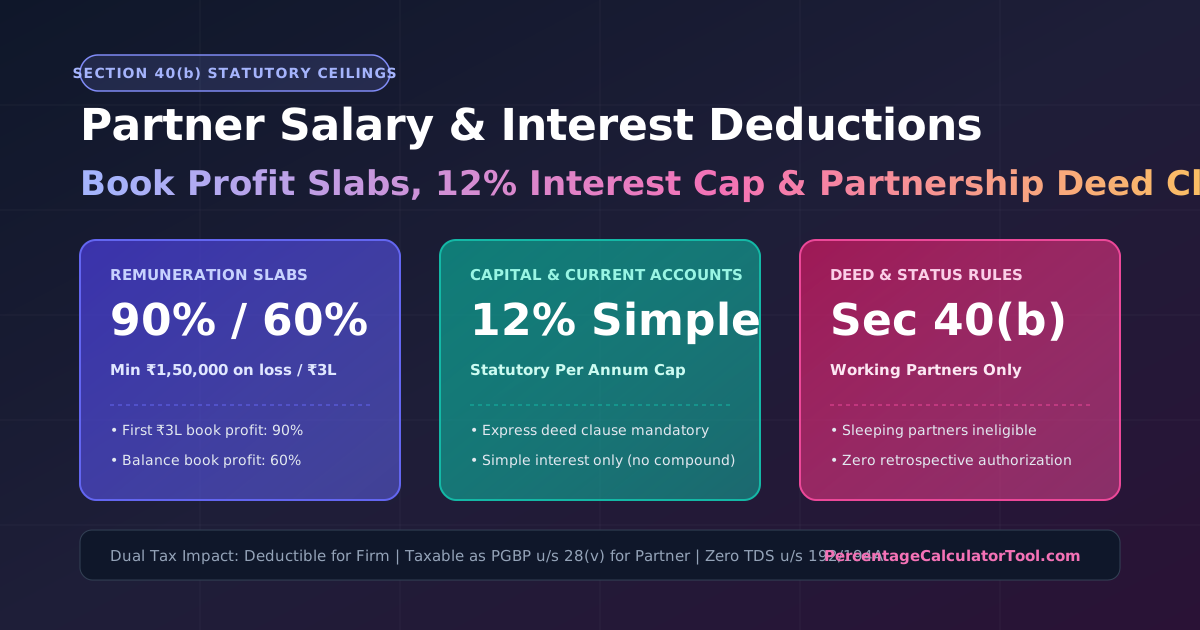
1. Legislative Architecture & Anti-Avoidance Purpose of Section 40(b)
In Indian tax jurisprudence, a partnership firm or Limited Liability Partnership (LLP) is taxed at a flat base rate of 30% plus surcharge and cess (effective 31.20% to 34.944%). In the absence of statutory safeguards, partners would simply pay out 100% of the firm's earnings as "managerial remuneration" or "interest on capital" to themselves, reducing the firm's taxable profit to absolute zero and subjecting the distributed sums to lower individual tax brackets or rebate benefits.
To eliminate this tax arbitrage while simultaneously recognizing legitimate commercial returns on partner sweat equity and invested capital, Parliament enacted Section 40(b) under Chapter IV-D of the Income Tax Act, 1961. Section 40(b) operates as an explicit non-obstante disallowance provision: it states that notwithstanding anything to the contrary in Sections 30 to 38, certain payments made by a firm to its partners shall not be deducted in computing the firm's business income, except within strictly defined statutory ceilings.
Section 40(b) regulates two fundamental categories of partner disbursements:
- Interest on Partner Capital and Current Accounts: Governed by Section 40(b)(ii) and Section 40(b)(iv).
- Partner Remuneration (Salary, Bonus, Commission): Governed by Section 40(b)(i), (iii), and (v).
2. "Working Partner" Definition Under Explanation 4: Mandatory Conditions
Under Section 40(b)(i), remuneration paid to any partner who is not a "working partner" is completely disallowed in the assessment of the firm. There is no partial allowance or discretion available to the Assessing Officer.
Statutory Definition (Explanation 4 to Section 40(b))
Explanation 4 defines a working partner with strict literal phrasing: "working partner means an individual who is actively engaged in conducting the affairs of the business or profession of the firm of which he is a partner."
| Partner Profile | Working Partner Status | Remuneration Tax Deductibility |
|---|---|---|
| Resident Individual Active Full-Time | Qualified Working Partner | Fully deductible within Section 40(b) limits |
| Sleeping / Financing Partner | Disqualified (Non-Working) | 100% Disallowed to the firm |
| Hindu Undivided Family (HUF) Partner | Disqualified (Entity, Not Individual) | 100% Disallowed (HUF cannot physically work) |
| Corporate Partner (Pvt Ltd / Ltd Co) | Disqualified (Artificial Juridical Person) | 100% Disallowed (Must be an "individual") |
| Minor Admitted to Benefits of Firm | Disqualified (Cannot enter contracts) | 100% Disallowed |
| Partner Living Abroad (NRI) | Qualified only if actively managing business affairs digitally/remotely | Allowable subject to evidentiary proof of active operational management |
Evidentiary Burden: During scrutiny assessments under Section 143(3), Assessing Officers regularly demand proof of active engagement—such as bank signing authorities, client correspondence, operational emails, GST filings signed, or project logs. If a partner is an inactive family member added merely for income splitting, the remuneration is summarily disallowed.
3. Partnership Deed Drafting Mandates: Why Vague Clauses Lead to 100% Disallowance
Section 40(b)(iii) establishes an unyielding procedural prerequisite: remuneration is deductible only if it is "authorized by, and is in accordance with, the terms of the partnership deed." Furthermore, it cannot relate to any period prior to the date of such partnership deed (prohibition against retrospective effect).
The "Specific Quantification" Doctrine
For decades, practitioners drafted loose clauses stating: "The working partners shall be paid salary as mutually decided by the partners at the end of the year, not exceeding the limits under Section 40(b)."
This practice was completely demolished by landmark judicial rulings, most notably by the Delhi High Court in CIT v. Sood Brij & Associates (2011) and the Himachal Pradesh High Court in Sudarshan & Co. The courts established that a partnership deed must either:
- State the exact fixed monetary sum payable to each working partner (e.g., ₹75,000 per month); OR
- Lay down a clear, self-executing mathematical formula or proportion by which the remuneration can be quantified without requiring a future subsequent agreement.
If the deed merely delegates the decision to a future oral or informal understanding, the statutory condition of being "in accordance with the terms of the partnership deed" is violated, and the entire remuneration is added back to the firm's income!
4. Interest on Capital Accounts: 12% Simple Interest Ceiling Under Section 40(b)(iv)
Under Section 40(b)(iv), any payment of interest paid by a firm to any partner is subject to dual statutory conditions:
- Written Authorization in the Deed: The payment of interest must be explicitly authorized by the partnership deed dating from or prior to the period for which interest is claimed. Zero interest can be deducted if the deed is silent.
- 12% Per Annum Simple Interest Cap: The interest rate must not exceed 12% per annum simple interest. If the deed specifies 15% or 18%, the excess over 12% is disallowed.
Critical Operational Nuances for Capital Interest
- Capital Accounts vs Current Accounts: The 12% ceiling applies to interest on both fixed capital accounts and fluctuating current accounts of partners.
- Prohibition on Compounding: Section 40(b)(iv) specifically specifies "simple interest". If the firm compounds interest quarterly or monthly such that the effective annualized rate exceeds 12%, the incremental compounding interest is disallowed.
- Overdrawn / Negative Current Accounts: If one partner has a positive capital of ₹50 Lakhs earning 12% interest, while another partner has an overdrawn (negative) current account of ₹40 Lakhs on which zero interest is charged to the partner, the Assessing Officer may invoke Section 36(1)(iii) disallowance for diversion of interest-bearing funds for non-business purposes. Firms must ensure the deed mandates reciprocal interest charges on debit balances.
- Interest to Partner in Representative Capacity: Under Explanation 1 and Explanation 2 to Section 40(b), where an individual is a partner in a representative capacity (e.g., Karta representing an HUF), interest paid to him in his personal capacity is not treated as interest to a partner, and vice versa.
5. Deriving Statutory "Book Profit": Detailed Add-Backs & Exclusions
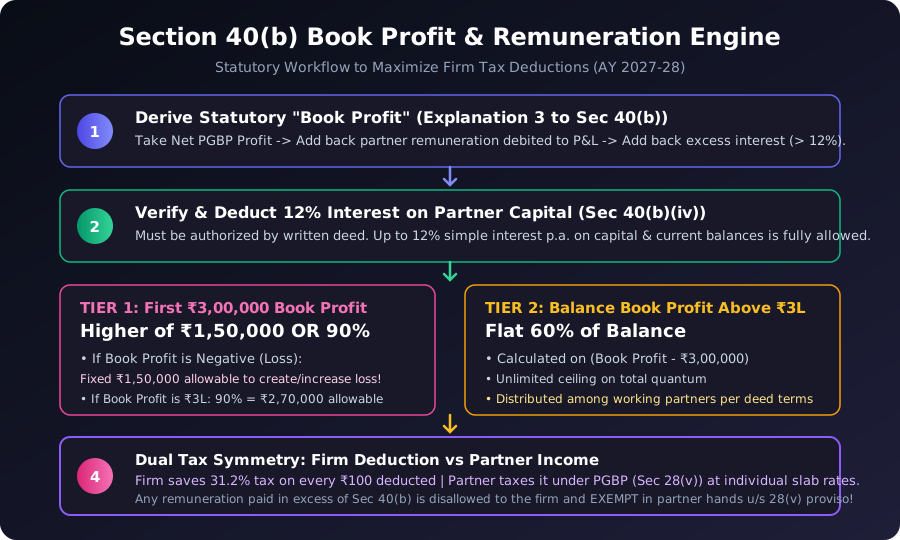
The maximum remuneration deductible under Section 40(b)(v) is not calculated on gross revenue or accounting profit, but on a specialized statutory construct designated as "Book Profit" under Explanation 3 to Section 40(b).
Statutory Definition of Book Profit
"Book profit means the net profit, as shown in the profit and loss account for the relevant previous year, computed in the manner laid down in Chapter IV-D, as increased by the aggregate amount of the remuneration paid or payable to all the partners of the firm if such amount has been deducted while computing the net profit."
Mathematical Formula for Book Profit:
Book Profit = Net Profit as per P&L (computed u/s 28 to 44DB) + Partner Remuneration debited to P&L + Excess Interest over 12% - Ineligible Income Heads (Capital Gains / Other Sources) - Brought Forward Business Depreciation (Sec 32(2))
Crucial Add-Back & Exclusion Principles
- Add Back Partner Remuneration: Any salary, bonus, or commission debited to the profit and loss account must be added back in full before applying the percentage slabs.
- Deduct Allowable 12% Interest First: Interest on capital within the 12% limit remains an allowable expenditure and is deducted before determining the book profit for partner remuneration.
- Exclusion of Non-PGBP Income: If the P&L account contains income from Capital Gains (e.g., sale of an office building), House Property (rental income), or Other Sources (interest on fixed deposits), these incomes must be subtracted. Judicial consensus (*Md. Serajuddin & Bros v. CIT*) confirms that book profit refers strictly to business income derived from operational activities.
- Treatment of Unabsorbed Depreciation vs Unabsorbed Loss: Under the Supreme Court ruling in CIT v. Mother India Refrigeration Industries, unabsorbed depreciation under Section 32(2) forms part of the current year’s depreciation allowance and must be deducted when computing book profit. In contrast, brought-forward business losses under Section 72 are set off at the Gross Total Income level and do not reduce the current year's book profit for Section 40(b) calculation.
6. The Two-Tier Statutory Remuneration Slabs: 90% and 60% Limits
Once the statutory Book Profit is calculated, Section 40(b)(v) prescribes a two-tier graduated formula to determine the maximum aggregate remuneration deductible for all working partners combined:
| Book Profit Tier | Statutory Ceiling Formula | Operational Mechanism & Practical Notes |
|---|---|---|
| Case 1: Book Profit is Negative (Firm Incurs a Business Loss) | Fixed sum of ₹1,50,000 | Even if the firm makes a massive commercial loss of ₹10 Lakhs, the firm is legally entitled to pay up to ₹1,50,000 total remuneration to working partners, increasing the tax loss to ₹11.50 Lakhs carried forward under Section 72! |
| Case 2: On the First ₹3,00,000 of Book Profit | ₹1,50,000 OR 90% of Book Profit, whichever is greater | For any book profit between ₹0 and ₹1,66,666, the ₹1,50,000 minimum applies. For book profit of ₹3,00,000, 90% equals ₹2,70,000 allowable remuneration. |
| Case 3: On the Balance Book Profit (Exceeding ₹3,00,000) | 60% of Balance Book Profit | Calculated strictly on the excess: (Book Profit - ₹3,00,000) × 60%. There is no upper rupee cap; the allowable deduction expands infinitely with higher book profits. |
Statutory Update Note: While proposals to adjust these historical thresholds to ₹3,00,000 minimum / ₹6,00,000 initial slab have been deliberated in recent Finance Bills, the fundamental two-tier structural formula (90% on initial tranche + 60% on balance) continues to govern standard computational practice for AY 2027-28.
7. Dual Tax Symmetry: Section 40(b) Firm Deduction vs Section 28(v) Partner Assessment
The Income Tax Act constructs an elegant, interlocking mirror between the firm’s tax assessment and the individual partner’s tax assessment. Remuneration and interest do not vanish into a vacuum; they transfer from the entity to the individual.
1. The Charging Section for Partners: Section 28(v)
Under Section 28(v), any interest, salary, bonus, commission, or remuneration, by whatever name called, due to or received by a partner of a firm from the firm is chargeable to income-tax under the head "Profits and Gains of Business or Profession" (PGBP).
Crucial Consequence: Partner salary is not taxed under the head "Salaries". As a result:
- The standard deduction of ₹75,000 under Section 16(ia) is NOT available against partner remuneration.
- However, the partner can claim genuine business expenses incurred exclusively for earning such remuneration (e.g., professional books, travel, mobile expenses, interest paid on capital borrowed to invest in the firm under Section 36(1)(iii)).
2. The Proviso to Section 28(v): Protection Against Double Taxation
What happens if a firm pays ₹20 Lakhs remuneration to its partners, but the Section 40(b) statutory ceiling limits the firm's deduction to ₹14 Lakhs? The firm is forced to add back ₹6 Lakhs and pay 31.2% tax on it.
Does the partner also pay personal income tax on that disallowed ₹6 Lakhs? ABSOLUTELY NOT.
The Proviso to Section 28(v) Statutory Shield:
"Provided that where any payment has not been allowed to be deducted under clause (b) of Section 40, the amount of income chargeable under this clause shall be adjusted to the extent of the amount not so allowed to be deducted."
This statutory proviso ensures that if an amount is taxed at the firm level due to Section 40(b) disallowance, it is 100% tax-free in the partner's hands. Double taxation is statutorily outlawed.
8. Complete Exemption from TDS: Sections 192, 194A & Advance Tax Duties
One of the most operational advantages of operating as a partnership firm or LLP is the complete absence of Tax Deducted at Source (TDS) on partner disbursements:
- Exemption from Salary TDS (Section 192): Under Indian law, a partner is a co-owner, not an employee. No employer-employee nexus exists. Therefore, Section 192 TDS on salary does not apply.
- Exemption from Interest TDS (Section 194A(3)(iv)): Section 194A specifically provides that no TDS shall be deducted on interest credited or paid by a firm to a partner of the firm.
- Exemption from Professional TDS (Section 194J) / Contractual TDS (Section 194C): Remuneration paid pursuant to the partnership deed does not attract Section 194J or 194C.
Advance Tax Obligations for Partners
Because the firm deducts ₹0 TDS on remuneration and interest, the partner must actively manage their personal tax liability. If the partner's estimated tax payable for the year exceeds ₹10,000, the partner is legally obligated under Section 208 to pay Advance Tax in four quarterly installments (15% by June 15, 45% by Sept 15, 75% by Dec 15, and 100% by March 15). Failure to do so triggers mandatory penal interest under Section 234B and Section 234C.
9. Tax Arbitrage Planning: Dropping Firm Tax from 31.2% to 0% in Personal Hands
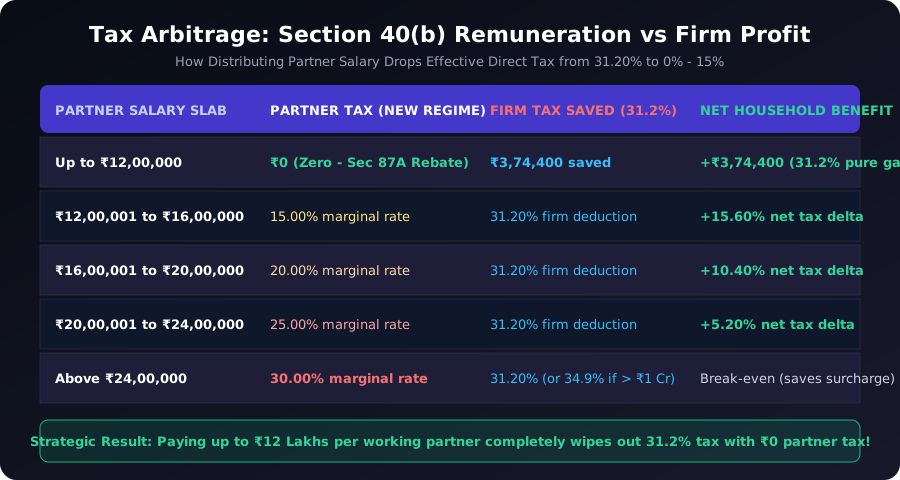
The combination of Section 40(b) deductions and the revamped New Tax Regime under Section 115BAC creates a colossal tax arbitrage opportunity for Indian small and mid-sized enterprises.
The Mechanics of the Zero-Tax Arbitrage Window
Under the FY 2026-27 / AY 2027-28 New Tax Regime, an individual taxpayer enjoys a Section 87A tax rebate ensuring that taxable income up to ₹12,00,000 attracts zero net income tax.
| Strategy Scenario | Firm Tax Consequence | Partner Personal Tax | Net Household Tax Paid |
|---|---|---|---|
| Scenario A: Retain as Firm Profit
Firm keeps ₹24,00,000 profit. Zero partner salary paid. |
Firm pays 31.20% tax on ₹24 Lakhs = ₹7,48,800 | Partner receives ₹16,51,200 exempt profit share u/s 10(2A) = ₹0 tax | ₹7,48,800 Total Tax |
| Scenario B: Section 40(b) Optimized Remuneration
Firm pays ₹12,00,000 salary each to 2 working partners (Total ₹24 Lakhs). |
Firm profit becomes ₹0. Firm pays ₹0 tax. | Partner 1: ₹12L income = ₹0 tax (Sec 87A)
Partner 2: ₹12L income = ₹0 tax (Sec 87A) |
₹0 TOTAL TAX! (100% Legal Tax Elimination) |
By simply drafting the partnership deed correctly and distributing ₹12 Lakhs per working partner, the business legally eliminates ₹7,48,800 of direct tax in a single financial year!
10. Mathematical Case Study: Precision Tax Model on ₹80 Lakhs Book Profit
Consider M/s Horizon Cloud Solutions LLP, an enterprise software consulting firm with three working partners (A, B, and C) sharing profits equally (1:1:1).
Financial Figures for Horizon Cloud Solutions LLP (AY 2027-28):
- Gross Business Receipts: ₹3,50,00,000.
- Commercial Operating Expenses: ₹2,50,00,000.
- Depreciation under Section 32: ₹20,00,000.
- Partner Capital: Partner A (₹50L), Partner B (₹30L), Partner C (₹20L) = Total ₹1,00,00,000.
- Partnership Deed Terms: Authorizes 12% interest on capital and maximum remuneration permissible under Section 40(b) divided equally among the 3 partners.
Step 1: Interest on Capital Deduction
Total Capital = ₹1,00,00,000. Permissible simple interest @ 12% = ₹12,00,000.
- Partner A: ₹50,00,000 × 12% = ₹6,00,000
- Partner B: ₹30,00,000 × 12% = ₹3,60,000
- Partner C: ₹20,00,000 × 12% = ₹2,40,000
Step 2: Statutory Book Profit Computation
- Gross Receipts: ₹3,50,00,000
- Less: Operating Expenses (₹2,50,00,000) & Depreciation (₹20,00,000) = ₹2,70,00,000
- PGBP Profit before Partner Payments: ₹80,00,000
- Less: Allowable 12% Interest on Capital: ₹12,00,000
- Statutory Book Profit for Remuneration: ₹68,00,000
Step 3: Calculating Section 40(b) Allowable Remuneration
- On first ₹3,00,000 @ 90%: ₹2,70,000
- On balance book profit (₹68,00,000 - ₹3,00,000 = ₹65,00,000) @ 60%: ₹39,00,000
- Total Permissible Remuneration: ₹2,70,000 + ₹39,00,000 = ₹41,70,000
- Per Partner Remuneration (÷ 3): ₹13,90,000 each.
Step 4: Final LLP Tax Liability
- Book Profit before Remuneration: ₹68,00,000
- Less: Permissible Remuneration: ₹41,70,000
- Net Taxable Total Income of LLP: ₹26,30,000
- Base Tax @ 30%: ₹26,30,000 × 30% = ₹7,89,000
- Surcharge: Nil (Income < ₹1 Crore)
- Health & Education Cess @ 4%: ₹31,560
- Total LLP Tax Payable: ₹8,20,560 (Effective rate on initial ₹80L profit drops to just 10.25%!).
Step 5: Partner Post-Tax Position (Partner A Example)
- Remuneration Income (PGBP u/s 28(v)): ₹13,90,000
- Interest Income (PGBP u/s 28(v)): ₹6,00,000
- Total Taxable Business Income: ₹19,90,000
- Share of Profit from LLP: (₹26,30,000 - ₹8,20,560) ÷ 3 = ₹6,03,147 (100% Tax-Free u/s 10(2A)).
11. Certified Model Partnership Deed Clauses for Legal Safety
To withstand rigorous scrutiny under Section 143(3), partnership deeds should incorporate battle-tested, unambiguous statutory clauses:
Clause 1: Remuneration to Working Partners
"It is hereby agreed that all the working partners who devote their full time and attention to the business of the firm shall be entitled to receive managerial remuneration. The aggregate remuneration payable to all working partners combined for each accounting year shall be computed in accordance with the provisions of Section 40(b)(v) of the Income Tax Act, 1961, being the maximum permissible limit calculated on the Book Profits of the firm. Such aggregate remuneration shall be allocated and credited to the respective accounts of the working partners in their agreed profit sharing ratio (or specified percentage) at the close of the accounting year."
Clause 2: Interest on Partner Capital & Current Accounts
"The firm shall pay simple interest at the rate of 12% (twelve per cent) per annum, or such lower rate as may be mutually determined, on the credit balance standing in the capital and current accounts of each partner at the end of each accounting year. Provided that if the statutory limit under Section 40(b)(iv) is amended, interest shall be credited at such amended statutory rate."
12. Frequently Asked Questions (FAQs)
Can a firm pay salary to a partner if the partnership deed does not mention it?
No. Under Section 40(b)(iii), payment of remuneration is strictly prohibited from deduction unless it is explicitly authorized by and in accordance with the written terms of the partnership deed. If the deed is silent, 100% of the remuneration will be disallowed in the firm's assessment.
Can capital gains earned by the firm be included in book profit for computing partner remuneration?
No. As affirmed by the Calcutta High Court in Md. Serajuddin & Bros and various ITAT benches, book profit under Explanation 3 to Section 40(b) is restricted to income computed under Chapter IV-D (Profits and Gains of Business or Profession). Capital gains, rental income, and interest on personal investments must be excluded from book profit when determining the 90%/60% remuneration ceiling.
If a partner invests borrowed capital into the firm, can they deduct interest expense against the 12% interest received?
Yes. Under Section 36(1)(iii) and Section 57, if a partner has borrowed funds from a third party or bank specifically to invest as capital in a firm, the interest paid on such borrowings is fully deductible against the 12% interest income received from the firm in the partner's personal tax return.
Can remuneration under Section 40(b) create or increase a business loss for the firm?
Yes. The statutory formula explicitly provides that on the first ₹3,00,000 of book profit or in case of a loss, the allowable deduction is ₹1,50,000 or 90% of book profit, whichever is more. Therefore, even if a firm incurs a net commercial loss, it can legally deduct ₹1,50,000 of remuneration, which increases the business loss to be carried forward for 8 assessment years under Section 72.