Partnership Firm & LLP Taxation in India: Flat 30% Rate, Surcharge, Alternate Minimum Tax (AMT u/s 115JC) & Compliance Guide
1. Statutory Framework: Partnership Firms vs Limited Liability Partnerships (LLPs)
In the direct tax landscape of India, non-corporate collaborative business structures operate primarily under two distinct statutory vehicles:
- Traditional Partnership Firms: Governed by the Indian Partnership Act, 1932. These entities lack perpetual succession and separate legal personality; partners bear joint, several, and unlimited personal liability for firm obligations.
- Limited Liability Partnerships (LLPs): Governed by the Limited Liability Partnership Act, 2008 and administered by the Ministry of Corporate Affairs (MCA). An LLP is a hybrid body corporate possessing a distinct legal entity status, perpetual succession, a common seal, and limited liability protection for all its partners up to their agreed capital contribution.
Crucially, for the purposes of the Income Tax Act, 1961, the definition of a "firm" under Section 2(23)(i) explicitly embraces both traditional partnerships and Limited Liability Partnerships. Furthermore, Section 2(23)(ii) stipulates that "partner" includes any person who has entered into a partnership or is a partner in an LLP, and Section 2(23)(iii) provides that "partnership" includes a limited liability partnership.
Consequently, unless a statutory provision explicitly carves out an exception (such as the presumptive taxation rules under Section 44AD and 44ADA), traditional partnership firms and LLPs are governed by the exact same substantive direct tax framework under Chapter IV-D (Profits and Gains of Business or Profession) and Chapter XII-BA (Alternate Minimum Tax).
2. Flat 30% Base Tax, 12% Surcharge & Health & Education Cess
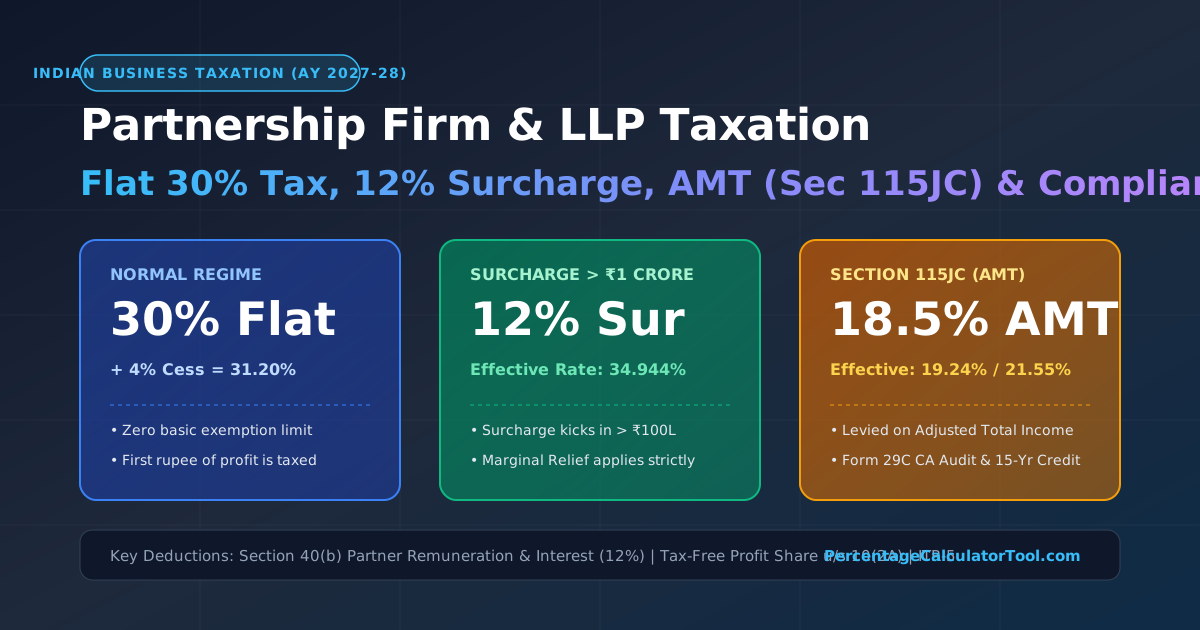
Unlike individual assessee files, Hindu Undivided Families (HUFs), or Association of Persons (AOPs), partnership firms and LLPs do not enjoy basic exemption limits or progressive graduated tax slabs. There is no nil rate on the initial ₹3,00,000 or ₹4,00,000 of income. The entity is taxed from the very first rupee of taxable net total income at a flat statutory rate.
Statutory Rate Breakdown for Assessment Year 2027-28
- Base Income Tax Rate: Exactly 30.00% flat on total taxable income.
- Statutory Surcharge:
- 0% Surcharge: When total taxable income does not exceed ₹1,00,00,000 (₹1 Crore).
- 12% Surcharge: When total taxable income exceeds ₹1,00,00,000 (₹1 Crore) on the base income tax payable.
- Health & Education Cess: Exactly 4.00% levied uniformly on the aggregate of income tax and applicable surcharge.
| Taxable Income Bracket | Base Tax Rate | Surcharge Rate | Health & Education Cess | Effective Tax Rate |
|---|---|---|---|---|
| Up to ₹1,00,00,000 (₹1 Crore) | 30.00% | Nil (0%) | 4% on Base Tax (1.20%) | 31.200% |
| Exceeding ₹1,00,00,000 (> ₹1 Crore) | 30.00% | 12% on Base Tax (3.60%) | 4% on (30% + 3.60%) = 1.344% | 34.944% |
This high baseline extraction rate of 31.20% to 34.944% means that establishing a firm or LLP requires aggressive and mathematically precise tax planning—particularly through the statutory utilization of partner remuneration and interest deductions permissible under Section 40(b).
3. Marginal Relief Calculation Formula Above ₹1 Crore
When a firm or LLP crosses the ₹1,00,00,000 income threshold, the sudden imposition of a 12% surcharge can produce an absurd economic anomaly: the additional tax payable could exceed the incremental income earned above ₹1 Crore. To prevent this confiscatory outcome, the Finance Act embeds a statutory Marginal Relief mechanism.
The Statutory Marginal Relief Rule
The total amount payable as income tax and surcharge on total income exceeding ₹1,00,00,000 shall not exceed the total tax payable on a total income of ₹1,00,00,000 by more than the amount of income that exceeds ₹1,00,00,000.
Mathematical Cap on Tax & Surcharge:
Max Tax Payable (Before Cess) = Tax on ₹1,00,00,000 + (Total Taxable Income - ₹1,00,00,000)
Where Tax on ₹1,00,00,000 = 30% of ₹1,00,00,000 = ₹30,00,000 (with zero surcharge).
Example Calculation: Marginal Relief on ₹1,02,00,000 Income
- Income Earned: ₹1,02,00,000 (Excess over ₹1 Crore = ₹2,00,000).
- Base Tax @ 30%: ₹30,60,000.
- Standard Surcharge @ 12%: ₹3,67,200.
- Total Regular Tax + Surcharge: ₹34,27,200.
- Permissible Maximum Tax under Marginal Relief:
Tax on ₹1,00,00,000 (₹30,00,000) + Excess Income (₹2,00,000) = ₹32,00,000. - Marginal Relief Granted: ₹34,27,200 - ₹32,00,000 = ₹2,27,200.
- Net Tax After Relief: ₹32,00,000.
- Add 4% Cess: ₹32,00,000 × 4% = ₹1,28,000.
- Final Tax Liability: ₹33,28,000 (instead of ₹35,64,288 without relief).
4. Alternate Minimum Tax (AMT) Under Section 115JC: Triggers & Computation
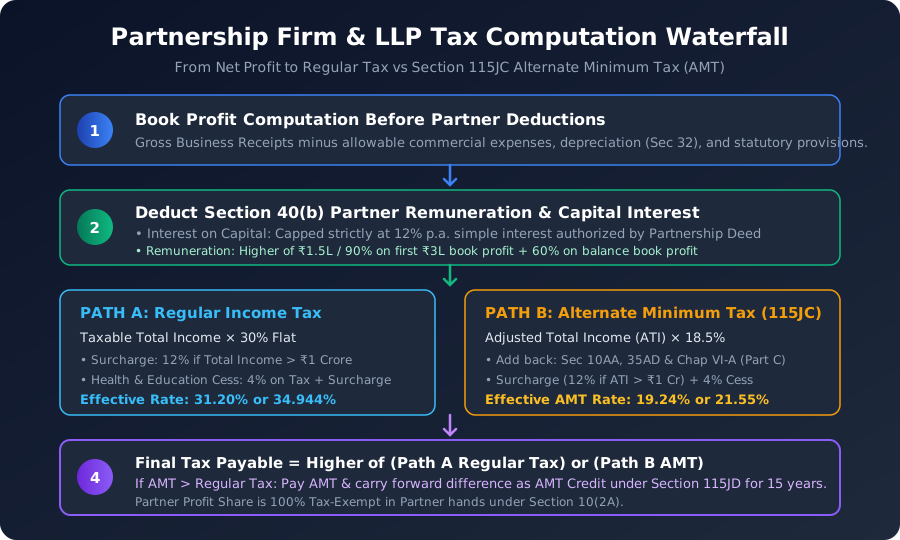
To prevent non-corporate taxpayers from zeroing out their tax obligations through aggressive exploitation of tax holidays, profit-linked deductions, and accelerated capital allowances, Chapter XII-BA of the Income Tax Act enacts the Alternate Minimum Tax (AMT) under Section 115JC.
While companies are subjected to Minimum Alternate Tax (MAT) on book profits under Section 115JB, non-corporate business entities—specifically partnership firms and LLPs—are subject to Section 115JC Alternate Minimum Tax.
Core Applicability Mandate
Under Section 115JC(1), where the regular income-tax payable for a previous year by a person (other than a company) is less than the Alternate Minimum Tax payable for such previous year, the Adjusted Total Income shall be deemed to be the total income of that person, and he shall be liable to pay income-tax on such adjusted total income at the rate of eighteen and one-half per cent (18.50%).
Statutory AMT Rates for AY 2027-28
- Base AMT Rate: 18.50% of Adjusted Total Income (ATI).
- Unit in IFSC Rate: 9.00% if the assessee is a unit located in an International Financial Services Centre (IFSC) deriving its income solely in convertible foreign exchange.
- Surcharge on AMT:
- 0% if ATI is up to ₹1,00,00,000 (₹1 Crore).
- 12% if ATI exceeds ₹1,00,00,000.
- Health & Education Cess: 4% applied across the board.
- Effective AMT Rate:
- ATI up to ₹1 Crore: 18.5% + 4% cess = 19.240%.
- ATI > ₹1 Crore: 18.5% + 12% surcharge + 4% cess = 21.549%.
5. Computing Adjusted Total Income (ATI) & Disallowed Deductions
Adjusted Total Income is defined with statutory precision under Section 115JC(2). It is not equivalent to accounting book profit; rather, it is derived by taking the assessee’s Net Taxable Total Income computed under the ordinary provisions of the Act and adding back three specific categories of statutory deductions:
| Statutory Add-Back Component | Income Tax Section | Nature of Incentive Neutralized |
|---|---|---|
| Deductions under Chapter VI-A (Part C) | Sections 80-IA to 80RRB (Excluding Section 80JJAA) | Profit-linked industrial undertakings, infrastructure development, housing projects (80-IBA), development of SEZs, and rural development incentives. Crucial Note: Section 80JJAA employment deduction is NOT added back. |
| Deduction for SEZ Units | Section 10AA | 100% or 50% export profit deductions claimed by units established in Special Economic Zones. |
| Investment-Linked Deduction for Specified Businesses | Section 35AD (Minus Depreciation u/s 32) | 100% capital expenditure deductions for cold chains, warehousing, cross-country pipelines, hospitals, affordable housing, etc., reduced by the normal depreciation under Section 32 that would have been allowable had Section 35AD not been claimed. |
Important Exemption for Small Partnerships
Under Section 115JEE(1), the provisions of AMT shall apply only if the assessee has claimed any deduction under Section 10AA, Section 35AD, or Chapter VI-A under the heading "C - Deductions in respect of certain incomes". Furthermore, under Section 115JEE(2), if an individual, HUF, or AOP has an Adjusted Total Income not exceeding ₹20,00,000, AMT does not apply. However, this ₹20 Lakh threshold exemption does NOT apply to partnership firms or LLPs! A firm or LLP claiming even ₹50,000 of Section 10AA or 80-IA deduction is immediately caught within the AMT net regardless of whether its total income is ₹5 Lakhs or ₹5 Crores.
6. Section 115JD AMT Credit Mechanics: 15-Year Carry-Forward & Utilization
Payment of Alternate Minimum Tax does not represent an absolute permanent loss of capital. Under Section 115JD, the excess tax paid under Section 115JC over and above the regular income tax payable under Chapter IV is recognized as an AMT Credit.
Statutory Formula for AMT Credit Generation
AMT Credit Generated = Alternate Minimum Tax Paid (u/s 115JC) - Regular Income Tax Payable
Key Operational Rules for AMT Credit:
- 15-Year Carry-Forward Window: The credit can be carried forward for up to 15 consecutive assessment years immediately succeeding the assessment year in which such credit is generated (Section 115JD(4)).
- Set-Off Condition: In any subsequent assessment year, the credit can only be utilized if the regular income tax payable for that year exceeds the Alternate Minimum Tax payable for that year.
- Maximum Permissible Set-Off Ceiling: The set-off allowed in any year is strictly capped at the difference between the Regular Income Tax and the AMT for that specific year:
Max Set-Off Allowed = Regular Income Tax - Alternate Minimum Tax - Zero Interest on Credit: The Income Tax Department pays zero interest under Section 244A on carried-forward AMT credit balances.
7. Form No. 29C Certification & E-Filing Due Dates
Any partnership firm or LLP to which the provisions of Section 115JC apply is legally mandated under Section 115JC(3) read with Rule 40FB to obtain a certified report from an independent Chartered Accountant in Form No. 29C.
Audit Verification Scope of Form 29C
- Verification of regular taxable income computations.
- Independent verification of Chapter VI-A (Part C) add-backs.
- Audit of Section 35AD asset schedules and recalculation of hypothetical Section 32 depreciation.
- Mathematical reconciliation of Adjusted Total Income (ATI).
- Verification of the cumulative AMT Credit ledger under Section 115JD, including past years' credit utilized and balance carried forward.
Mandatory Due Date: Form No. 29C must be furnished electronically through the e-filing portal at least one month prior to the due date for furnishing the return of income under Section 139(1). For tax audit entities whose ITR deadline is October 31, Form 29C must be submitted on or before September 30 of the assessment year.
8. Section 44AD / 44ADA Presumptive Taxation: Firm Eligibility vs LLP Ban
A critical divergence between traditional partnership firms and LLPs lies in their eligibility for the presumptive taxation schemes designed for micro and small enterprises:
Section 44AD (Small Business Presumptive Scheme - Up to ₹3 Crores)
Under Section 44AD, eligible businesses with turnover up to ₹2 Crores (or ₹3 Crores if digital receipts constitute 95%+ of gross receipts) can declare profits at 8% (cash receipts) or 6% (digital receipts) without maintaining voluminous books of account.
- Traditional Partnership Firms: ELIGIBLE. A traditional partnership firm is explicitly recognized as an "eligible assessee" under Section 44AD(1).
- Limited Liability Partnerships (LLPs): STRICTLY PROHIBITED. The Explanation to Section 44AD explicitly states that an eligible assessee does not include a limited liability partnership firm. LLPs cannot use Section 44AD under any circumstances.
Section 44ADA (Professional Presumptive Scheme - Up to ₹75 Lakhs)
Section 44ADA allows notified professionals (legal, medical, engineering, architectural, accountancy, technical consultancy, interior decoration) with gross receipts up to ₹50 Lakhs (or ₹75 Lakhs if digital receipts exceed 95%) to offer 50% of receipts as deemed taxable profit.
- Traditional Partnership Firms: ELIGIBLE. Professional partnership firms can file under Section 44ADA.
- Limited Liability Partnerships (LLPs): STRICTLY EXCLUDED. Under judicial interpretations and CBDT notifications, LLPs are barred from availing Section 44ADA benefits.
This structural disparity means that professionals and small traders wanting minimal audit exposure often begin as traditional partnership firms before converting to LLPs once turnover crosses presumptive thresholds.
9. Comprehensive Entity Comparison: Partnership Firm vs LLP vs Private Limited (Sec 115BAA)
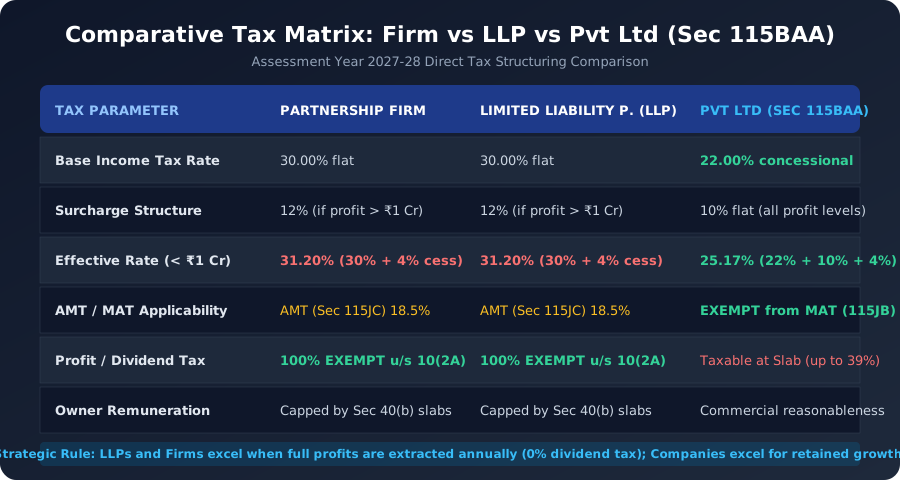
Choosing between a Partnership Firm, an LLP, and a Private Limited Company is one of the most vital strategic choices for Indian promoters. While companies enjoy a lower headline tax rate of 22% (25.17% effective under Section 115BAA), the ultimate post-tax yield in the promoters' pockets tells a very different story.
| Structuring Dimension | Traditional Partnership Firm | Limited Liability Partnership (LLP) | Private Limited Company (Sec 115BAA) |
|---|---|---|---|
| Governing Statute | Indian Partnership Act, 1932 | LLP Act, 2008 (MCA) | Companies Act, 2013 (MCA) |
| Partner / Shareholder Liability | Unlimited personal liability | Limited to agreed capital | Limited to face value of shares |
| Entity Level Base Tax Rate | 30% flat | 30% flat | 22% flat |
| Effective Rate (< ₹1 Crore) | 31.20% | 31.20% | 25.17% |
| Effective Rate (> ₹1 Crore) | 34.944% | 34.944% | 25.17% |
| Minimum Alternate Tax (MAT/AMT) | AMT u/s 115JC (18.5%) | AMT u/s 115JC (18.5%) | Completely EXEMPT u/s 115JB(5A) |
| Profit Extraction by Owners | 100% TAX-FREE u/s 10(2A) | 100% TAX-FREE u/s 10(2A) | Taxed as Dividend at Individual Slab Rates (up to 39%) |
| Overall Two-Tier Effective Tax on Withdrawn Profit | 31.20% - 34.944% (Total Final Tax) | 31.20% - 34.944% (Total Final Tax) | 47.6% - 54.3% (Company Tax + Personal Dividend Tax) |
| Annual MCA Filing Burdens | Zero MCA filings; Registrar of Firms only | Form 8 (Accounts) & Form 11 (Annual Return) | AOC-4, MGT-7, DIR-3 KYC, Board resolutions, statutory secretarial audit |
Strategic Tax Takeaway: If the owners intend to reinvest all net operating earnings back into retained capital for aggressive expansion, the Private Limited Company under Section 115BAA is mathematically superior (25.17% vs 31.20%). However, if the business generates steady operating cash flow that is distributed annually to the owners, the LLP or Partnership Firm wins by a massive margin because profit share is 100% exempt from personal income tax under Section 10(2A), completely avoiding the crushing 30%-39% personal dividend tax levied on corporate shareholders.
10. Mathematical Case Study: Full Tax Waterfall on ₹1.50 Crore Net Profit
To examine the comprehensive tax mechanics in action, consider M/s Apex Precision Engineering LLP, an engineering firm with two equal working partners for AY 2027-28.
Financial Profile of Apex Precision LLP:
- Gross Commercial Book Profit (P&L): ₹1,50,00,000 (₹1.50 Crores).
- Partner Capital Balance: ₹1,00,00,000 (₹50 Lakhs each). Partnership Deed authorizes 12% simple interest.
- Partner Remuneration: Both partners actively work; deed authorizes maximum remuneration permissible u/s 40(b).
- Chapter VI-A (Part C) Incentives Claimed: ₹20,00,000 claimed under Section 80-IA for infrastructure manufacturing.
Step 1: Section 40(b) Partner Remuneration & Interest Deductions
- Interest on Capital: ₹1,00,00,000 × 12% = ₹12,00,000 allowable.
- Book Profit for Section 40(b) Remuneration:
₹1,50,00,000 - ₹12,00,000 (Interest) = ₹1,38,00,000. - Permissible Remuneration Slab Calculation:
- On first ₹3,00,000 @ 90%: ₹2,70,000.
- On balance ₹1,35,00,000 @ 60%: ₹81,00,000.
- Total Permissible Remuneration: ₹2,70,000 + ₹81,00,000 = ₹83,70,000 (₹41.85 Lakhs per partner).
- LLP Taxable PGBP Income: ₹1,38,00,000 - ₹83,70,000 = ₹54,30,000.
Step 2: Regular Income Tax Computation (Path A)
- Gross Total Income: ₹54,30,000.
- Less Chapter VI-A Deduction (Section 80-IA): ₹20,00,000.
- Net Taxable Total Income: ₹34,30,000.
- Base Tax @ 30%: ₹34,30,000 × 30% = ₹10,29,000.
- Surcharge: Nil (Total Income is under ₹1 Crore).
- Health & Education Cess @ 4%: ₹10,29,000 × 4% = ₹41,160.
- Regular Income Tax Payable: ₹10,70,160.
Step 3: Alternate Minimum Tax (AMT) Computation (Path B)
- Net Taxable Total Income: ₹34,30,000.
- Add Back Section 80-IA Deduction: ₹20,00,000.
- Adjusted Total Income (ATI): ₹54,30,000.
- Base AMT @ 18.5%: ₹54,30,000 × 18.5% = ₹10,04,550.
- Surcharge: Nil (ATI is under ₹1 Crore).
- Health & Education Cess @ 4%: ₹10,04,550 × 4% = ₹40,182.
- Total AMT Payable: ₹10,44,732.
Step 4: Final Settlement & Tax Determination
Comparing Path A and Path B:
- Regular Tax: ₹10,70,160.
- AMT Liability: ₹10,44,732.
- Final Tax Payable: Because Regular Tax (₹10,70,160) is higher than AMT (₹10,44,732), the firm pays the Regular Tax of ₹10,70,160. Zero AMT credit is generated or utilized this year.
Step 5: Post-Tax Partner Cash Extraction
- LLP Post-Tax Residual Profit: ₹34,30,000 - ₹10,70,160 = ₹23,59,840 distributed 50:50 = ₹11,79,920 per partner (100% Tax-Free u/s 10(2A)).
- Partner Individual Assessment: Each partner reports ₹41,85,000 Remuneration + ₹6,00,000 Interest = ₹47,85,000 as PGBP business income under Section 28(v) in their personal ITR-3, taking advantage of standard slabs and Section 87A / 80C deductions.
11. Section 44AB Tax Audit Thresholds & ITR-5 Filing Deadlines
Partnership firms and LLPs are subject to the statutory tax audit provisions under Section 44AB of the Income Tax Act:
Tax Audit Thresholds for AY 2027-28
- Business Assessees: Tax audit by an independent CA is mandatory if total turnover, sales, or gross receipts exceed ₹1 Crore in the previous year.
- 10-Crore Enhanced Digital Threshold: If cash receipts and cash payments do not exceed 5% of aggregate receipts and payments respectively, the tax audit threshold is elevated to ₹10 Crores.
- Professional Assessees: Tax audit is mandatory if gross professional receipts exceed ₹50 Lakhs (or ₹75 Lakhs under enhanced digital rules).
Statutory ITR Filing Forms & Deadlines
- ITR Form: Both partnership firms and LLPs file ITR-5 exclusively. (ITR-5 must be verified using a Digital Signature Certificate - DSC - for LLPs and tax-audit firms).
- Due Date (Non-Audit Firms): July 31 of the assessment year.
- Due Date (Audit Entities):
- Tax Audit Report (Form 3CA/3CD) & Form 29C (AMT): September 30 of the assessment year.
- ITR-5 Return of Income: October 31 of the assessment year.
- Due Date (Transfer Pricing u/s 92E): November 30 of the assessment year if the firm undertook international or specified domestic transactions.
12. Frequently Asked Questions (FAQs)
Is an LLP liable to pay Minimum Alternate Tax (MAT) on book profits under Section 115JB?
No. Minimum Alternate Tax (MAT) under Section 115JB applies exclusively to corporate entities (companies). Non-corporate business entities like LLPs and partnership firms are completely outside the ambit of Section 115JB. Instead, they are governed by Alternate Minimum Tax (AMT) under Section 115JC based on Adjusted Total Income.
Can a partnership firm carry forward losses if there is a change in the constitution of partners?
Under Section 78(1), where a change has occurred in the constitution of a firm due to the retirement or death of a partner, the firm is not entitled to carry forward and set off so much of the loss proportionate to the share of the retired or deceased partner. However, this restriction applies only to business losses and does not apply to unabsorbed depreciation under Section 32(2).
Does a firm need to deduct TDS when paying remuneration or interest to its partners?
No. Under Section 192 and Section 194A, payments of salary, bonus, commission, or interest on capital made by a partnership firm or LLP to its partners are exempt from TDS. The partner directly pays advance tax on this income under Section 28(v) as PGBP income.
What is the penalty for failing to file Form 29C for Alternate Minimum Tax?
Failure to obtain and furnish Form No. 29C before the statutory due date does not attract a specific standalone fee, but it results in the immediate denial of Chapter VI-A or Section 10AA deductions during assessment, automatic recalculation of tax under Section 143(1) or 143(3), and interest levies under Sections 234A, 234B, and 234C.