Sections 9B and 45(4) Firm Dissolution & Reconstitution Tax: Rules, Formula & Guide (AY 2027-28)
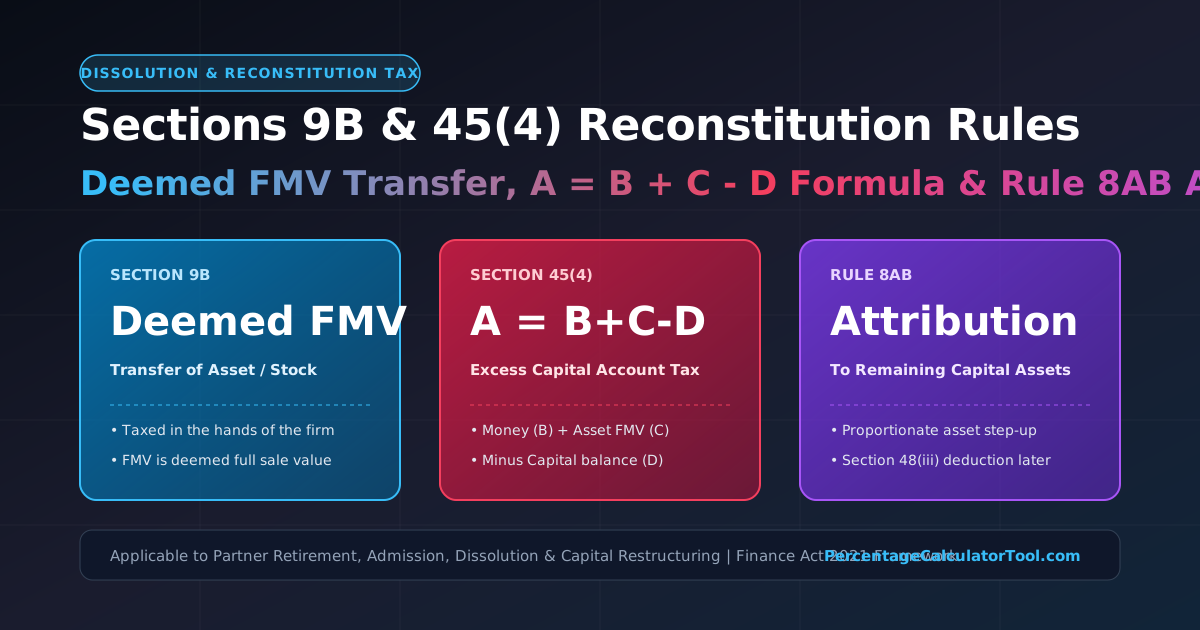
1. Historical Loopholes & The Pre-Finance Act 2021 Legal Architecture
Prior to the monumental amendments introduced by the Finance Act, 2021, the restructuring of partnership firms and Limited Liability Partnerships (LLPs) served as one of the most prolific tax-avoidance mechanisms in Indian commercial property transactions.
The Classic Real Estate Revaluation Loophole
Under the erstwhile provisions of Section 45(4), capital gains tax was triggered only upon the "transfer of a capital asset by way of distribution of capital assets on the dissolution of a firm". Tax planning exploited this language through a sequence of steps:
- A firm owning agricultural land or commercial property would not dissolve. Instead, it would undergo a reconstitution: new incoming wealthy partners were admitted, introducing massive liquid capital.
- The firm revalued its real estate assets from historical book value (e.g., ₹1 Crore) to current fair market value (e.g., ₹50 Crores). The ₹49 Crore revaluation reserve was credited directly to the capital accounts of the original retiring partners.
- The original partners then retired, withdrawing their inflated capital balance of ₹50 Crores in cash.
- Zero Tax Outcome: Based on the Supreme Court’s celebrated ruling in CIT v. Mohanbhai Pamabhai (1987) and Sunil Siddharthbhai (1985), the courts held that a retiring partner receiving cash in satisfaction of their partnership interest did not effect a "transfer" of an asset under Section 2(47). Consequently, tens of billions of rupees in real estate gains escaped capital gains tax entirely!
To permanently dismantle this aggressive scheme, Parliament enacted Section 9B and completely substituted Section 45(4) via the Finance Act, 2021, backed by Rule 8AB and CBDT Circular No. 14 of 2021.
2. Section 9B Deemed Transfer: Distribution of Capital Assets & Stock-in-Trade
Effective from Assessment Year 2021-22 onwards, Section 9B acts as a comprehensive statutory charging gatekeeper whenever a specified entity (partnership firm, LLP, or AOP/BOI) distributes property to a specified person (partner or member).
Statutory Conditions of Section 9B
Under Section 9B(1), where a specified person receives during the previous year any capital asset or stock-in-trade (or both) from a specified entity in connection with the dissolution or reconstitution of such specified entity, then:
- The specified entity shall be deemed to have transferred such capital asset or stock-in-trade to the specified person in the year of receipt.
- The Fair Market Value (FMV) of the capital asset or stock-in-trade on the date of receipt shall be deemed to be the full value of the consideration received or accruing as a result of such deemed transfer.
| Nature of Asset Distributed | Statutory Tax Head | Full Value of Consideration | Cost of Acquisition Allowed |
|---|---|---|---|
| Stock-in-Trade (e.g., flats held as inventory by builder firm) | Profits & Gains of Business or Profession (PGBP) u/s 28 | Fair Market Value (FMV) on date of distribution | Book cost of inventory / development expenditure |
| Capital Asset (e.g., land, factory, commercial office) | Capital Gains (Section 45 read with Sec 9B) | Fair Market Value (FMV) on date of distribution | Indexed cost of acquisition (if LTCG) or Section 50 WDV (if depreciable asset) |
Crucial Rule: The income arising under Section 9B is charged to tax in the hands of the firm/LLP, not the partner, at the entity's flat 31.2% or 34.944% rate.
3. Section 45(4) Substituted Regime: The A = B + C - D Mathematical Formula
While Section 9B taxes the deemed transfer of the distributed asset itself, Section 45(4) operates as a secondary, distinct charging provision designed to capture the excess value received by a retiring partner over their legitimate historical capital investment.
The Substituted Section 45(4) Mandate
Where a specified person receives during the previous year any money or capital asset (or both) from a specified entity in connection with the reconstitution of such entity, then any profits or gains arising from such receipt shall be chargeable to income-tax as income of such specified entity under the head "Capital gains".
Statutory Section 45(4) Formula:
A = B + C - D
- A: Profits and gains chargeable to income-tax as Capital Gains in the hands of the specified entity. (If A is negative, it is treated as NIL; no capital loss can be claimed).
- B: Value of any money given by the specified entity to the specified person on the date of receipt.
- C: The amount of Fair Market Value (FMV) of any capital asset received by the specified person on the date of receipt.
- D: The balance in the capital account of the specified person in the books of accounts of the specified entity at the time of reconstitution.
4. Revaluation Stripping: Calculating 'D' Without Book Upgrades or Goodwill
The linchpin of Section 45(4) lies in the statutory definition of variable 'D'. Promoters historically inflated 'D' by passing journal entries revaluing land and self-generated goodwill. Parliament eliminated this tactic through the mandatory Explanation to Section 45(4).
Statutory Exclusions from Capital Balance 'D'
The Explanation stipulates: "balance in the capital account of the specified person in the books of account of the specified entity is to be calculated without taking into account the increase in the capital account of the specified person due to revaluation of any asset or due to self-generated goodwill or any other self-generated asset."
| Component in Partner's Capital Ledger | Included in 'D'? | Statutory Reason & Impact |
|---|---|---|
| Actual Capital Introduced (Cheque / Bank) | YES (Included) | Represents genuine hard capital invested by partner |
| Accumulated Past Taxed Profits (Retained Earnings) | YES (Included) | Represents post-tax profits on which firm already paid tax |
| Partner Remuneration & Interest Credited | YES (Included) | Valid commercial earnings recognized in past ITRs |
| Less: Past Drawings by Partner | YES (Reduces 'D') | Drawings reduce actual capital standing |
| Asset Revaluation Reserves Credited | STRICTLY EXCLUDED | Must be completely stripped out and reversed! |
| Self-Generated Goodwill Credited | STRICTLY EXCLUDED | Cannot artificially inflate capital balance |
By mandating that 'D' be stripped of all book appreciation, any payment (money or property FMV) representing the unrealized surplus of the firm automatically surfaces as a positive taxable gain 'A' under Section 45(4)!
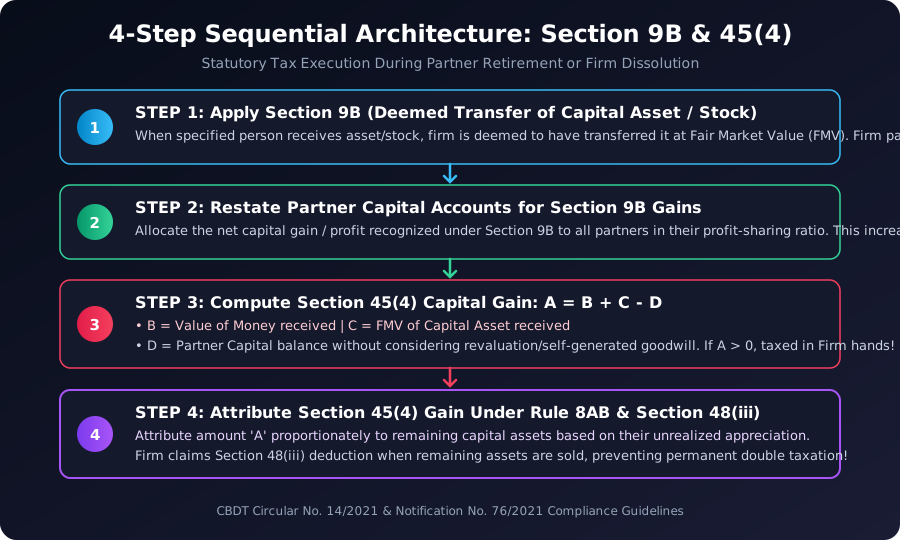
5. The Mandatory Two-Step Sequential Computation: Interaction of 9B and 45(4)
In practice, when a partner retires and receives a capital asset, does Section 9B apply first, or Section 45(4)?
The Central Board of Direct Taxes (CBDT), via Circular No. 14 of 2021, officially clarified the mandatory chronological sequence:
- Step 1 (Section 9B First): The firm must first compute the deemed capital gain or business profit under Section 9B on the capital asset or stock-in-trade distributed. The FMV is taken as full value of consideration, and cost of acquisition is deducted. The firm pays tax on this gain.
- Step 2 (Credit Net 9B Gain to Capital Accounts): The net profit or capital gain recognized under Section 9B (after entity tax) belongs to all partners in their agreed profit-sharing ratio. Therefore, the retiring partner’s share of this Section 9B gain is credited to their capital account! This legitimately increases the partner's capital balance 'D' before calculating Section 45(4).
- Step 3 (Section 45(4) Computation): Next, apply $A = B + C - D$. Here, $C$ is the same FMV of the capital asset already taxed under Section 9B. Because the partner’s capital account $D$ was stepped up by their share of the Section 9B profit in Step 2, double taxation of that exact portion is mathematically prevented!
6. Rule 8AB Attribution Mechanics: Allocating Gains to Continuing Assets
When the firm pays tax under Section 45(4) on amount 'A', that tax was triggered because the retiring partner received the benefit of unrealized appreciation locked inside the firm’s continuing capital assets.
If the firm were to subsequently sell those continuing capital assets in future years without any adjustment, the firm would pay capital gains tax a second time on the exact same appreciation! To eliminate this structural double taxation, the Finance Act inserted clause (iii) into Section 48 and notified Rule 8AB of the Income Tax Rules, 1962.
The Rule 8AB Attribution Formula
Rule 8AB prescribes that the capital gain amount 'A' taxed under Section 45(4) must be attributed to the remaining capital assets of the firm in proportion to the unrealized appreciation of each asset:
Attribution to Asset (i) = Amount 'A' × [ (FMV of Asset (i) - Book Value of Asset (i)) ÷ Total Unrealized Appreciation of All Continuing Assets ]
Conditions for Rule 8AB Attribution:
- Attribution can be made only to capital assets (not stock-in-trade).
- Attribution can be made to both depreciable and non-depreciable capital assets.
- If the capital gain 'A' relates to self-generated goodwill, and the firm does not have any remaining capital assets with unrealized appreciation, the amount cannot be attributed to any asset and lapses without Section 48(iii) shelter.
7. Section 48(iii) Deduction: Neutralizing Permanent Double Taxation on Future Sale
The practical magic of Rule 8AB attribution manifests in future years through Section 48(iii). Under Section 48(iii), when computing capital gains on the subsequent actual sale or transfer of a continuing capital asset by the firm, the firm is entitled to deduct:
Section 48 Computation on Future Sale of Continuing Asset:
Net Capital Gain = Full Value of Consideration - (Indexed) Cost of Acquisition - Cost of Improvement - Attributed Amount under Section 45(4) via Rule 8AB (Section 48(iii))
Vital Depreciation Rule: Under the second proviso to Section 48(iii), the amount attributed under Rule 8AB cannot be added to the block of assets for claiming annual depreciation under Section 32! It sits as a special off-balance-sheet capital tax deduction, claimable exclusively at the time of final transfer of the asset under Section 48.
8. Short-Term vs Long-Term Classification Under Rule 8AA(5)
Because Section 45(4) is a deemed capital gain that does not directly arise from the physical sale of an identifiable asset, how is its character (Short-Term vs Long-Term) determined?
Rule 8AA(5) Classification Rules
The Income Tax Rules determine the tax nature of Section 45(4) gain based on the character of the remaining capital assets to which the amount 'A' is attributed under Rule 8AB:
- Long-Term Capital Gain (LTCG): To the extent the gain 'A' is attributed to remaining capital assets that are long-term capital assets (held for more than 24 months for immovable property, or 12 months for listed securities), that portion of 'A' is taxed as Long-Term Capital Gain.
- Short-Term Capital Gain (STCG): To the extent the gain 'A' is attributed to remaining capital assets that are short-term capital assets, or block of depreciable assets governed by Section 50, that portion is taxed as Short-Term Capital Gain.
- Unattributed / Goodwill Surplus: If the gain 'A' cannot be attributed to any remaining capital asset (e.g., all assets were revalued to zero surplus or the payment was for self-generated goodwill with no tangible backing), it is deemed to be Short-Term Capital Gain.
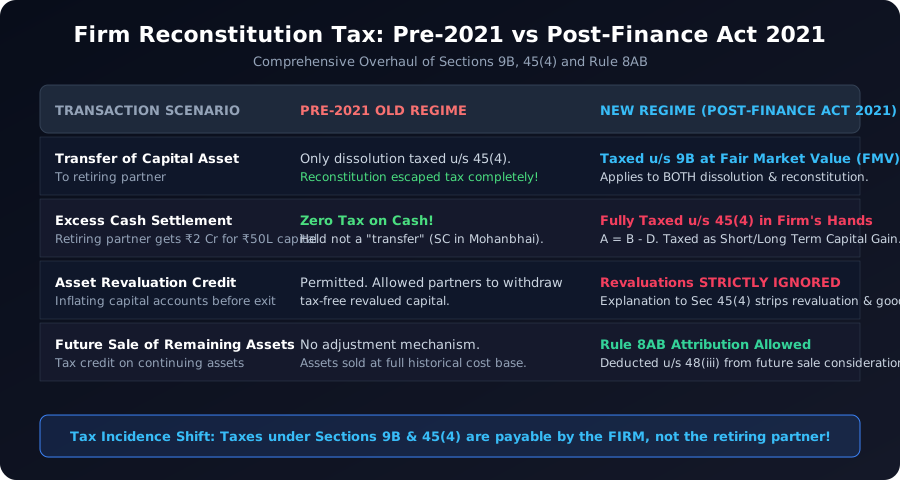
9. Pre-2021 vs Post-2021 Reconstitution Tax Landscape
To grasp the profound shift in corporate and real estate structuring, examine how transactions are treated under the current legal regime compared to the pre-amendment era:
| Structuring Dimension | Pre-2021 Historical Position | AY 2027-28 Modern Statutory Position |
|---|---|---|
| Asset Distribution on Retirement | Taxed only if firm dissolved. Reconstitution distribution escaped tax (*Mohanbhai Pamabhai*). | Fully Taxed u/s 9B at Fair Market Value in firm's hands on distribution date. |
| Cash Payout Exceeding Capital | 100% Tax-Free in hands of both firm and partner. Held no transfer of property. | Fully Taxed u/s 45(4) in firm's hands under formula $A = B - D$. |
| Asset Revaluation Treatment | Revaluation of land/building created valid capital balance to withdraw tax-free cash. | Strictly Ignored. Explanation to Sec 45(4) strips revaluation reserves from 'D'. |
| Tax Assessee Liable for Payment | Neither firm nor partner paid tax. Complete black hole. | The Firm / LLP pays the tax at 31.2% - 34.944% under Sections 9B and 45(4). |
| Relief for Continuing Entity | Zero mechanism. Future sale taxed full gain without credit. | Rule 8AB Attribution enables deduction u/s 48(iii) on future asset sale. |
10. Master Mathematical Case Study: Partner Retirement with Land & Cash Settlement
To master the interlocking mathematics of Section 9B, Section 45(4), and Rule 8AB, examine this detailed case study of M/s Greenfield Infrastructure Associates.
Firm Balance Sheet Before Reconstitution (AY 2027-28)
Greenfield Infrastructure is a partnership firm with three equal partners: A, B, and C (Profit Sharing Ratio 1:1:1). Partner C decides to retire.
- Partner Capital Accounts (Historical Book Value):
- Partner A: ₹50,00,000
- Partner B: ₹50,00,000
- Partner C (Retiring): ₹50,00,000
- Firm Assets on Balance Sheet:
- Capital Asset 1 (Commercial Plot): Book Cost = ₹30,00,000. Current Fair Market Value (FMV) = ₹1,50,00,000 (Long-term asset held 5 years).
- Capital Asset 2 (Industrial Building): Book Cost / WDV = ₹60,00,000. Current FMV = ₹2,40,00,000 (Long-term asset held 4 years).
- Bank Balance: ₹1,00,00,000.
Retirement Settlement Agreement with Partner C
The firm agrees to settle Partner C’s retirement by distributing:
- Asset Distribution: Capital Asset 1 (Commercial Plot, FMV ₹1,50,00,000) given to Partner C.
- Cash Distribution: ₹30,00,000 in cash paid from bank balance.
- Total value received by Partner C = ₹1,50,00,000 (Plot) + ₹30,00,000 (Cash) = ₹1,80,00,000.
Step 1: Section 9B Deemed Transfer Tax on Capital Asset 1
- Full Value of Deemed Consideration (FMV) = ₹1,50,00,000
- Less Indexed Cost of Acquisition = ₹30,00,000 (assume for illustration)
- Long-Term Capital Gain under Section 9B: ₹1,50,00,000 - ₹30,00,000 = ₹1,20,00,000.
- Tax Payable by Firm u/s 9B @ 20% + 12% surcharge + 4% cess: ₹1,20,00,000 × 23.296% = ₹27,95,520.
Step 2: Restatement of Partner Capital Accounts
The net gain realized under Section 9B (₹1,20,00,000) is credited to all three partners equally (1:1:1):
- Partner C's 1/3rd share of Section 9B gain = ₹1,20,00,000 ÷ 3 = ₹40,00,000.
- Partner C’s Restated Capital Balance ('D'):
Initial Capital (₹50,00,000) + Section 9B Share (₹40,00,000) = ₹90,00,000.
Step 3: Section 45(4) Formula Computation
Now apply $A = B + C - D$:
- B (Money Received): ₹30,00,000
- C (FMV of Capital Asset Received): ₹1,50,00,000
- D (Restated Capital Balance): ₹90,00,000
- Calculation of A:
A = ₹30,00,000 + ₹1,50,00,000 - ₹90,00,000 = ₹90,00,000 - Capital Gain Chargeable u/s 45(4) in Firm's Hands: ₹90,00,000.
- Tax Payable by Firm u/s 45(4): ₹90,00,000 × 23.296% = ₹20,96,640.
Step 4: Rule 8AB Attribution to Continuing Asset (Capital Asset 2)
The firm has one continuing capital asset: Industrial Building (Asset 2).
- Book Value of Building = ₹60,00,000; FMV = ₹2,40,00,000.
- Unrealized appreciation in Asset 2 = ₹2,40,00,000 - ₹60,00,000 = ₹1,80,00,000.
- Because Asset 2 is the sole continuing appreciated asset, 100% of Amount 'A' (₹90,00,000) is attributed to Asset 2 under Rule 8AB.
Future Consequence: Section 48(iii) Deduction
Two years later, Greenfield sells Industrial Building (Asset 2) for ₹3,00,00,000:
- Sale Consideration = ₹3,00,00,000
- Less Indexed Cost of Acquisition = ₹75,00,000
- Less Section 48(iii) Attributed Deduction: ₹90,00,000
- Net Taxable Capital Gain on Sale: ₹3,00,00,000 - ₹75,00,000 - ₹90,00,000 = ₹1,35,00,000 (instead of ₹2,25,00,000).
The firm successfully recovers the exact tax paid under Section 45(4) at the time of Partner C's retirement, completely eliminating double taxation!
11. Reconstitution Documentation, Valuation Reports & ITR-5 Disclosures
Executing a partnership or LLP reconstitution under Sections 9B and 45(4) demands meticulous legal and statutory compliance:
- Registered Valuer's Report: Rule 11U and Rule 11UA mandate that the Fair Market Value of any distributed capital asset or continuing revalued asset must be established by a formal valuation report from an IBBI Registered Valuer as on the exact date of reconstitution.
- Deed of Reconstitution: Must explicitly recite the transfer of specific assets, cash consideration paid, capital account balances before and after restatement, and acknowledgment of Section 9B and 45(4) tax liability.
- ITR-5 Schedule CG Reporting: Partnership firms filing ITR-5 must disclose Section 9B deemed transfers and Section 45(4) calculations in the dedicated rows of Schedule CG (Capital Gains), along with Rule 8AB attribution tables.
- Form No. 29C Reporting: If the firm claims Chapter VI-A deductions, the Adjusted Total Income under Section 115JC (Alternate Minimum Tax) will incorporate the Section 9B and 45(4) capital gains.
12. Frequently Asked Questions (FAQs)
Does Section 45(4) apply if a new partner joins the firm without any partner retiring?
Under Section 9B(4) read with the Explanation to Section 45(4), reconstitution includes the admission of one or more partners. However, Section 45(4) is triggered only if money or a capital asset is received by a partner. If a new partner joins and simply introduces capital which remains inside the firm's bank account without any distribution to existing partners, Section 45(4) is not triggered.
What happens if the calculation A = B + C - D results in a negative figure?
If the result of A = B + C - D is negative (i.e., the partner received less money and assets than their capital account balance), variable 'A' is statutorily deemed to be NIL. The firm cannot claim a capital loss under Section 45(4), nor can any negative amount be carried forward.
Can the retiring partner claim exemption under Section 54EC by investing in REC/PFC bonds?
No. The capital gain under Section 9B and Section 45(4) is legally deemed to be the income of the specified entity (the firm), not the retiring partner. If Section 54EC exemption is to be claimed, the investment in capital gains bonds must be made by and in the name of the firm, not the individual partner.
Does Section 9B apply to stock-in-trade distributed upon total dissolution of a firm?
Yes. Section 9B explicitly covers both capital assets and stock-in-trade distributed upon either dissolution or reconstitution. If stock-in-trade is distributed, the difference between its Fair Market Value on the date of distribution and its book cost is taxed in the firm's hands as business profits under Section 28.