How EMI Is Calculated: Formula, Example and Amortization
Whether taking a ₹50 Lakh home loan, financing a new car, or clearing a personal credit line, Equated Monthly Installments (EMIs) govern middle-class Indian finance. Discover how the reducing balance formula works, why bank interest is heavily front-loaded in Year 1, and how paying 1 extra EMI a year saves ₹12+ Lakh.

Table of Contents
- 1. What is an EMI? The Concept of Loan Equated Monthly Installment
- 2. The Reducing Balance EMI Formula: Derivation and Mechanics
- 3. Step-by-Step Worked Example: ₹50 Lakh Home Loan Calculation
- 4. The Front-Loaded Interest Trap: The 80/20 Initial Shift
- 5. Visual Comparison: 20-Year Amortization Curve & Prepayment Savings
- 6. Flat vs Reducing Interest Rate: The Deceptive Car Loan Trick
- 7. Strategic Prepayment Hacks: The '1 Extra EMI Per Year' Miracle
- 8. Income Tax Deductions: Sections 24(b) and 80C in FY 2026-27
- 9. Frequently Asked Questions (FAQ)
1. What is an EMI? The Concept of Loan Equated Monthly Installment
An Equated Monthly Installment (EMI) is a fixed payment amount made by a borrower to a financial lender at a specified calendar date each month. It is designed to pay off both the loan principal and accumulated interest over a specified tenure, leaving a zero balance at the end of the term.
While the headline monthly installment figure remains completely fixed throughout the life of a fixed-rate loan (or stable during steady floating-rate benchmark cycles), the internal composition of every single payment is in perpetual motion.
Every EMI payment comprises two distinct components:
EMI = Principal Repayment Component + Monthly Interest Charge
2. The Reducing Balance EMI Formula: Derivation and Mechanics
All Indian commercial scheduled banks (SBI, HDFC, ICICI, Axis, PNB) and Housing Finance Companies (LIC HFL, HDFC) calculate retail loans using the monthly reducing balance annuity formula:
Where: P = Principal Loan Amount • r = Monthly Interest Rate • n = Loan Duration in Months
Deconstructing the Three Variables:
- P (Principal): The exact initial sum sanctioned and disbursed by the bank (e.g. ₹50,00,000).
-
r (Monthly Interest Rate): Banks advertise annual interest rates (R). Because EMI is remitted monthly, you must divide the annual rate by 12 and then by 100:
r = Annual Rate (R) ÷ 12 ÷ 100. If the home loan rate is 8.5% p.a.,r = 8.5 ÷ 1200 = 0.0070833. -
n (Tenure in Months): The loan duration multiplied by 12. For a standard 20-year home loan:
n = 20 × 12 = 240 months. For a 5-year car loan:n = 60 months.
3. Step-by-Step Worked Example: ₹50 Lakh Home Loan Calculation
Let us calculate the exact monthly EMI for an Indian homebuyer purchasing an apartment in Pune with a ₹50,00,000 loan at 8.50% annual interest over a 20-year tenure:
- Principal (P) =
₹50,00,000 - Monthly interest rate (r) =
8.5 ÷ 1200 = 0.00708333 - Number of monthly installments (n) =
20 × 12 = 240 months - Calculate
(1 + r)^n = (1.00708333)^240 ≈ 5.43729 - Numerator =
50,00,000 × 0.00708333 × 5.43729 = ₹1,92,571 - Denominator =
5.43729 - 1 = 4.43729 - Monthly EMI =
1,92,571 ÷ 4.43729 = ₹43,391 per month
The Shocking Total Cost of a 20-Year Loan:
- Total amount paid to bank:
240 months × ₹43,391 = ₹1,04,13,879 - Original principal borrowed: ₹50,00,000
- Total interest paid: ₹54,13,879
- You repay more than double what you borrowed! The bank earns more interest than the principal itself.
4. The Front-Loaded Interest Trap: The 80/20 Initial Shift
Borrowers who inspect their loan statement after faithfully paying EMIs for three full years are often horrified to find that their loan balance has barely budged.
Why does this happen? Under the reducing balance method, interest is calculated on your outstanding balance at the end of each month:
- In Month 1: You owe the full ₹50,00,000. Interest for Month 1 =
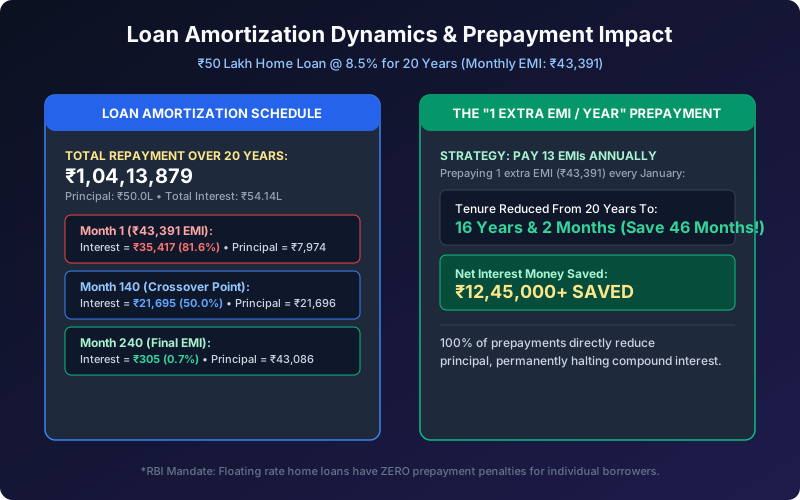
₹50,00,000 × (8.5% ÷ 12) = ₹35,417. Out of your ₹43,391 EMI, a massive ₹35,417 (81.6%) is pocketed by the bank as interest, and only ₹7,974 reduces your principal debt! - In Year 10 (Month 120): Your outstanding principal has dropped to ₹36,50,000. Monthly interest falls to ₹25,854, allowing ₹17,537 to pay down principal.
- In Year 12 (Month 140): The crossover point occurs, where principal repayment finally exceeds monthly interest.
- In Year 20 (Month 240): Outstanding principal is only ₹43,000. The interest component drops to just ₹305, with ₹43,086 paying off the final balance.
5. Visual Comparison: 20-Year Amortization Curve & Prepayment Savings
The infographic below charts the shifting balance between principal and interest over 240 months and demonstrates the wealth-building power of the 1-extra-EMI strategy:
6. Flat vs Reducing Interest Rate: The Deceptive Car Loan Trick
When shopping for auto loans, two-wheeler financing, or instant personal loans, non-banking financial companies (NBFCs) and auto dealerships frequently advertise attractive single-digit rates: "Get an exclusive car loan at just 9.0% flat interest!"
This is an extremely deceptive financial trap:
A. Flat Interest Rate (Deceptive)
Interest is calculated on the entire original principal throughout the loan tenure, completely ignoring the fact that you repay principal every month.
On a ₹10 Lakh car loan for 5 years at 9% flat: Total interest = 10,00,000 × 9% × 5 = ₹4,50,000. Monthly EMI = (₹14,50,000 ÷ 60) = ₹24,167.
B. Reducing Balance Rate (True APR)
Interest is calculated only on the remaining balance. As you pay off principal, your monthly interest charge falls.
Paying ₹24,167/month for 5 years on a ₹10L loan corresponds to an effective reducing balance rate of 16.8% per annum!
7. Strategic Prepayment Hacks: The '1 Extra EMI Per Year' Miracle
Because initial EMIs are overwhelmingly consumed by interest, early prepayments are disproportionately powerful. Every rupee prepayed in Year 1 to 5 goes 100% directly toward reducing the principal balance, permanently eliminating all future compound interest on that amount.
Hack 1: The '1 Extra EMI Per Year' Rule
Instead of paying 12 EMIs a year, use your annual performance bonus or Diwali incentive to pay 13 EMIs annually (one extra monthly payment of ₹43,391):
- Your 20-year tenure is slashed to 16 years and 2 months (saving 46 months of debt!).
- You save over ₹12,45,000 in pure interest.
Hack 2: The 5% Annual Step-Up Prepayment
As your career advances and your salary increments by 8% to 12% annually, instruct your bank to increase your monthly EMI by just 5% every year:
- Your 20-year home loan will be completely paid off in just 12 years.
- You eliminate nearly ₹23,00,000 in interest charges!
8. Income Tax Deductions: Sections 24(b) and 80C in FY 2026-27
Under the Indian Income Tax Act, home loan borrowers can access significant tax relief, depending on their chosen tax regime:
Under the Old Tax Regime:
- Section 24(b) (Interest Deduction): You can deduct up to ₹2,00,000 per financial year on the interest component of a self-occupied property. (For let-out rented property, the actual loss from house property up to ₹2 Lakh can be set off against salary).
- Section 80C (Principal Repayment): The principal repayment component of your EMI qualifies for deduction within the overall ₹1,50,000 Section 80C limit (alongside EPF, PPF, and ELSS).
Neither Section 24(b) interest deduction (for self-occupied homes) nor Section 80C principal deduction is permitted under the New Tax Regime. If you carry a heavy home loan with annual interest exceeding ₹2 Lakh, you must run a detailed comparison using our CTC calculator to evaluate whether the Old Regime's home loan deductions outweigh the lower slab rates of the New Regime.
Frequently Asked Questions (FAQ)
What is the mathematical formula used by Indian banks to calculate EMI?
Banks use the Reducing Balance Annuity formula: EMI = [ P × r × (1 + r)^n ] ÷ [ (1 + r)^n - 1 ], where P is the Principal loan amount, r is the monthly interest rate (Annual Rate ÷ 12 ÷ 100), and n is the total tenure in months (Years × 12).
Why does the principal balance hardly reduce during the first few years of a home loan?
This is known as the front-loaded amortization effect. Because interest is calculated monthly on the outstanding principal balance, and your principal is highest in the initial years, up to 75% to 80% of your initial monthly EMI goes entirely toward paying interest, leaving only 20% to reduce the actual principal debt.
How does a 10% Flat Rate compare to a Reducing Balance Rate in car loans?
A 10% Flat Rate is deceptive because it calculates interest on the entire original principal for the entire loan duration, ignoring principal repayments. A 10% flat rate on a 5-year loan is roughly equivalent to an effective reducing balance rate of 18.2% to 18.7%. Always ask the lender for the reducing balance APR.
How much interest can you save by paying 1 extra EMI every year?
On a ₹50,00,000 home loan at 8.5% interest for 20 years, paying just 1 additional EMI every calendar year reduces the effective repayment tenure from 240 months down to approximately 194 months (saving 46 months / almost 4 years) and saves over ₹12,45,000 in interest out of pocket.
Can banks in India charge a prepayment penalty on home loans?
Under Reserve Bank of India (RBI) regulations, commercial banks and housing finance companies (HFCs) are strictly prohibited from levying any prepayment or foreclosure penalties on floating-rate home loans availed by individual borrowers.
Free Loan & Investment Calculators
Simulate full loan amortization schedules, compare interest rates, and test prepayment scenarios:
Related Banking & Tax Guides
About PercentageCalculatorTool Editorial Team
Our retail banking and personal finance team analyzes consumer credit guidelines, RBI monetary policy committee decisions, and debt management strategies to help Indian families reduce borrowing costs and achieve financial freedom.