Table of Contents
- 1. Core Definitions: The Fundamental Distinction
- 2. Mathematical Formulas & Variables Breakdown
- 3. The Compounding Frequency Effect (Annual, Quarterly, Daily)
- 4. 30-Year Simulation: ₹1 Lakh at 10% Across Time Horizons
- 5. Real Indian Products: FDs, PPF, Savings Accounts & Debt
- 6. The Rule of 72: Derivation and Mental Math Shortcuts
- 7. When Compounding Works Against You: Credit Card APRs
- 8. 5 Costly Misconceptions in Interest Calculations
- 9. Frequently Asked Questions (FAQ)
- 10. Summary & Key Lessons
1. Core Definitions: The Fundamental Distinction
At its most elementary level, interest is the rent paid for the temporary use of capital. Whether you lend money to a commercial bank via a Fixed Deposit or borrow funds to buy a home, the mathematical architecture governing how that rent is computed determines your total financial outcome.
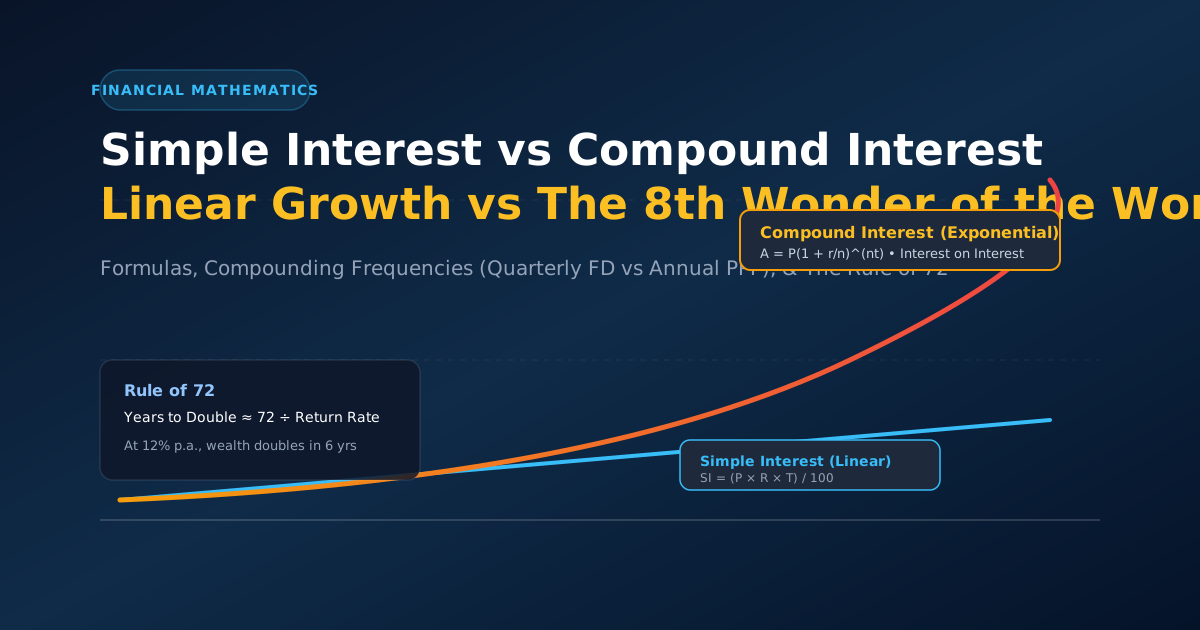
Simple Interest (SI) is static and linear. In a simple interest regime, interest is calculated solely on the original principal sum for the entire duration of the loan or deposit. The interest earned in Year 1 does not participate in generating returns in Year 2; it remains dormant or is paid out as a cash distribution. If you deposit ₹1,00,000 at 8% simple interest, you receive exactly ₹8,000 in Year 1, exactly ₹8,000 in Year 2, and exactly ₹8,000 in Year 20. The curve plotted on a graph is a rigid, straight line.
Compound Interest (CI) is dynamic and exponential. Under a compound interest regime, interest accrued during an interval is added back to the original principal, creating a larger capital base for the next cycle. In essence, you earn interest on interest. In Year 1, your ₹1,00,000 earns ₹8,000. But in Year 2, the 8% interest is calculated on ₹1,08,000, yielding ₹8,640. In Year 3, interest applies to ₹1,16,640, yielding ₹9,331. Plotted on a chart, compound interest generates a hockey-stick curve that accelerates with each passing period.
In the short term (1 to 3 years), the absolute rupee divergence between simple and compound interest appears modest. Over long multi-decade horizons (10 to 30 years), the compounding effect completely overwhelms the original principal, turning modest regular savings into life-changing generational wealth.
2. Mathematical Formulas & Variables Breakdown
To execute rigorous financial projections, you must understand the exact algebraic variables governing both calculations.
Simple Interest Formula
SI = (P × R × T) / 100
Total Maturity Amount (A) = P + SI = P × [1 + (R × T / 100)]
- P = Principal amount borrowed or invested.
- R = Annual interest rate expressed as a percentage (e.g., 7 for 7%).
- T = Time period in years (if given in months, divide by 12; if in days, divide by 365).
Compound Interest Formula
A = P × (1 + r / n)(n × t)
Compound Interest (CI) = A - P
- A = Final maturity amount including principal and accumulated compound interest.
- P = Initial principal balance.
- r = Nominal annual interest rate in decimal form (e.g., 8.5% = 0.085).
- n = Number of compounding periods per calendar year.
- t = Number of years capital remains invested.
3. The Compounding Frequency Effect (Annual, Quarterly, Daily)
A critical factor that retail savers often overlook is the compounding frequency n. The more frequently interest is calculated and converted into principal, the faster your money snowballs.
| Compounding Frequency | Value of n | Effective Periodic Rate | Typical Indian Product |
|---|---|---|---|
| Annual | n = 1 | r / 1 | Public Provident Fund (PPF) |
| Semi-Annual | n = 2 | r / 2 | RBI Floating Rate Savings Bonds |
| Quarterly | n = 4 | r / 4 | Bank Fixed Deposits & Post Office TD |
| Monthly | n = 12 | r / 12 | Home Loans & Recurring Deposits |
| Daily | n = 365 | r / 365 | Savings Account Interest & Credit Cards |
To illustrate the impact, let us take ₹10,00,000 invested at a nominal interest rate of 8.0% p.a. for 5 years across varying compounding frequencies:
- Annual Compounding (n=1): A = 10,00,000 × (1 + 0.08/1)5 = ₹14,69,328
- Semi-Annual Compounding (n=2): A = 10,00,000 × (1 + 0.08/2)10 = ₹14,80,244 (+₹10,916)
- Quarterly Compounding (n=4): A = 10,00,000 × (1 + 0.08/4)20 = ₹14,85,947 (+₹16,619)
- Monthly Compounding (n=12): A = 10,00,000 × (1 + 0.08/12)60 = ₹14,89,846 (+₹20,518)
- Daily Compounding (n=365): A = 10,00,000 × (1 + 0.08/365)1825 = ₹14,91,759 (+₹22,431)
Notice that the jump from Annual to Quarterly compounding creates a substantial gain, whereas moving from Monthly to Daily produces minor incremental returns. In mathematical calculus, as compounding approaches infinity (n → ∞), the equation converges to continuous compounding represented by Euler's constant: A = P × e(rt).
4. 30-Year Simulation: ₹1 Lakh at 10% Across Time Horizons
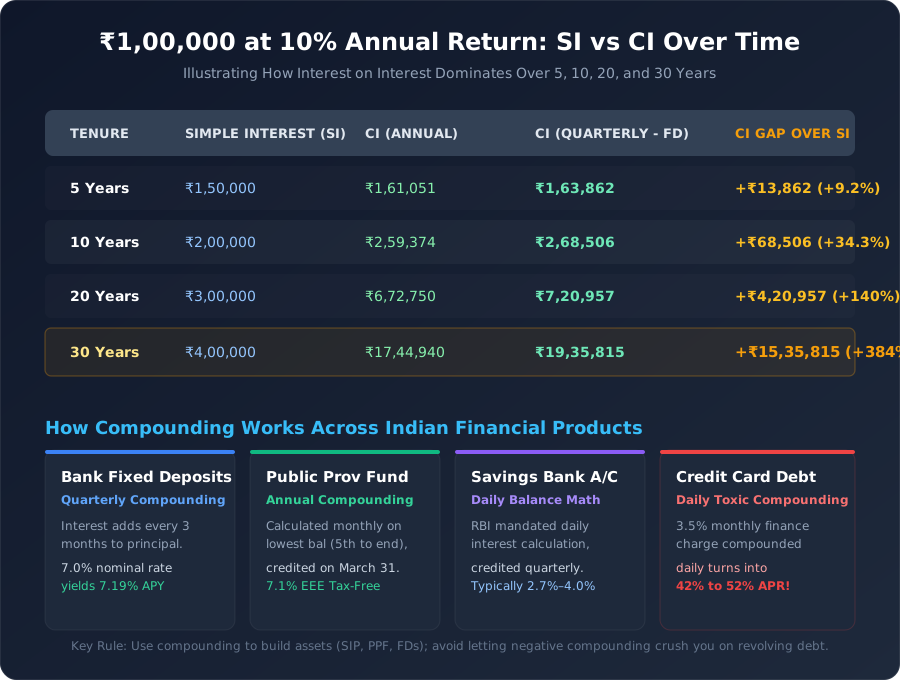
To truly appreciate the power of compounding, let us observe a side-by-side empirical model. We take an initial sum of ₹1,00,000 invested at a constant 10.0% annual return and track its trajectory across 5, 10, 20, and 30 years.
Review the numbers carefully:
- At Year 5: Simple Interest yields ₹1,50,000 while quarterly compound interest yields ₹1,63,862. The compound advantage is just ₹13,862. Many uninitiated investors look at this minor gap and conclude that compounding is overrated.
- At Year 10: Simple Interest doubles the money to ₹2,00,000. Meanwhile, compound interest pushes the balance to ₹2,68,506—a ₹68,506 bonus.
- At Year 20: Simple Interest stands at ₹3,00,000. Compound interest skyrockets to ₹7,20,957. The compounding advantage is now ₹4,20,957—more than four times the original capital!
- At Year 30: Simple interest climbs linearly to ₹4,00,000. But quarterly compound interest reaches an astonishing ₹19,35,815. Compound interest delivered nearly 500% of the entire simple interest outcome!
In the final 10 years (from Year 20 to Year 30), compound interest generated more than ₹12,00,000 in pure interest—more than double the entire wealth accumulated over the preceding 20 years combined. This is the hallmark of exponential growth: all the massive gains are back-loaded into the later years.
5. Real Indian Products: FDs, PPF, Savings Accounts & Debt
Understanding interest theory is useless unless mapped to the actual financial products available in Indian banks and post offices. Here is how statutory compounding operates across common instruments:
1. Bank Fixed Deposits (Quarterly Compounding)
Under Reserve Bank of India (RBI) directives, Indian commercial banks (HDFC, SBI, ICICI, etc.) compound interest on cumulative Fixed Deposits on a quarterly basis. When a bank quotes a 7.00% p.a. interest rate on a 3-year FD, your effective Annualized Yield (APY) is actually:
Taxation Warning: Even though interest compounds quarterly and is only received upon maturity, TDS under Section 194A is deducted annually if total bank interest exceeds ₹40,000 (₹50,000 for senior citizens).
2. Public Provident Fund (PPF - The 5th of the Month Rule)
PPF is one of India's most popular sovereign tax-saving tools, backed by sovereign guarantee with Exempt-Exempt-Exempt (EEE) status. However, its compounding mechanics have a unique quirk:
- Interest is calculated on the minimum balance in your PPF account between the close of the 5th day and the end of each calendar month.
- Interest is calculated every month, but it is officially credited to the account only once per financial year on March 31st.
- Practical Tip: Always deposit your PPF funds on or before the 5th of the month. If you deposit on the 6th, you forfeit an entire month of interest on that deposit!
3. Savings Bank Accounts (Daily Balance Calculation)
Historically, Indian banks calculated savings account interest on the lowest balance between the 10th and the last day of each month. In 2010, the RBI revolutionized this by mandating that savings bank interest must be calculated on a daily end-of-day balance basis:
While calculated daily, this interest is credited to your bank account every quarter. Under Section 80TTA, interest earned from savings bank accounts up to ₹10,000 per financial year is completely tax-exempt for individuals under 60.
6. The Rule of 72: Derivation and Mental Math Shortcuts
The Rule of 72 is an indispensable mental math heuristic used by Wall Street and Dalal Street traders to estimate the time required for an investment to double under compound interest.
Years to Double ≈ 72 / Annual Interest Rate
Where does 72 come from? Mathematically, if an investment doubles, A / P = 2. Using continuous compounding:
Thus, t = 69.3 / R. However, 69.3 is awkward to divide mentally. 72 is chosen because it is remarkably close to 69.3 and has numerous integer divisors: 2, 3, 4, 6, 8, 9, 12, 18, 24, and 36!
- At 6% interest (Post Office MIS / conservative debt): 72 / 6 = 12 years to double.
- At 8% interest (EPF / corporate bonds): 72 / 8 = 9 years to double.
- At 12% interest (Equity Mutual Funds / Nifty 50): 72 / 12 = 6 years to double.
- At 15% interest (Top-tier Flexi Cap / Midcap funds): 72 / 15 = 4.8 years to double.
7. When Compounding Works Against You: Credit Card APRs
Compounding is an agnostic mathematical engine. While it builds immense wealth when working in your favor, it can cause catastrophic financial ruin when applied to consumer debt.
Consider revolving credit card debt in India. Most credit card banks advertise a monthly finance fee of 3.5% per month. To an unsuspecting cardholder, 3.5% seems manageable. But because interest is compounded daily on unpaid balances, the annualized effective interest rate (APR) is staggering:
If you accumulate an unpaid credit card balance of ₹1,00,000 and only pay the "Minimum Amount Due" (typically 5% consisting mostly of interest and taxes), it will take you over 18 years to clear that ₹1,00,000 balance, and you will pay more than ₹2,80,000 in pure interest! Always pay credit card statements in full before the due date.
8. 5 Costly Misconceptions in Interest Calculations
1. Confusing Flat Interest Rate with Reducing Balance Interest Rate
Used car and personal loan lenders often pitch a "flat rate" of 8%. In a flat loan, interest is calculated on the full initial loan amount for the entire tenure, even when you have paid off 80% of the loan! An 8% flat interest rate is equivalent to an alarming 14.5% to 15.2% reducing balance interest rate. Always ask the lender for the reducing balance EMI rate.
2. Ignoring Inflation's Erosion of Compound Interest
If your bank Fixed Deposit compounds to 7.0% per year, but retail inflation (CPI) is running at 5.5%, your real compounding rate is only 1.5%. After deducting 30% income tax on interest, your real return turns negative (-0.6%). Wealth must be compounded in assets that outpace inflation after tax.
3. Breaking Compounding Early by Withdrawing Interest Payouts
Many investors opt for monthly or quarterly interest payouts on their FDs to spend on discretionary lifestyle consumption. By doing so, you convert a compound interest instrument into a simple interest instrument, destroying the multi-year snowball effect.
4. Believing Compounding Requires Large Starting Capital
The primary ingredient in compound interest is not capital—it is time. An investor who starts investing ₹3,000/month at age 22 accumulates more wealth by age 60 than an investor who waits until age 35 and invests ₹10,000/month. Start early with whatever amount you can spare.
5. Forgetting Section 80TTA and 80TTB Deductions
Under Section 80TTA, you can claim up to ₹10,000 deduction on savings account interest. For senior citizens (age 60+), Section 80TTB offers a massive deduction of up to ₹50,000 covering both savings and Fixed Deposit interest!
9. Frequently Asked Questions (FAQ)
What is the primary difference between simple interest and compound interest?
Simple interest is calculated solely on the original principal for the entire duration. Compound interest is calculated on the principal plus all accumulated interest from prior periods, leading to exponential growth over time.
How often do Indian bank Fixed Deposits (FDs) compound interest?
Indian commercial banks compound Fixed Deposit interest quarterly (every 3 months) under standard RBI regulations. This is why a 7.0% nominal rate yields approximately 7.19% annual effective yield.
How does interest compounding work in the Public Provident Fund (PPF)?
In PPF accounts, interest is calculated monthly on the lowest balance between the 5th and the end of each month, but it is officially credited to the account once a year on March 31st. Always deposit on or before the 5th to avoid losing a month of interest.
What is the Rule of 72 and how accurate is it?
The Rule of 72 estimates how many years it takes for an investment to double: divide 72 by the annual return rate (e.g., 72 / 12% = 6 years). It provides a very close approximation for interest rates between 6% and 12%.
Why does credit card revolving debt compound so destructively?
Credit cards in India charge finance fees of approximately 3.5% per month, compounded daily on unpaid balances. This translates to an effective APR exceeding 42% to 52%, rapidly multiplying outstanding debt if not paid in full.
10. Summary & Key Lessons
The difference between simple interest and compound interest is the difference between working for your money and having your money work for you:
- Give it time: In the first 5 years, compounding feels slow. By Year 20, interest dwarfs your principal contributions.
- Frequency matters: Quarterly and monthly compounding put extra cash in your pocket without taking additional financial risk.
- Eliminate high-cost debt: Never allow negative compound interest to accumulate on credit cards or personal loans.
- Reinvest earnings: Avoid withdrawing annual dividend or interest payouts; let the capital base expand untouched.
Simulate your own numbers right now using our free Simple & Compound Interest Calculator, or project monthly mutual fund growth on our SIP Calculator.