Conversion of Pvt Ltd to LLP: Section 47(xiiib) Tax Exemption, Turnover Ceilings & Compliance Guide

1. Commercial & Tax Rationale for Converting a Private Limited Company to an LLP
In modern Indian business structuring, thousands of closely held private limited companies find themselves burdened by excessive corporate compliance without reaping the equity benefits of public investment. Converting an established private limited company into a Limited Liability Partnership (LLP) under the Limited Liability Partnership Act, 2008 offers profound structural and fiscal advantages:
Primary Drivers for Conversion
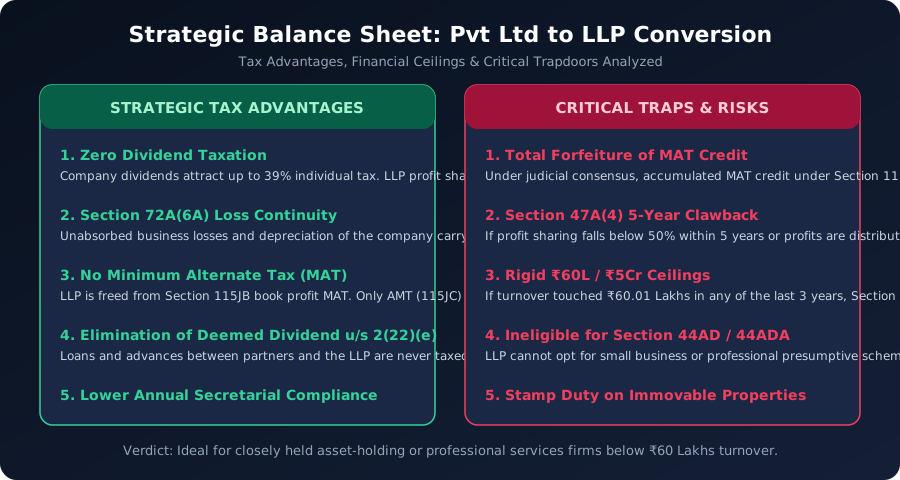
- Elimination of Crushing Dividend Taxation: Under the Indian classical corporate tax system, companies pay 22% base tax (effective 25.17% u/s 115BAA). When post-tax profits are distributed to shareholders as dividends, they are taxed a second time in the shareholders' hands at individual slab rates (up to 39%), producing a combined two-tier fiscal extraction of nearly 50% to 54.3%! In contrast, an LLP pays 31.2% flat tax, and all profit distributions to partners are 100% tax-free under Section 10(2A).
- Liberation from Section 115JB Minimum Alternate Tax (MAT): LLPs are completely exempt from corporate MAT on book profits. While they are subject to Alternate Minimum Tax (AMT) under Section 115JC, AMT applies only if specific Chapter VI-A (Part C) or Section 10AA deductions are claimed.
- Removal of Section 2(22)(e) Deemed Dividend Hazards: In a private limited company, any loan or advance given to a substantial shareholder (≥ 10% voting power) is treated as a taxable "deemed dividend" to the extent of accumulated profits. In an LLP, partners can freely withdraw capital, draw loans, and adjust current accounts without triggering deemed dividend taxation.
- Dramatic Reduction in Secretarial Compliances: LLPs are free from mandatory statutory audit (until turnover exceeds ₹40 Lakhs or capital exceeds ₹25 Lakhs), quarterly board meetings, secretarial standards, CSR outlays, internal financial controls reporting, and numerous ROC filings (AOC-4, MGT-7, DIR-3 KYC).
2. The Statutory Exemption Umbrella: Section 47(xiiib) Architecture
Under ordinary tax principles, a conversion of a company into an LLP involves a dual transfer under Section 2(47) of the Income Tax Act:
- The company transfers all its tangible, intangible, movable, and immovable assets to the successor LLP.
- The shareholders extinguish their shareholding rights in exchange for partnership rights and capital interest in the LLP.
In the absence of a specific statutory shelter, this conversion would trigger enormous capital gains tax liabilities on both the company (at market value of assets) and the shareholders (on the difference between LLP capital allotted and historical share cost).
To facilitate corporate restructuring into agile LLP formats, Parliament enacted Section 47(xiiib) via the Finance (No. 2) Act, 2010. Section 47(xiiib) declares that any transfer of a capital asset or intangible asset by a private company or unlisted public company to an LLP, or any transfer of shares by a shareholder on conversion, shall not be regarded as a transfer for capital gains purposes, provided all statutory conditions are met.
3. The 6 Inviolable Statutory Conditions of Section 47(xiiib)
The tax exemption under Section 47(xiiib) is conditional, not absolute. The statute establishes six rigorous conditions that must be fulfilled simultaneously:
| Clause | Statutory Requirement | Operational Mandate |
|---|---|---|
| Clause (a) | Transfer of All Assets & Liabilities | All the assets and liabilities of the company immediately before conversion must become the assets and liabilities of the LLP. Zero cherry-picking or retention of assets is permitted. |
| Clause (b) | Universal Shareholder Participation | All the shareholders of the company immediately before conversion must become partners of the LLP. Their capital contribution and profit sharing ratio must be in the exact same proportion as their shareholding in the company. |
| Clause (c) | Zero Other Consideration | The shareholders must not receive any consideration or benefit, directly or indirectly, in any form or manner, other than their agreed share in profits and capital contribution in the LLP. |
| Clause (d) | 50% Continuity for 5 Years | The aggregate of the profit sharing ratio of the erstwhile shareholders must not be less than 50% at any time during a period of 5 years from the date of conversion. |
| Clause (ea) | Turnover ≤ ₹60 Lakhs Ceiling | The total sales, turnover or gross receipts in business of the company did not exceed ₹60,00,000 (₹60 Lakhs) in ANY of the three previous years preceding the conversion year. |
| Clause (eb) | Gross Assets ≤ ₹5 Crores Ceiling | The total value of the assets as appearing in the books of account of the company in ANY of the three previous years preceding the conversion year did not exceed ₹5,00,00,000 (₹5 Crores). |
| Clause (f) | No Reserve Distribution for 3 Years | No amount is paid directly or indirectly to any partner out of the balance of accumulated profits standing on the date of conversion for a period of 3 years from the date of conversion. |

4. Analyzing the Financial Ceilings: ₹60 Lakh Turnover & ₹5 Crore Asset Thresholds
Clauses (ea) and (eb) represent the most rigid gatekeepers in Section 47(xiiib). Added by the Finance Act 2016 to prevent large conglomerates and real estate giants from converting to LLPs tax-free, these thresholds require strict chronological auditing.
1. The ₹60 Lakh Turnover Ceiling (Clause (ea))
- 3-Year Retrospective Window: The test is not applied solely to the year of conversion; it scrutinizes the three previous years immediately preceding the conversion year.
- Strict Disqualification: If a company had turnover of ₹45 Lakhs in Year 1, ₹62 Lakhs in Year 2, and ₹50 Lakhs in Year 3, it is permanently disqualified from Section 47(xiiib) exemption because turnover breached ₹60 Lakhs in Year 2!
- Gross Receipts Scope: Turnover includes all operating revenues, consultancy fees, and gross professional receipts. It does not include pure interest or dividend income unless financial services constitute the primary business.
2. The ₹5 Crore Book Asset Ceiling (Clause (eb))
- Book Value Test: The threshold refers explicitly to the "total value of the assets as appearing in the books of account". It does not refer to Fair Market Value (FMV).
- Historical Book Value: Gross book assets before deducting liabilities must remain at or below ₹5,00,00,000 across all three preceding financial years. If a company revalued its factory land and recorded gross assets of ₹6 Crores in its audited balance sheet, it is disqualified.
5. Section 47A(4) Clawback Mechanics: The 5-Year & 3-Year Trapdoors
Securing tax exemption at the time of conversion is only half the battle. Parliament embedded a severe penal clawback mechanism under Section 47A(4) to police post-conversion operations.
The Statutory Clawback Triggers
Under Section 47A(4), if any of the following events occur after conversion:
- Dilution of Shareholder Stake Below 50%: If the erstwhile shareholders together cease to hold at least 50% of the profit sharing ratio of the LLP at any point within 5 years from conversion (e.g., admitting a heavy equity investor who takes 55% profit share).
- Accumulated Profit Siphoning Within 3 Years: If any amount is paid, directly or indirectly, to any partner out of the accumulated profits of the predecessor company within 3 years from conversion (e.g., paying a massive dividend or special capital withdrawal).
Section 47A(4) Legal Consequence:
The entire capital gains which were not charged to tax under Section 47(xiiib) at the time of conversion shall be deemed to be the capital gains of the successor LLP chargeable to tax in the previous year in which such non-compliance takes place!
Furthermore, because the tax is assessed in the year of default, interest under Sections 234A, 234B, and 234C, along with severe penalty exposure under Section 270A, can devastate the LLP's working capital.
6. Loss Carry Forward Under Section 72A(6A): A Fresh 8-Year Clock
One of the most powerful statutory boons of a valid Section 47(xiiib) conversion is the treatment of accumulated business losses and unabsorbed depreciation under Section 72A(6A).
The Fresh 8-Year Clock Rule
Under Section 72A(6A), where a private company is succeeded by an LLP fulfilling all Section 47(xiiib) conditions:
- The accumulated business loss and unabsorbed depreciation of the predecessor company are deemed to be the business loss or depreciation allowance of the successor LLP for the previous year in which conversion was effected.
- Resetting the 8-Year Window: The successor LLP gets a brand new 8-year clock to carry forward and set off the predecessor company’s accumulated business losses under Section 72, regardless of how many years the company had already carried them forward!
- Unabsorbed Depreciation (Section 32(2)): Unabsorbed depreciation transfers seamlessly to the LLP and can be carried forward indefinitely, with zero time limit.
7. The Fatal Trap: Permanent Forfeiture of Section 115JAA MAT Credit
While business losses and depreciation carry forward under Section 72A(6A), corporate taxpayers face a devastating statutory trap regarding accumulated Minimum Alternate Tax (MAT) Credit under Section 115JAA.
Why MAT Credit Does Not Transfer
- Absence of Enabling Statutory Provision: While Section 72A(6A) explicitly provides for the carry forward of business losses and depreciation, the Income Tax Act contains zero corresponding provision permitting the carry forward of Section 115JAA MAT credit to an LLP.
- No AMT Credit Conversion: MAT credit cannot be transformed into Alternate Minimum Tax (AMT) credit under Section 115JD. MAT is governed by Chapter XII-B, whereas AMT is governed by Chapter XII-BA.
- Authoritative Judicial Precedents: In Aravali Polymers LLP v. JCIT (ITAT Kolkata) and M/s Rolcon Engineering, the Income Tax Appellate Tribunal unequivocally held that the successor LLP is an entirely distinct legal assessee and has no statutory authority to utilize the predecessor company's MAT credit.
Strategic Rule: If a company holds ₹30 Lakhs or ₹1 Crore in accumulated unutilized MAT credit under Section 115JAA, it must never convert to an LLP immediately. The company should continue operating under corporate form until its MAT credit is completely utilized against regular corporate tax liability, and only then proceed with conversion.
8. Procedural Roadmap Under Companies Act & LLP Act (MCA Forms 18 & FiLLiP)
The conversion of a private limited company into an LLP is governed legally by the Third Schedule of the Limited Liability Partnership Act, 2008 and executed through the Ministry of Corporate Affairs (MCA) V3 portal:
Step-by-Step MCA Conversion Process
- Board Resolution & Consent: Convene a meeting of the Board of Directors of the company to approve the conversion. Obtain 100% written consent from all shareholders.
- Name Reservation (RUN-LLP): Apply for reservation of the LLP name on the MCA portal. (Usually identical to the company name, replacing "Private Limited" with "LLP").
- No-Objection Certificates (NOC) from Creditors: Obtain written NOCs from all secured and unsecured creditors of the company agreeing to the transfer of liabilities to the LLP.
- Filing MCA Form 18 (Application for Conversion): Submit Form 18 along with:
- Audited Statement of Assets and Liabilities certified by an independent CA (not older than 30 days).
- Statement of consent from 100% of shareholders.
- Statement of clearance from secured creditors.
- Copy of the latest ITR acknowledgement and audited financial statements.
- Filing MCA Form FiLLiP (Incorporation of LLP): File Form FiLLiP concurrently with Form 18 to establish the registered office, designated partner DINs, and partner capital contributions.
- Issuance of Certificate of Registration (Form 19): Upon verification, the Registrar of Companies (ROC) issues a Certificate of Registration of Conversion in Form 19. From this date, the company stands dissolved, and the LLP comes into legal existence.
- Drafting & Filing LLP Agreement (Form 3): Within 30 days of registration, execute the formal LLP Agreement on appropriate stamp paper and file Form 3 on the MCA portal.
9. Stamp Duty on Immovable Property Transfers Across Key Indian States
While Section 47(xiiib) grants immunity from Central income tax, state stamp duty laws operate under state jurisdictions. When a private limited company owning land, offices, or factories converts to an LLP, does stamp duty apply to the transmission of property?
| State Jurisdiction | Judicial View / Statutory Law | Stamp Duty Applicability on Conversion |
|---|---|---|
| Maharashtra | Bombay Stamp Act, 1958 (Article 25) | Treated as a statutory vesting by operation of law under Third Schedule of LLP Act; several High Court rulings have held no conveyance deed is required, though nominal registration charges apply. |
| Delhi | Indian Stamp (Delhi Amendment) Act | Vesting recognized without full ad-valorem conveyance duty provided all shareholders remain identical. |
| Karnataka | Karnataka Stamp Act, 1957 | Stamp authorities often dispute automatic vesting and demand conveyance duty; careful drafting of the conversion order and High Court precedents must be deployed. |
| Gujarat & Tamil Nadu | State Stamp Acts | Exemptions or concessional duties available if property continues to be held in identical equity proportions. |
10. Strategic Decision Framework & Arithmetic Breakeven Modeling
Before initiating conversion under Section 47(xiiib), promoters and tax advisors must run a strict mathematical breakeven model:
Conversion Decision Matrix
- Condition 1: Turnover ≤ ₹60 Lakhs in all 3 preceding years? If NO, conversion is automatically taxable. Do NOT convert.
- Condition 2: Book Assets ≤ ₹5 Crores in all 3 preceding years? If NO, conversion is automatically taxable. Do NOT convert.
- Condition 3: Unutilized MAT Credit balance > ₹5 Lakhs? If YES, delay conversion until MAT credit is fully absorbed against future profits.
- Condition 4: Are profits extracted annually as dividends? If YES, conversion saves up to 20% net personal tax annually.
- Condition 5: Does the company plan to raise institutional VC funding or issue ESOPs? If YES, remain a Private Limited Company. VCs and institutional investors rarely invest directly into LLPs.
11. Post-Conversion Direct Tax Compliance & ITR Filing Steps
Upon receiving the Certificate of Registration in Form 19 from the ROC, the newly formed LLP must immediately execute these mandatory tax transition steps:
- Apply for New PAN and TAN: An LLP is an entirely distinct taxable person under Section 2(23). The company’s old PAN and TAN cannot be reused; a brand new PAN and TAN must be obtained for the LLP.
- Split-Year ITR Filing: For the financial year of conversion:
- Return 1 (Company): Filed under the old PAN for the period from April 1 up to the date immediately preceding the conversion certificate.
- Return 2 (LLP - ITR-5): Filed under the new PAN for the period from the conversion date up to March 31.
- File Intimation to Assessing Officer: Submit a formal letter of conversion along with ROC Form 19 to the jurisdictional Assessing Officer under Section 170 (Succession to business otherwise than on death).
- Update GST, Bank Accounts & Vendor Registrations: Transfer all GSTINs, bank accounts, vendor contracts, import-export codes (IEC), and intellectual property registrations into the name of the new LLP.
12. Frequently Asked Questions (FAQs)
Can an unlisted public limited company convert to an LLP under Section 47(xiiib)?
Yes. Section 47(xiiib) explicitly applies to both a "private company" and an "unlisted public company". Listed public companies are strictly ineligible for conversion under Section 47(xiiib).
If a shareholder has 10% shares in the company, can they be given 20% profit share in the LLP?
No. Under Clause (b) of Section 47(xiiib), the capital contribution and profit sharing ratio of all shareholders must be in the exact same proportion as their shareholding in the company immediately before conversion. Any variation in profit-sharing proportions voids the tax exemption entirely.
What is the cost of acquisition of capital assets in the hands of the successor LLP?
Under Section 49(1)(iii)(e), the cost of acquisition of the capital asset in the hands of the successor LLP is deemed to be the cost for which the predecessor company acquired it, as increased by any cost of improvement incurred by either the company or the LLP.
Can the LLP issue sweat equity or admit an employee as a partner immediately after conversion?
Yes, but with extreme caution. Under Clause (d), the original shareholders must collectively continue to hold at least 50% of the aggregate profit sharing ratio for at least 5 years. If an employee is admitted with up to 49% profit share, Section 47(xiiib) remains intact; if the new partner is given 51%, Section 47A(4) clawback is instantly triggered.