Section 80G Charitable Donations: 50% vs 100% Exemption Rules, Adjusted GTI & Form 10BE Guide
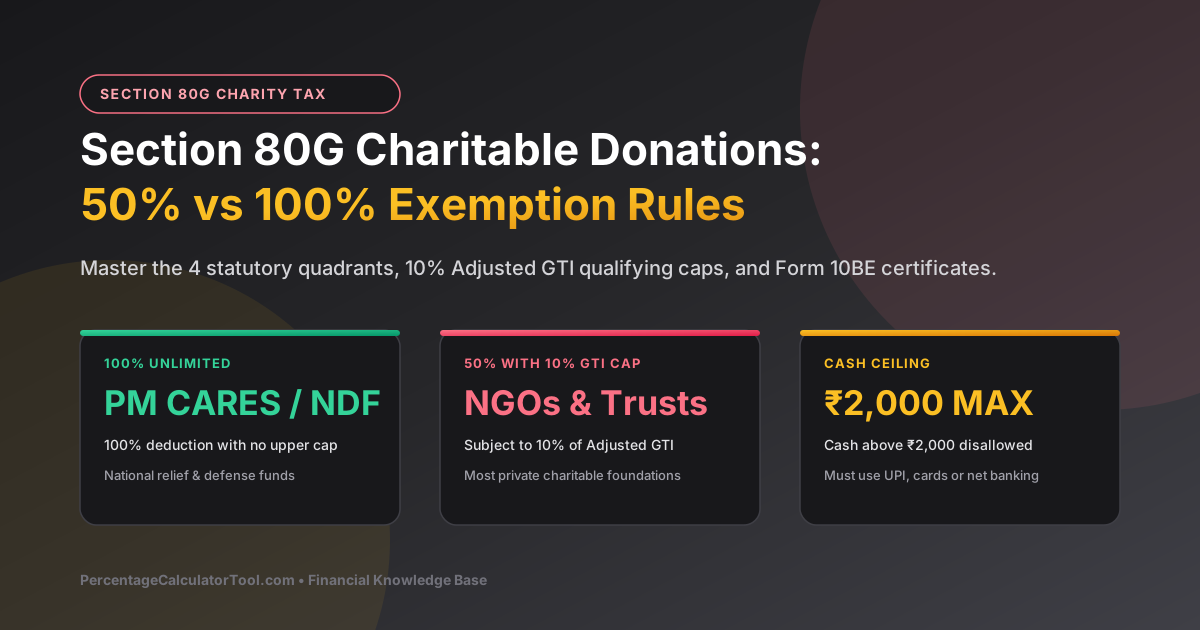
Whether donating to the PM CARES Fund, contributing to child welfare foundations, or offering renovation funds to registered places of worship, explore the four statutory quadrants of Section 80G, the 10% Adjusted Gross Total Income (AGTI) qualifying cap, the ₹2,000 cash ceiling, and mandatory Form 10BE filing rules for Assessment Year 2027-28 (Financial Year 2026-27).
§ Table of Contents
- 1. The Legislative Architecture of Section 80G
- 2. The 4 Statutory Quadrants of Section 80G
- 3. Category 1 & 2: Donations Without Qualifying Limits
- 4. Category 3 & 4: Private NGOs & The 10% AGTI Cap
- 5. Visual Architecture: The 4-Quadrant Matrix
- 6. Step-by-Step Mathematical Calculation of Adjusted GTI
- 7. Cash Donation Rules: The Strict ₹2,000 Statutory Bar
- 8. The Electronic Form 10BE Mandate & Verification
- 9. Empirical Modeling: Deductions Across Tax Brackets
- 10. Section 80G in New vs. Old Tax Regime
- 11. Practical Case Study: ₹20 LPA Professional Philanthropy
- 12. Frequently Asked Questions (Direct Tax FAQs)
1. The Legislative Architecture of Section 80G
Philanthropy is an ancient tradition in Indian society. To actively incentivize citizens and corporate executives to support national emergencies, social welfare, public health, and cultural heritage, Parliament enacted Section 80G of the Income-tax Act, 1961.
Section 80G provides a direct deduction from Gross Total Income for monetary contributions made to approved charitable organizations, government relief funds, and notified religious shrines.
However, Section 80G is among the most frequently miscalculated sections on Indian income tax returns. Donors routinely assume that every rupee donated yields an identical tax write-off. In reality, the Income Tax Department categorizes donations into four distinct statutory buckets, varying widely in deduction percentages (100% vs 50%) and subject to strict qualifying ceilings based on your net income.
2. The 4 Statutory Quadrants of Section 80G
To compute your deduction accurately, you must first classify the donee institution into one of the four statutory categories codified under Section 80G(1) and Section 80G(2):
| Statutory Category | Deduction % | Qualifying Limit | Typical Eligible Funds / Institutions |
|---|---|---|---|
| Quadrant 1 | 100% | No Qualifying Limit | National Defence Fund, PM CARES Fund, PMNRF, Clean Ganga Fund |
| Quadrant 2 | 50% | No Qualifying Limit | PM Drought Relief Fund, National Children’s Fund |
| Quadrant 3 | 100% | Subject to 10% AGTI Cap | Government/local bodies for promoting family planning |
| Quadrant 4 | 50% | Subject to 10% AGTI Cap | All registered private NGOs, charitable trusts, approved places of worship |
3. Category 1 & 2: Donations Without Qualifying Limits
Under Quadrant 1 and Quadrant 2, the tax law grants an open-ended deduction without capping the eligible donation amount against your personal income:
Quadrant 1: 100% Deduction (Unlimited)
Reserved exclusively for central national emergency and strategic sovereign causes. If you donate ₹2,00,000 to the PM CARES Fund or the National Defence Fund, your taxable income is reduced by exactly ₹2,00,000. Other eligible funds include the Clean Ganga Fund, the National Disaster Management Authority (NDMA) fund, and the National Foundation for Communal Harmony.
Quadrant 2: 50% Deduction (Unlimited)
Covers specified quasi-governmental and historical charitable trusts, including the Prime Minister’s Drought Relief Fund and the National Children's Fund. If you donate ₹1,00,000 here, you receive a flat ₹50,000 deduction on your tax return with no qualifying restriction.
4. Category 3 & 4: Private NGOs & The 10% AGTI Cap
The vast majority (over 90%) of charitable donations made by salaried Indian professionals fall under Quadrant 4: 50% deduction subject to the qualifying limit.
This category encompasses:
- Child education and malnutrition charities (e.g., Akshaya Patra, CRY, Smile Foundation).
- Charitable cancer hospitals, palliative centers, and eye care trusts (e.g., Tata Memorial Trust, Sankara Eye Foundation).
- Animal welfare shelters, orphanages, and disaster relief NGOs.
- Historic temples, mosques, churches, and gurdwaras notified under Section 80G(2)(b) specifically for renovation or repair.
The Statutory Safeguard: To prevent high-net-worth individuals from donating their entire income to private family foundations to artificially zero out their tax liabilities, the law mandates that the total eligible donation cannot exceed 10% of the donor’s Adjusted Gross Total Income (AGTI).
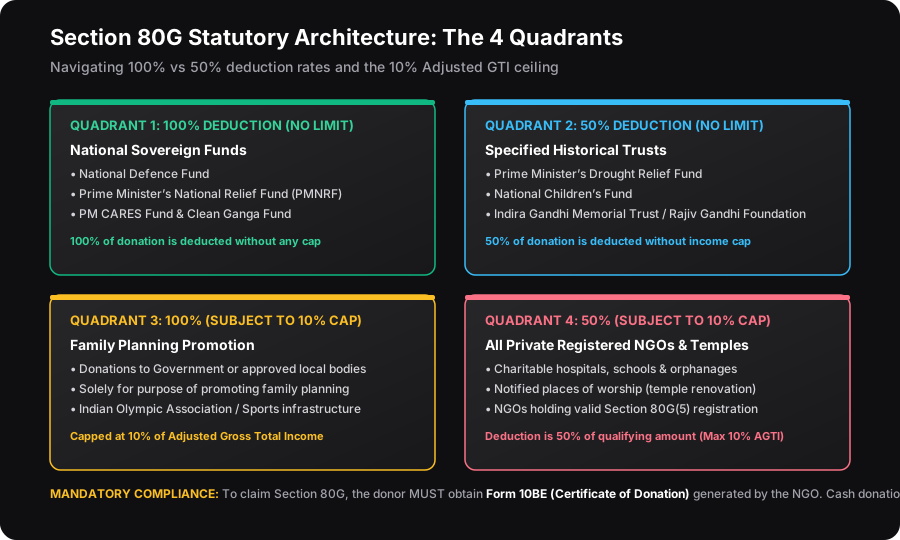
5. Visual Architecture: The 4-Quadrant Matrix
When planning your annual charitable giving, determine your claim through these three sequential rules:
- Verify 80G Registration: Ensure the donee trust possesses an active, valid registration under Section 80G(5) issued by the Principal Commissioner of Income Tax (CIT Exemption).
- Compute Adjusted GTI Ceiling: Calculate 10% of your Adjusted GTI. If donating to a Category 4 NGO, your qualifying donation is capped at this figure.
- Apply 50% Multiplication: Your final tax deduction on Form 16 or ITR is 50% of the qualifying donation.
6. Step-by-Step Mathematical Calculation of Adjusted GTI
Under the Explanation to Section 80G, Adjusted Gross Total Income (AGTI) has a strict legal definition that requires subtracting several statutory deductions:
Adjusted Gross Total Income (AGTI) Formula:
Adjusted GTI = Gross Total Income (GTI)
- Long-Term Capital Gains (LTCG under Section 112 & Section 112A)
- Short-Term Capital Gains on listed equities (STCG under Section 111A)
- All Chapter VI-A deductions EXCEPT Section 80G (i.e., less 80C, 80D, 80CCD, 80E, 80TTA)
- Any income exempt under Section 10A / 10AA
Practical AGTI Calculation Example:
• Gross Salary: ₹18,00,000
• Standard Deduction: -₹50,000 → GTI = ₹17,50,000
• Section 80C Deduction: -₹1,50,000
• Section 80D Health Insurance: -₹50,000
• Adjusted GTI = ₹17,50,000 - ₹2,00,000 = ₹15,50,000
• 10% Qualifying Limit = 10% of ₹15,50,000 = ₹1,55,000
If you donate ₹2,00,000 to an NGO, the qualifying donation is capped at ₹1,55,000. Your allowable 80G deduction is 50% of ₹1,55,000 = ₹77,500.
7. Cash Donation Rules: The Strict ₹2,000 Statutory Bar
Under Section 80G(5D), the Central Government enforced an aggressive anti-black-money restriction on cash philanthropy:
The ₹2,000 Cash Ceiling Mandate
"No deduction shall be allowed under this section in respect of donation of any sum exceeding two thousand rupees unless such sum is paid by any mode other than cash."
If you drop ₹5,000 or ₹10,000 in paper currency into a temple donation hundi or hand cash to an NGO representative against a physical paper receipt, not a single rupee can be claimed as a tax deduction! To secure your deduction, always transfer funds via UPI (Google Pay, PhonePe, Paytm), net banking NEFT/RTGS, debit card, or account payee cheque.
In-Kind Donations Disallowed: Donating bags of rice, clothes, blankets, books, or old laptops carries immense moral value, but Section 80G allows ZERO tax deduction for in-kind gifts. Only genuine monetary transactions qualify.
8. The Electronic Form 10BE Mandate & Verification
In the past, taxpayers often claimed fraudulent 80G deductions by submitting fake paper receipts. To eliminate this tax leak, the CBDT instituted a digitized reporting regime governed by Rule 18AB.
Under modern direct tax administration:
- Every registered NGO and charitable trust is legally mandated to file an annual statement of donations in Form 10BD with the Income Tax Department by 31st May following the close of the financial year.
- Upon filing Form 10BD, the tax portal generates an electronic Certificate of Donation in Form 10BE for each individual donor.
- The Form 10BE contains: (1) Donor's Name and PAN, (2) NGO's Unique Registration Number (URN), (3) Date of Donation, and (4) Exact Amount Donated.
- The donation automatically auto-populates into your Annual Information Statement (AIS) on the e-filing portal!
Crucial Filing Warning: If you donate to an NGO that fails to file Form 10BD and does not issue you a digital Form 10BE certificate, the Centralized Processing Centre (CPC) in Bengaluru will reject your 80G claim during automated ITR processing.

9. Empirical Modeling: Deductions Across Tax Brackets
The chart above demonstrates how different donation scenarios perform for an individual earning an Adjusted GTI of ₹15,00,000 in the 30% tax bracket (31.2% with cess):
- PM CARES (₹1,00,000 Donated): 100% deduction = ₹1,00,000 → Saves ₹31,200 in tax.
- Registered NGO (₹60,000 Donated): Within 10% AGTI cap (₹1.5L). 50% deduction = ₹30,000 → Saves ₹9,360 in tax.
- Charitable Trust (₹2,00,000 Donated): Exceeds 10% AGTI cap (₹1.5L). Eligible donation restricted to ₹1,50,000. 50% deduction = ₹75,000 → Saves ₹23,400 in tax.
- Cash Donation > ₹2,000 (₹10,000 Donated): 100% disallowed → ₹0 tax saved.
- In-Kind Blankets/Food (₹25,000 Value): 100% disallowed → ₹0 tax saved.
10. Section 80G in New vs. Old Tax Regime
Under the New Tax Regime (Section 115BAC), Section 80G has been completely dismantled.
If you elect to file under the New Tax Regime, any donations made to charities, disaster funds, or temples provide zero direct tax shelter. Philanthropy under the New Tax Regime is performed purely out of goodwill and personal social responsibility without any tax write-off.
11. Practical Case Study: ₹20 LPA Professional Philanthropy
Let us observe Meera, an Associate Director in Mumbai earning ₹20,00,000 per annum, who makes two charitable donations during Financial Year 2026-27:
12. Frequently Asked Questions (Direct Tax FAQs)
Can I claim Section 80G for donations made to political parties? ▼
No. Donations made to registered political parties or electoral trusts are NOT covered under Section 80G. Instead, they are governed by Section 80GGC (for individuals) and Section 80GGB (for companies), which offer a 100% deduction provided the contribution is made through non-cash banking channels.
What happens if my Form 10BE has an incorrect PAN or spelling error? ▼
If your PAN is wrongly reported on Form 10BE, the donation will fail to match your AIS records and will be flagged as an anomaly. You must contact the NGO's finance department immediately to file a revised Form 10BD before you submit your tax return.
Can I claim Section 80G for donations made to foreign charities? ▼
No. Under Section 80G(5)(i), the charitable institution must be established in India and the funds must be applied solely for relief work within the sovereign territory of India. Donations to foreign NGOs (e.g., Red Cross International or UNICEF USA) do not qualify.
Does paying religious tithing or mandatory church tithe qualify under 80G? ▼
Only if the religious institution holds an explicit notification under Section 80G(2)(b) specifically designating the funds for the renovation or repair of a historic temple, mosque, church, or gurdwara. General religious tithes or ritual offerings do not qualify.