Section 80E Education Loan Interest: No Upper Cap Tax Benefits, Foreign Studies & 8-Year Rules
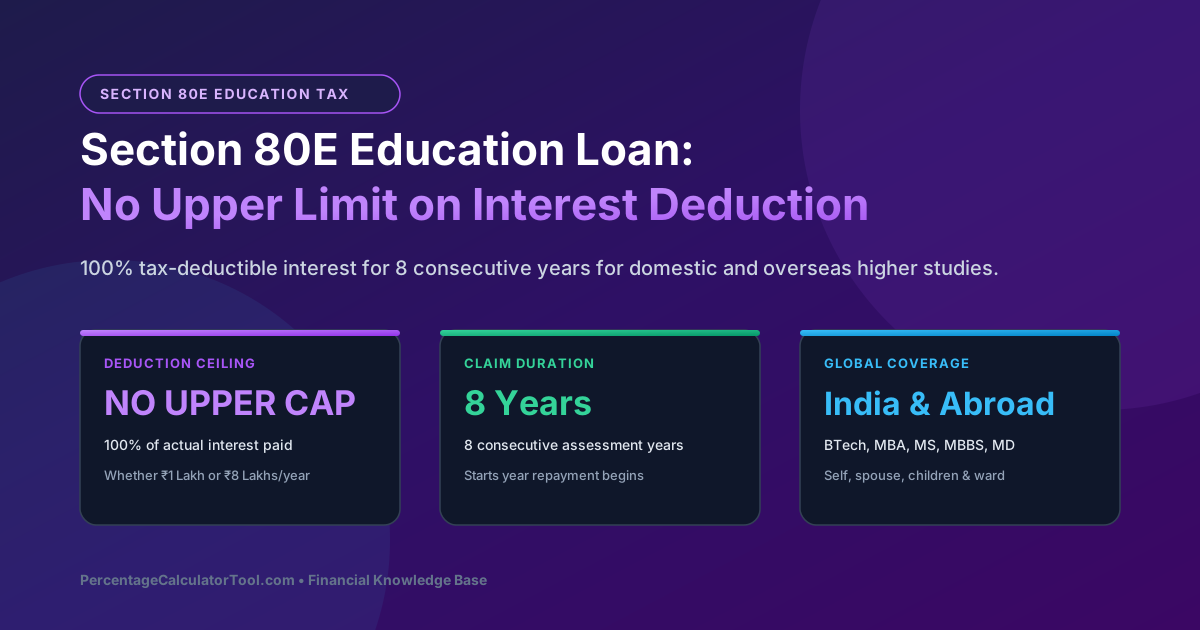
With premier global MBA programs, MS degrees, and medical courses costing between ₹30 Lakhs and ₹80 Lakhs, explore how Section 80E of the Income-tax Act provides an extraordinary 100% uncapped interest deduction. Master the 8-consecutive-year tenure clock, lender approval mandates, and effective borrowing cost reductions for Assessment Year 2027-28 (Financial Year 2026-27).
§ Table of Contents
- 1. The Unique Statutory Power of Section 80E
- 2. The "No Upper Monetary Cap" Principle Explained
- 3. The 8-Consecutive-Year Repayment Clock
- 4. Approved Lenders Mandate: Banks vs. Private Borrowing
- 5. Eligible Beneficiaries & The Sibling Restriction
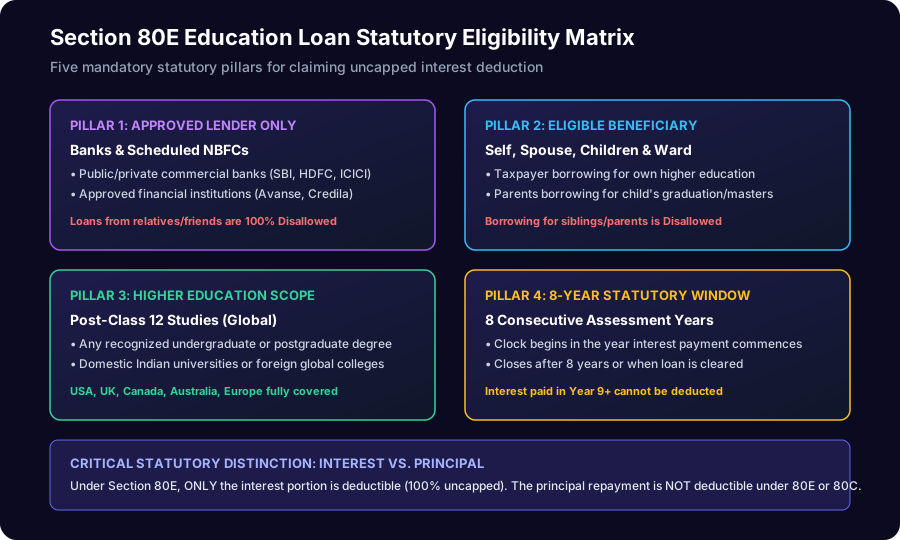
- 6. Visual Architecture: The 5 Statutory Pillars
- 7. Scope of "Higher Education": India vs. Foreign Universities
- 8. The Crucial Divide: Principal vs. Interest Repayment
- 9. 8-Year Amortization Schedule & Effective Interest Slashing
- 10. Section 80E in New vs. Old Tax Regime Analysis
- 11. Practical Case Study: ₹50 Lakh US Master's Degree Loan
- 12. Frequently Asked Questions (Direct Tax FAQs)
1. The Unique Statutory Power of Section 80E
Under Chapter VI-A of the Indian Income-tax Act, 1961, almost every personal tax concession is constrained by an aggressive statutory ceiling. Section 80C caps you at ₹1,50,000, Section 80CCD(1B) caps you at ₹50,000, Section 80D restricts you to ₹25,000–₹50,000, and Section 24(b) limits self-occupied home loan interest to ₹2,00,000.
Section 80E is the lone, spectacular exception.
Enacted by Parliament to encourage academic excellence and equip India's youth with advanced professional credentials, Section 80E allows an individual taxpayer to deduct 100% of the interest paid on an education loan without any upper rupee limit whatsoever.
2. The "No Upper Monetary Cap" Principle Explained
What does "no upper ceiling" mean in concrete financial terms?
If a parent or graduate borrows ₹60 Lakhs at an interest rate of 10.5% per annum to fund an MBA at INSEAD, Harvard, or ISB, the annual interest payment during the first year of repayment can easily reach ₹6,15,000.
Section 80E Uncapped Deduction Illustration:
• Gross Taxable Salary: ₹30,00,000
• Section 80E Interest Deducted: -₹6,15,000 (100% Allowed!)
• Net Taxable Salary: ₹23,85,000
Direct Annual Tax Saved (31.2% effective rate) = ₹1,91,880 in cash!
By slashing almost ₹2 Lakhs off the family's annual income tax liability, the government effectively subsidizes nearly one-third of the borrowing interest cost.
3. The 8-Consecutive-Year Repayment Clock
While Section 80E has no monetary cap, it does enforce a strict temporal boundary codified under Section 80E(2):
The 8-Year Statutory Limitation
The deduction is available for a maximum period of eight consecutive assessment years, beginning with the assessment year relevant to the previous year in which the taxpayer begins paying interest on the loan, or until the interest is paid off in full, whichever is earlier.
Strategic Implications for Borrowers:
- Moratorium Period Dynamics: Most educational loans feature a moratorium period (duration of course + 6 to 12 months grace period). If you choose to pay "simple interest" during the study moratorium, the 8-year clock begins ticking immediately!
- Tenure Optimization: If you structure your education loan with a 12-year or 15-year repayment schedule, interest paid in Year 9 through Year 15 is completely ineligible for tax deduction. Borrowers should strategically structure aggressive prepayments to eliminate the entire loan within the 8-year tax-deductible window.
4. Approved Lenders Mandate: Banks vs. Private Borrowing
Under Section 80E(3)(a), the education loan must be borrowed from an approved financial institution or an approved charitable institution:
Approved Qualifying Lenders
- • All Scheduled Commercial Public Banks (SBI, PNB, BoB, Canara)
- • All Scheduled Private Banks (HDFC, ICICI, Axis, Kotak)
- • RBI-registered NBFCs specifically notified (HDFC Credila, Avanse, Auxilo, InCred)
- • Approved charitable institutions under Section 10(23C) or Section 80G
Strictly Disallowed Lenders
- • Loans borrowed from parents, relatives, or in-laws
- • Loans borrowed from employers or company staff funds
- • Loans borrowed from private moneylenders or informal trusts
- • Peer-to-peer (P2P) lending platforms
5. Eligible Beneficiaries & The Sibling Restriction
Under the Explanation to Section 80E, the education loan must be borrowed for the higher education of:
- The Individual Taxpayer (e.g., a software engineer borrowing for their own MBA or MS).
- The Spouse of the individual.
- The Children of the individual (son or daughter).
- A Student for whom the individual is the Legal Guardian (formally appointed by a court of law).
The Elder Sibling Disqualification Trap
In Indian families, it is common for an elder brother or sister working in IT to take an education loan to fund their younger brother's or sister's engineering degree. This loan is 100% DISQUALIFIED under Section 80E! A sibling is not a child or legal ward. If the elder sibling takes the loan in their name, neither the elder sibling nor the younger sibling can claim tax deduction.
Legal Solution: The younger sibling should take the loan in their own name with the elder sibling acting merely as a co-borrower/guarantor. Once the student gets employed, they can repay the loan and claim the full 80E deduction!
6. Scope of "Higher Education": India vs. Foreign Universities
Historically, Section 80E applied only to specialized postgraduate professional courses (like engineering, medicine, and management).
However, the law was amended to establish an expansive definition:
Statutory Definition of "Higher Education":
"Higher education means any course of study pursued after passing the Senior Secondary Examination or its equivalent examination conducted by any school, board or other authority recognized by the Central Government or State Government."
This broad phrasing covers:
- All Bachelor’s Degrees (B.Tech, MBBS, BBA, B.Com, B.Sc, BA, LLB, B.Des).
- All Master’s Degrees (MBA, M.Tech, MS, MD, LLM, MA).
- Doctoral programs (Ph.D.) and research fellowships.
- Vocational training diplomas and commercial pilot licenses (CPL).
- Foreign Global Universities: Fully covered without restriction across the United States, United Kingdom, Canada, Australia, Ireland, Germany, and Europe.
7. The Crucial Divide: Principal vs. Interest Repayment
Unlike a home loan—where Section 24(b) covers interest and Section 80C covers principal repayment—education loan principal repayment receives ZERO tax benefit under Indian direct tax law.
Every monthly EMI paid to the bank is split into two components:
| Loan EMI Component | Statutory Section | Tax Treatment |
|---|---|---|
| Interest Paid | Section 80E | 100% Tax-Deductible (Zero Ceiling) |
| Principal Repayment | None | 0% Benefit (Disallowed under 80C & 80E) |
At the end of each financial year, download the Section 80E Interest Certificate from your lending bank's portal. The certificate will state the exact rupee figure of interest paid during the fiscal year, which must be keyed into your ITR under Chapter VI-A.
8. 8-Year Amortization Schedule & Effective Interest Slashing
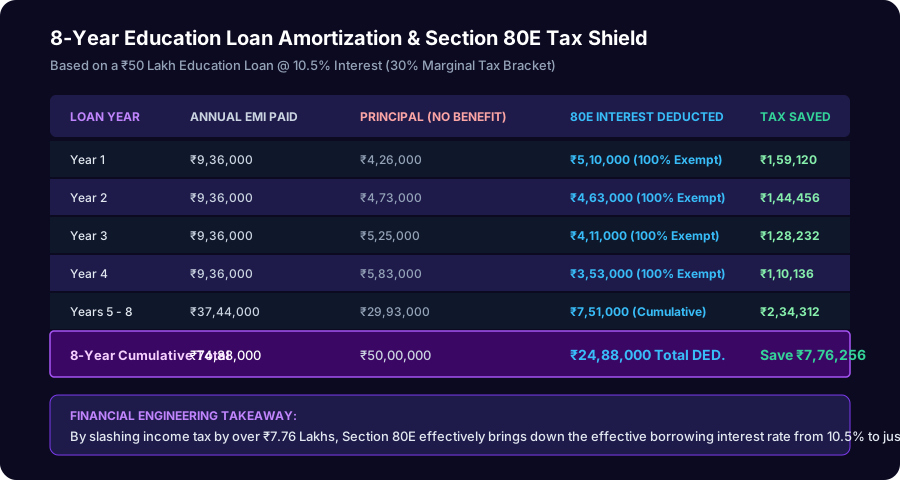
The chart above evaluates a standard ₹50,000,000 education loan taken for an overseas master's program at 10.5% interest over an 8-year repayment tenure:
- Total Interest Paid over 8 Years: ₹24,88,000
- 100% Uncapped Section 80E Deduction: ₹24,88,000
- Direct Tax Saved in 30% Slab (31.2% with cess): ₹7,76,256
- Net Effective Interest Borne: ₹24,88,000 - ₹7,76,256 = ₹17,11,744
- Effective Post-Tax Borrowing Rate: Drops from 10.50% to just 7.22%!
This mathematical reality demonstrates why borrowing an education loan through formal banking channels is often far smarter than liquidating family mutual funds or fixed deposits upfront.
9. Section 80E in New vs. Old Tax Regime Analysis
Under the New Tax Regime (Section 115BAC), Section 80E education loan deductions are completely disallowed.
For young professionals repaying large education loans in the initial 3 to 4 years of their careers, the Old Tax Regime is almost universally superior. Because Section 80E deductions often exceed ₹3,00,000 to ₹5,00,000 annually on their own, the total tax shelter under the Old Regime dwarfs the lower marginal tax slabs of the New Tax Regime.
10. Practical Case Study: ₹50 Lakh US Master's Degree Loan
Let us observe Siddharth, who returned to India after completing an MS in Data Science in the US and joined a multinational technology enterprise in Bengaluru at an annual CTC of ₹32,00,000.
Default Slabs with Zero 80E
- • Gross Salary: ₹32,00,000
- • Standard Deduction: -₹75,000
- • Section 80E Deduction: ₹0 (Disallowed!)
- • Taxable Income: ₹31,25,000
- • Income Tax + 4% Cess: ₹6,31,800
- • Loan Interest Outflow: -₹5,10,000
- • Net In-Pocket Cash: ₹20,58,200
Leveraging Uncapped Section 80E
- • Gross Salary: ₹32,00,000
- • Standard Deduction: -₹50,000
- • Section 80C (EPF): -₹1,50,000
- • Section 80E Interest: -₹5,10,000 (100% Uncapped!)
- • Taxable Income: ₹24,90,000
- • Income Tax + 4% Cess: ₹4,33,680
- • Net In-Pocket Cash: ₹22,56,320
By simply choosing the Old Tax Regime and claiming Section 80E, Siddharth pockets an extra ~₹16,500 every single month.
11. Frequently Asked Questions (Direct Tax FAQs)
Can a parent and student both claim Section 80E for the same loan? ▼
No. The deduction can only be claimed by the person who actually pays the interest out of their taxable income. If the parent and child are co-borrowers and both contribute to EMI repayments from their respective bank accounts, each can claim deduction strictly in proportion to the interest actually paid by them, supported by bank statements.
Can I claim Section 80E for interest paid on an education loan top-up?
▼
Yes, provided the top-up loan was sanctioned by an approved bank or financial institution specifically for higher education expenses (such as living expenses, university tuition, or study materials) and the interest is distinctly certified by the lender.
What happens if I repay the entire education loan in 4 years?
▼
If you clear the loan within 4 years, you will claim 80E deductions for those 4 financial years. The deduction ceases as soon as the loan interest is paid off; you cannot claim any unused years later.
Can I claim interest paid on an education loan taken for distance learning?
▼
Yes. The statutory definition of "higher education" under Section 80E includes any course of study pursued after Class 12, regardless of whether it is full-time, part-time, evening college, or distance education, provided the degree/diploma is recognized by a competent authority.