Table of Contents
- 1. Anatomy of Indian CTC: The Two Competing Financial Goals
- 2. Lever 1: Capping EPF at the Statutory ₹1,800 Limit
- 3. Lever 2: Corporate NPS Section 80CCD(2) (The New Regime Gem)
- 4. Lever 3: Flexi-Benefit Basket (FBP) Allowances
- 5. Lever 4: Car Lease & Fuel Perquisites for Senior Roles
- 6. Visual Master Blueprint: The 4 Restructuring Levers
- 7. Case Study: ₹18 LPA Software Engineer Before & After
- 8. The Trade-offs: Gratuity, HRA, and Long-Term EPF Compounding
- 9. How to Negotiate With HR: Scripts & Declaration Windows
- 10. Frequently Asked Questions (FAQ)
- 11. Summary & Monthly Cash Action Plan
1. Anatomy of Indian CTC: The Two Competing Financial Goals
When an Indian corporation extends an offer letter stating a Cost to Company (CTC) of ₹15 LPA, ₹20 LPA, or ₹30 LPA, that number does not represent money transferred into your savings account. It represents the total annual budget the company has allocated to retain you.
A standard Indian CTC package is partitioned into three distinct buckets:
- Direct Monthly Cash (Gross Salary): Basic Salary, House Rent Allowance (HRA), Special Allowance, and Conveyance.
- Deferred Retirals (Non-Cash CTC Components): Employer Provident Fund (12% of Basic) and Gratuity provision (4.81% of Basic).
- Variable Pay & Perquisites: Annual performance bonuses, group medical insurance premiums, and stock grants (ESOPs/RSUs).
Every salaried employee faces a strategic choice between two competing financial philosophies:
- Philosophy A (Maximum Retirement & Debt Accumulation): High Basic salary (50% of CTC), uncapped 12% EPF deductions, high statutory gratuity provisioning. This locks away significant capital into 8.25% sovereign provident funds for retirement, but leaves you with a smaller monthly paycheck for EMIs, rent, and discretionary lifestyle investments.
- Philosophy B (Maximum Immediate Cash Liquidity): Capping statutory EPF at ₹1,800, minimizing fully taxable Special Allowances, maximizing non-taxable expense reimbursements, and utilizing Corporate NPS. This channels maximum liquid cash into your bank account on the 30th of every month, giving you the flexibility to deploy capital into high-growth mutual fund SIPs or prepay high-interest home loans.
Neither philosophy is universally "right"—but being trapped in an inefficient structure without knowing you have choices is a massive financial setback. Let us examine the four primary levers you can use to reconfigure your CTC.
2. Lever 1: Capping EPF at the Statutory ₹1,800 Limit
The single most powerful lever to immediately surge monthly in-hand take-home pay is capping your Employee Provident Fund contribution.
Under the Employees' Provident Funds and Miscellaneous Provisions Act, 1952, statutory provident fund enrollment is mandatory only for employees with a monthly Basic wage of up to ₹15,000. On a ₹15,000 Basic wage, the mandatory 12% statutory employee contribution is exactly ₹1,800 per month (with matching ₹1,800 from the employer).
For wages exceeding ₹15,000, contributing on actual Basic is strictly voluntary under Paragraph 26(6) of the EPF Scheme. However, most Indian IT firms and MNCs automatically apply 12% on your entire Basic salary by default!
The Math of Uncapped vs Capped EPF on ₹18 LPA CTC
Suppose your monthly Basic salary is ₹65,000:
- Default Uncapped EPF: Employee PF = 12% of ₹65,000 = ₹7,800/month. Employer PF = ₹7,800/month. Total locked in PF = ₹15,600/month (₹1,87,200/year).
- Capped Statutory EPF: Employee PF = 12% of ₹15,000 = ₹1,800/month. Employer PF = ₹1,800/month. Total locked in PF = ₹3,600/month (₹43,200/year).
- Immediate Monthly In-Hand Cash Released: ₹7,800 − ₹1,800 = +₹6,000 liquid cash in your pocket every month!
What happens to the employer's differential ₹6,000? In a standard CTC package, it does not vanish—it is reallocated into your monthly "Special Allowance", increasing your taxable gross pay. For employees who prefer investing in equity index funds or need cash for high city rents, recovering ₹6,000 to ₹10,000 per month in cold hard cash is transformative.
3. Lever 2: Corporate NPS Section 80CCD(2) (The New Regime Gem)
When the government introduced the New Tax Regime, it eliminated nearly every traditional deduction: Section 80C (PPF/ELSS), Section 80D (Health Insurance), and Section 24b (Home Loan Interest).
However, Parliament left one monumental institutional tax shield completely intact under both the New and Old Tax Regimes: Section 80CCD(2) — Employer Contribution to the National Pension System (NPS).
Under Section 80CCD(2):
- Your employer can contribute up to 10% of your Basic Salary + DA (14% for Central and State Government employees) directly into your Tier-1 NPS account.
- This deduction sits completely outside the Section 80C ₹1.5 Lakh limit.
- The entire contribution is deducted directly from your gross salary before tax slabs are calculated, reducing your taxable income rupee-for-rupee!
Real Tax Savings on Corporate NPS (₹20 LPA CTC)
Suppose your Basic salary is ₹75,000/month (₹9,00,000/year). Your employer enrolls you in Corporate NPS at 10% of Basic = ₹7,500/month (₹90,000/year).
In the 20% to 30% tax brackets under the New Tax Regime, this ₹90,000 deduction saves you between ₹18,720 and ₹28,080 in pure income tax every year! Your employer simply redirects ₹7,500/month from your fully taxable Special Allowance into your NPS account, converting fully taxable cash into tax-sheltered retirement equity.
4. Lever 3: Flexi-Benefit Basket (FBP) Allowances
Many Indian IT companies and corporations offer a "Flexi-Benefit Plan" (FBP) or "Flexible Compensation Structure". This allows you to carve out specific tax-exempt allowances from your Special Allowance by providing receipts for legitimate professional expenses.
1. Meal Vouchers / Food Cards (Rule 3(7)(iii))
Meal cards (such as Sodexo/Pluxee, Zaggle, or Edenred) provide tax-free food allowances under the Income Tax Rules. The statutory exemption limit is ₹50 per meal for two meals a day. Assuming 22 working days in a month:
For someone in the 30% slab, opting for meal cards saves ₹8,237 in annual income tax on grocery and dining expenditures you were going to spend anyway!
2. Telephone & Internet Broadband Reimbursement
Under Section 10(14) read with Rule 3(7)(ix), reimbursement of mobile phone and high-speed broadband connection bills used for official duties is 100% tax-free with no statutory upper cap (provided expenses are reasonable and backed by genuine bills). Most companies permit ₹1,500 to ₹3,000/month (₹18,000 to ₹36,000/year) tax-free.
3. Books, Periodicals & Professional Subscriptions
Reimbursement for technical books, research journals, software licenses, and career upskilling periodicals is 100% tax-exempt upon bill submission. Typical allocation: ₹1,000 to ₹2,000/month (₹12,000 to ₹24,000/year).
4. Uniform / Attire Allowance
If your organization mandates a dress code, business attire allowances are exempt to the extent actually spent on purchasing and maintaining office attire.
5. Lever 4: Car Lease & Fuel Perquisites for Senior Roles
For senior software engineers, team leads, and managers earning above ₹18–₹20 LPA, corporate car leasing is the ultimate tax reduction perquisite.
Instead of buying a ₹15 Lakh car with post-tax savings and paying high EMI interest, the employer leases the vehicle on your behalf. The monthly lease rental (e.g., ₹28,000/month) is deducted directly from your pre-tax salary.
Furthermore, fuel bills (up to ₹15,000/month) and chauffeur salary (up to ₹15,000/month) can be reimbursed tax-free, subject only to nominal perquisite valuation under Rule 3:
- For cars with engine capacity ≤ 1,600 cc: Perquisite value is just ₹1,800/month (car + fuel) + ₹900/month (driver).
- For cars with engine capacity > 1,600 cc: Perquisite value is ₹2,400/month + ₹900/month (driver).
By substituting ₹4,00,000 of fully taxable Special Allowance with pre-tax car lease rentals and fuel reimbursements, an executive in the 30% slab saves upwards of ₹1,10,000 in income tax every year while driving a brand-new vehicle!
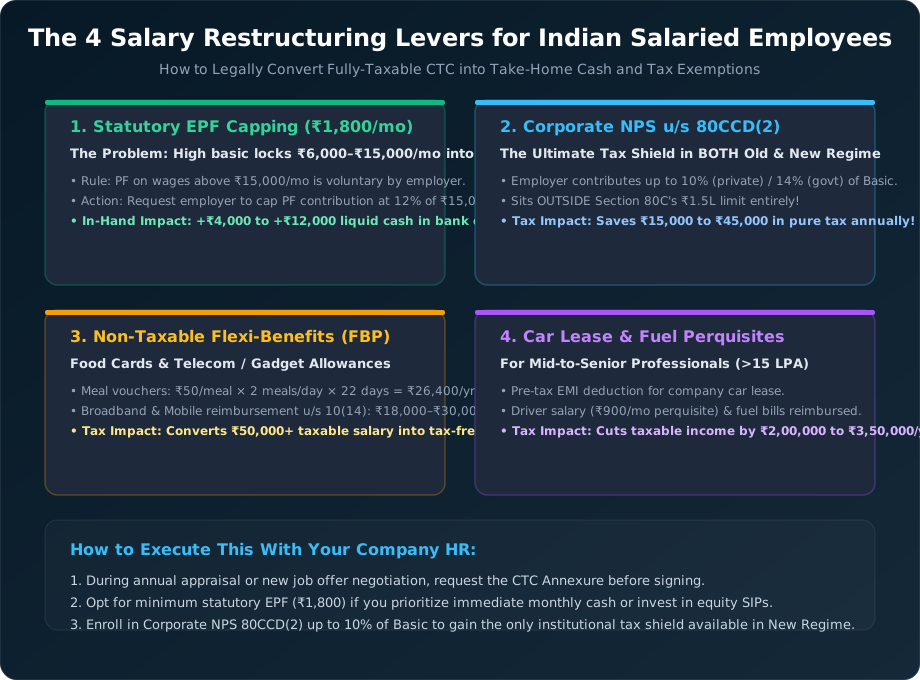
6. Visual Master Blueprint: The 4 Restructuring Levers
Here is how all four restructuring levers work together to shield your CTC from excessive taxation and illiquidity:
7. Case Study: ₹18 LPA Software Engineer Before & After
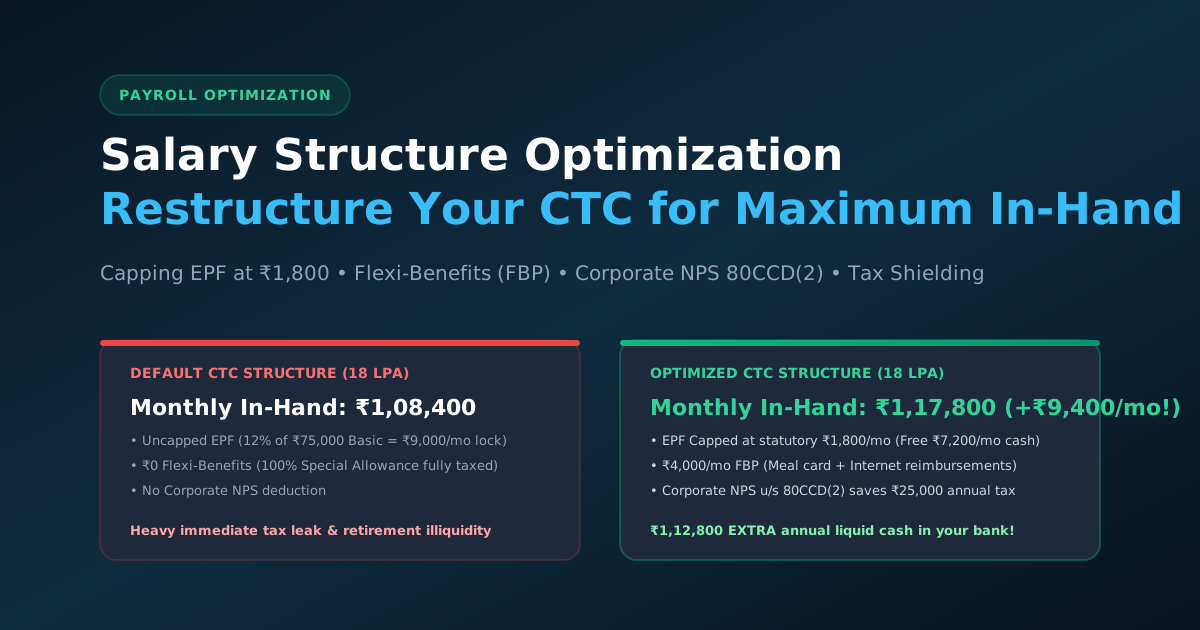
Let us witness the power of salary restructuring on a real-world software developer earning a ₹18,00,000 CTC in Bengaluru under the New Tax Regime.
| Salary Component | Structure A (Default / Unoptimized) | Structure B (Restructured / Optimized) | Monthly Difference |
|---|---|---|---|
| Monthly Basic Salary | ₹75,000 | ₹60,000 | -₹15,000 |
| HRA (40% non-metro / metro) | ₹30,000 | ₹24,000 | -₹6,000 |
| Special Allowance (Fully Taxable) | ₹32,700 | ₹39,500 | +₹6,800 |
| Flexi-Benefits (Meal + Internet) | ₹0 | ₹5,200 | +₹5,200 Tax-Free |
| Corporate NPS u/s 80CCD(2) | ₹0 | ₹6,000 | +₹6,000 Tax-Free |
| Employer PF Contribution | ₹9,000 (12% of ₹75k) | ₹1,800 (Statutory Capped) | +₹7,200 in Gross |
| Employee PF Deduction | ₹9,000 (12% of ₹75k) | ₹1,800 (Statutory Capped) | +₹7,200 in In-Hand |
| Monthly Professional Tax (PT) | ₹200 | ₹200 | ₹0 |
| Estimated Monthly TDS (Tax) | ₹13,200 | ₹10,400 | -₹2,800 Tax Saved |
| NET MONTHLY IN-HAND CASH | ₹1,09,800 | ₹1,18,300 | +₹8,500/month! |
Look at the final take-home row: an extra ₹8,500 in liquid cash is deposited into the developer's bank account on the 30th of every month! Over a full year, that represents ₹1,02,000 in additional liquidity.
Moreover, the developer is simultaneously building a ₹72,000 annual nest egg in low-cost Corporate NPS, and saving over ₹33,600 in pure income tax.
8. The Trade-offs: Gratuity, HRA, and Long-Term EPF Compounding
Before you blindly slash your Basic salary to ₹15,000, you must understand the statutory consequences. Several critical benefits in Indian employment law are tethered directly to your Basic salary:
1. Gratuity Calculation Impact
Under the Payment of Gratuity Act, 1972, gratuity payout upon completing 5 years of service is calculated as:
If your Basic salary is ₹30,000 instead of ₹70,000, your 10-year gratuity drops from ₹4,03,846 to ₹1,73,077. If you plan to remain with a company for many years, a higher Basic yields a substantially higher tax-free gratuity check upon departure.
2. HRA Exemption (Old Tax Regime Filers Only)
Under Section 10(13A), HRA exemption is calculated as the minimum of three values, two of which depend on Basic salary: 40%/50% of Basic salary, or Rent Paid minus 10% of Basic salary. A lower Basic reduces your eligible HRA exemption ceiling.
3. Sovereign 8.25% Guaranteed Compounding
EPF earns an 8.25% sovereign interest rate with EEE tax exemption (up to ₹2.5 Lakh annual employee contribution). For conservative investors who struggle to invest in equity markets disciplinedly, voluntary uncapped EPF serves as an involuntary forced savings mechanism.
9. How to Negotiate With HR: Scripts & Declaration Windows
You cannot restructure your salary at random times of the year. Indian payroll departments operate under strict compliance schedules:
- Window 1: Offer Letter Negotiation (Best Time): When negotiating a new job offer, always ask the recruiter: "Could you share the detailed CTC Annexure and break up? Does your company allow capping EPF at statutory ₹1,800, and do you support Corporate NPS 80CCD(2) and Flexi-Benefits?" Requesting this before the offer letter is generated takes zero HR effort.
- Window 2: Annual Appraisal / FBP Window (April / May): Every corporate HR opens the Flexi-Benefit declaration window at the start of the financial year. Log in immediately and allocate funds into meal vouchers, broadband reimbursement, and book allowances.
Email Template for HR Payroll Desk
"Dear Payroll Team,
In reference to my employment CTC structure for FY 2026-27, I would like to request that my EPF employee and employer contributions be restricted to the statutory limit of 12% on the wage ceiling of ₹15,000 (i.e. ₹1,800 per month), as permitted under Paragraph 26(6) of the EPF Scheme. Please reallocate the remaining balance to Special Allowance.
Additionally, please advise on the procedure to enroll in Corporate NPS under Section 80CCD(2) at 10% of Basic salary.
Thank you for your support.
Warm regards, [Your Name] • Employee ID: [12345]"
10. Frequently Asked Questions (FAQ)
Can I legally cap my EPF contribution at ₹1,800 per month?
Yes. Under the EPF Act, mandatory contribution is required only on Basic wages up to ₹15,000 per month (12% = ₹1,800). Any contribution above this wage ceiling is strictly voluntary. If your employer's HR policy permits, you can restrict contributions to ₹1,800, releasing immediate cash into your monthly pay.
Is Corporate NPS under Section 80CCD(2) available in the New Tax Regime?
Yes! Section 80CCD(2) is the only major retirement tax deduction allowed under BOTH the Old and New Tax Regimes. Your employer can contribute up to 10% of your Basic salary into NPS, reducing your taxable income directly before tax slabs are calculated.
How do meal cards and food vouchers save income tax?
Under Rule 3(7)(iii), meal vouchers provided during working hours are tax-free up to ₹50 per meal. For two meals a day across 22 working days, you can claim ₹2,200/month (₹26,400/year) completely tax-free, saving over ₹8,000 in annual tax in the 30% slab.
Does reducing my Basic salary negatively impact my gratuity?
Yes. Gratuity is calculated strictly based on your last drawn Basic salary. Lowering your Basic salary reduces your lump-sum gratuity payout upon completing 5 years of service. It also lowers your maximum eligible HRA exemption if you file under the Old Tax Regime.
When is the best time to request salary restructuring with HR?
The ideal windows are during the initial offer negotiation before signing your contract, or in April during the company's annual Flexi-Benefit declaration window when the payroll system opens for adjustments.
11. Summary & Monthly Cash Action Plan
A high CTC that does not translate into monthly bank balance is an illusion. To maximize your financial agility:
- Cap EPF at ₹1,800: If you need immediate monthly cash flow or prefer higher-yielding equity mutual funds over debt illiquidity.
- Activate Corporate NPS 80CCD(2): Enjoy the only institutional pre-tax retirement shield permitted under the New Tax Regime.
- Opt into Meal Cards & Broadband Allowances: Convert ₹50,000+ of fully taxable salary into tax-free cash for groceries and internet bills.
- Balance Basic at 40%-50%: Avoid dropping Basic below 40% of CTC to preserve reasonable gratuity and emergency security.
Ready to audit your own salary slip? Use our free CTC to In-Hand Salary Calculator to test capped vs uncapped EPF options and compare Old vs New Tax Regimes side-by-side in real time!