Rent-Free Accommodation (RFA) Perquisite Tax: Valuation Slabs, Leased Flats & CBDT Rules
Whether you occupy a company-owned executive guest quarter in Delhi, a corporate-leased penthouse in Mumbai, or a township villa in an industrial corridor, explore the revised 10%, 7.5%, and 5% valuation slabs under amended Rule 3(1), the Cost Inflation Index (CII) ceiling, and RFA vs HRA financial comparisons for Assessment Year 2027-28 (Financial Year 2026-27).
§ Table of Contents
- 1. Conceptual Architecture of Rent-Free Accommodation (RFA)
- 2. Government Employees vs. Private Sector Employees
- 3. Revised Population Slabs: 10%, 7.5%, and 5% (CBDT Reforms)
- 4. Valuation of Employer-Leased or Rented Housing
- 5. Statutory Definition of "Salary" for RFA Computation
- 6. Step-by-Step Statutory Computation Flow
- 7. Furnished Accommodation & Appliance Valuation Rules
- 8. The Cost Inflation Index (CII) Multi-Year Tenancy Safe Harbour
- 9. Financial Comparison: Company Quarters (RFA) vs. HRA
- 10. Hotel Stays & 90-Day Dual Accommodation on Transfer
- 11. Practical Case Study: ₹30 LPA Senior Manager in Bengaluru
- 12. Frequently Asked Questions (Direct Tax FAQs)
1. Conceptual Architecture of Rent-Free Accommodation (RFA)
Under Section 17(2)(i) and 17(2)(ii) of the Income-tax Act, 1961, the value of any rent-free accommodation or accommodation provided at a concessional rent to an employee by their employer constitutes a taxable non-monetary perquisite.
Housing is universally recognized as the single largest living expenditure for salaried professionals in Indian metropolitan centres. When an organization provides an executive with an upscale company-owned bungalow, a departmental flat in an employee township, or enters into a direct corporate lease with a third-party landlord for a premium gated apartment, the market rental value of such housing can easily range from ₹40,000 to ₹1,50,000 per month.
If the entire actual fair market rent were added to the employee’s salary, the resulting income tax liability would be punitive. Conversely, exempting corporate housing entirely would encourage rampant tax avoidance. To strike a balanced and transparent equilibrium, Rule 3(1) of the Income Tax Rules, 1962 prescribes a rigid mathematical framework where accommodation is taxed on a deemed percentage of the employee’s base compensation rather than subjective real-estate market valuations.
2. Government Employees vs. Private Sector Employees
The statutory valuation of Rent-Free Accommodation bifurcates fundamentally based on the nature of employment:
Central & State Government Employees
For civil servants, defense personnel, and public officers living in government quarters (e.g., CPWD flats), the taxable perquisite is determined strictly according to the License Fee determined by the government in accordance with the rules framed for allotment of houses, minus any license fee deducted from their monthly pay slip. This license fee is nominal (often only ₹500 to ₹2,500/month).
Corporate, Tech & Non-Government Staff
For all private corporate employees, IT/BPO personnel, bank officers, and public sector undertakings (PSUs), license fees do not apply. Instead, valuation is strictly regulated under the population-based formula or the leased housing formula of Rule 3(1).
3. Revised Population Slabs: 10%, 7.5%, and 5% (CBDT Reforms)
Historically, corporate employees faced aggressive perquisite tax rates: 15% of salary for cities with a population above 25 Lakhs, 10% for populations between 10 and 25 Lakhs, and 7.5% for other areas. Recognizing that these rates were disproportionately penalizing middle-class and senior corporate executives, the Central Board of Direct Taxes issued landmark Notification No. 65/2023 (amending Rule 3(1)).
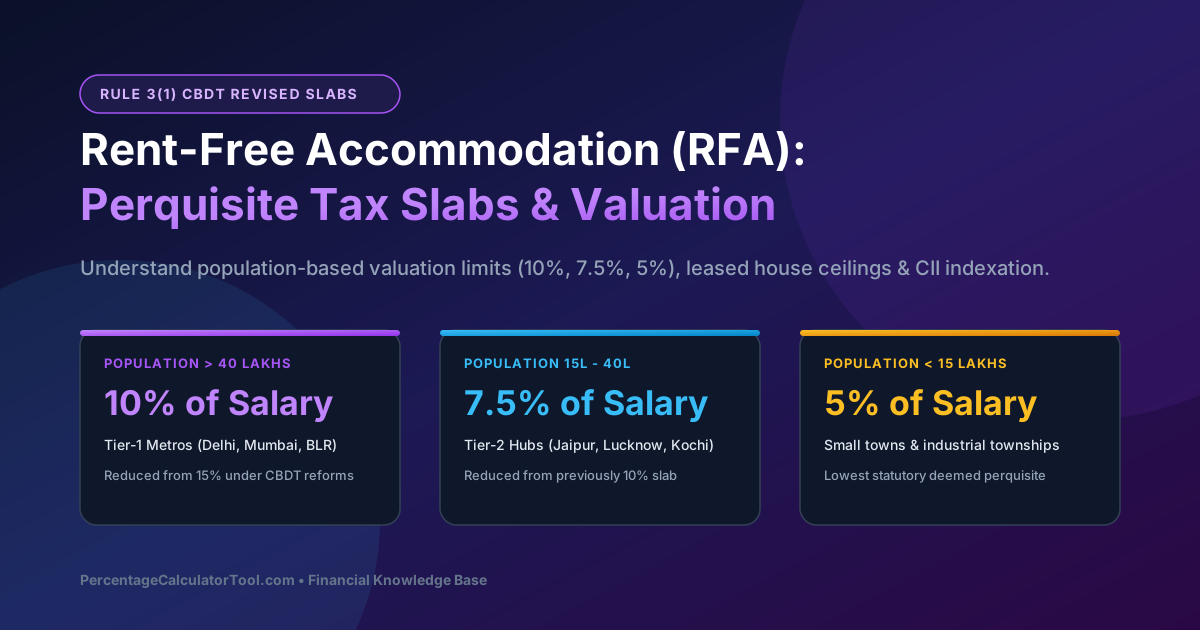
Under the amended provisions, which govern Assessment Year 2027-28 (Financial Year 2026-27), the valuation rates for employer-owned unfurnished accommodation have been substantially reduced across all demographic tiers based on the 2011 Census:
| Population Tier (2011 Census) | Representative Cities | Pre-2023 Old Rate | Revised CBDT Rate (Current) |
|---|---|---|---|
| Exceeding 40 Lakhs | Mumbai, Delhi NCR, Bengaluru, Hyderabad, Chennai, Kolkata, Ahmedabad, Pune | 15% of salary | 10% of salary |
| Between 15 Lakhs and 40 Lakhs | Jaipur, Lucknow, Kochi, Surat, Nagpur, Indore, Patna, Vadodara, Coimbatore | 10% of salary | 7.5% of salary |
| Less than 15 Lakhs | Tier-3 towns, district headquarters, manufacturing hubs, mining townships | 7.5% of salary | 5% of salary |
Note: The census figures used for classification remain pegged to the official 2011 Census data until newly notified decennial census statistics are formally published and adopted by the CBDT.
4. Valuation of Employer-Leased or Rented Housing
In commercial hubs like Gurugram, Whitefield (Bengaluru), and Bandra-Kurla Complex (Mumbai), corporate employers rarely own residential residential towers outright. Instead, companies execute commercial corporate lease deeds with private landlords or real-estate developers to house their managerial personnel.
Where the residential accommodation is taken on lease or rent by the employer, Rule 3(1) prescribes that the taxable perquisite is determined as the LOWER of the following two figures:
Leased Accommodation Perquisite Formula:
Taxable Perquisite = Minimum of:
(A) Actual lease rental paid or payable by the employer, OR
(B) 10% of the employee’s salary (harmonized down from 15%)
This dual test creates exceptional statutory protection for employees. For instance, if an employer pays ₹1,20,000 per month (₹14.4 Lakhs annually) to lease a luxury flat for a Vice President whose qualifying annual salary is ₹50 Lakhs:
- Actual lease paid: ₹14,40,000
- 10% of Salary: ₹5,00,000
- Taxable Perquisite: Only ₹5,00,000!
The remaining ₹9,40,000 of real-estate value enjoyed by the executive escapes direct perquisite taxation entirely!
5. Statutory Definition of "Salary" for RFA Computation
A critical error made by payroll administrators and individual taxpayers is multiplying the 10% rate against the gross Cost-to-Company (CTC). Under the Income Tax Rules, "Salary" for RFA calculation has a very precise, statutory legal definition that excludes several standard salary heads.
| Included in RFA "Salary" Base | Strictly Excluded from RFA "Salary" Base |
|---|---|
|
• Basic Salary
• Dearness Allowance (DA) - only if considered for retirement benefits
• City Compensatory Allowance (CCA)
• Special Allowance & Personal Pay
• Performance Bonus & Guaranteed Incentives
• Commission on sales or fixed commission
• Any other taxable monetary allowance
|
• Employer's Provident Fund (EPF) Contribution
• Employer NPS contribution under Section 80CCD(2)
• Dearness Allowance NOT forming part of superannuation
• Medical bill reimbursements & health premiums
• Exempt portions of allowances (e.g., official travel)
• Value of all other perquisites (car perq, club perq)
• Gratuity, retrenchment compensation, leave encashment
|
Because substantial CTC elements such as employer PF (12% of basic), employer NPS (up to 14% of basic), and non-cash perquisites are completely excluded from the base, the statutory "Salary" for RFA is typically 15% to 25% lower than the employee’s nominal gross CTC.
6. Step-by-Step Statutory Computation Flow
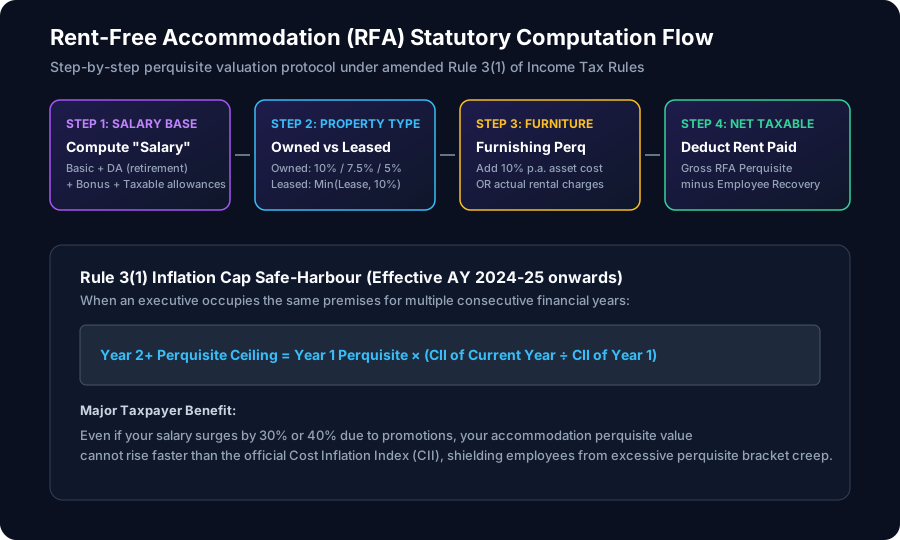
To calculate your accurate taxable perquisite on Form 16, execute the following 5-step computational pipeline:
- Step 1: Determine Tenancy Period: Aggregate qualifying salary earned only during the specific months the accommodation was actually occupied by the employee.
- Step 2: Calculate Unfurnished Perquisite: Apply the demographic percentage (10%, 7.5%, or 5%) if owned, or lower of 10% vs lease rent if leased.
- Step 3: Calculate Furniture Perquisite (if applicable): Add 10% per annum of original furniture purchase cost or actual rental charges.
- Step 4: Compute Gross Accommodation Perquisite: Sum unfurnished perquisite value + furniture perquisite value.
- Step 5: Deduct Concessional Recovery: Subtract any nominal rent deducted by the employer from the employee's monthly pay slip. The net remainder is the taxable perquisite added to "Income from Salaries".
7. Furnished Accommodation & Appliance Valuation Rules
When an employer equips the accommodation with furnishings—such as modular kitchens, air conditioners, television sets, washing machines, refrigerators, and designer furniture—the accommodation is classified as Furnished Accommodation under Rule 3(1).
The taxable perquisite for such furnishings is computed as follows:
- Furniture Owned by Employer: Add 10% per annum of the original acquisition cost of the appliances and furniture. For example, if the employer spent ₹4,00,000 purchasing furniture, the annual perquisite is ₹40,000 (₹3,333/month).
- Furniture Hired / Leased by Employer: Add the actual rental or hire charges paid by the employer to the furniture rental agency.
Crucial Note on Wear and Tear: The 10% per annum rule is based on the original historical cost of the furniture, not its written-down value (WDV). Even if the furniture is 8 years old and fully depreciated in the corporate books, the 10% annual perquisite charge continues based on the original invoice price until the asset is replaced.
8. The Cost Inflation Index (CII) Multi-Year Tenancy Safe Harbour
One of the most innovative and pro-taxpayer reforms introduced in Notification 65/2023 is the statutory Inflation Indexation Cap.
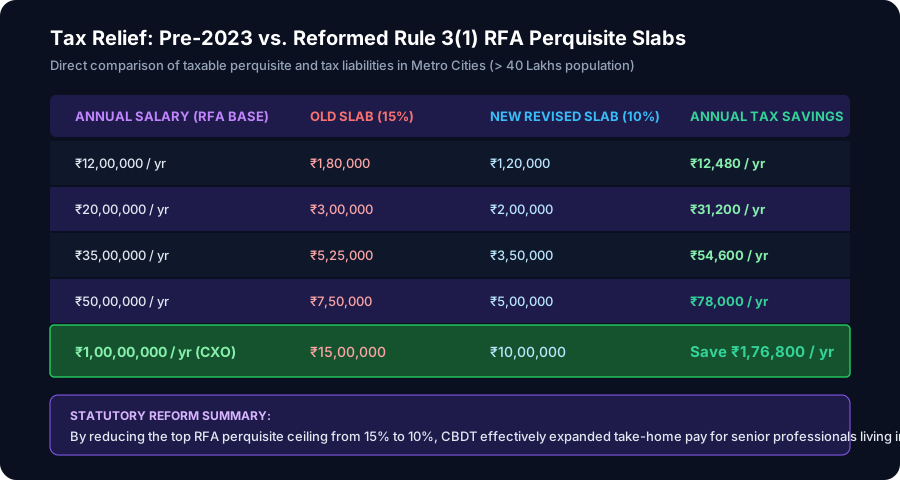
In the past, if an employee lived in the same company apartment for 5 years and received substantial annual increments (e.g., salary growing from ₹20 Lakhs to ₹35 Lakhs), their RFA perquisite automatically surged from ₹3,00,000 to ₹5,25,000, even though the physical apartment had not changed at all.
Under amended Rule 3(1), when an employee occupies the same residential accommodation for two or more consecutive financial years, the taxable perquisite in subsequent years is legally capped:
CII Safe Harbour Formula
Maximum Taxable Perquisite (Year N) = Taxable Perquisite of Base Year × [ CII of Year N ÷ CII of Base Year ]
If your computed 10% salary perquisite in Year 2 or Year 3 exceeds this inflation-adjusted ceiling, your taxable perquisite is restricted to the lower indexed ceiling! This completely eliminates artificial perquisite bracket creep caused by promotions or merit bonuses.
9. Financial Comparison: Company Quarters (RFA) vs. HRA
Salaried employees often debate whether they should accept company-provided housing (RFA) or opt for House Rent Allowance (HRA) and rent a home independently. The financial decision depends heavily on which tax regime you select:
| Parameter | House Rent Allowance (HRA) | Rent-Free Accommodation (RFA) |
|---|---|---|
| Governing Section | Section 10(13A) & Rule 2A | Section 17(2) & Rule 3(1) |
| Old Tax Regime Advantage | Superb: Exemption up to 50% basic - 10% rent | Moderate: Taxable perquisite added to income |
| New Tax Regime (115BAC) | 100% Taxable (HRA Exemption Abolished!) | Highly Favourable! (Saves pre-tax CTC) |
| Administrative Burden | Requires rent agreements, landlord PAN, receipts | Zero paperwork for employee; managed by HR |
The New Tax Regime Dynamic: Under the New Tax Regime (Section 115BAC), HRA is completely stripped of all exemptions and taxed at full marginal rates. However, with RFA, the company absorbs the expensive real-estate rent through corporate expenses, and the employee is merely assessed a modest 10% presumptive perquisite. Therefore, for professionals paying high rents in Tier-1 metros under the New Tax Regime, RFA is overwhelmingly superior to HRA.
10. Hotel Stays & 90-Day Dual Accommodation on Transfer
When an employee is transferred from one corporate branch to another (e.g., from Pune to Bengaluru), two specific transition relief mechanisms apply under Rule 3(1):
1. Hotel Accommodation on Transfer (15-Day Blanket Exemption)
If the employer puts up the transferred employee in a hotel, guest house, or serviced apartment, no perquisite is taxed if the stay does not exceed 15 days in aggregate. If the hotel stay exceeds 15 days, perquisite is charged from the 16th day onward at the lower of: (a) 24% of salary for the period, or (b) actual hotel room charges paid by the employer.
2. 90-Day Grace Period for Dual Accommodations
Where an employee is allotted a house at the new location while still retaining their company accommodation at the previous location (to allow children to finish the school year), only ONE accommodation (having the lower perquisite value) is taxed for the first 90 days. If dual occupancy extends beyond 90 days, both houses become fully taxable as perquisites from the 91st day onward.
11. Practical Case Study: ₹30 LPA Senior Manager in Bengaluru
To visualize the complete mathematical mechanics of Rule 3(1), let us examine the case of Priya, a Senior Product Manager in Bengaluru (population > 40 Lakhs).
Strategic Takeaway: Even though Priya's employer paid ₹7.8 Lakhs in rent and provided ₹3 Lakhs of furniture, Priya's taxable salary increased by only ₹2,20,000. At her 30% marginal slab, her direct tax outflow is just ₹68,640 per year (~₹5,720/month) for living in a luxury ₹65,000/month apartment!
12. Frequently Asked Questions (Direct Tax FAQs)
What are the revised population slabs under Rule 3(1)? ▼
For employer-owned housing: 10% of salary for cities with population > 40 Lakhs; 7.5% for cities between 15 Lakhs and 40 Lakhs; and 5% for areas with population < 15 Lakhs. For leased houses, perquisite is the lower of actual rent paid or 10% of salary.
Can an employee claim both HRA and RFA simultaneously? ▼
No. Under direct tax provisions, an employee cannot claim Section 10(13A) HRA exemption for the same city where they are already occupying employer-provided rent-free accommodation.
Is utility billing (electricity and water) covered under RFA? ▼
No. If the employer pays your domestic electricity, gas, or water utility bills, this is valued separately under Rule 3(4) as an independent perquisite at actual cost paid to the utility provider, and is added to taxable salary over and above the RFA value.
How does the Cost Inflation Index (CII) ceiling protect employees? ▼
When an employee stays in the same accommodation across multiple financial years, the taxable perquisite in later years cannot exceed the first year's perquisite inflated by the official CII index ratio, even if the employee's salary jumps significantly.