Company Car Perquisite Tax: 1600cc Engine Rules, Driver Valuation & Corporate Car Lease Guide
Corporate car lease policies and employer-provided company vehicles represent one of corporate India’s most powerful non-monetary salary perks. Discover the statutory perquisite valuation formulas under Rule 3(2), engine capacity slabs, driver valuations, and how salaried executives save lakhs in income tax for Assessment Year 2027-28 (Financial Year 2026-27).

§ Table of Contents
- 1. The Statutory Framework: Section 17(2) & Rule 3(2)
- 2. The 1600cc Cubic Capacity Threshold Explained
- 3. Comprehensive Rule 3(2) Perquisite Valuation Matrix
- 4. Chauffeur & Driver Perquisite Valuation Rules
- 5. Financial Engineering: Corporate Car Lease vs. Personal Auto Loan
- 6. Step-by-Step Decision Architecture Flowchart
- 7. Employee-Owned Cars & Employer Fuel Reimbursement
- 8. 100% Official Use Logbook Compliance & Provisos
- 9. Impact Under New Tax Regime vs Old Tax Regime
- 10. Practical Case Study: ₹25 LPA Executive Vehicle Optimization
- 11. Frequently Asked Questions (Direct Tax FAQs)
1. The Statutory Framework: Section 17(2) & Rule 3(2)
Under the Indian Income-tax Act, 1961, any benefit, amenity, or non-cash privilege granted by an employer to an employee is legally classified as a perquisite under Section 17(2). Perquisites constitute an integral component of "Income from Salaries" and are subjected to direct taxation at the employee’s applicable marginal slab rates.
Among executive compensation structures, the provision of motor vehicles has historically presented unique tax compliance challenges. A vehicle provided by an enterprise is rarely used solely for pure business errands or purely for weekend family vacations; instead, it routinely serves a dual purpose—facilitating daily home-to-office executive commutes while remaining available for personal weekend and family use.
To prevent arbitrary taxation and eliminate the need for tax officers to audit every single kilometre driven, the Central Board of Direct Taxes (CBDT) formulated a rigid, standardized deeming formula enshrined within Rule 3(2) of the Income Tax Rules, 1962. Under this rule, the taxable value of a motor car provided by an employer is computed on a fixed presumptive monthly schedule rather than the actual vehicle invoice value or retail leasing charges, creating a massive tax planning opportunity for Indian corporate employees.
2. The 1600cc Cubic Capacity Threshold Explained
The fundamental dividing line in company car taxation under Rule 3(2) is the cubic capacity (cc) of the vehicle’s internal combustion engine, with the statutory demarcation line established at 1.6 litres (1,600 cubic centimetres):
- Small / Sub-1.6L Cars (≤ 1,600 cc): Encompasses hatchbacks, premium hatchbacks, compact sedans, and compact crossovers (e.g., Maruti Baleno, Swift, Dzire; Hyundai i20, Venue; Tata Nexon 1.2L Turbo; Honda City 1.5L; Skoda Slavia 1.0L / 1.5L TSI). Under tax law, these vehicles represent standard executive transportation.
- Large / Above-1.6L Cars (> 1,600 cc): Encompasses mid-sized luxury sedans, rugged off-roaders, and full-sized multi-utility vehicles (e.g., Mahindra Scorpio-N 2.0L/2.2L, Tata Safari 2.0L Diesel, Toyota Innova Crysta / Hycross 2.0L, BMW 3-Series 2.0L, Audi A4, Mercedes-Benz C-Class). These vehicles represent luxury transportation and attract a higher presumptive perquisite tax.
What about Electric Vehicles (EVs)? In modern corporate fleets featuring vehicles like the Tata Nexon EV, MG ZS EV, or BYD Atto 3, there is no combustion cylinder cubic capacity. According to CBDT administrative circulars and standard corporate payroll practices, when motor cars lack combustion engines, the motor power output is correlated with equivalent displacement categories, or payroll departments universally classify mainstream commuter EVs within the sub-1600cc lower tax bracket unless explicitly designated as high-output luxury vehicles.
3. Comprehensive Rule 3(2) Perquisite Valuation Matrix
The statutory valuation under Rule 3(2)(A) varies based on three factors: (a) who owns or leases the car, (b) who pays for running and maintenance (fuel, servicing, tires, insurance), and (c) the primary purpose of vehicle utilization. The table below outlines every combination mandated by the Income Tax Department:
| Ownership / Lease | Running & Fuel Paid By | Permitted Usage | Engine ≤ 1600cc | Engine > 1600cc | Chauffeur |
|---|---|---|---|---|---|
| Employer | Employer | 100% Official Use | NIL* | NIL* | NIL* |
| Employer | Employer | 100% Personal Use | Actual Running Costs + 10% Car Depreciation p.a. | Actual Salary | |
| Employer | Employer | Partly Official & Personal | ₹1,800 / mo | ₹2,400 / mo | + ₹900 / mo |
| Employer | Employee | Partly Official & Personal | ₹600 / mo | ₹900 / mo | + ₹900 / mo |
| Employee | Employer | Partly Official & Personal | Actual Reimbursement minus ₹1,800/₹2,400 per month | - ₹900 / mo | |
*Subject to strict logbook maintenance and employer certification as mandated under Rule 3(2) provisos.

4. Chauffeur & Driver Perquisite Valuation Rules
In executive corporate policies, it is standard practice for the company to provide a dedicated chauffeur or reimburse driver wages up to ₹20,000 to ₹25,000 per month. Under ordinary principles of commercial taxation, paying an employee’s private driver ₹25,000 each month would constitute a taxable benefit of ₹3,00,000 per year.
However, under Rule 3(2)(c) of the Income Tax Rules, where the motor car is used for mixed business and personal travel, the statutory perquisite value for a chauffeur or driver provided by the employer is fixed at an astonishingly modest ₹900 per month (₹10,800 annually).
Key Direct Tax Insight on Driver Perquisite
Regardless of whether the actual market salary paid to the chauffeur is ₹15,000, ₹22,000, or ₹30,000 per month, the exact sum added to your taxable income under Form 16 is capped at ₹900 per month. For an executive in the 30% slab (31.2% with health & education cess), the net annual income tax incurred on an employer-funded ₹2.4 Lakh driver wage is a mere ₹3,370 per year!
5. Financial Engineering: Corporate Car Lease vs. Personal Auto Loan
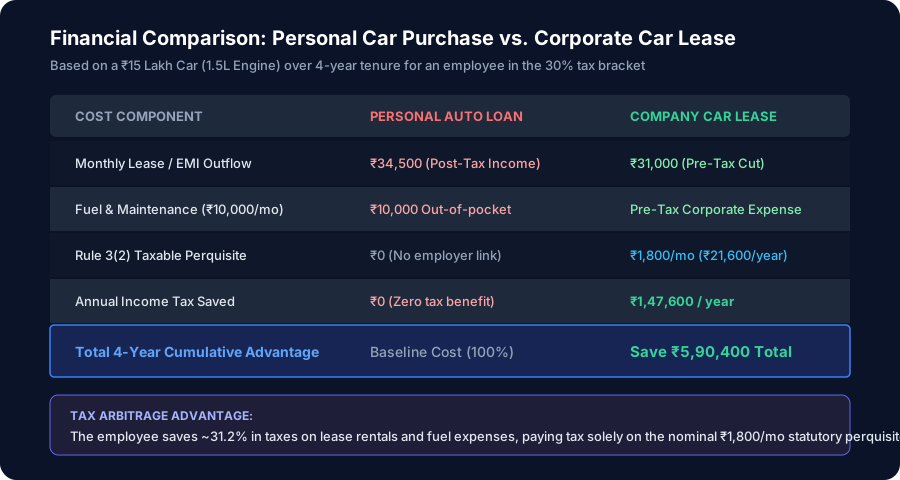
Why do leading multinational enterprises and tech firms in Bengaluru, Gurgaon, Mumbai, and Hyderabad heavily promote Corporate Car Lease Schemes (often partnered with leasing corporations like ALD Automotive, LeasePlan, or Avis)? The answer lies in the phenomenal tax arbitrage created between Section 17(2) perquisite valuation and gross salary sacrifice.
When an individual purchases a car on a personal bank loan:
- The monthly EMI is paid completely out of post-tax net in-hand salary.
- GST on the car purchase (typically 28% plus compensation cess ranging from 1% to 22%) is permanently sunk and non-recoverable.
- All fuel expenses, service bills, maintenance costs, and comprehensive insurance premiums are financed out of taxed savings with zero tax write-offs.
In contrast, under a structured Corporate Car Lease Plan:
- The employer signs an operating lease with the leasing entity. The monthly rental is subtracted from the employee's pre-tax Cost-to-Company (CTC) before calculating TDS.
- Monthly fuel allocations (e.g., ₹12,000/month) and annual maintenance packages (₹40,000/year) are billed directly to the corporate account.
- The only taxable impact on the employee's payroll is the presumptive perquisite: ₹1,800 (car) + ₹900 (driver) = ₹2,700 per month.
6. Step-by-Step Decision Architecture Flowchart
To verify whether your company car qualifies for standard presumptive valuation under Rule 3(2), evaluate the following four statutory litmus tests:
- Lease Registration Test: The registration certificate (RC) or the tripartite operating lease agreement must be executed either in the corporate name of the employer or designated under the employer's corporate fleet program.
- Displacement Verification: Inspect the vehicle's Form 23 / Registration Smart Card for the precise engine displacement. A 1,498 cc engine (e.g., Honda City, Skoda Slavia 1.5) qualifies as ≤ 1600cc (attracting ₹1,800/mo), whereas a 1,968 cc engine (e.g., Audi A4 2.0 TDI) is > 1600cc (attracting ₹2,400/mo).
- Commercial Mixed Use Presumption: The car must be acknowledged as being utilized for both executive official commutation and personal household journeys. No logbook is legally required for claiming the standard presumptive ₹1,800 / ₹2,400 slab.
- Employer Recovery Deduction: If the employer recovers any nominal fee from your monthly pay for providing the vehicle, the recoverable sum is deducted from the taxable perquisite. However, under Rule 3(2)(A), the perquisite value cannot be reduced below zero.
7. Employee-Owned Cars & Employer Fuel Reimbursement
What occurs when an employee owns their personal vehicle (RC registered in the employee's personal name), but the employer provides a fuel and driver reimbursement allowance (e.g., ₹18,000 per month for fuel and ₹15,000 per month for driver)?
Under Rule 3(2)(B), the tax calculation shifts from a presumptive perquisite addition to an exemption-subtraction model:
Taxable Perquisite Calculation Formula:
Taxable Perquisite = Total Actual Reimbursement Paid by Employer
- Statutory Deemed Official Cost [₹1,800 or ₹2,400]
- Chauffeur Allowance Exemption [₹900]
- Higher Official Mileage Proven through Logbook (if maintained)
Example Scenario: Rajesh owns a 1500cc Hyundai Creta. His employer reimburses ₹15,000 per month for petrol bills and ₹10,000 for his driver (total ₹25,000/month or ₹3,00,000 annually). If Rajesh does not maintain a daily official logbook:
- Statutory official deduction permitted: (₹1,800 + ₹900) × 12 = ₹32,400 per annum.
- Taxable Perquisite added to salary: ₹3,00,000 - ₹32,400 = ₹2,67,600.
Therefore, owning the car personally and claiming reimbursements without maintaining a detailed official logbook exposes a large portion of the reimbursement to income tax. This illustrates why the corporate leasing model (employer-owned/leased) is overwhelmingly preferred by tax planners over employee-owned reimbursements.
8. 100% Official Use Logbook Compliance & Provisos
An employer or employee may argue that a company vehicle is used 100% exclusively for official corporate business (such as regional sales directors, factory audit inspectors, or logistics supervisors). In such instances, the statutory perquisite value is strictly ₹0 (NIL).
However, the Assessing Officer (AO) will disallow the exemption and assess the vehicle as 100% personal use unless the strict evidentiary conditions stipulated in the Provisos to Rule 3(2) are satisfied:
Condition 1: Continuous Journey Logbook
The employer must maintain an active, daily journey register capturing: date of journey, destination, starting odometer reading, closing odometer reading, exact distance in kilometres, and explicit business purpose of the meeting or trip.
Condition 2: Employer Supervisory Certificate
The employer's authorized supervisory authority (VP HR, Finance Controller, or Fleet Manager) must formally certify that the vehicle was utilized wholly and exclusively for the discharge of official corporate responsibilities.
9. Impact Under New Tax Regime vs Old Tax Regime
Under the Finance Act, the New Tax Regime under Section 115BAC serves as the default tax system. While Section 115BAC abolished dozens of standard exemptions (such as House Rent Allowance under Section 10(13A), Leave Travel Concession under Section 10(5), and Chapter VI-A deductions under Section 80C), the valuation principles of perquisites under Section 17(2) and Rule 3 remain fully active!
| Component | Old Tax Regime | New Tax Regime (Sec 115BAC) |
|---|---|---|
| Rule 3(2) Valuation Schedule | Fully Applicable (₹1,800 / ₹2,400) | Fully Applicable (Identical values) |
| Pre-Tax Lease CTC Deduction | Allowed (Reduces gross taxable salary) | Allowed (Reduces gross taxable salary) |
| Fuel & Maintenance via CTC | Tax-free business expense | Tax-free business expense |
| Standard Deduction | ₹50,000 | ₹75,000 |
Consequently, corporate car leasing has become even more prized under the New Tax Regime. Because salaried employees cannot claim deductions under 80C or HRA (if living in their own home), restructuring ₹4 Lakhs to ₹6 Lakhs of annual CTC into a corporate-leased vehicle represents one of the few legal avenues left to dramatically compress taxable income.
10. Practical Case Study: ₹25 LPA Executive Vehicle Optimization
Let us evaluate a practical mathematical case study for Vikram, an Engineering Director in Gurugram earning a gross CTC of ₹25,00,000 per annum under the New Tax Regime.
Buys ₹15 Lakh SUV on Personal Auto Loan
- • Gross Salary: ₹25,00,000
- • Standard Deduction: -₹75,000
- • Taxable Income: ₹24,25,000
- • Income Tax + Cess: ₹4,13,400
- • Net Post-Tax Take-Home: ₹20,86,600
- • Personal Loan EMI (4 yrs): -₹4,14,000
- • Fuel & Service out of pocket: -₹1,50,000
- • Net Disposable Cash: ₹15,22,600 / year
Opts for Company Car Lease Scheme
- • Gross Base Salary: ₹25,00,000
- • Less Lease Rental from CTC: -₹3,72,000
- • Less Fuel & Maintenance: -₹1,50,000
- • Add Rule 3(2) Perquisite (1.5L + Driver): +₹32,400
- • Revised Gross Salary: ₹20,10,400
- • Standard Deduction: -₹75,000
- • Taxable Income: ₹19,35,400
- • Income Tax + Cess: ₹2,60,645
- • Net Disposable Cash: ₹17,07,355 / year
Over a standard 4-year lease lifecycle, Vikram saves over ₹7,39,000 in income tax simply by leveraging statutory Rule 3(2) perquisite provisions.
11. Frequently Asked Questions (Direct Tax FAQs)
What is the taxable perquisite value of a company car below 1600cc? ▼
Under Rule 3(2)(A), for cars having cubic capacity up to 1600cc where the employer pays running and maintenance expenses, the taxable perquisite value is ₹1,800 per month (₹21,600 per year). If a driver is also provided, an additional ₹900 per month is added, totaling ₹2,700 per month.
What happens if the employer provides more than one company car?
▼
Under Rule 3(2)(A) proviso, if an employer provides two or more motor cars to the employee or their household, the employee can treat only ONE car as being used for mixed official and personal purposes (taxed at presumptive ₹1,800 or ₹2,400/month). The other car(s) will be legally deemed as 100% personal use, and will be taxed at full actual running expenses plus 10% annual depreciation of vehicle cost.
Does the employee own the car at the end of the corporate lease tenure?
▼
Most corporate operating leases allow the employee to purchase the vehicle at its predetermined residual market value (typically 15% to 20% of original ex-showroom price) or surrender the vehicle to the leasing company to roll into a brand new vehicle lease contract.
Are tolls and parking charges tax-exempt when reimbursed?
▼
Fastag toll charges and commercial parking tickets incurred during official client travel are legitimate business operational expenses and are 100% tax-free to the employee upon submitting genuine electronic receipts to the finance department.