Leave Travel Allowance (LTA) Exemption: 2026-2029 Block Rules, Travel Limits & Carryover Policy
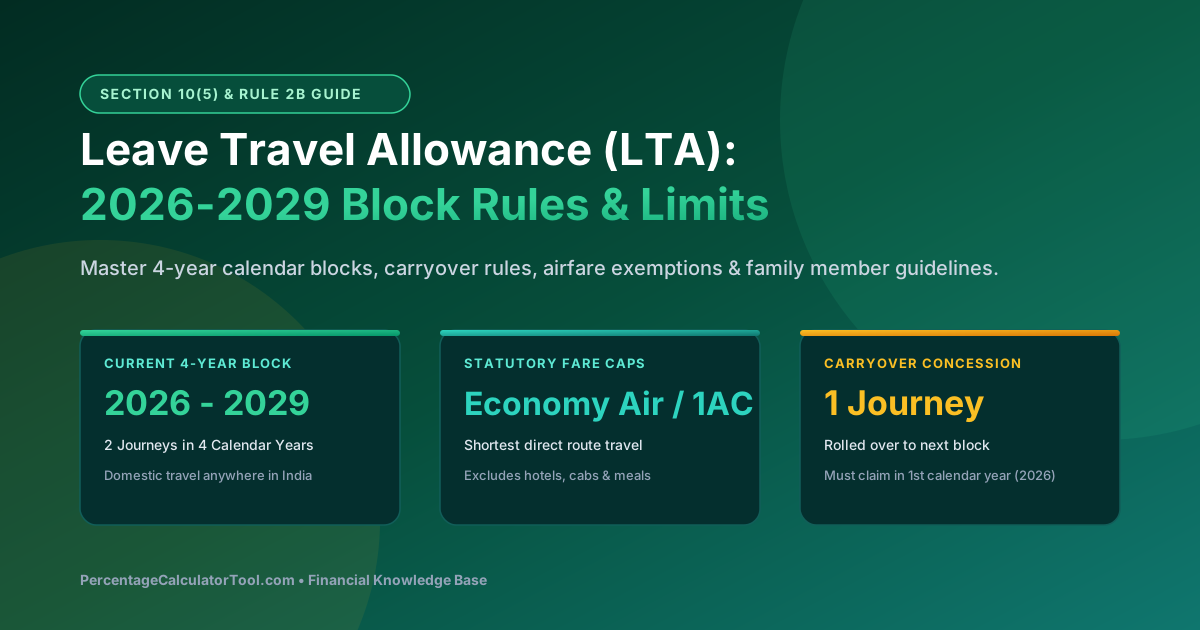
With the dawn of the official 2026-2029 statutory calendar block, discover how to maximize tax-free vacation travel across India. Explore economy airfare ceilings, AC First Class rail rules, family eligibility limits, carryover concessions, and the complete audit verification protocol under Section 10(5) and Rule 2B for Assessment Year 2027-28 (Financial Year 2026-27).
§ Table of Contents
- 1. The Statutory Framework: Section 10(5) & Rule 2B
- 2. The 4-Year Calendar Block System (The 2026-2029 Cycle)
- 3. The Carryover Concession: Rolling Over 1 Unused Journey
- 4. Statutory Travel Mode Ceilings: Air, Rail & Road
- 5. The "Shortest Direct Route" Principle & Multi-City Stops
- 6. Six-Point Statutory Compliance Architecture
- 7. Definition of "Family" & The Two-Child Restriction
- 8. Disallowed Non-Fare Expenses: Hotels, Food & Cabs
- 9. Impact Under New Tax Regime vs Old Tax Regime
- 10. Audit Verification Matrix: Allowed vs. Disallowed
- 11. Practical Case Study: ₹70,000 Family Flight Exemption
- 12. Frequently Asked Questions (Direct Tax FAQs)
1. The Statutory Framework: Section 10(5) & Rule 2B
Under Section 10(5) of the Income-tax Act, 1961, read alongside Rule 2B of the Income-tax Rules, 1962, any assistance or reimbursement received by an Indian individual from their employer in connection with proceeding on leave to any place within India is exempt from income tax, subject to prescribed statutory conditions.
Commonly designated as Leave Travel Allowance (LTA) in private corporate employment contracts or Leave Travel Concession (LTC) in government service, this allowance is intended to facilitate family rejuvenation and promote domestic cultural tourism.
However, LTA is among the most scrutinized allowances during direct tax scrutiny assessments. Because taxpayers frequently confuse general vacation holiday spending with statutory travel concessions, the Central Board of Direct Taxes (CBDT) enforces strict evidentiary boundaries regarding booking routes, eligible family members, and transport classes.
2. The 4-Year Calendar Block System (The 2026-2029 Cycle)
Unlike most provisions in the Income-tax Act—which operate on the Financial Year (1st April to 31st March)—the statutory framework for Leave Travel Allowance operates strictly on predefined four-year Calendar Blocks (running from 1st January of Year 1 to 31st December of Year 4).
These 4-year blocks are not customized to your date of joining an organization; they are universal statutory cycles fixed uniformly by the Central Government across the entire nation:
| Statutory Calendar Block | Period Duration | Status for Taxpayers | Permitted Journeys |
|---|---|---|---|
| Block 2018 - 2021 | 01-Jan-2018 to 31-Dec-2021 | Permanently Closed | 2 Journeys (Expired) |
| Block 2022 - 2025 | 01-Jan-2022 to 31-Dec-2025 | Recently Concluded | 2 Journeys (Subject to carryover) |
| Block 2026 - 2029 | 01-Jan-2026 to 31-Dec-2029 | CURRENT ACTIVE BLOCK | 2 Fresh Journeys Permitted |
| Block 2030 - 2033 | 01-Jan-2030 to 31-Dec-2033 | Future Cycle | 2 Journeys (Scheduled) |
Key Journey Distribution Rule: An employee is permitted to claim tax exemption for two domestic journeys within each 4-year block. The employee is not required to space them out evenly; you may undertake both journeys in the very same calendar year (e.g., two family trips in 2026) or take one trip in 2027 and another in 2029.
3. The Carryover Concession: Rolling Over 1 Unused Journey
What happens if an employee was unable to travel during the previous 2022-2025 block due to work pressures, parenting commitments, or health reasons?
Under the statutory Carryover Concession of Rule 2B, if an employee has not availed themselves of the exemption in respect of either one or both journeys during an eligible four-year block, they are entitled to carry forward exactly ONE journey to the immediately succeeding four-year block.
The Strict First-Year Utilization Condition
The carried-forward journey cannot be taken whenever you please. It must be availed and claimed in the very first calendar year of the new block (i.e., during calendar year 2026 for the 2026-2029 block)!
If you carried over an unutilized trip from the 2022-2025 block but do not travel before 31st December 2026, the carried-over journey lapses permanently. However, if you successfully claim the carried-over trip in 2026, you can still claim your two regular journeys in the remaining years of the 2026-2029 block—effectively enjoying three tax-exempt family journeys in a single 4-year cycle!
4. Statutory Travel Mode Ceilings: Air, Rail & Road
Rule 2B establishes rigid transport-specific caps based on the mode of passenger transit utilized for the journey:
| Transit Mode | Statutory Upper Exemption Cap | Audit Mandate |
|---|---|---|
| Commercial Aviation (Air) | Economy Class airfare of the National Carrier (Air India) or actual economy fare paid via shortest direct route | Boarding passes + e-tickets with names |
| Indian Railways (Train) | Air-Conditioned First Class (AC 1st Class) rail fare via the shortest route | Confirmed IRCTC ticket copies |
| Public Road Transport | First class or deluxe class bus fare by recognized state/public transport corporation | Official transport bus tickets |
| Private Vehicle / No Public Transit | AC First Class train fare equivalent for the overland distance covered | Fuel receipts, toll receipts & log |
Business Class Warning: If an executive travels with family on domestic Business Class flight tickets costing ₹45,000 per seat when the equivalent Economy Class ticket on that same route was ₹12,000, the tax exemption is strictly capped at ₹12,000 per passenger. The surplus ₹33,000 per seat is fully taxable.
5. The "Shortest Direct Route" Principle & Multi-City Stops
A fundamental statutory cornerstone of Rule 2B is that the journey must be performed via the shortest direct route between the origin (employee’s primary city of employment or home) and the farthest holiday destination point.
Many families construct circular vacation itineraries—for instance, flying from New Delhi to Mumbai, then traveling to Goa, onward to Bengaluru, and finally returning to Delhi.
Multi-City Circuit Exemption Formula:
When multiple transit stops are made during a continuous vacation, the total exemption is capped at the notional direct point-to-point Economy Airfare or AC First Rail fare between the starting point (Delhi) and the farthest single destination touched (Goa/Bengaluru), multiplied by two for round-trip return.
Any extra fares incurred due to zigzagging or circuitous leisure detours are considered personal vacation choices and are pruned during employer payroll verification.
6. Six-Point Statutory Compliance Architecture
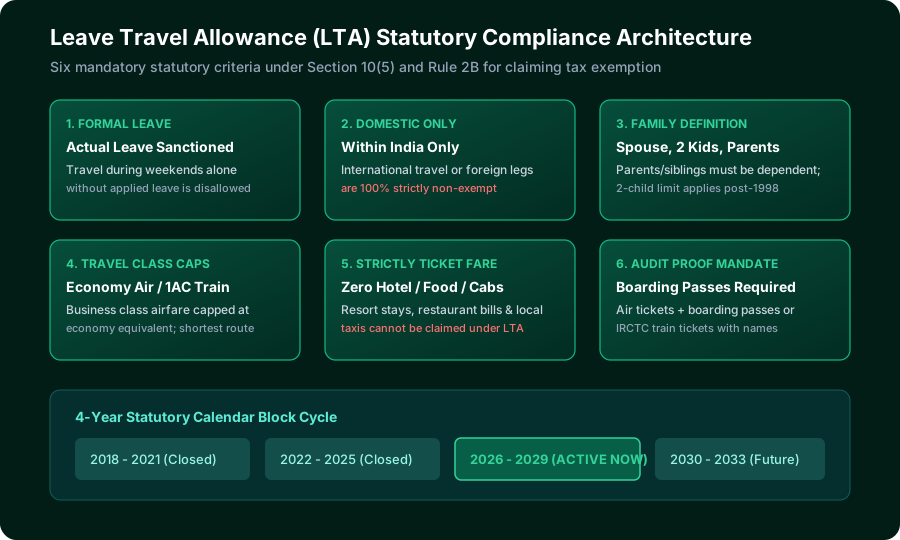
To ensure your LTA claim clears payroll verification and survives Income Tax Department scrutiny, you must fulfill each of the following six statutory parameters:
- Formal Leave Approval: You must apply for and receive formal sanctioned annual or earned leave from your employer covering the exact travel dates. Travel on weekends or gazetted holidays alone without approved leave is ineligible.
- Sovereign Domestic Boundaries: The journey must take place entirely within India. If an itinerary includes a foreign stopover (e.g., flying from Chennai to Port Blair via Colombo), the entire journey is tainted and loses tax exemption.
- Passenger Alignment: The tickets must be booked in the names of eligible family members. The employee themselves must be part of the traveling party (or family members traveling to join the employee).
- Economy Airfare Benchmark: Air travel claims are evaluated strictly against prevailing domestic economy class rates.
- Zero Anomaly Documentation: Retain all original physical or digital boarding passes. In tax scrutiny assessments, flight tickets alone without corresponding boarding passes are routinely disallowed by Assessing Officers.
- Monetary Limit: Exemption is limited to the actual fare paid or the LTA component specified in your CTC structure, whichever is lower.
7. Definition of "Family" & The Two-Child Restriction
Under the Explanation to Section 10(5), "family" in relation to an individual is defined with statutory precision:
Always Eligible Family Members
- • The individual employee
- • The employee's legal spouse (whether working or non-working)
- • Children of the employee (subject to the 2-child rule)
Eligible ONLY If Wholly / Mainly Dependent
- • Parents (father and mother)
- • Brothers and sisters
- • Note: If parents or siblings have independent taxable income or pensions, their travel fares cannot be claimed!
The 2-Child Restriction Rule
For children born on or after 1st October 1998, the exemption is restricted to a maximum of two surviving children. However, there is an explicit legislative exception: if the first birth resulted in a single child and the second birth resulted in twins or multiple births, the exemption is legally extended to all three children. Conversely, if twins were born first, a subsequent child does not qualify for exemption.
8. Disallowed Non-Fare Expenses: Hotels, Food & Cabs
One of the most persistent misunderstandings in executive taxation is assuming that an "All-Inclusive Holiday Package" booked via MakeMyTrip, Thomas Cook, or Club Mahindra can be claimed under LTA.
Under Rule 2B, the exemption is strictly and exclusively confined to the passenger fare of transit. The following expenses are 100% DISALLOWED by law:
- Hotel & Resort Accommodations: Room tariffs, luxury villas, homestays, and spa charges cannot be deducted under LTA.
- Food & Dining: Restaurant bills, room service, buffet breakfasts, and in-flight catering paid separately.
- Local Sightseeing & Intraday Cabs: Hired rental cars, local Uber/Ola rides for city touring, cable car passes, or boat cruises.
- Travel Agency Service Fees: Processing surcharges, travel insurance premiums, or sightseeing tour guides.
If you purchase a packaged holiday invoice that lists a lump-sum amount (e.g., "₹1,20,000 for 5-Day Kerala Holiday Package") without itemizing the exact airline ticket PNR and airfare breakdown, your employer's finance department is legally obligated to reject the entire claim!
9. Impact Under New Tax Regime vs Old Tax Regime
The choice between the New and Old Tax Regimes fundamentally dictates whether LTA holds any financial value for you:
| Parameter | Old Tax Regime | New Tax Regime (Section 115BAC) |
|---|---|---|
| Section 10(5) Exemption | Fully Available (Up to 2 trips per block) | 100% ABOLISHED (Zero Exemption) |
| Tax Treatment of LTA Received | Exempt to the extent of qualifying fares | Added directly to taxable "Income from Salaries" |
| Proof Submission Mandate | Mandatory boarding passes & tickets | None required (treated as plain cash) |
If you have permanently migrated to the New Tax Regime to benefit from lower marginal tax rates and the enhanced ₹75,000 standard deduction, you do not need to collect boarding passes or submit travel proofs. LTA will simply be paid to you as regular taxable salary, and no exemption can be claimed.
10. Audit Verification Matrix: Allowed vs. Disallowed
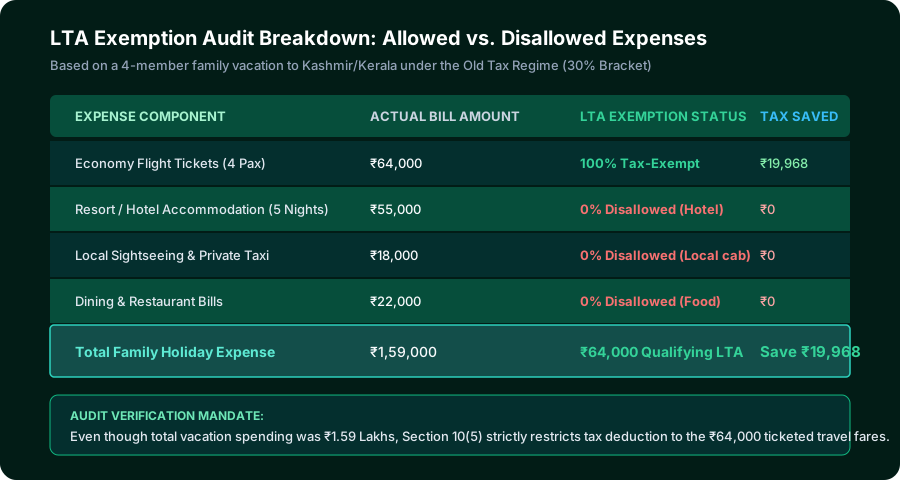
The chart above highlights an authentic vacation breakdown for an executive earning ₹28 LPA in the 30% slab who took a 5-day holiday with a spouse and two children:
- Total Family Travel Expenditure: ₹1,59,000
- Disallowed non-fare elements: Hotel (₹55,000) + Local Sightseeing Cabs (₹18,000) + Dining (₹22,000) = ₹95,000 (Non-Exempt)
- Eligible Economy Airfare: ₹64,000 (100% Tax-Exempt under Section 10(5))
- Direct Income Tax Saved (30% + 4% Cess): ₹19,968
11. Practical Case Study: ₹70,000 Family Flight Exemption
Let us examine Rahul, a Vice President in Hyderabad whose CTC structure includes an annual LTA component of ₹80,000.
In May 2026, Rahul takes sanctioned annual leave and flies with his spouse and mother (who is financially dependent on Rahul) from Hyderabad to Srinagar (Jammu & Kashmir).
12. Frequently Asked Questions (Direct Tax FAQs)
Can husband and wife both claim LTA for different journeys? ▼
Yes. If both spouses are salaried individuals receiving LTA from their respective employers, each spouse can independently claim exemption for two journeys in the same 4-year block. However, both cannot claim exemption for the exact same ticket expenses for the same family journey; the same ticket cannot be double-claimed.
What happens if I travel to an international destination? ▼
International travel is completely disqualified under Section 10(5). Even if you fly from Delhi to Dubai or Mumbai to Singapore, you cannot claim exemption for the domestic leg of the journey if the ultimate destination is outside India.
Can I claim LTA if I travel alone without my family? ▼
Yes. An employee can travel alone on sanctioned leave and claim LTA exemption for their own individual passenger ticket.
Are tatkal or dynamic surge rail/air fares permitted under LTA? ▼
Yes. The actual fare paid for an Economy flight or IRCTC AC 1st Class ticket—including dynamic pricing or Tatkal booking surcharges printed directly on the travel ticket—is fully eligible for exemption.