Food Coupons & Meal Allowance Tax Exemption: ₹50 Per Meal Tax Rules, Sodexo Cards & Regime Strategy
From Pluxee (formerly Sodexo) and Zeta digital meal cards to free office cafeteria lunches and cash meal allowances, learn the precise statutory rules governing meal perquisites under Rule 3(7)(iii), the ₹26,400 annual tax-free threshold, and why switching to the New Tax Regime requires an urgent salary restructure for Assessment Year 2027-28 (Financial Year 2026-27).
§ Table of Contents
- 1. Statutory Architecture: Section 17(2) & Rule 3(7)(iii)
- 2. The ₹50 Per Meal Threshold: Mathematical Mechanics
- 3. The Standard ₹26,400 Annual Tax-Free Limit Explained
- 4. Cash Meal Allowance vs. Electronic Meal Cards (Pluxee/Sodexo)
- 5. Statutory Decision Architecture Flowchart
- 6. The Big Trap: Food Coupons Under the New Tax Regime
- 7. Office Canteen Food, Working Tea & Light Snacks
- 8. Remote Worksites & Offshore Oil Rig Exemption
- 9. Bracket-by-Bracket Net Take-Home Impact
- 10. Practical Payroll Case Study: Restructuring a ₹15 LPA CTC
- 11. Frequently Asked Questions (Direct Tax FAQs)
1. Statutory Architecture: Section 17(2) & Rule 3(7)(iii)
Under Section 17(2)(viii) of the Income-tax Act, 1961, any other fringe benefit or amenity provided by an employer to an employee is treated as a taxable perquisite. To regulate corporate dining perks, food allowances, and prepaid meal vouchers, the Central Board of Direct Taxes (CBDT) codified Rule 3(7)(iii) of the Income Tax Rules, 1962.
The fundamental legislative objective behind Rule 3(7)(iii) was to encourage employers to nourish their workforce during active working hours without burdening employees with income tax on sustenance meals. When companies provide free dining in workplace canteens or issue prepaid electronic vouchers usable strictly at grocery stores, bakeries, supermarkets, and restaurants, the tax law grants an explicit partial or total tax exemption.
However, with corporate salary structures aggressively optimizing every component of the Cost-to-Company (CTC), food card benefits have evolved into a staple flexi-benefit basket item for millions of Indian salaried employees in the IT, consulting, banking, and manufacturing sectors.
2. The ₹50 Per Meal Threshold: Mathematical Mechanics
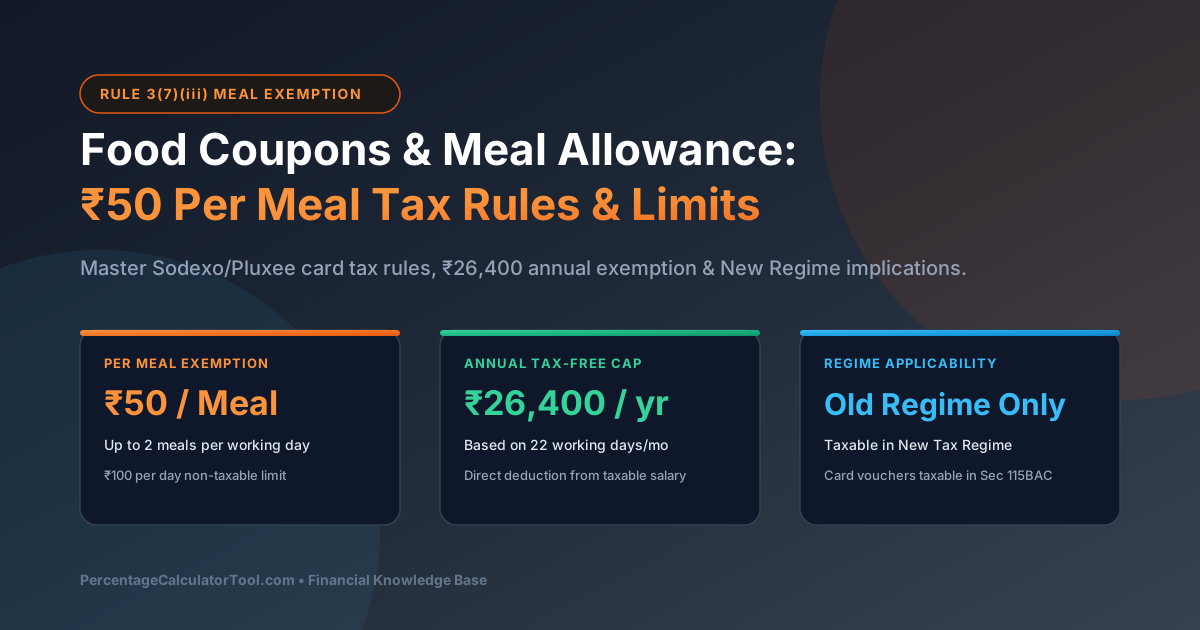
The statutory core of Rule 3(7)(iii) provides that free food and non-alcoholic beverages provided by an employer through paid non-transferable vouchers usable only at eating joints is exempt up to ₹50 per meal.
While the ₹50 statutory rate has not been updated by the Ministry of Finance for over two decades—leading many critics to argue that finding a wholesome meal for ₹50 in modern Mumbai, Bengaluru, or Delhi is nearly impossible—the administrative tax interpretation remains generous regarding meal counts.
Under standard corporate employment contracts, a typical full-time workday spans 8 to 9 hours. Tax authorities recognize that an employee requires at least two meals / nourishment sessions during a full working shift (e.g., lunch plus an evening tea/snack meal).
Standard Daily Exemption Formula:
Daily Exemption = ₹50 per meal × 2 meals per working day
= ₹100 per working day (Tax-Exempt)
3. The Standard ₹26,400 Annual Tax-Free Limit Explained
How does the ₹100 daily exemption translate into annual payroll calculations? Corporate payroll systems operate on standardized working calendars:
- 5-Day Work Week (Standard Corporate / IT): Approximately 22 working days per month (excluding Saturdays, Sundays, and public holidays). 22 days × ₹100 = ₹2,200 per month. Over 12 calendar months, this yields an annual tax exemption of exactly ₹26,400.
- 6-Day Work Week (Manufacturing / Operations): Approximately 26 working days per month. 26 days × ₹100 = ₹2,600 per month, yielding an annual tax exemption of ₹31,200.
Because the vast majority of corporate employers enforce a 5-day work week, the figure of ₹2,200 per month or ₹26,400 per year has become the near-universal standard allocation loaded onto corporate employee food cards across India.
4. Cash Meal Allowance vs. Electronic Meal Cards (Pluxee/Sodexo)
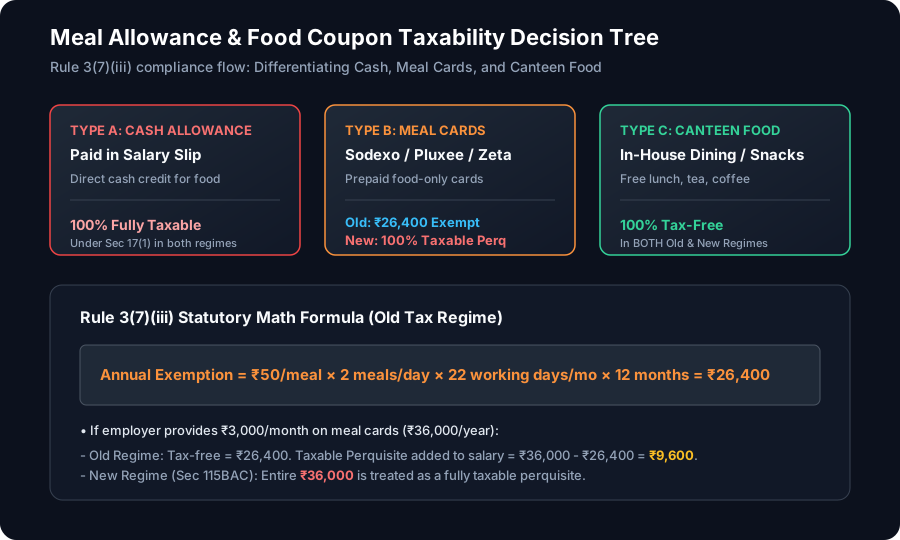
A dangerous misconception among salaried taxpayers is believing that any line item labeled "Food Allowance" or "Meal Reimbursement" on their monthly pay slip is tax-exempt. The statutory language of Rule 3(7)(iii) imposes a strict delivery requirement:
Direct Cash in Monthly Pay Slip
If your employer pays you ₹2,200 or ₹3,000 as a cash allowance credited into your salary savings account alongside your base pay, it is 100% FULLY TAXABLE under Section 17(1). Cash allowances do not qualify for any exemption under Rule 3(7)(iii), regardless of whether you spent the money on food or groceries.
Digital Cards (Pluxee, Sodexo, Zeta)
When the employer loads pre-tax funds onto a designated, non-transferable prepaid meal card (or digital wallet) programmed with Merchant Category Codes (MCC) restricted solely to food outlets, supermarkets, and restaurants, it qualifies for the ₹50/meal exemption under the Old Tax Regime.
5. Statutory Decision Architecture Flowchart
To determine whether your meal perk provides genuine tax savings, evaluate these three statutory checkpoints:
- Method of Provision: Is the nourishment provided in-kind (canteen food) or via an electronic card/voucher? If provided in direct cash, it is fully taxable immediately.
- Tax Regime Selected: Have you elected the Old Tax Regime or the default New Tax Regime (Section 115BAC)? If you chose the New Tax Regime, digital meal cards are 100% taxable!
- Monthly Threshold Compliance: Under the Old Tax Regime, any monthly voucher allocation exceeding ₹2,200 (for 22 working days) represents a taxable perquisite for the excess amount. For example, if ₹3,000/month is loaded, ₹2,200 is exempt and ₹800/month is added to taxable salary.
6. The Big Trap: Food Coupons Under the New Tax Regime
This is one of the most widespread payroll mistakes affecting Indian corporate employees following the overhaul of Section 115BAC.
When the government established the New Tax Regime as the default tax system, the Central Board of Direct Taxes amended the provisos to Rule 3(7)(iii). The amended rule explicitly dictates:
Critical Statutory Proviso to Rule 3(7)(iii)
"Provided that nothing contained in this sub-clause shall apply to the employee who has exercised an option under sub-section (5) of section 115BAC of the Act in respect of paid vouchers which are not transferable and usable only at eating joints."
What this means in plain English: If you file your income taxes under the New Tax Regime, you cannot claim the ₹50 per meal exemption on meal cards or vouchers! The entire ₹26,400 loaded onto your Sodexo or Pluxee card is treated as a 100% taxable perquisite under Section 17(2) and added right back into your taxable income on Form 16.
Actionable Takeaway: If you are enrolled in the New Tax Regime, having your employer deduct ₹2,200 each month from your salary to load a meal card provides ZERO tax advantage while unnecessarily locking your hard-earned money into restricted merchant-restricted cards. You should immediately opt out of the food coupon flexi-basket and take the amount as regular cash salary!
7. Office Canteen Food, Working Tea & Light Snacks
While digital food vouchers are disqualified under the New Tax Regime, there is a major statutory exception that remains 100% tax-free under BOTH the Old and New Tax Regimes:
1. Meals Served at Workplace / In-House Canteen
Free meals provided directly by the enterprise to employees during working hours at the company’s business premises or cafeteria remain completely non-taxable. Even if the buffet lunch costs the company ₹300 per plate, no perquisite is taxed on the employee.
2. Tea, Coffee & Office Working Snacks
Rule 3(7)(iii) unambiguously excludes tea, coffee, cold beverages, fruit baskets, biscuits, and light snacks provided during working hours from being classified as a perquisite. This benefit carries zero tax liability and has no statutory monetary ceiling.
8. Remote Worksites & Offshore Oil Rig Exemption
For specialized industries such as petroleum exploration, mining, highway infrastructure, and renewable energy installations, employees frequently work in harsh or remote conditions.
Under the first proviso to Rule 3(7)(iii), free food and non-alcoholic beverages provided by an employer in:
- A remote area (defined as any area located at least 40 kilometres away from a town with a population of 20,000 or more), OR
- An offshore installation (e.g., offshore oil platforms, drilling vessels in India's Exclusive Economic Zone)
is 100% tax-free without any monetary limit. In these designated zones, employers can provide full gourmet catering, residential messes, and imported provisions with zero perquisite taxation on workers.
9. Bracket-by-Bracket Net Take-Home Impact
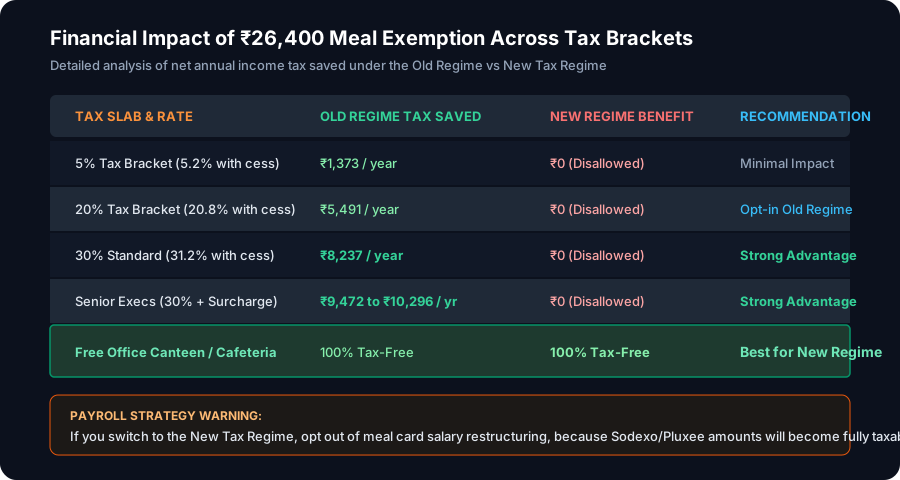
For individuals evaluating the Old Tax Regime, the ₹26,400 annual meal exemption delivers meaningful tax savings that directly increase disposable income:
| Marginal Slab Rate | Effective Rate (with 4% Cess) | Old Regime Tax Saved | New Regime Benefit |
|---|---|---|---|
| 5% Tax Bracket | 5.20% | ₹1,373 / year | ₹0 (Disallowed) |
| 20% Tax Bracket | 20.80% | ₹5,491 / year | ₹0 (Disallowed) |
| 30% Standard Bracket | 31.20% | ₹8,237 / year | ₹0 (Disallowed) |
| 30% + 10% Surcharge | 34.32% | ₹9,060 / year | ₹0 (Disallowed) |
| 30% + 15% Surcharge | 35.88% | ₹9,472 / year | ₹0 (Disallowed) |
10. Practical Payroll Case Study: Restructuring a ₹15 LPA CTC
Let us observe how Ananya, a Software Engineer in Pune earning a gross CTC of ₹15,00,000 per annum, handles her food allowance across both regimes:
Opts for ₹2,200/mo Pluxee Meal Card
- • Gross Salary: ₹15,00,000
- • Food Voucher Allocation: ₹26,400 (pre-tax cut)
- • Rule 3(7)(iii) Exemption: -₹26,400
- • Section 80C + 80D + HRA Deductions: -₹3,50,000
- • Standard Deduction: -₹50,000
- • Taxable Income: ₹10,73,600
- • Net Direct Tax Saved on Meals: ₹8,237
- • Result: Highly recommended to retain meal card.
Retaining Meal Card in New Regime
- • Gross Salary: ₹15,00,000
- • Food Voucher Allocation: ₹26,400
- • Rule 3(7)(iii) Exemption: ₹0 (Disallowed!)
- • Standard Deduction: -₹75,000
- • Form 16 Taxable Perquisite: +₹26,400 added back
- • Net Tax Saved: ₹0.00
- • Result: Money is restricted to food stores without any tax benefit. Ananya should opt out immediately!
11. Frequently Asked Questions (Direct Tax FAQs)
Can I use my meal card on food delivery apps like Swiggy and Zomato? ▼
Yes. Modern digital meal cards (such as Pluxee/Sodexo and Zeta) can be linked directly as payment instruments on food ordering apps (Swiggy, Zomato, Zepto Cafe, Blinkit Food) provided the items ordered fall within approved culinary grocery and food merchant category codes.
Can I encash unspent meal card balances at the end of the year? ▼
No. RBI prepaid payment instrument (PPI) regulations and direct tax rules strictly prohibit cash withdrawal or cash refunds from prepaid meal cards. The balance must be spent exclusively on food and groceries.
What happens to my food card if I resign from my company? ▼
Upon resignation, the employer ceases monthly card reloads. However, any existing funds previously loaded onto your KYC-compliant digital card remain valid until the card's stated expiration date.
Does meal voucher salary reduction affect EPF or Gratuity? ▼
No. In a standard corporate CTC structure, the ₹2,200 monthly meal card allocation is carved out of the "Special Allowance" or "Flexible Benefit Plan (FBP)" pool. It does not reduce your Basic Salary or Dearness Allowance, meaning your EPF contributions and future Gratuity entitlements remain 100% unaffected.