Professional Tax by State in India: Complete Slabs and Rate Charts
Why do corporate employees in Mumbai pay ₹200 a month with an unexpected ₹300 spike in February, while their peers in Gurgaon or Noida pay exactly zero? Explore the constitutional origins of Professional Tax, current state slabs for FY 2026-27, and Section 16(iii) deduction rules.
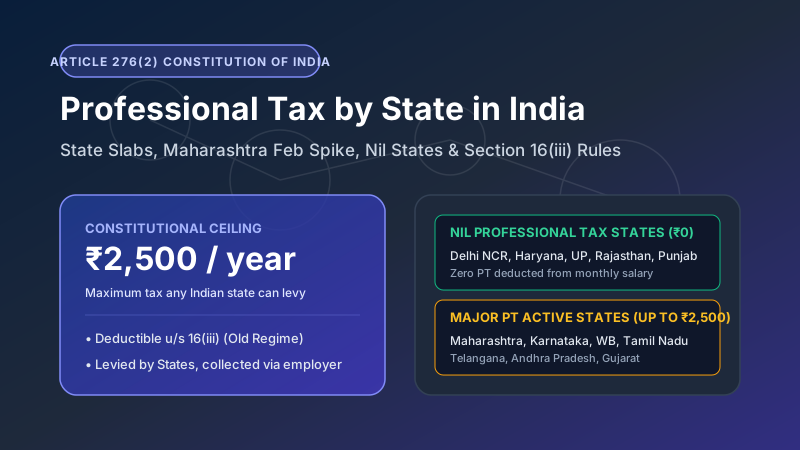
Table of Contents
- 1. What is Professional Tax? The Constitutional Framework (Article 276)
- 2. States and Union Territories with NIL Professional Tax
- 3. Detailed Rate Charts for Major Indian States
- 4. The Maharashtra Mystery: Why ₹300 is Deducted in February
- 5. Visual Comparison: State-by-State Professional Tax Chart
- 6. Comprehensive 28-State Professional Tax Reference Table
- 7. Income Tax Deductibility: Section 16(iii) in Old vs New Tax Regime
- 8. Employer Responsibilities: PTRC vs PTEC and Non-Compliance Penalties
- 9. Frequently Asked Questions (FAQ)
1. What is Professional Tax? The Constitutional Framework (Article 276)
Despite its name, Professional Tax (PT) is not a tax levied exclusively on doctors, chartered accountants, or lawyers. It is a direct tax levied by state governments on anyone earning an income from a salary, profession, trade, calling, or employment.
Under the Seventh Schedule of the Constitution of India, taxation powers are divided between the Union and the States. While taxes on income (other than agricultural income) belong to the Central Government under Entry 82 of List I (Union List), Entry 60 of List II (State List) empowers State Legislatures to levy "taxes on professions, trades, callings and employments".
The ₹2,500 Constitutional Upper Ceiling
To ensure that state governments do not impose excessive levies that encroach upon central income taxation, Article 276(2) of the Constitution places an absolute cap on the total amount of professional tax that can be demanded from any single individual:
Article 276(2) Maximum Limit = ₹2,500 per person per financial year
This limit was originally ₹250 when the Constitution was drafted in 1950, and was subsequently raised to ₹2,500 in 1988 via the Sixtieth Constitutional Amendment. Because constitutional amendments require special parliamentary majorities, this cap has remained unchanged for nearly four decades.
2. States and Union Territories with NIL Professional Tax
Because Entry 60 is an enabling power rather than a constitutional obligation, several Indian states choose not to levy any Professional Tax whatsoever. In these jurisdictions, employees enjoy 100% of their earnings without this state-level payroll friction:
Delhi National Capital Region
The Government of NCT of Delhi does not levy professional tax. Tech and corporate workers in Delhi pay ₹0 PT.
Haryana (Gurgaon / Manesar)
Despite being India's premier corporate millennium hub, Haryana levies zero professional tax on salaried employees.
Uttar Pradesh (Noida / Greater Noida)
Uttar Pradesh has no active professional tax enactment. Corporate professionals in Noida pay zero PT.
Other Prominent Nil States
Rajasthan, Punjab, Himachal Pradesh, Uttarakhand, Chandigarh, Goa, Arunachal Pradesh, and Jammu & Kashmir.
3. Detailed Rate Charts for Major Indian States
In states where Professional Tax is enforced, the rates and slab structures are determined by individual state acts. Below is the verified operational breakdown for key economic hubs:
Karnataka (Bengaluru Tech Corridor)
Governed by the Karnataka Tax on Professions, Trades, Callings and Employments Act, 1976:
- Gross Monthly Salary < ₹25,000: NIL (₹0)
- Gross Monthly Salary ≥ ₹25,000: ₹200 per month
- Annual Total: ₹2,400 per year
West Bengal (Kolkata Hub)
Governed by the West Bengal State Tax on Professions Act, 1979 with progressive monthly tiers:
- Monthly Gross ≤ ₹10,000: NIL
- ₹10,001 to ₹15,000: ₹110 per month
- ₹15,001 to ₹20,000: ₹130 per month
- ₹20,001 to ₹40,000: ₹150 per month
- Monthly Gross > ₹40,000: ₹200 per month (₹2,400 per year)
Telangana and Andhra Pradesh (Hyderabad & Amaravati)
Both states share an identical historical legislative foundation:
- Monthly Gross ≤ ₹15,000: NIL
- ₹15,001 to ₹20,000: ₹150 per month
- Monthly Gross > ₹20,000: ₹200 per month (₹2,400 per year)
Tamil Nadu (Chennai Industrial & IT Hub)
Tamil Nadu administers professional tax through local municipal corporations on a half-yearly basis (deducted in September and March):
- Average Monthly Gross > ₹75,000: ₹1,250 every 6 months (₹2,500 per year)
- Lower salary brackets pay between ₹168 to ₹1,025 half-yearly.
4. The Maharashtra Mystery: Why ₹300 is Deducted in February
If you work in Mumbai, Pune, or Nagpur, examining your salary slip in February will reveal a curious phenomenon: your normal ₹200 professional tax deduction jumps by 50% to ₹300.
This occurs because the Maharashtra State Tax on Professions, Trades, Callings and Employments Act, 1975 is engineered to collect the exact constitutional maximum ceiling of ₹2,500 per year:
- April to January (10 months):
10 × ₹200 = ₹2,000 - February (1 month):
1 × ₹300 = ₹300 - March (1 month):
1 × ₹200 = ₹200 - Total Annual Deduction:
₹2,000 + ₹300 + ₹200 = ₹2,500
Gender Exemption in Maharashtra: Female employees earning a gross salary up to ₹25,000 per month are completely exempt from professional tax in Maharashtra. Only women earning above ₹25,000 per month pay the standard ₹200/₹300 deduction.
5. Visual Comparison: State-by-State Professional Tax Chart
The comparative chart below outlines the monthly schedules and annual maximum thresholds across leading Indian commercial states:

6. Comprehensive 28-State Professional Tax Reference Table
Keep this authoritative reference table handy to determine your statutory liability when relocating across state borders:
| State / UT | Exemption Threshold | Highest Monthly Slab | Annual Maximum | Key Statutory Nuance |
|---|---|---|---|---|
| Maharashtra | ≤ ₹7,500 (Men) / ≤ ₹25,000 (Women) | ₹200 (₹300 in Feb) | ₹2,500 | Women earning ≤ ₹25k pay zero |
| Karnataka | < ₹25,000 / month | ₹200 | ₹2,400 | Uniform ₹200 across all 12 months |
| West Bengal | ≤ ₹10,000 / month | ₹200 (> ₹40k) | ₹2,400 | Five progressive monthly tiers |
| Tamil Nadu | ≤ ₹21,000 / half-year | ₹1,250 (half-yearly) | ₹2,500 | Collected semi-annually in Sep/Mar |
| Telangana & AP | ≤ ₹15,000 / month | ₹200 (> ₹20k) | ₹2,400 | ₹15k - 20k bracket pays ₹150/mo |
| Gujarat | ≤ ₹12,000 / month | ₹200 (> ₹12k) | ₹2,400 | Revised in recent budget relief |
| Delhi, Haryana, UP | 100% Exempt | ₹0 (NIL) | ₹0 | Zero professional tax enacted |
7. Income Tax Deductibility: Section 16(iii) in Old vs New Tax Regime
Under the Indian Income Tax Act, Section 16 allows three standard deductions from "Salaries":
- Section 16(ia): Standard Deduction (₹75,000 in New Regime / ₹50,000 in Old Regime).
- Section 16(ii): Entertainment Allowance (government employees only).
- Section 16(iii): Tax on Employment (Professional Tax paid).
Crucial Distinction for FY 2026-27:
Under the Old Tax Regime: Professional Tax is 100% deductible from your gross salary on actual payment basis. If you paid ₹2,500 in Maharashtra, your taxable income is reduced by ₹2,500.
Under the New Tax Regime (Section 115BAC): The Section 16(iii) deduction is strictly disallowed. Only the ₹75,000 standard deduction is permitted. Therefore, under the New Regime, paying professional tax gives you zero tax deduction.
8. Employer Responsibilities: PTRC vs PTEC and Non-Compliance Penalties
For employers and startups setting up payroll operations in India, professional tax compliance requires two distinct certificates:
PTEC (Professional Tax Enrolment Certificate)
PTEC is mandatory for the business itself (private limited companies, LLPs, proprietorships) and its designated partners or directors. The entity pays annual professional tax (usually ₹2,500) to the state government simply for holding the legal right to practice business.
PTRC (Professional Tax Registration Certificate)
PTRC is mandatory for any employer with staff on payroll. It authorizes the company to deduct the appropriate state slab from each employee's monthly pay and remit the accumulated funds to the state treasury before the monthly due date (typically by the 20th or last day of the following month).
Penalties for Default
Failing to deduct or remit professional tax attracts severe commercial penalties under state enactments. In Maharashtra, for instance, delay in remittance attracts simple interest at 1.25% per month plus a statutory penalty of 10% to 25% of the unpaid tax, and failure to obtain PTRC attracts a penalty of ₹5 per day of continued default.
Frequently Asked Questions (FAQ)
What is the maximum Professional Tax that any Indian state can levy?
Under Article 276(2) of the Constitution of India, the maximum professional tax that any state government or municipal authority can legally levy on an individual is strictly capped at ₹2,500 per financial year.
Why is ₹300 deducted as Professional Tax in Maharashtra in the month of February?
In Maharashtra, the standard monthly professional tax deduction for male employees earning over ₹10,000 is ₹200 per month from April to January (10 months × ₹200 = ₹2,000). To reach the constitutional maximum limit of exactly ₹2,500 per year, the state levies ₹300 in the month of February (₹2,000 + ₹300 + ₹200 in March = ₹2,500).
Which Indian states do not levy any Professional Tax?
Several prominent Indian states and Union Territories levy zero (NIL) Professional Tax on salaried employees and professionals. These include Delhi, Haryana (Gurgaon/Faridabad), Uttar Pradesh (Noida/Lucknow), Rajasthan, Punjab, Himachal Pradesh, Uttarakhand, Goa, and Jammu & Kashmir.
Is Professional Tax deductible under the New Tax Regime?
No. Under the New Tax Regime (Section 115BAC), only the standard deduction under Section 16(ia) of ₹75,000 is permitted. The deduction for Professional Tax under Section 16(iii) is not allowed. In contrast, under the Old Tax Regime, professional tax paid is fully deductible from gross salary in addition to the ₹50,000 standard deduction.
What is the difference between PTRC and PTEC in professional tax compliance?
PTEC (Professional Tax Enrolment Certificate) is obtained by the business entity, directors, or self-employed practitioners to pay tax on their own trade or profession. PTRC (Professional Tax Registration Certificate) is obtained by the employer to deduct professional tax from their employees' salaries and remit it to the state commercial tax department.
Free Salary & Tax Calculators
Calculate your net take-home pay with exact state-specific professional tax and income tax slabs:
Related Salary & Tax Guides
About PercentageCalculatorTool Editorial Team
Our state tax compliance desk monitors legislative gazettes across all 28 states and 8 union territories. We track revisions to Professional Tax schedules, municipal levies, and CBDT circulars to provide Indian employees and employers with verified payroll data.