How to Calculate a Salary Hike Percentage Correctly
Your annual appraisal letter arrives stating you were awarded a "20% hike", but when next month's salary hits your bank account, your take-home cash barely crept up by 8%. What happened? Learn how to calculate hikes accurately, expose CTC padding, avoid tax bracket creep, and negotiate for real in-hand wealth.

Table of Contents
- 1. The Core Formula for Calculating Salary Hike Percentage
- 2. The CTC Illusion: Fixed Base vs Variable CTC
- 3. Case Study: Where Did the 25% Hike Disappear?
- 4. Tax Bracket Creep: Why Higher Pay Pushes You Into 15% and 20% Slabs
- 5. Nominal Hike vs Real Hike: Factoring in Inflation
- 6. Job Switch Tricks: One-Time Joining Bonuses and Paper ESOPs
- 7. Complete Before-and-After Salary Slip Comparison Table
- 8. Strategic Negotiation Playbook for Annual Appraisals
- 9. Frequently Asked Questions (FAQ)
1. The Core Formula for Calculating Salary Hike Percentage
At its mathematical foundation, calculating a salary hike percentage is an application of the standard percentage increase formula. You take the absolute monetary difference between your new compensation and old compensation, divide it by the original baseline, and multiply by 100:
Alternatively: Hike (%) = [ (New Salary ÷ Old Salary) - 1 ] × 100
Step-by-Step Numerical Example
Suppose your annual fixed salary in your previous fiscal cycle was ₹8,00,000, and your employer awards an appraisal elevating your annual fixed salary to ₹9,60,000:
- Subtract the old salary from the new salary:
₹9,60,000 - ₹8,00,000 = ₹1,60,000(Absolute Hike). - Divide the increment by your old starting baseline:
₹1,60,000 ÷ ₹8,00,000 = 0.20. - Multiply by 100 to convert to a percentage:
0.20 × 100 = 20.0% Hike.
While this basic arithmetic is simple, the true corporate dilemma lies in what specific numbers you plug into the equation.
2. The CTC Illusion: Fixed Base vs Variable CTC
In corporate India, employers rarely speak in terms of net take-home salary. Every discussion centers around Cost to Company (CTC).
Cost to Company is not what you earn. CTC is the aggregate accounting expenditure that an employer incurs to keep you on their rolls for one financial year. When HR announces an appraisal, they almost invariably quote the hike percentage on Total CTC, which bundles three completely different categories of money:
1. Guaranteed Fixed Pay
Basic Salary, HRA, and Special Allowance. This is the only portion that guarantees a monthly credit to your bank account.
2. Performance Variable Pay
Discretionary annual bonuses tied to company profitability and individual bell-curve ratings. Often paid at only 60-80% of target.
3. Statutory & Non-Cash Benefits
Employer EPF matching (12%), gratuity accrual (4.81% of basic), and group medical insurance premiums. You never touch this monthly.
The Classic Corporate Appraisal Trick: To make an appraisal look generous without inflating recurring payroll commitments, an employer may increase your variable pay pool from 10% to 25% of CTC. On paper, you receive a flashy "20% CTC hike", but your guaranteed monthly fixed pay remains almost identical!
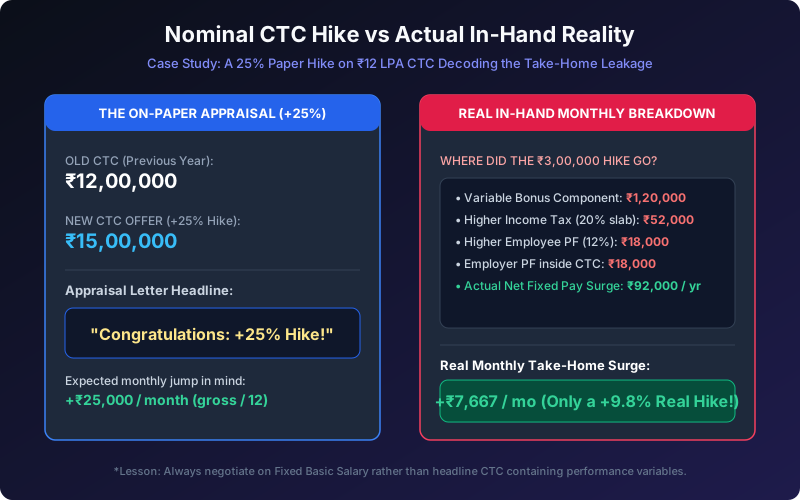
3. Case Study: Where Did the 25% Hike Disappear?
The flowchart below dissects a real-life ₹12 LPA to ₹15 LPA appraisal (+25% CTC hike), showing where the ₹3,00,000 increment actually leaks away before reaching the bank:
4. Tax Bracket Creep: Why Higher Pay Pushes You Into 15% and 20% Slabs
In a progressive tax system like India's, as your taxable income expands, the incremental rupees you earn are taxed at progressively higher marginal rates. This phenomenon is known as tax bracket creep.
Under the revised New Tax Regime (Section 115BAC for FY 2026-27), observe the slab thresholds:
- ₹0 to ₹3,00,000: NIL (0%)
- ₹3,00,001 to ₹7,00,000: 5%
- ₹7,00,001 to ₹10,00,000: 10%
- ₹10,00,001 to ₹12,00,000: 15%
- ₹12,00,001 to ₹15,00,000: 20%
- Above ₹15,00,000: 30% (plus 4% Health & Education Cess)
If your CTC rises from ₹11 Lakh to ₹14 Lakh, that incremental ₹3,00,000 does not experience an average 7% or 8% tax rate. Because your lower slabs are already saturated, the entire ₹3,00,000 increment is taxed at 15% and 20% plus 4% cess, instantly siphoning over ₹50,000 to the income tax department!
5. Nominal Hike vs Real Hike: Factoring in Inflation
A crucial error salaried workers make is confusing nominal income with real purchasing power.
If your grocery basket, school fees, rent, fuel, and healthcare costs increase by 6% over the year, receiving a 6% salary hike means your standard of living has stayed exactly the same. You are simply running faster to stay in the exact same economic place.
Real Salary Hike (%) ≈ Nominal Salary Hike (%) - CPI Inflation Rate (%)
For instance, if your company awards a modest 7% appraisal hike during a period when urban retail inflation runs at 5.5%, your real salary growth is barely 1.5%. If your employer awards a 4% increment, you have effectively received a -1.5% real-terms pay cut.
6. Job Switch Tricks: One-Time Joining Bonuses and Paper ESOPs
When switching companies, recruitment consultants frequently pitch headline numbers like: "We are offering you a 45% hike on your current CTC!"
Before signing an offer letter, scrutinize the compensation structure for these three deceptive packaging techniques:
- The One-Time Joining Bonus Trap: A company offers you a ₹2,00,000 joining bonus paid with your first salary, but adds it to your "Year 1 CTC". In Year 2, that bonus does not recur. If your base pay did not increase significantly, your Year 2 compensation will drop.
- The Clawback Clause: Most joining bonuses come with a mandatory 12 to 24 month clawback agreement. If you resign before completing that tenure, you must return 100% of the gross bonus amount (even though tax was already deducted).
- Unvested Paper ESOPs: Many startups include employee stock option grants valued at ₹5 Lakh per year inside the CTC headline. ESOPs typically vest over 4 years with a 1-year cliff and cannot be liquidated until a secondary sale or IPO occurs. Never treat illiquid stock options as equivalent to guaranteed fixed cash.
7. Complete Before-and-After Salary Slip Comparison Table
Examine this side-by-side comparison of an Indian software engineer transitioning from ₹10 LPA CTC to ₹13 LPA CTC (a 30% CTC Hike) under the New Tax Regime:
| Salary Slip Component | Old Salary (₹10 LPA) | New Salary (₹13 LPA) | Absolute Change | Effective Hike (%) |
|---|---|---|---|---|
| Monthly Basic Salary (40%) | ₹33,333 | ₹43,333 | +₹10,000 | +30.0% |
| Monthly HRA (20%) | ₹16,667 | ₹21,667 | +₹5,000 | +30.0% |
| Special Allowance & Other | ₹25,333 | ₹31,667 | +₹6,334 | +25.0% |
| Employee EPF (12% Basic) | ₹4,000 | ₹5,200 | +₹1,200 (Deduction) | +30.0% |
| Professional Tax | ₹200 | ₹200 | ₹0 | 0.0% |
| Monthly Income Tax (TDS) | ₹3,900 | ₹7,800 | +₹3,900 (Tax Surge) | +100.0% |
| Net Monthly In-Hand Cash | ₹67,233 | ₹83,467 | +₹16,234 / mo | +24.1% Real Take-Home |
Notice the reality: While the headline CTC hike was 30%, higher marginal income tax (doubling from ₹3,900 to ₹7,800/month) and mandatory EPF deductions brought the actual monthly cash increment down to 24.1%.
8. Strategic Negotiation Playbook for Annual Appraisals
To ensure your appraisal translates into tangible wealth rather than HR buzzwords, deploy these three negotiation tactics:
1. Anchor the Negotiation on Guaranteed Base Salary
When entering compensation discussions, specify your expectations in terms of Fixed Gross Pay. For example, state: "My target is to increase my fixed compensation from ₹12 Lakh to ₹15 Lakh. I am happy to discuss performance variable bonuses on top of this fixed baseline." This prevents management from artificially inflating your offer with conditional bonuses.
2. Restructure Allowances to Maximize In-Hand
If your company operates under capped EPF (₹1,800/month), you can legally request that your basic salary be optimized to maximize take-home cash while keeping statutory deductions predictable. Requesting reimbursements (fuel, telephone, broadband, book grants) can also reduce your taxable income under specific employment conditions.
3. Use Written Quantification of Impact
Never justify a salary hike request based on personal expenses, inflation, or home loan EMIs. Companies award above-average hikes (20%+) to employees who clearly document how their projects reduced costs, generated direct revenue, or prevented operational downtime over the preceding 12 months.
Frequently Asked Questions (FAQ)
What is the mathematical formula to calculate a salary hike percentage?
The salary hike percentage formula is: Hike (%) = [ (New Salary - Old Salary) ÷ Old Salary ] × 100. For instance, if your annual fixed compensation increases from ₹10,00,000 to ₹12,50,000, your hike is: [ (12,50,000 - 10,00,000) ÷ 10,00,000 ] × 100 = +25%.
Why is my monthly in-hand increase lower than the appraisal letter percentage?
Appraisal letters calculate hikes on total Cost to Company (CTC), which frequently lumps in variable bonuses, employer EPF matching, and gratuity accruals. Furthermore, higher gross pay pushes portions of your earnings into higher tax brackets (e.g., jumping from 10% to 15% or 20%), while higher basic salary triggers higher mandatory employee EPF deductions.
Should I negotiate salary hikes on CTC or Fixed Base Salary?
Always negotiate on Fixed Base Salary. CTC is an accounting construct that companies can inflate with discretionary performance bonuses, group health insurance premiums, and non-cash perks. Fixed salary guarantees higher predictable monthly cash flow and directly boosts statutory retirement benefits like EPF and gratuity.
How does inflation affect the real value of an appraisal hike?
Your real hike is your nominal percentage hike minus the prevailing Consumer Price Index (CPI) inflation rate. If your employer awards an 8% salary hike while retail inflation runs at 5.5%, your real purchasing power expands by only 2.5%. Any hike below the inflation rate is effectively a real-terms pay cut.
How do joining bonuses and ESOPs distort job switch hike percentages?
Companies often boast a '40% hike offer' by inserting a one-time joining bonus or multi-year vesting ESOP stock grants into Year 1 CTC. In Year 2, when the one-time bonus vanishes and stock vesting schedules stabilize, your recurring monthly cash compensation may actually remain flat or drop unless your recurring fixed base was substantial.
Free Salary & Appraisal Calculators
Estimate your exact monthly take-home salary and simulate appraisal scenarios with our verified calculators:
Related Salary & Career Guides
About PercentageCalculatorTool Editorial Team
Our payroll compensation researchers and corporate HR consultants provide transparent, mathematically sound guidance to Indian professionals navigating salary negotiations, appraisals, and career growth.