Section 80D Health Insurance Tax Deductions: Parents & Family Limits (FY 2026-27)
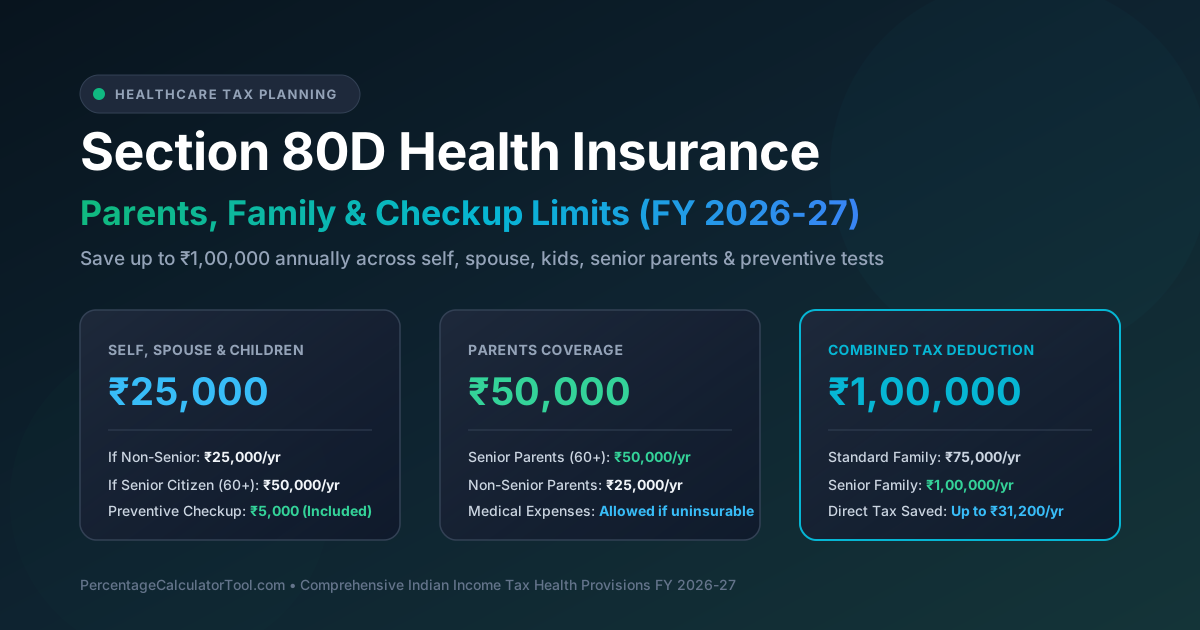
With private healthcare inflation in India galloping at 14% annually, securing adequate medical insurance coverage for your spouse, children, and aging parents is no longer an optional financial luxury—it is an existential necessity. A single major hospitalization in a tertiary metro hospital can easily erase five years of diligent family savings.
Recognizing the vital role private health insurance plays in safeguarding citizens against medical insolvency, Parliament created Section 80D of the Income Tax Act, 1961. Unlike Section 80C, which forces taxpayers to lock their money into long-term savings instruments like PPF or ELSS, Section 80D provides a pure, direct tax deduction on money spent on risk protection: health insurance premiums, central government health schemes (CGHS), preventive medical screenings, and even direct out-of-pocket medical bills for senior citizen parents.
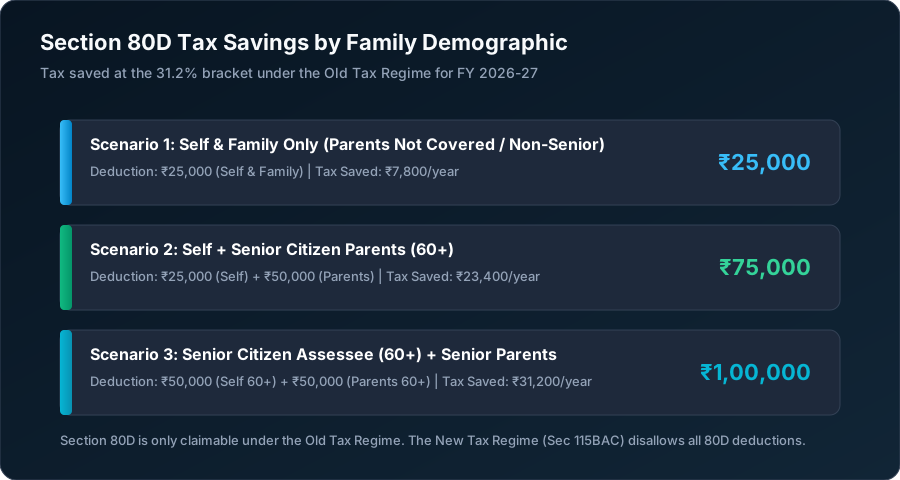
Under current statutory rules, a salaried employee can claim between ₹25,000 and ₹1,00,000 per financial year in Section 80D deductions. For professionals operating in the 30% tax bracket, this delivers up to ₹31,200 in direct tax refunds every year—effectively subsidizing nearly half the total cost of comprehensive family healthcare coverage.
In this guide, we provide a complete analysis of Section 80D for Financial Year 2026-27 (Assessment Year 2027-28). You will understand the exact deduction limits across all family demographics, explore the special medical expenditure relief for uninsured senior citizens, review the rules on multi-year policy amortization, and discover how to handle cash payments for preventive health checkups.
Table of Contents
- 1. Section 80D Demographic Limits: Self, Family & Parents
- 2. Preventive Health Checkup: The ₹5,000 Cash Exception
- 3. Medical Expenditure Deduction for Uninsurable Senior Parents
- 4. Multi-Year Health Policies: Proportionate Claim Rules
- 5. Permissible Payment Modes: The Strict Non-Cash Mandate
- 6. Section 80D in Old vs New Tax Regime (FY 2026-27)
- 7. Frequently Asked Questions (FAQ)
1. Section 80D Demographic Limits: Self, Family & Parents
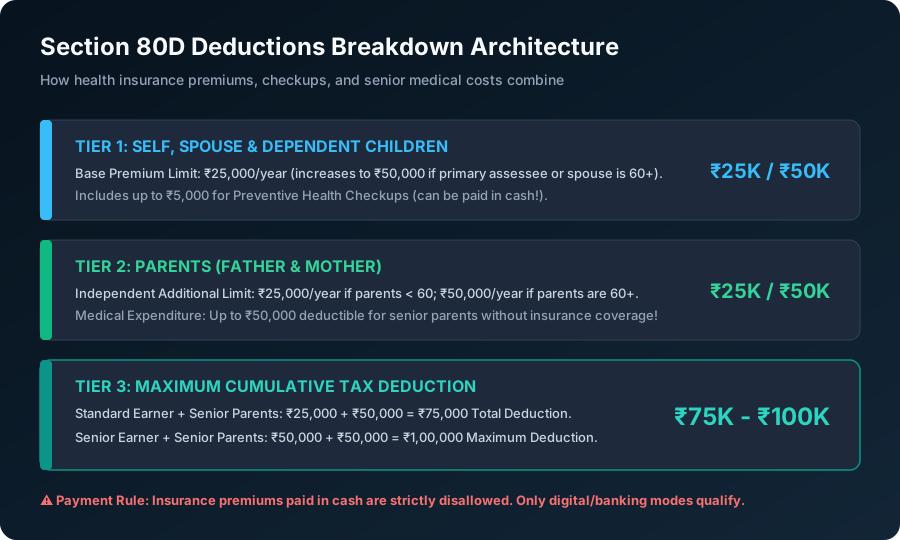
Section 80D splits health insurance deductions into two distinct, independent buckets: Bucket A (Self & Nuclear Family) and Bucket B (Parents). Crucially, the limits in Bucket B are completely separate from and additional to Bucket A.
| Family Demographic Profile | Self & Family (₹) | Parents (₹) | Total Deduction Limit (₹) |
|---|---|---|---|
| Self < 60 and Parents < 60 | ₹25,000 | ₹25,000 | ₹50,000 |
| Self < 60 and Parents ≥ 60 (Senior) | ₹25,000 | ₹50,000 | ₹75,000 |
| Self ≥ 60 (Senior) and Parents ≥ 60 | ₹50,000 | ₹50,000 | ₹1,00,000 |
| HUF (Hindu Undivided Family) | ₹25,000 (Non-Senior) | ₹50,000 (Senior Member) | ₹25,000 to ₹50,000 |
Who qualifies as family? For Section 80D, your family comprises you (the assessee), your spouse, and your dependent children. Independent, working children or married daughters cannot be covered under your Section 80D claim. On the parents' side, both father and mother can be claimed whether they are financially dependent on you or not!
2. Preventive Health Checkup: The ₹5,000 Cash Exception
Under Section 80D(2)(b), the Income Tax Act allows a deduction of up to ₹5,000 per financial year for expenses incurred on preventive health checkups.
Here are the critical operational rules you must know:
- Inside the Overall Cap: The ₹5,000 limit is not an additional deduction. It sits within the overall ₹25,000 or ₹50,000 limit of Section 80D. For example, if you pay ₹21,000 for medical insurance premium, you can claim an additional ₹4,000 for routine diagnostic blood tests, full-body scans, or dental exams.
- Cumulative Family Limit: The ₹5,000 threshold applies to the entire family combined (self, spouse, children, and parents). You cannot claim ₹5,000 for self and another ₹5,000 for parents.
- The Cash Exception: While health insurance premiums paid in cash are totally banned, preventive health checkup bills CAN legally be paid in cash. Retain the clinic receipt and diagnostic invoice as proof.
3. Medical Expenditure Deduction for Uninsurable Senior Parents
One of the most compassionate and under-utilized provisions in the Indian tax code is Section 80D(2)(c).
Many senior citizens aged 65 to 80 suffer from pre-existing chronic conditions (diabetes, cardiovascular disease, hypertension) that make obtaining comprehensive private medical insurance impossible, or result in exorbitant annual premiums with harsh waiting periods.
Claiming Direct Out-of-Pocket Medical Bills
If your senior citizen parent (age 60 or older) does not have any active health insurance policy, you can claim a direct tax deduction of up to ₹50,000 per financial year on actual medical expenditures incurred for their health.
Eligible Expenses Include: Doctor consultation fees, monthly prescription medicines, diagnostic lab tests, dialysis, chemotherapy, hearing aids, pacemaker checks, and surgical hospitalization bills. Maintain detailed invoices, medical prescriptions, and non-cash bank payment records.
4. Multi-Year Health Policies: Proportionate Claim Rules
General insurance companies frequently offer 5% to 15% discounts when policyholders pay health insurance premiums for 2 or 3 years in a single upfront lump sum.
Under Section 80D(4B), you cannot claim the entire multi-year premium in year one. Instead, the deduction must be apportioned proportionately across the duration of the policy:
Multi-Year Formula Example:
Suppose you purchase a 3-year family floater policy on May 1, 2026, paying a total single premium of ₹66,000.
- Annual Proportionate Deduction = Total Premium ÷ Policy Duration = ₹66,000 ÷ 3 years = ₹22,000 per year.
- You will claim ₹22,000 in FY 2026-27, ₹22,000 in FY 2027-28, and ₹22,000 in FY 2028-29.
- Because ₹22,000 is below the ₹25,000 annual ceiling, the entire amount is fully deductible each year.
5. Permissible Payment Modes: The Strict Non-Cash Mandate
Section 80D contains a strict statutory condition regarding payment modes:
| Expense Category | Cash Payment Allowed? | Approved Payment Modes |
|---|---|---|
| Health Insurance Premium | ❌ Strictly PROHIBITED | Net Banking, Credit/Debit Card, UPI, Cheque, Demand Draft |
| Senior Medical Expenditure (u/s 80D(2)(c)) | ❌ Strictly PROHIBITED | Any digital, card, or banking transaction |
| Preventive Health Checkup | ✔ 100% PERMITTED (Up to ₹5,000) | Cash, UPI, Card, Net Banking |
Crucial Tip: If you pay your health insurance premium in cash at an insurer’s branch, the tax deduction is permanently lost, even if the insurance company issues an official 80D certificate. Always pay electronically.
6. Section 80D in Old vs New Tax Regime (FY 2026-27)
Under the Revised New Tax Regime (Section 115BAC), Section 80D is completely unavailable. Does this mean you should abandon your health insurance? Absolutely not—health insurance is a medical risk management tool, not merely a tax shield.
However, if you are actively deciding whether to file your taxes under the Old or New Regime:
- A taxpayer with elderly parents claiming ₹75,000 under Section 80D, plus ₹1,50,000 under Section 80C, plus ₹2,00,000 under Section 24(b) home loan interest, accumulates ₹4,25,000 in itemized deductions.
- Adding the ₹50,000 standard deduction brings total deductions to ₹4,75,000.
- At this deduction level, the Old Tax Regime becomes competitive with the New Tax Regime for salary packages between ₹10 LPA and ₹22 LPA. Use our comparison tool to find your exact breakeven.
Simulate Your Exact Tax Savings
Compare Old vs New Tax Regimes, calculate salary in-hand pay, and verify medical deductions with our free calculators:
7. Frequently Asked Questions (FAQ)
Can I claim Section 80D under the New Tax Regime? ▼
No. Section 80D deductions are unavailable under the New Tax Regime (Section 115BAC). You must file under the Old Tax Regime to claim medical insurance deductions.
Can I claim health insurance paid for my in-laws under Section 80D? ▼
No. Section 80D specifically allows deductions only for your biological or adoptive parents (father and mother). Premiums paid for in-laws cannot be claimed by you, though your spouse can claim them against their own independent income.
What documents are needed to claim medical bills for uninsured senior parents? ▼
You require doctor prescriptions, hospital discharge summaries or treatment notes, official pharmacy or clinic tax invoices bearing the patient's name, and bank statements proving digital payment.
Can both husband and wife claim Section 80D for parents? ▼
Yes! If both spouses have independent taxable income, the husband can claim up to ₹50,000 for his senior parents, and the wife can claim up to ₹50,000 for her senior parents, effectively sheltering ₹1,00,000 across the two sets of parents.
Are GST charges on health insurance premiums eligible for Section 80D deduction? ▼
Yes. The total premium amount paid, including the 18% Goods and Services Tax (GST), is eligible for deduction under Section 80D, subject to the statutory ceiling limits.
Written by the PercentageCalculatorTool Team
Our health insurance and direct taxation specialists provide rigorous, verified financial guidance for salaried individuals, senior citizens, and Indian families.