50 LPA In Hand Salary: Crossing Surcharge & Marginal Relief (FY 2026-27)
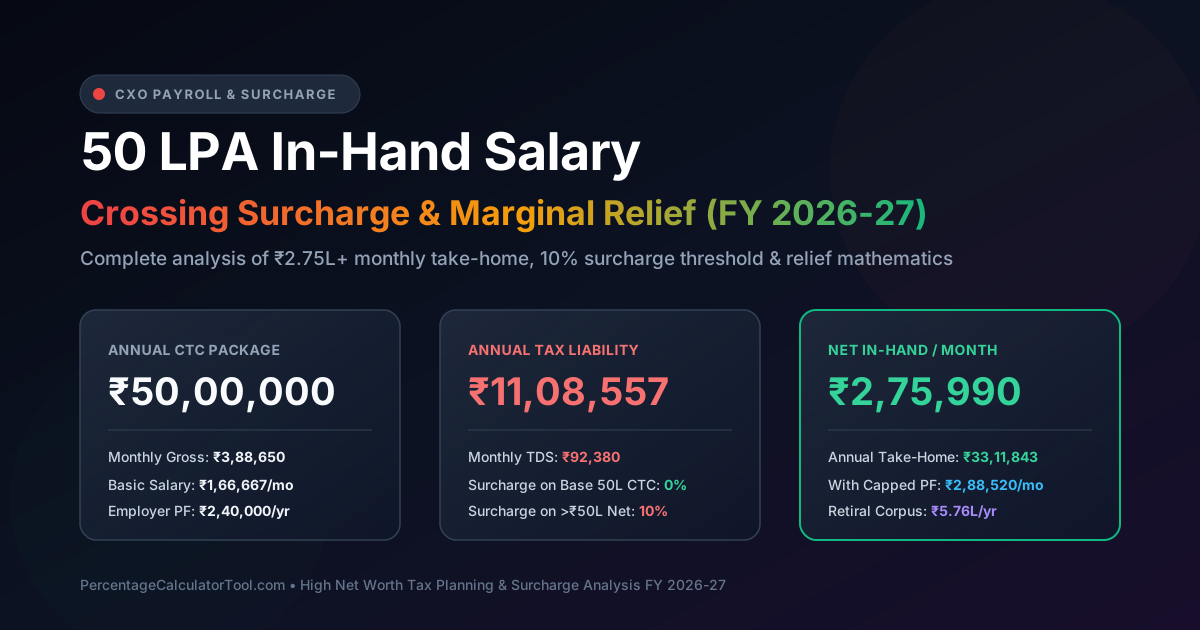
Crossing the legendary half-crore annual compensation threshold (₹50,00,000 or 50 LPA) is an extraordinary professional achievement. In corporate India, a ₹50 LPA package is reserved for top leadership: Vice Presidents of Engineering, Business Unit Heads, Consulting Partners, Chief Technology Officers, and General Managers. It represents a massive financial scale—over ₹4,16,667 per month in total company commitment.
However, the ₹50 Lakh mark is also the single most critical boundary line in the Indian direct tax code. It is the exact inflection point where the central government activates the Income Tax Surcharge—an additional levy applied directly on top of your calculated income tax.
Many executives erroneously assume that an offer letter stating "50 LPA CTC" automatically incurs a 10% surcharge penalty. As we will reveal through exact payroll mathematics, this is often untrue for standard fixed CTC structures due to corporate retiral exclusions. Yet, for leaders earning bonuses, stock grants, or consulting income that pushes net taxable income beyond ₹50,00,000, understanding the statutory Marginal Relief formula under Section 115BAC is vital to avoid paying thousands of rupees in avoidable taxes.
In this masterclass guide, we unpack the complete economics of a ₹50 LPA compensation package for Financial Year 2026-27 (Assessment Year 2027-28). You will discover your exact monthly take-home pay, master the surcharge and marginal relief calculations, and explore executive tax structuring tactics.
Table of Contents
- 1. Executive 50 LPA CTC Anatomy: Retirals vs Cash
- 2. The 50 LPA Monthly Salary Waterfall: To Bank Account
- 3. Income Tax Math under FY 2026-27 Slabs
- 4. The ₹50 Lakh Surcharge Cliff Explained
- 5. The Marginal Relief Formula: Mathematical Proof
- 6. Executive Wealth Structuring: Corporate NPS & Car Lease
- 7. Frequently Asked Questions (FAQ)
1. Executive 50 LPA CTC Anatomy: Retirals vs Cash
When an enterprise budgets ₹50 Lakhs for a senior executive, corporate finance structures the compensation to balance cash liquidity, tax efficiency, and long-term retiral reserves:
| Salary Component | Formula / Rule | Annual Value (₹) | Monthly Value (₹) |
|---|---|---|---|
| Basic Salary | 40% of CTC | ₹20,00,000 | ₹1,66,667 |
| House Rent Allowance (HRA) | 50% of Basic | ₹10,00,000 | ₹83,333 |
| Special / Executive Allowance | Balancing Cash Component | ₹16,63,800 | ₹1,38,650 |
| Employer EPF Contribution | 12% of Basic (Uncapped) | ₹2,40,000 | ₹20,000 |
| Statutory Gratuity Provision | 4.81% of Basic | ₹96,200 | ₹8,017 |
| Total Cost to Company (CTC) | Half-Crore Annual Package | ₹50,00,000 | ₹4,16,667 |
Crucial Tax Finding: Notice that your Gross Salary is ₹46,63,800 (not ₹50,00,000), because Employer EPF (₹2.40 Lakhs) and statutory gratuity reserves (₹96,200) are removed from the CTC upfront. After applying the ₹75,000 Standard Deduction and ₹2,400 Professional Tax, your Net Taxable Income is ₹45,86,400. Because this figure is well below ₹50,00,000, a pure fixed 50 LPA CTC package pays ZERO surcharge!
2. The 50 LPA Monthly Salary Waterfall: To Bank Account
Let us trace how ₹4,16,667 of monthly CTC translates to your actual bank credit:
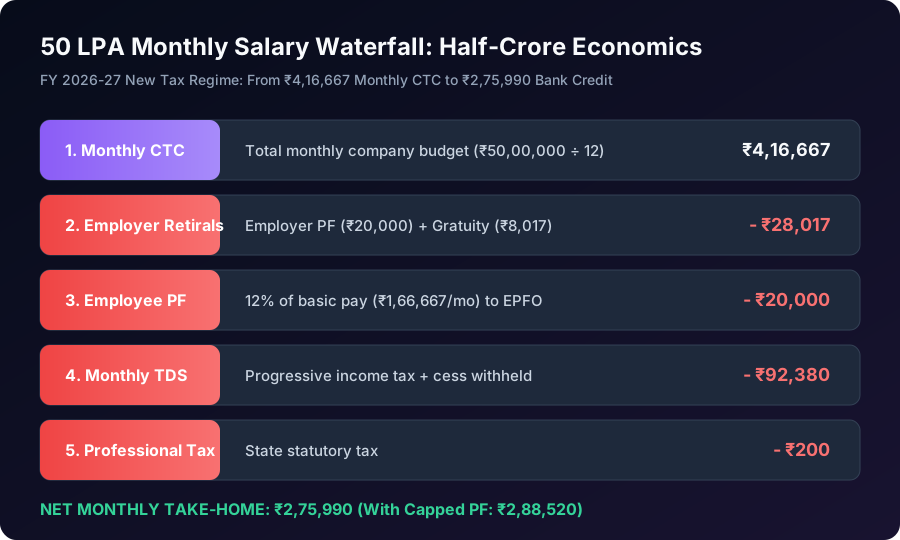
| Deduction Step | Line Item Description | Monthly Cash (₹) | Annual Cash (₹) |
|---|---|---|---|
| 1 | Monthly Gross Salary (Earnings) | ₹3,88,650 | ₹46,63,800 |
| 2 | Employee EPF (12% of Basic) | - ₹20,000 | - ₹2,40,000 |
| 3 | Monthly Income Tax TDS (New Regime) | - ₹92,380 | - ₹11,08,557 |
| 4 | State Professional Tax (PT) | - ₹200 | - ₹2,400 |
| ✔ | Net Take-Home Monthly Bank Credit | ₹2,75,990 | ₹33,11,843 |
With uncapped EPF contributions, you take home ₹2,75,990 every month, while quietly accumulating ₹5,76,200 annually in guaranteed retiral reserves (₹2.4L employee PF + ₹2.4L employer PF + ₹96.2k gratuity). If your organization allows capping EPF at the statutory ₹1,800/month, your monthly in-hand jumps to ₹2,88,520.
3. Income Tax Math under FY 2026-27 Slabs
Under Section 115BAC for FY 2026-27, here is how the ₹45,86,400 net taxable income on a 50 LPA fixed CTC is computed:
| Tax Slab (New Regime FY 26-27) | Rate | Taxable Chunk (₹) | Tax Amount (₹) |
|---|---|---|---|
| ₹0 to ₹3,00,000 | 0% | ₹3,00,000 | ₹0 |
| ₹3,00,001 to ₹7,00,000 | 5% | ₹4,00,000 | ₹20,000 |
| ₹7,00,001 to ₹10,00,000 | 10% | ₹3,00,000 | ₹30,000 |
| ₹10,00,001 to ₹12,00,000 | 15% | ₹2,00,000 | ₹30,000 |
| ₹12,00,001 to ₹15,00,000 | 20% | ₹3,00,000 | ₹60,000 |
| Above ₹15,00,000 (up to ₹45,86,400) | 30% | ₹30,86,400 | ₹9,25,920 |
| Base Income Tax | ₹10,65,920 | ||
| Surcharge (Taxable Income < ₹50L) | ₹0 (0%) | ||
| Add: Health & Education Cess (4%) | + ₹42,637 | ||
| Total Annual Income Tax Liability | ₹11,08,557 | ||
4. The ₹50 Lakh Surcharge Cliff Explained
What happens when your actual net taxable income crosses ₹50,00,000? This commonly happens if you receive an annual performance bonus of ₹6 Lakhs or have RSU vestings that push your total taxable income to ₹51,00,000.
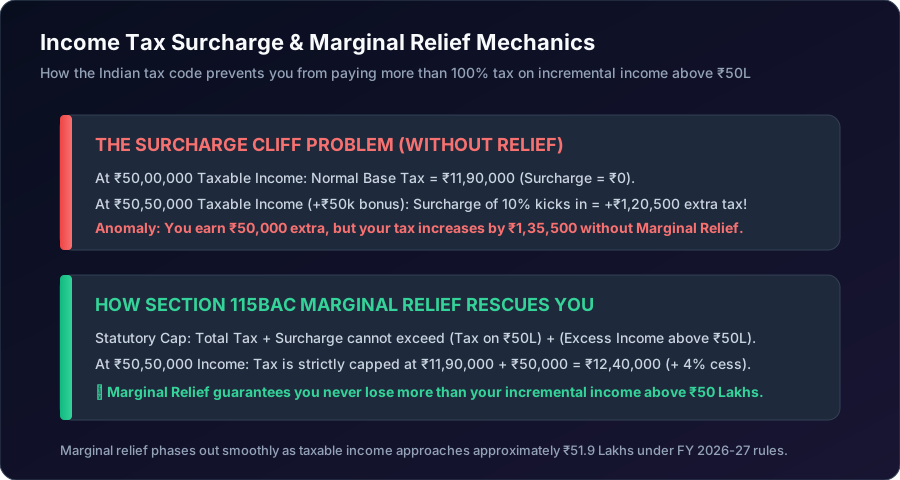
Under Indian tax law, once net taxable income exceeds ₹50 Lakhs (up to ₹1 Crore), a 10% surcharge is levied on the entire base tax.
- Base tax on ₹50,00,000 taxable income = ₹11,90,000.
- Base tax on ₹50,50,000 taxable income = ₹11,90,000 + (30% of ₹50,000) = ₹12,05,000.
- A 10% surcharge on ₹12,05,000 = +₹1,20,500!
- Total tax without relief = ₹12,05,000 + ₹1,20,500 = ₹13,25,500.
Look at the mathematical absurdity: by earning an extra ₹50,000 in bonus, your tax jumps by ₹1,35,500! You would end up ₹85,500 poorer for earning more money. This is the classic Surcharge Cliff.
5. The Marginal Relief Formula: Mathematical Proof
To prevent this perverse outcome, Parliament enacted the Marginal Relief provision under Section 115BAC.
Statutory Marginal Relief Formula
Total Tax (including Surcharge) payable on Total Income exceeding ₹50,00,000 shall NOT exceed:
Let us apply this rule to our executive with ₹50,50,000 taxable income:
- Base tax on exactly ₹50,00,000 = ₹11,90,000.
- Excess income above ₹50 Lakhs = ₹50,50,000 - ₹50,00,000 = ₹50,000.
- Statutory maximum allowable tax before cess = ₹11,90,000 + ₹50,00,000 = ₹12,40,000.
- Unadjusted tax with 10% surcharge = ₹13,25,500.
- Marginal Relief Granted: ₹13,25,500 - ₹12,40,000 = ₹85,500 relief deduction!
- Final Base Tax Payable = ₹12,40,000 + 4% cess = ₹12,89,600.
Marginal Relief ensures that the government takes at most 100% of your incremental income above ₹50 Lakhs, completely eliminating the negative cash flow anomaly.
6. Executive Wealth Structuring: Corporate NPS & Car Lease
If your total compensation crosses ₹50 Lakhs, avoiding the surcharge boundary through legitimate deductions is far superior to relying on marginal relief:
- 1. Corporate NPS under Section 80CCD(2): Your employer can contribute up to 10% of Basic (₹2,00,000 per year) to NPS. This ₹2,00,000 is deducted before your taxable income is calculated, pulling your taxable income from ₹51.5 Lakhs down to ₹49.5 Lakhs—completely eliminating both the 30% slab tax and the 10% surcharge liability!
- 2. Executive Company Car Lease: A ₹25 Lakh executive SUV leased via company payroll deducts roughly ₹50,000 per month (₹6,00,000 per year) from your pre-tax special allowance, shielding that entire sum from income tax and surcharge.
Simulate Your Executive Compensation
Calculate your exact take-home pay, model variable bonus impacts, and verify income tax with our free tools:
7. Frequently Asked Questions (FAQ)
What is the monthly in-hand salary for a 50 LPA CTC in India? ▼
In FY 2026-27 under the New Tax Regime, a fixed 50 LPA CTC yields an in-hand take-home of approximately ₹2,75,990 per month with uncapped EPF. If your employer caps EPF at ₹1,800/month, your take-home rises to roughly ₹2,88,520 per month.
Does a 50 LPA CTC package trigger surcharge? ▼
No. On a standard ₹50,00,000 CTC package, employer EPF and gratuity are deducted before gross salary, leaving net taxable income of roughly ₹45.86 Lakhs—comfortably under the ₹50 Lakh surcharge threshold.
What are the surcharge slabs in India under the New Tax Regime? ▼
Under the New Tax Regime: 0% up to ₹50 Lakhs; 10% between ₹50 Lakhs and ₹1 Crore; 15% between ₹1 Crore and ₹2 Crores; and a capped maximum of 25% for taxable income exceeding ₹2 Crores.
Can Marginal Relief be claimed automatically in the ITR utility? ▼
Yes. The official Income Tax Department online e-filing portal (ITR-2 and ITR-3 utilities) automatically calculates and applies Marginal Relief under Section 115BAC when computing total tax liability on incomes marginally exceeding ₹50 Lakhs.
How much annual income tax is paid on a 50 Lakh CTC? ▼
Under the New Tax Regime, total annual income tax is approximately ₹11,08,550 including 4% cess. This translates to an effective tax rate of approximately 22.2% on total CTC.
Written by the PercentageCalculatorTool Team
Our senior tax advisors and wealth architects specialize in high-net-worth compensation engineering, surcharge mitigation, and executive estate structures.