40 LPA In Hand Salary: ESOPs, RSUs & Marginal Tax Rates (FY 2026-27)
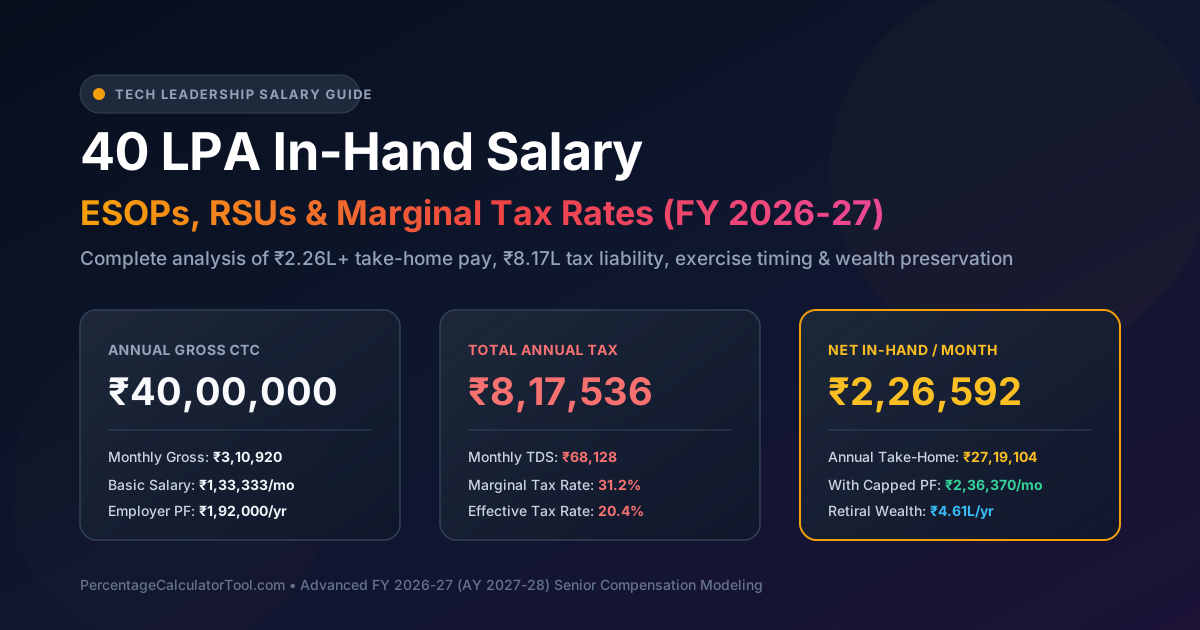
Commanding an annual compensation package of ₹40,00,000 (40 LPA) places you firmly among India's elite engineering directors, principal AI researchers, senior quantitative analysts, and enterprise business leaders. At an impressive ₹3,33,333 per month in total corporate commitment, this compensation level unlocks profound wealth-building opportunities.
However, at the 40 LPA tier, the relationship between gross package and net bank credit undergoes a major tax shift. You are operating almost entirely within the highest statutory income tax bracket of 30% plus 4% cess (31.2% marginal rate). Over eight lakh rupees annually (₹8,17,536) is diverted into income tax before your take-home pay is determined.
Equally crucial is the nature of your compensation. Modern 40 LPA packages frequently blend fixed cash salary with sophisticated equity grants: Restricted Stock Units (RSUs) in public tech corporations, or Employee Stock Option Plans (ESOPs) in late-stage unicorns. Exercising stock options without understanding the perquisite tax rules can trigger catastrophic out-of-pocket tax bills on illiquid paper wealth.
In this guide, we provide a complete financial roadmap for a ₹40 LPA package under Financial Year 2026-27 (Assessment Year 2027-28) regulations. You will explore exact month-by-month cash flows, contrast the tax mechanics of ESOPs vs RSUs, evaluate the Section 80-IAC tax deferral, and learn how to optimize your salary structure.
Table of Contents
- 1. Anatomy of a 40 LPA Executive CTC Package
- 2. The 40 LPA Monthly Salary Waterfall: Detailed Deductions
- 3. Income Tax Math under FY 2026-27 New Tax Regime
- 4. ESOP vs RSU: The Two Faces of Equity Compensation
- 5. The Startup ESOP Tax Deferral (Section 80-IAC)
- 6. Capped PF vs Uncapped EPF: Gaining ₹9,778 Monthly Cash
- 7. Frequently Asked Questions (FAQ)
1. Anatomy of a 40 LPA Executive CTC Package
In Indian enterprise payroll engineering, a ₹40,00,000 package is structured to balance monthly gross cash with statutory retirement contributions. Let us examine a standard 100% fixed 40 LPA structure:
| Salary Component | Formula / Rule | Annual Allocation (₹) | Monthly Allocation (₹) |
|---|---|---|---|
| Basic Salary | 40% of CTC | ₹16,00,000 | ₹1,33,333 |
| House Rent Allowance (HRA) | 50% of Basic | ₹8,00,000 | ₹66,667 |
| Special / Executive Allowance | Balancing Cash Head | ₹13,31,040 | ₹1,10,920 |
| Employer EPF Contribution | 12% of Basic (Uncapped) | ₹1,92,000 | ₹16,000 |
| Statutory Gratuity Provision | 4.81% of Basic | ₹76,960 | ₹6,413 |
| Total Cost to Company (CTC) | Annual Package | ₹40,00,000 | ₹3,33,333 |
2. The 40 LPA Monthly Salary Waterfall: Detailed Deductions
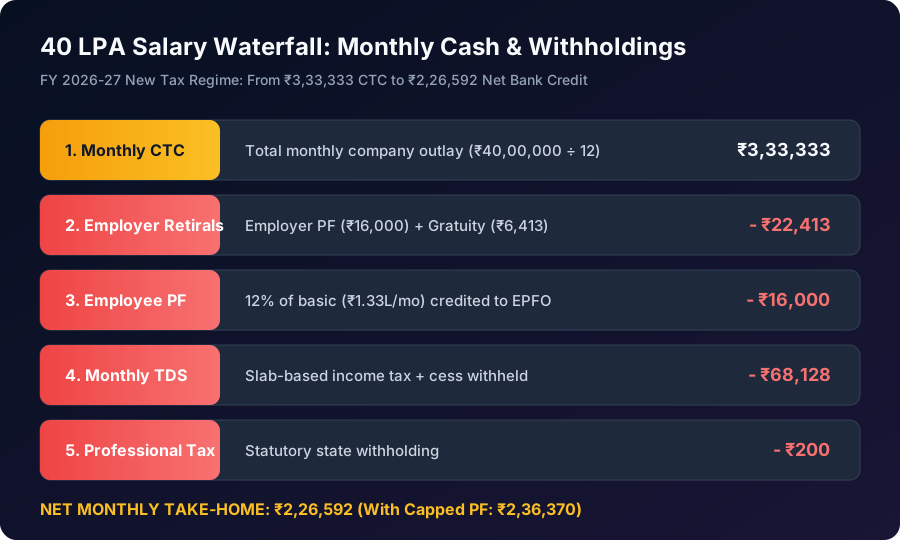
Corporate payroll first removes retiral costs from the ₹3,33,333 CTC to calculate your Monthly Gross Salary of ₹3,10,920. From there, standard employee statutory deductions are withheld to produce your monthly take-home deposit:
| Deduction Stage | Line Item Description | Monthly Cash (₹) | Annual Cash (₹) |
|---|---|---|---|
| 1 | Monthly Gross Salary (Earnings) | ₹3,10,920 | ₹37,31,040 |
| 2 | Employee EPF (12% of Basic) | - ₹16,000 | - ₹1,92,000 |
| 3 | Monthly Income Tax TDS (New Regime) | - ₹68,128 | - ₹8,17,536 |
| 4 | State Professional Tax (PT) | - ₹200 | - ₹2,400 |
| ✔ | Net Take-Home Bank Deposit | ₹2,26,592 | ₹27,19,104 |
With uncapped EPF contributions, you take home ₹2,26,592 per month (68% of CTC), while amassing ₹4,60,960 annually in guaranteed retiral wealth (₹1.92L employee PF + ₹1.92L employer PF + ₹76.9k gratuity).
3. Income Tax Math under FY 2026-27 New Tax Regime
With a standard deduction of ₹75,000 and ₹2,400 professional tax, your Net Taxable Income equals ₹36,53,640. Here is the slab-by-slab tax breakdown:
| Tax Slab (New Regime FY 26-27) | Rate | Taxable Chunk (₹) | Tax Amount (₹) |
|---|---|---|---|
| ₹0 to ₹3,00,000 | 0% | ₹3,00,000 | ₹0 |
| ₹3,00,001 to ₹7,00,000 | 5% | ₹4,00,000 | ₹20,000 |
| ₹7,00,001 to ₹10,00,000 | 10% | ₹3,00,000 | ₹30,000 |
| ₹10,00,001 to ₹12,00,000 | 15% | ₹2,00,000 | ₹30,000 |
| ₹12,00,001 to ₹15,00,000 | 20% | ₹3,00,000 | ₹60,000 |
| Above ₹15,00,000 (up to ₹36,53,640) | 30% | ₹21,53,640 | ₹6,46,092 |
| Base Income Tax | ₹7,86,092 | ||
| Add: Health & Education Cess (4%) | + ₹31,444 | ||
| Total Annual Income Tax Payable | ₹8,17,536 | ||
4. ESOP vs RSU: The Two Faces of Equity Compensation
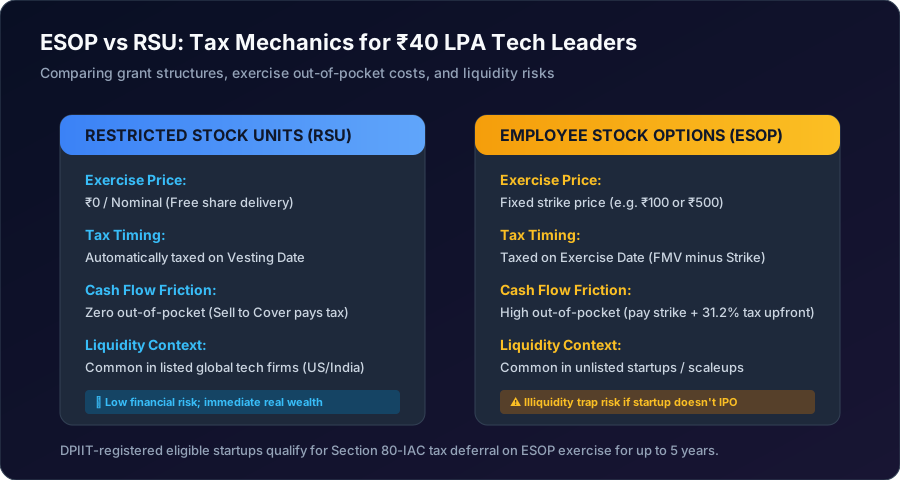
For senior talent earning 40 LPA, equity is typically the engine of transformative wealth creation. However, the mechanisms and financial risks of ESOPs vs RSUs differ markedly:
Restricted Stock Units (RSUs)
Common in public tech firms (Google, Microsoft, Amazon, Infosys). RSUs are delivered as shares at zero strike cost upon vesting. Because the company is publicly traded, the brokerage automatically sells roughly 31.2% of the shares to pay your Indian income tax (Sell to Cover). You incur zero out-of-pocket cash risk.
Employee Stock Option Plans (ESOPs)
Common in high-growth startups. You receive the right to purchase shares at a fixed strike price (e.g., ₹50/share). When you exercise, you must pay the strike price in cash, AND pay 31.2% perquisite tax on the gap between current Fair Market Value (FMV) and your strike price.
⚠ Warning: If the startup is unlisted, you cannot sell shares immediately. You must pay this tax out of your personal bank savings, creating serious liquidity strain if the company fails to exit or IPO.
5. The Startup ESOP Tax Deferral (Section 80-IAC)
To address the liquidity crisis caused by paying tax on unlisted shares, the Indian government introduced Section 80-IAC ESOP Tax Deferral. Under this rule, if your startup is officially recognized by the DPIIT and certified by the Inter-Ministerial Board (IMB), the employer is not required to deduct perquisite TDS upon exercise.
Instead, the tax liability is deferred to the earliest of the following three events:
- The expiry of 5 years (48 months + 12 months) from the end of the financial year in which options were exercised.
- The date on which the employee sells or transfers the exercised shares (such as in a secondary buyback or IPO).
- The date on which the employee terminates employment with the startup.
Crucial Career Strategy: If you are leaving an unlisted startup, note that resigning terminates your Section 80-IAC tax deferral, triggering immediate tax on all exercised options within 14 days of resignation.
6. Capped PF vs Uncapped EPF: Gaining ₹9,778 Monthly Cash
At a 40 LPA compensation level, your 40% basic salary is ₹1,33,333 per month. Under standard uncapped EPF rules, you contribute ₹16,000 monthly, and your employer matches with ₹16,000 monthly.
However, statutory EPFO regulations require mandatory contributions only on basic pay up to ₹15,000 per month (yielding a ₹1,800 monthly PF deduction). If your employer’s HR policy allows you to cap your EPF contribution at ₹1,800/month:
- Your monthly employee PF deduction drops from ₹16,000 to ₹1,800, freeing ₹14,200 in monthly earnings.
- After accounting for 31.2% tax on that incremental income, your net monthly take-home increases by ₹9,770 (rising from ₹2,26,592 to ₹2,36,362).
- For aggressive equity investors who prefer allocating to index funds or flexi-cap mutual funds rather than debt-oriented EPFO returns, capping PF provides immediate investable liquidity.
Simulate Your Executive Compensation
Calculate your exact take-home pay, model variable bonus impacts, and verify income tax with our free tools:
7. Frequently Asked Questions (FAQ)
What is the monthly in-hand salary for a 40 LPA CTC in India? ▼
In FY 2026-27 under the New Tax Regime, a 40 LPA CTC translates to a net take-home of approximately ₹2,26,590 per month with standard uncapped EPF. If your employer caps EPF at ₹1,800/month, take-home increases to roughly ₹2,36,370 per month.
How much annual income tax is deducted on a 40 Lakh salary? ▼
Under the New Tax Regime with standard deduction of ₹75,000, your annual income tax liability is approximately ₹8,17,500 including 4% cess. This translates to an effective tax rate of roughly 20.4% on gross CTC.
What is cashless exercise of ESOPs? ▼
A cashless exercise is a mechanism where a broker lends you the funds required to exercise the options and simultaneously sells enough shares on the market to cover the purchase cost, taxes, and transaction fees. The remaining shares or cash profit are then credited to you with zero upfront out-of-pocket expenditure.
Can a 40 LPA earner save tax using Section 80CCD(2) Corporate NPS? ▼
Yes. By enrolling in Corporate NPS up to 10% of basic pay (₹1,60,000 per year), you reduce taxable income in the 30% slab, saving a clean ₹49,920 in annual income tax.
Is income tax surcharge levied on a 40 LPA salary? ▼
No. In India, surcharge applies only when taxable income crosses ₹50 Lakhs (at 10%). A 40 LPA salary pays 0% surcharge.
Written by the PercentageCalculatorTool Team
Our compensation analysts and tax professionals specialize in tech equity grants, cross-border perquisite taxation, and high-income payroll modeling.