30 LPA In Hand Salary: Wealth Structuring & Retention Bonuses (FY 2026-27)
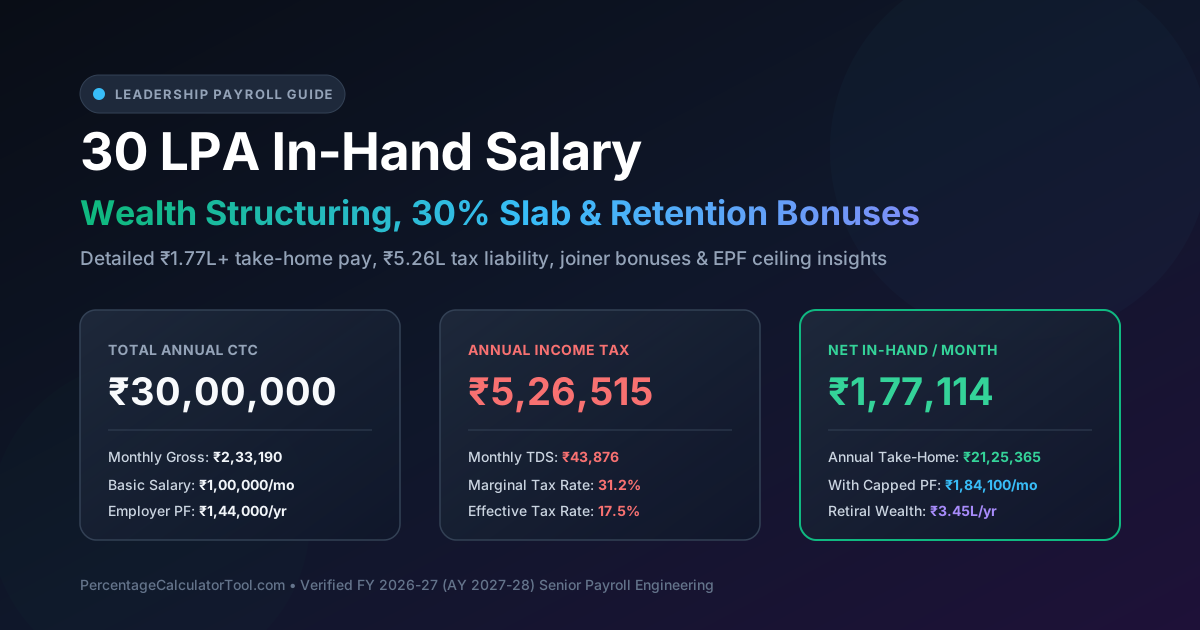
Reaching an annual compensation of ₹30,00,000 (30 LPA) places you firmly among India’s top tier of corporate leaders, principal architects, product directors, and senior strategy heads. At two-and-a-half lakhs per month on paper, a 30 LPA package represents substantial financial firepower—enabling rapid debt elimination, aggressive SIP investing, and premium lifestyle flexibility.
However, compensation design at the ₹30 LPA echelon transforms fundamentally. Below ₹15 LPA, salary packages consist primarily of basic pay, standard HRA, and fixed allowances. At ₹30 LPA, corporate human resources departments introduce sophisticated compensation instruments: retention milestones, signing bonuses, variable profit-sharing, uncapped vs capped provident fund options, and deferred equity grants.
More critically, you enter deeply into the sovereign 30% income tax slab. With standard deduction and cess, nearly one-fifth of your total package is redirected to central and state treasuries before a single rupee reaches your savings account. Understanding the precise mathematics of this conversion—and knowing how to optimize salary heads—is the difference between taking home ₹1.70 Lakhs versus ₹1.84 Lakhs every month.
In this comprehensive guide, we unpack the complete mechanics of a ₹30 LPA salary for Financial Year 2026-27 (Assessment Year 2027-28), evaluate signing bonus tax clawbacks, compare structural cash flow scenarios, and outline actionable wealth preservation tactics.
Table of Contents
- 1. Executive 30 LPA CTC Architecture: Fixed vs Retirals
- 2. The 30 LPA Monthly Salary Waterfall: Detailed Deductions
- 3. Income Tax Math under New Regime FY 2026-27
- 4. Three Salary Structuring Models: Capped PF vs Corporate NPS
- 5. Signing Bonuses & Retention Clauses: The 31.2% TDS Clawback Trap
- 6. Why Old Regime Rarely Works at 30 LPA in 2026-27
- 7. Frequently Asked Questions (FAQ)
1. Executive 30 LPA CTC Architecture: Fixed vs Retirals
When an organization offers a 30 LPA CTC, they are budgeting a total expenditure of ₹2,50,000 per month. But companies do not pay this entire amount in cash. They carve out retirement provisions and employer taxes first.
In a standard, 100% fixed 30 LPA package, the components are typically balanced across basic salary, statutory retirement contributions, and taxable allowances:
| Salary Component | Formula / Basis | Annual Allocation (₹) | Monthly Allocation (₹) |
|---|---|---|---|
| Basic Salary | 40% of CTC | ₹12,00,000 | ₹1,00,000 |
| House Rent Allowance (HRA) | 50% of Basic | ₹6,00,000 | ₹50,000 |
| Special / Flexi Allowance | Balancing Cash Component | ₹9,98,280 | ₹83,190 |
| Employer EPF Contribution | 12% of Basic (Uncapped) | ₹1,44,000 | ₹12,000 |
| Statutory Gratuity Reserve | 4.81% of Basic (15/26 days) | ₹57,720 | ₹4,810 |
| Total Cost to Company (CTC) | Full Annual Package | ₹30,00,000 | ₹2,50,000 |
2. The 30 LPA Monthly Salary Waterfall: Detailed Deductions
Let us trace how monthly Cost to Company converts into liquid bank credit. The employer first deducts corporate retiral costs to determine your Monthly Gross Salary (₹2,33,190), after which statutory payroll withholdings are applied.
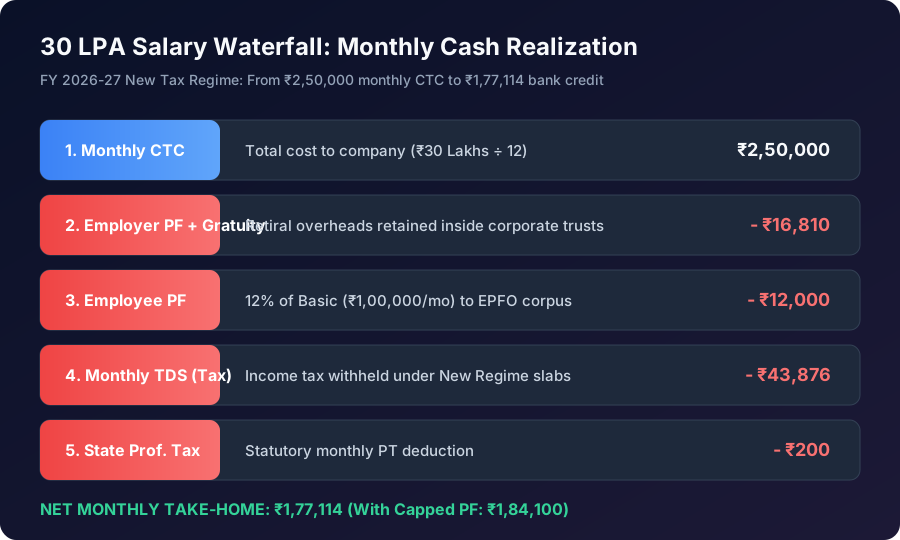
| Deduction Step | Line Item Description | Monthly Cash Flow | Annual Sum |
|---|---|---|---|
| 1 | Gross Salary (Before Tax & Employee PF) | ₹2,33,190 | ₹27,98,280 |
| 2 | Employee EPF Deduction (12% of Basic) | - ₹12,000 | - ₹1,44,000 |
| 3 | Monthly Income Tax TDS (New Regime) | - ₹43,876 | - ₹5,26,515 |
| 4 | State Professional Tax (PT) | - ₹200 | - ₹2,400 |
| ✔ | Net Take-Home Bank Credit | ₹1,77,114 | ₹21,25,365 |
On an annual basis, you realize ₹21,25,365 in immediate bank liquidity, while simultaneously accumulating ₹3,45,720 in sovereign-backed retirement wealth (₹2,88,000 total EPF plus ₹57,720 in gratuity vesting).
3. Income Tax Math under New Regime FY 2026-27
Under the Revised New Tax Regime (Section 115BAC), tax calculations are completely transparent. Standard deduction stands at ₹75,000 for all salaried taxpayers. Here is how your ₹27,98,280 gross salary is taxed across the official slabs:
| Income Slab | Applicable Slab Rate | Taxable Chunk (₹) | Tax Amount (₹) |
|---|---|---|---|
| ₹0 to ₹3,00,000 | Nil | ₹3,00,000 | ₹0 |
| ₹3,00,001 to ₹7,00,000 | 5% | ₹4,00,000 | ₹20,000 |
| ₹7,00,001 to ₹10,00,000 | 10% | ₹3,00,000 | ₹30,000 |
| ₹10,00,001 to ₹12,00,000 | 15% | ₹2,00,000 | ₹30,000 |
| ₹12,00,001 to ₹15,00,000 | 20% | ₹3,00,000 | ₹60,000 |
| Above ₹15,00,000 (up to ₹27,20,880) | 30% | ₹12,20,880 | ₹3,66,264 |
| Total Base Income Tax | ₹5,06,264 | ||
| Add: Health & Education Cess (4%) | + ₹20,251 | ||
| Total Annual Income Tax Payable | ₹5,26,515 | ||
Notice that out of your total tax of ₹5,26,515, more than 70% (₹3,80,915 including cess) originates strictly from the portion of income that exceeds ₹15,00,000. Every rupee above ₹15 Lakhs is taxed at an effective rate of 31.2%.
4. Three Salary Structuring Models: Capped PF vs Corporate NPS
Not all 30 LPA packages yield the same monthly paycheck. Depending on your payroll options, you can choose between maximizing immediate monthly cash in hand or optimizing long-term tax sheltering:
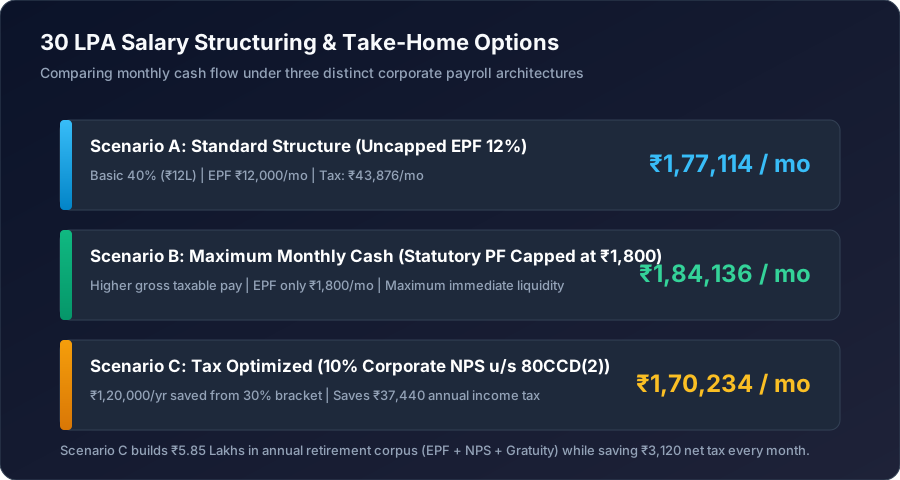
Scenario A: Standard Uncapped PF
Both you and your employer deposit 12% of basic (₹12,000/mo each) into EPFO.
Scenario B: Capped Statutory PF
EPF restricted to statutory minimum ₹1,800/mo. Remaining cash paid out as taxable allowance.
Scenario C: 10% Corporate NPS
Employer contributes 10% basic (₹1.2L/yr) to Tier-1 NPS u/s 80CCD(2), fully tax-exempt.
5. Signing Bonuses & Retention Clauses: The 31.2% TDS Clawback Trap
When negotiating a 30 LPA transition, senior candidates often secure signing bonuses ranging between ₹3,00,000 and ₹6,00,000. However, understanding the tax clawback dynamics is critical to avoiding financial loss.
Suppose an employer offers you a ₹5,00,000 joining bonus with a 1-year clawback clause. When disbursed in month one, payroll will treat this as salary income in the 30% slab, deducting 31.2% TDS (₹1,56,000). You receive ₹3,44,000 net in your bank account.
The Resignation Clawback Trap
If you resign after 8 months, the company’s employment agreement requires you to repay the entire gross bonus of ₹5,00,000—not the ₹3,44,000 you actually received. You must fund the ₹1,56,000 difference out of your own pocket. To recover the ₹1,56,000 TDS remitted to the government, you must request an amended Form 16 from the company or pursue an income tax refund claim during ITR filing, which can lead to prolonged scrutiny. Always negotiate for clawbacks on a net-of-tax basis or pro-rata service duration.
6. Why Old Regime Rarely Works at 30 LPA in 2026-27
Many executives wonder whether claiming maximum deductions under the Old Tax Regime could beat the New Regime. At 30 LPA, the Old Regime requires staggering deduction amounts to become competitive:
- Under the Old Regime, the 30% tax bracket triggers at just ₹10,00,000 (compared to ₹15,00,000 in the New Regime).
- To match the New Regime's low baseline tax rates, a 30 LPA earner must claim total deductions exceeding ₹5,10,000 annually.
- Even if you max out Section 80C (₹1.5L), Section 80D (₹75k), and Section 24b Home Loan Interest (₹2.0L), your total deductions reach ₹4.25 Lakhs—still ₹85,000 below the breakeven point.
Unless you pay exorbitant house rent in a tier-1 metro yielding an HRA exemption of ₹3.5 Lakhs or more, the New Tax Regime is mathematically superior for over 92% of 30 LPA earners, while leaving your funds unencumbered by multi-year lock-in products.
Evaluate Your Exact Payroll Math
Calculate your net take-home pay, compare old versus new regime taxes, and project future wealth growth with our suite of free tools:
7. Frequently Asked Questions (FAQ)
What is the monthly in-hand salary for a 30 LPA CTC in India? ▼
In FY 2026-27 under the New Tax Regime, a 30 LPA package yields a monthly take-home between ₹1,76,000 and ₹1,84,000. If your company caps EPF contributions at ₹1,800/month, your take-home reaches approximately ₹1,84,100/month.
How much annual tax do you pay on a 30 LPA salary? ▼
Under the New Tax Regime with standard deduction of ₹75,000, your annual income tax liability is approximately ₹5,26,500 including 4% cess. This translates to an effective tax rate of roughly 17.5% on gross CTC.
Is surcharge applicable on a 30 LPA salary? ▼
No. In India, surcharge applies only when taxable income crosses ₹50 Lakhs (at 10%). A 30 LPA salary pays 0% surcharge.
How does corporate car lease save tax at 30 LPA? ▼
Under an official company car lease program, the monthly lease EMI, insurance, and maintenance costs are deducted directly from your gross special allowance before income tax is calculated. Since you are in the 31.2% marginal tax bracket, you effectively receive a 31.2% government subsidy on vehicle ownership expenses.
Can I invest my 30 LPA surplus in SIPs to achieve financial freedom? ▼
Yes. With a monthly take-home of ₹1,77,000, investing a disciplined ₹75,000 monthly SIP into broad-market index funds and flexi-cap mutual funds at an expected 12% annual CAGR accumulates over ₹1.74 Crores in 10 years, providing solid early-retirement independence.
Written by the PercentageCalculatorTool Team
Our compensation and tax experts create rigorous, data-verified financial guides for high-income salaried professionals across India.