25 LPA In Hand Salary: Executive Take-Home & High-Bracket Tax Slabs (FY 2026-27)
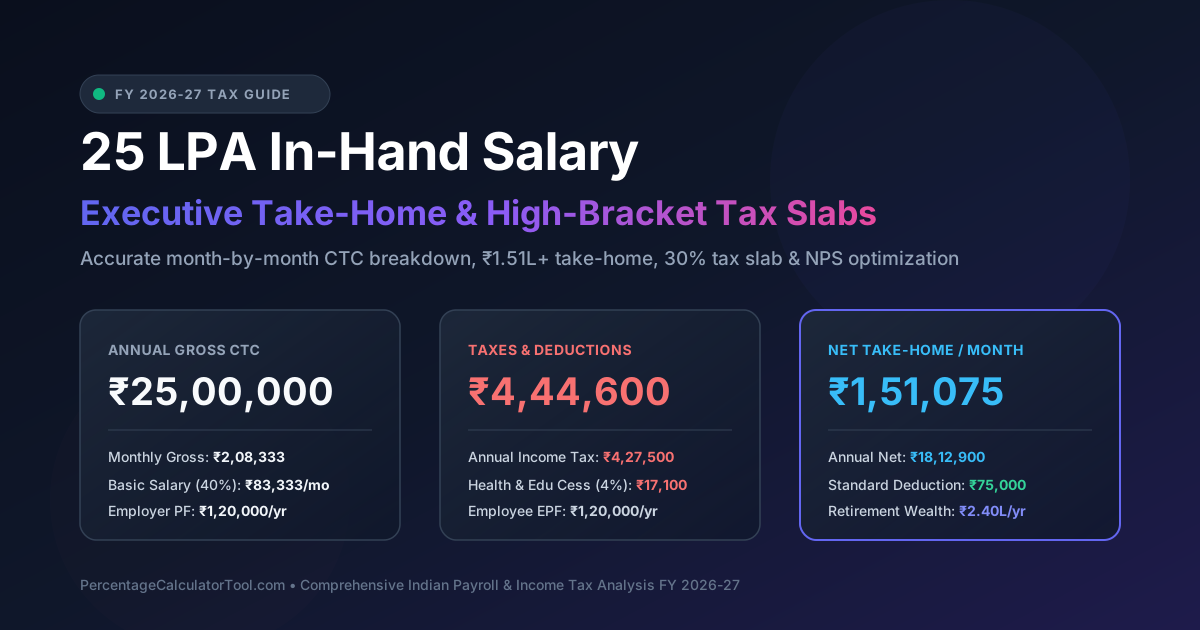
Transitioning into an annual Cost to Company (CTC) of ₹25,00,000 (25 LPA) is a watershed career milestone in the Indian corporate landscape. Whether you are stepping up into an Engineering Manager role, a Senior Product Leader, an Investment Banking Associate, or a Management Consultant, crossing the quarter-crore mark firmly elevates your financial profile into India’s elite top 2% salaried earners.
However, the mathematical reality of receiving a ₹25 LPA offer letter often triggers acute sticker shock when the first month’s payslip arrives. Simple division suggests that ₹25,00,000 divided by 12 equals ₹2,08,333 per month. Yet, virtually no executive in India takes home over two lakhs every month from a 25 LPA CTC. Instead, your actual monthly bank deposit typically hovers between ₹1,50,000 and ₹1,53,000.
Where does that missing ₹55,000 to ₹58,000 vanish each month? It is distributed across statutory retirement retentions (Employee and Employer Provident Fund), mandatory gratuity accruals, group health insurance premiums, professional taxes, and—most significantly—the steep progressive income tax slabs where every rupee earned above ₹15,00,000 is taxed at 30% plus cess.
In this masterclass guide, we dissect the exact anatomy of a ₹25 LPA salary structure for Financial Year 2026-27 (Assessment Year 2027-28). You will discover step-by-step calculations under both the default New Tax Regime and the legacy Old Tax Regime, explore corporate tax-optimization instruments such as Section 80CCD(2) Corporate NPS and executive flexi-benefits, and learn how to negotiate your CTC to extract the maximum possible cash flow.
Table of Contents
- 1. Anatomy of a 25 LPA CTC: Fixed vs Retirals vs Allowances
- 2. The 25 LPA Monthly Salary Waterfall: From CTC to Bank Account
- 3. Income Tax Calculation for 25 LPA in FY 2026-27
- 4. Old vs New Tax Regime: The High-Earner Breakeven Point
- 5. Section 80CCD(2) Corporate NPS: Saving ₹31,200 Extra Tax Legally
- 6. Performance Bonuses, ESOPs, and Deferred Compensation
- 7. Frequently Asked Questions (FAQ)
1. Anatomy of a 25 LPA CTC: Fixed vs Retirals vs Allowances
Cost to Company (CTC) is an aggregate financial metric tracking every single rupee an employer commits to maintaining your position over twelve months. At an executive compensation level of 25 LPA, human resource payroll designers construct your compensation into three distinct tranches:
- Fixed Base & Direct Monthly Allowances: Includes Basic Salary, House Rent Allowance (HRA), Special Allowance, and City Compensatory Allowance (CCA). These directly determine your monthly gross pay.
- Retiral Benefits & Statutory Allocations: Includes the Employer's matching contribution to the Employees' Provident Fund (EPF), Statutory Gratuity provision under the Payment of Gratuity Act, and group corporate health insurance. These are company costs but are never credited to your bank account monthly.
- Variable Performance Pay (Target Incentive): Many 25 LPA contracts allocate between 10% and 20% (₹2.5L to ₹5.0L) to annual performance bonuses paid quarterly or yearly based on company and individual KPI achievement.
Let us look at a standard, realistic 100% fixed compensation structure for a ₹25,00,000 package in top Indian tech, banking, and professional service companies:
| Salary Component | Percentage / Rule | Annual Value (₹) | Monthly Value (₹) |
|---|---|---|---|
| Basic Salary | 40% of CTC | ₹10,00,000 | ₹83,333 |
| House Rent Allowance (HRA) | 50% of Basic (Metro) | ₹5,00,000 | ₹41,667 |
| Special Allowance / Flexi-Pay | Balancing Component | ₹8,32,000 | ₹69,333 |
| Employer EPF Contribution | 12% of Basic (Uncapped) | ₹1,20,000 | ₹10,000 |
| Gratuity Provision | 4.81% of Basic | ₹48,000 | ₹4,000 |
| Total Cost to Company (CTC) | 100% Fixed Package | ₹25,00,000 | ₹2,08,333 |
2. The 25 LPA Monthly Salary Waterfall: From CTC to Bank Account
To understand exactly how ₹2,08,333 per month converts to your take-home pay, we trace the monthly salary deductions. There are two tiers of deductions: Pre-Gross Corporate Deductions (items included in CTC but kept by the company for long-term benefits) and Post-Gross Statutory Deductions (amounts withheld directly from your gross pay for taxes and employee savings).
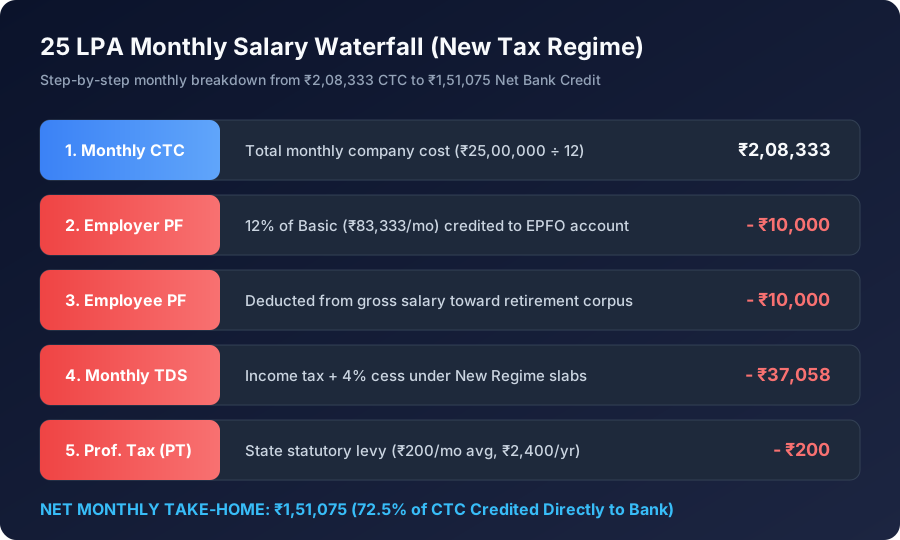
| Step | Financial Parameter | Monthly Amount | Annual Equivalent |
|---|---|---|---|
| 1 | Monthly Gross Salary (Earnings) | ₹1,94,333 | ₹23,32,000 |
| 2 | Less: Employee EPF (12% of Basic) | - ₹10,000 | - ₹1,20,000 |
| 3 | Less: Income Tax TDS (New Regime) | - ₹33,063 | - ₹3,96,760 |
| 4 | Less: Professional Tax (State Avg) | - ₹200 | - ₹2,400 |
| ✔ | Net Take-Home Monthly Bank Credit | ₹1,51,070 | ₹18,12,840 |
Notice that your net take-home represents 72.5% of your total stated CTC. The remaining 27.5% is composed of:
- Total Retirement Savings (EPF + Gratuity): ₹2,88,000 per year (₹10,000 employer PF + ₹10,000 employee PF + ₹4,000 monthly gratuity reserve). This is your wealth, earning 8.25% sovereign interest, but completely illiquid today.
- Direct Government Taxation: ₹3,96,760 per year in income tax and mandatory cess, plus ₹2,400 in state professional tax.
3. Income Tax Calculation for 25 LPA in FY 2026-27
Let us examine the precise slab-by-slab tax mathematics under the New Tax Regime (Section 115BAC) for FY 2026-27 (AY 2027-28). With an executive package of 25 LPA, you comfortably cross into the peak 30% tax bracket, which triggers on all taxable income above ₹15,00,000.
| Tax Slab (New Regime FY 26-27) | Tax Rate | Taxable Portion (₹) | Calculated Tax (₹) |
|---|---|---|---|
| ₹0 to ₹3,00,000 | 0% | ₹3,00,000 | ₹0 |
| ₹3,00,001 to ₹7,00,000 | 5% | ₹4,00,000 | ₹20,000 |
| ₹7,00,001 to ₹10,00,000 | 10% | ₹3,00,000 | ₹30,000 |
| ₹10,00,001 to ₹12,00,000 | 15% | ₹2,00,000 | ₹30,000 |
| ₹12,00,001 to ₹15,00,000 | 20% | ₹3,00,000 | ₹60,000 |
| Above ₹15,00,000 (up to ₹22,54,600) | 30% | ₹7,54,600 | ₹2,26,380 |
| Base Income Tax | ₹3,66,380 | ||
| Add: Health & Education Cess (4%) | + ₹14,655 | ||
| Total Annual Income Tax Payable | ₹3,81,035 | ||
Note on Computations: The gross salary subject to tax equals Gross Salary (₹23,32,000) minus Standard Deduction (₹75,000) minus Professional Tax (₹2,400), yielding a Net Taxable Income of ₹22,54,600. At 30% plus 4% cess, every incremental ₹1,00,000 hike you negotiate at this level will incur ₹31,200 in income tax, leaving you with ₹68,800 net cash.
4. Old vs New Tax Regime: The High-Earner Breakeven Point
A common misconception among senior executives earning 25 LPA is that because they pay hefty rents and invest heavily in ELSS and insurance, the Old Tax Regime must save them more tax. Let us evaluate the cold, hard numbers side by side.
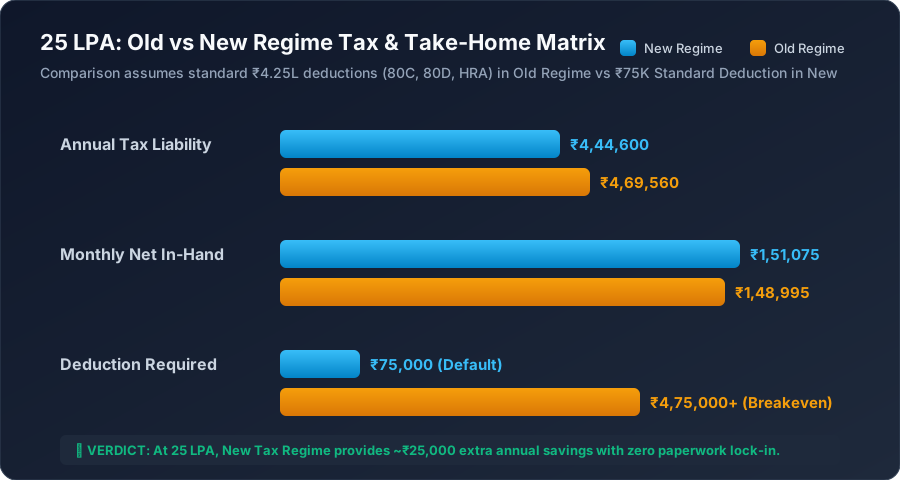
Under the Old Tax Regime, you have access to extensive itemized exemptions:
- Standard Deduction: ₹50,000 (compared to ₹75,000 in New).
- Section 80C: ₹1,50,000 maximum (EPF, PPF, ELSS, Life Insurance).
- Section 80D: ₹25,000 for self/family + ₹50,000 for senior citizen parents (₹75,000 total).
- Section 24(b): Up to ₹2,00,000 on home loan interest for a self-occupied property.
- HRA Exemption (Section 10(13A)): Actual exempt rent calculated as least of HRA received, rent minus 10% basic, or 50% basic.
The 25 LPA Regime Breakeven Number: ₹4,75,000
In FY 2026-27, for a ₹25 LPA executive, the mathematical breakeven point between regimes is ₹4,75,000. If your total combined deductions (80C + 80D + HRA + Home Loan Interest + NPS 80CCD(1B)) are less than ₹4,75,000, the New Tax Regime will put more cash in your bank account every single month. Furthermore, the New Regime eliminates the requirement to lock up ₹1.5 Lakhs in 3-to-15 year instruments and submit dozens of rent receipts.
5. Section 80CCD(2) Corporate NPS: Saving ₹31,200 Extra Tax Legally
For individuals earning 25 LPA or more, one of the most powerful wealth-building tools under Indian tax law is Corporate National Pension System (NPS) under Section 80CCD(2).
While personal 80C and 80CCD(1B) investments are completely disallowed under the New Tax Regime, Section 80CCD(2) remains fully exempt in both Old and New Regimes. Under this provision, your employer can deduct up to 10% of your Basic Salary (or 14% for government employees) directly from your gross pay and remit it into your Tier-1 NPS PRAN account.
| Metric | Without Corporate NPS | With 10% Corporate NPS |
|---|---|---|
| Basic Salary (Annual) | ₹10,00,000 | ₹10,00,000 |
| Section 80CCD(2) Deduction | ₹0 | ₹1,00,000 |
| Taxable Income Saved | ₹0 | ₹1,00,000 deducted from 30% bracket |
| Direct Annual Tax Savings | ₹0 | ₹31,200 (30% + 4% Cess) |
By opting into your company’s Corporate NPS desk, you shield ₹1,00,000 from direct taxation, compound it inside diversified pension funds (equities, corporate debt, and government gilts) at zero wealth tax, and keep ₹31,200 out of the taxman's hands every year.
6. Performance Bonuses, ESOPs, and Deferred Compensation
At the 25 LPA level, executive packages frequently feature variable compensation and long-term equity incentives. Knowing how these are taxed prevents painful surprises:
- 1. Variable Bonus Payouts: If ₹3,00,000 of your 25 LPA package is tied to an annual bonus, your monthly take-home throughout the year is based on a ₹22 LPA fixed CTC (approximately ₹1.34 Lakhs/month). When the ₹3,00,000 bonus is paid out in March or April, your company payroll will deduct full marginal tax at 31.2% (₹93,600), depositing ₹2,06,400 net into your account.
- 2. Employee Stock Options (ESOPs) & RSUs: Stock grants are taxed twice: first as a Perquisite on the date of exercise (the Fair Market Value minus exercise price is added to your salary and taxed at 31.2%), and second as Capital Gains when you eventually sell the shares in the open market.
- 3. Corporate Car Lease Programs: Many tier-1 firms allow executives to purchase an automobile via pre-tax company lease. The monthly EMI, insurance, and maintenance are deducted from your gross taxable special allowance before income tax is calculated, saving you 31.2% tax on the entire vehicle expenditure.
Simulate Your Exact CTC & Salary Structure
Test different PF capping choices, HRA exemptions, and Corporate NPS allocations using our free interactive calculators:
7. Frequently Asked Questions (FAQ)
What is the monthly in-hand salary for a 25 LPA CTC in India? ▼
For a ₹25,00,000 CTC under the New Tax Regime (FY 2026-27), your monthly take-home pay is typically between ₹1,50,000 and ₹1,53,000. If your company caps EPF at statutory ₹1,800/month rather than 12% of actual basic, your monthly in-hand increases to approximately ₹1,57,500.
How much income tax is deducted on a 25 Lakh salary? ▼
Under the New Tax Regime for FY 2026-27, with the standard deduction of ₹75,000 and standard PF deductions, your annual income tax liability is approximately ₹3,81,000 to ₹3,96,000 including 4% Health & Education Cess.
Does a 25 LPA earner have to pay surcharge in India? ▼
No. In India, income tax surcharge begins only when your net taxable income exceeds ₹50,00,000 (10% surcharge). On a 25 LPA package, you pay 0% surcharge.
How does capping PF to ₹1,800 affect monthly in-hand salary? ▼
If your employer restricts EPF deduction to the statutory ceiling of ₹1,800 per month rather than 12% of your actual basic pay (₹10,000), you gain ₹8,200 in monthly gross earnings. After accounting for 31.2% income tax on that additional cash, your monthly take-home increases by approximately ₹5,640, though your retirement fund receives less annual inflow.
Can I switch between Old and New Tax Regimes every year? ▼
Yes. Salaried employees with no business or professional freelance income (Income from Salaries and House Property only) are permitted to select whichever regime provides maximum tax savings every financial year when filing Form ITR-1 or ITR-2 by July 31.
Written by the PercentageCalculatorTool Team
Our team of chartered accountants and senior payroll analysts specialize in Indian direct taxation, compensation modeling, and wealth engineering for salaried professionals.